
By Jill Szoo Wilson
Introduction
From the festival stages of ancient Athens to the minimalist black boxes of the modern age, theatre has never merely been a mirror held up to nature. It has served as a site of moral tension, philosophical debate, and spiritual inquiry. For the Greeks, whose tragedies laid the foundation for Western drama and whose philosophers shaped the roots of Western thought, theatre was not neutral ground. It was divisive, provocative, and volatile. What is the purpose of theatre? Is it ethical instruction or emotional indulgence? Is it a path to wisdom or a distraction from truth?
This essay explores the philosophical tensions surrounding theatre in the writings of Plato, Socrates (as portrayed by Plato), and Aristotle. In their competing visions—suspicion, interrogation, and celebration—we encounter a triptych of enduring questions about the role of art in civic and moral life. Their disagreements are not confined to the past. They still echo in conversations about education, politics, and the power of performance.
These tensions are not relics of antiquity. They continue to animate our understanding of what theatre is and what it ought to be. When a play unsettles us, when a performance asks us to feel more deeply or consider a truth we have avoided, we are stepping into the same territory the Greeks once debated. The question is not only what theatre shows, but what it stirs and what it asks of us as thinking, feeling, moral beings.
Plato on Theatre: Emotion Without Reason
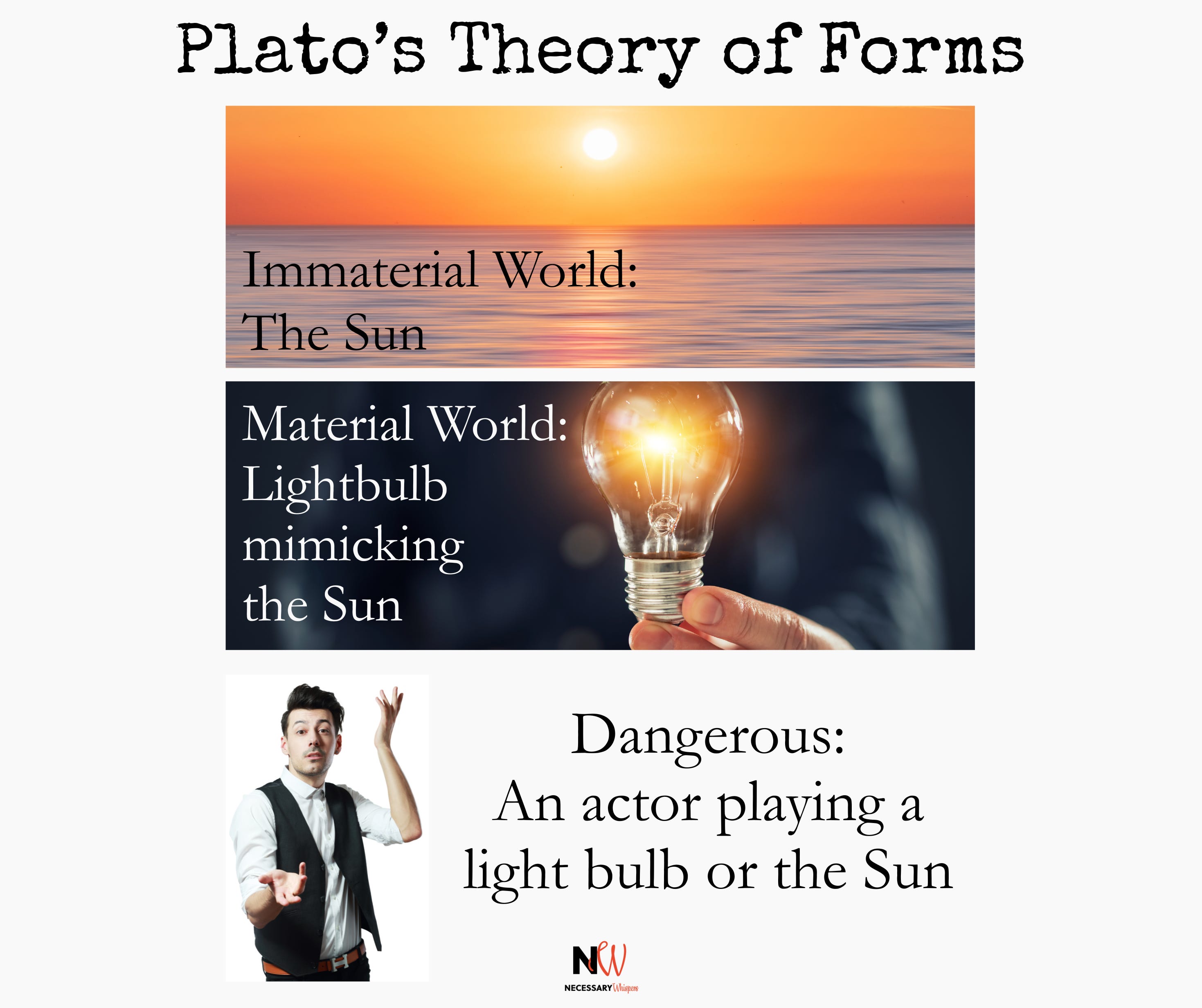
In The Republic, Plato’s distrust of theatre is unmistakable. For him, mimesis, or imitation, is not a creative virtue but a philosophical deficiency. According to his theory of Forms, the material world is already a shadow of a higher, eternal reality. Every physical object—a tree, a table, a human face—is merely an imperfect reflection of its ideal Form, which exists outside time and space. Knowledge, in this view, involves turning the soul away from sensory appearances and toward the realm of intelligible truth.
Art, and especially theatre, compounds the problem. A dramatic performance does not depict the Form of justice or courage; it portrays a person who appears to be just or courageous, often in highly distorted or emotionally exaggerated terms. Theatrical representation, then, becomes an imitation of an imitation: once removed from the eternal Forms by material reality, and once more by the artist’s interpretation of that reality. It is, in Plato’s words, “thrice removed from the truth.” As a result, art risks misleading the soul rather than educating it.
In Book X, Plato writes:
“We must remain firm in our conviction that no poetry should be admitted save hymns to the gods and encomia of good men” (Republic X.607a).
His condemnation is not primarily aesthetic but moral. The poet does not possess true knowledge of justice or the good, and therefore cannot be entrusted with shaping public consciousness. Tragedy, in particular, inflames the irrational parts of the soul. By encouraging audiences to identify with characters who suffer, fail, or behave disgracefully, drama bypasses the rational faculties that Plato considers essential to the formation of a virtuous life. It does not guide the audience toward reasoned understanding; it captivates and unsettles through spectacle. The result, he fears, is a citizenry more attuned to feeling than to thinking.
Plato’s anxiety is ultimately a question of power. Theatre, with its ability to move collective emotion, poses a threat to the philosopher’s authority as the rightful guide of the polis. In the ideal republic, governed by philosopher-kings, the stage has no place unless it can be strictly controlled. Plato imagines no version of poetry that does not require censorship, for the poetic voice competes with philosophy in shaping public values.
This suspicion of theatricality finds a distant but resonant echo in the work of Judith Butler, who argues in Excitable Speech that performative acts are not merely expressive but constitutive. This is to say, they do not simply reflect existing truths; they produce new realities through repetition and societal normalization. Although Butler’s focus is on gender, power, and language, her argument shares with Plato a central concern: speech and performance are not neutral. They are acts of world-making. Plato feared this generative capacity. For him, theatre does not merely mirror emotion; it incites it, destabilizes reason, and reshapes the soul without its consent. Both thinkers recognize that performance does not stay on the stage. It has the power to enter the world and alter it.
Socrates (via Plato): Interrogation Over Imitation
Socrates, who left no writings of his own, appears in Plato’s dialogues as a relentless questioner. As such, he is a figure more disruptor than dramatist, and a kind of anti-poet. In Ion, Gorgias, and The Apology, Socrates consistently distances himself from theatricality, often drawing sharp distinctions between genuine knowledge and rhetorical display. In Ion, for example, he confronts a rhapsode—a professional performer of epic poetry—who claims to interpret Homer:
“You speak of Homer, not as one having knowledge, but as one inspired… possessed” (Ion 533d).
Here, the artist is not a sage but a conduit. The rhapsode, though perhaps divinely touched, does not speak from knowledge but from inspiration. He performs poetry with passion, yet cannot explain its meaning. He moves others, but cannot account for his own words. For Socrates, this is a problem. Without understanding, performance becomes a kind of possession rather than a practice of reason.
Socratic philosophy demands more. It requires individuals to examine their beliefs, define their terms, and refine their views through conversation and debate. Knowledge, in this framework, is earned through dialogue. It is a process of discovery, not delivery. Truth must be questioned into existence.
By contrast, theatre tends to offer conclusions. It presents complete gestures, polished arcs, and emotional resolution. It engages the audience through emotion first, which, for Socrates, risks replacing reflection with identification. This kind of passivity may satisfy the appetite for entertainment, but it does little to cultivate wisdom. Art that stirs the soul without engaging the mind falls short of philosophy’s aim.
Yet the Socratic method itself is deeply performative. While Socrates critiques theatre for offering conclusions without examination, his own philosophical practice unfolds in forms that closely resemble dramatic encounter. Plato’s dialogues are structured not as essays but as scenes—carefully shaped exchanges between characters, full of tension, irony, and reversal. These are not lectures. They are dramatizations of inquiry. Characters enter with confidence and leave in confusion. Positions are tested, undermined, and reframed. The reader, like a spectator, witnesses the friction of minds in motion.
Even Socrates’ death, as recorded in The Apology and Phaedo, bears the marks of theatrical form. He drinks the hemlock not in solitude, but before a gathered public. His final words are neither anguished nor sentimental. They are measured, even instructive. The moment resists catharsis and refuses spectacle. If Greek tragedy aims for emotional release, Socrates’ death stages something else entirely: philosophical resolve. It becomes a kind of anti-tragedy, where the central figure does not unravel but remains fully composed, fully Socratic. In this light, Socrates does not reject performance altogether. He reclaims it for philosophy. His form of theatre is not emotional, but dialectical. It’s not a medium for answers, but for recursive questions, meaning questions that generate more questions rather than definitive answers. For example: What is justice? What is courage? What is the good life? In posing these questions again and again, Socrates transforms the act of dialogue into a space where inherited beliefs are challenged and thinking is tested.
This mode of engagement anticipates the work of later thinkers such as Bertolt Brecht, who sought to break the illusion of conventional theatre and replace it with critical distance. Brecht’s concept of the Verfremdungseffekt, or alienation effect, aims to interrupt emotional immersion and redirect the audience toward thought. His theatre invites discomfort and deliberately reminds the audience that what they are seeing is constructed, not natural, encouraging reflection rather than emotional immersion. In Socratic terms, Brechtian drama becomes a modern rehearsal of philosophical dialogue. It is deliberately unresolved, designed not to console, but to provoke.
Aristotle: Theatre Teaches Us How to Feel Wisely
If Plato regarded theatre with suspicion, Aristotle regarded it as a potential instrument of moral education. In Poetics, he does not dismiss tragedy; rather, he categorizes and defends it through careful analysis. For Aristotle, art does not distract from reality. It orders it. He defines tragedy as follows:
“An imitation of an action that is serious, complete, and of a certain magnitude… through pity and fear effecting the proper purgation of these emotions” (Poetics 1449b24–28).
The concept of catharsis, a cornerstone of Aristotle’s theory, anchors his defense of tragedy. Though notoriously difficult to translate, the term is often understood as a kind of purgation or purification of the emotions, specifically pity and fear. But catharsis is not simply the release of emotion. It is the transformation of emotional experience into a clearer understanding of human nature.
According to Aristotle, tragedy does not lead the audience into irrationality or emotional excess. It invites them to feel deeply in a structured and meaningful way. By observing characters who confront moral dilemmas, endure consequences, and wrestle with forces beyond their control, the audience participates in a kind of ethical rehearsal. The emotions that arise are not random or indulgent. They are guided and shaped by the dramatic structure.
In this process, pity and fear are not seen as weaknesses to be suppressed. They are part of what it means to be human. Tragedy does not eliminate these feelings. It refines them. The result is not a detachment from emotion, but a deeper engagement with it. Rather than leaving the theatre in confusion, the audience emerges with moral clarity. They are not simply moved. They are moved toward insight.
In this respect, Aristotle’s position bears resemblance to that of Martha Nussbaum, who argues in The Fragility of Goodness that literature and drama prepare us to live within the limits of human vulnerability. For Nussbaum, emotional exposure is not a threat to reason. It is a precondition for ethical development. The spectator does not learn through abstraction alone, but through attachment. The pain of watching Antigone bury her brother, or Lear descend into madness, or Willy Loman fracture under the weight of illusion, is not incidental. It is formative.
Aristotle’s account of mimesis differs markedly from Plato’s. He does not see imitation as mimicry. He sees it as clarification. The artist, in Aristotle’s view, imitates not what has already occurred, but what might occur according to the logic of probability or necessity. Theatre becomes a site not of replication but of distillation. It does not merely show reality; it interprets and refines it. The stage is not a place of deception. It is a space of recognition. Within a functioning polis, that kind of shared recognition is essential.
The Core Divide: Emotion, Truth, and the Function of Story
Beneath the disagreements among Plato, Socrates, and Aristotle is a question that continues to shape how we teach, interpret, and respond to art: Does it distort reality or reveal it? The answer, for each thinker, depends on how one understands the relationship between emotion and truth, imitation and insight, and individual perception and collective good.
Plato feared that the stage lured audiences away from the pursuit of truth by appealing to the unstable regions of the soul. Drama, in his view, persuades through illusion rather than reason. It encourages spectators to empathize with flawed characters and to feel emotions that are disproportionate or misdirected. This response, far from virtuous, is seen as corrosive to civic health. The mimetic arts, according to Plato, should be kept at a distance from the education of citizens, for they nurture confusion rather than clarity. As he insists in Republic X, the dramatist “has no knowledge worth mentioning” and yet may powerfully influence public emotion (X.600e–601a). The danger lies not only in the content of the play, but in the seductive form itself.
By contrast, Aristotle defends tragedy as a morally clarifying experience. Rather than pulling the spectator away from reason, it guides emotion toward understanding. In Poetics, he writes that through the emotions of pity and fear, tragedy effects the catharsis of these passions, a term often interpreted as purification, clarification, or release. Where Plato sees manipulation, Aristotle sees education. Art imitates action, not to deceive but to distill. It reveals the structures of human behavior, especially the consequences of ethical decisions, in ways that theoretical argument alone cannot. The tragic stage becomes a moral laboratory, offering spectators the opportunity to experience complex situations without suffering their real-life consequences.
Socrates, as depicted in Plato’s dialogues, withholds approval from artistic forms that do not provoke or permit rigorous dialectical examination. His skepticism emerges not from aesthetic disdain but from moral urgency. Truth, for Socrates, cannot be received passively; it must be earned through confrontation, reflection, and intellectual unrest. The Apology dramatizes this position through Socrates’ trial, where his refusal to perform repentance for the sake of appeasing the jury becomes a final defense of truth over spectacle. Even so, the dialogues in which he appears are themselves theatrical in structure; rich with irony, characterization, and rhetorical tension. Plato thus stages Socratic resistance within a literary form, a paradox that suggests the possibility of art not as deception, but as a vehicle for inquiry.
This tension between emotion and reason, between spectacle and scrutiny, persists well beyond antiquity. In the nineteenth century, the German philosopher G. W. F. Hegel revisits these ancient concerns in his Lectures on Aesthetics, offering one of the most influential modern accounts of art’s function. Where Plato feared illusion and Aristotle defended catharsis, Hegel seeks to reconcile both positions by proposing that art reveals Spirit (Geist), which he defines as the evolving self-awareness of human freedom as it unfolds through culture, history, and form. For Hegel, art is not merely decorative or moralizing. It is a mode of truth-telling, one that gives shape to the contradictions at the heart of human existence.
Tragedy, in particular, becomes the site where such contradictions are made visible. It is not a story of simple right and wrong, but of clashing ethical claims, including freedom versus necessity, private loyalty versus public duty, and the moral individual versus the lawful state. In Sophocles’ Antigone, for instance, Hegel sees no clear hero or villain. Instead, he finds what he calls a tragic collision (tragischer Konflikt), where “both are right, and both are wrong.” Antigone is justified in honoring her brother; Creon is justified in upholding the law. The tragedy lies in the fact that these principles, though noble on their own, cannot coexist. The power of the play does not lie in its resolution, but in its ability to embody irreconcilable truths and force the audience to bear witness to them.
Later thinkers, such as Martha Nussbaum, draw upon this tradition to argue for the ethical necessity of literature and drama in cultivating the moral imagination. In Love’s Knowledge and The Fragility of Goodness, Nussbaum asserts that emotions are not irrational intrusions upon reason, but modes of knowing in themselves. The capacity to feel pity, fear, grief, or admiration within a dramatic framework expands one’s understanding of the human condition. The arts, she argues, teach us not only what choices matter, but what it feels like to make them. This fusion of emotion and cognition positions theatre as a vital contributor to ethical development, not as its enemy.
Even the philosopher Hans-Georg Gadamer, whose work on hermeneutics emphasizes the dialogical nature of understanding, identifies aesthetic experience as an event of truth. In Truth and Method, he describes art as something that addresses the interpreter, not merely as an object of scrutiny, but as a partner in a conversation. Theatrical performance, in this light, is not simply a representation to be watched, but a provocation to which the audience must respond.
Across these traditions, the core divide remains sharply felt. Is theatre a seduction that disrupts reason, or a reckoning that illuminates it? Does it offer clarity, or does it merely entertain? Plato fears its capacity to bypass intellect. Aristotle defends its ability to deepen it. Socrates insists on its subordination to the examined life. Yet each, in different ways, acknowledges that theatre is never neutral. It touches the soul, shapes the city, and provokes the mind.
What theatre reveals may not always be comfortable or conclusive. Still, it remains one of the few places where contradiction is not only permitted, but required. Its purpose may never be singular. Its truth, however, continues to be hard-earned, unsettling, and urgently human.
Conclusion: The Curtain Rises on an Ancient Argument
The question of theatre’s purpose is not new. It has echoed through centuries of aesthetic theory and moral philosophy. This essay has explored how three foundational thinkers—Plato, Socrates, and Aristotle—approached the question from markedly different perspectives, each illuminating distinct tensions between representation, emotion, and truth.
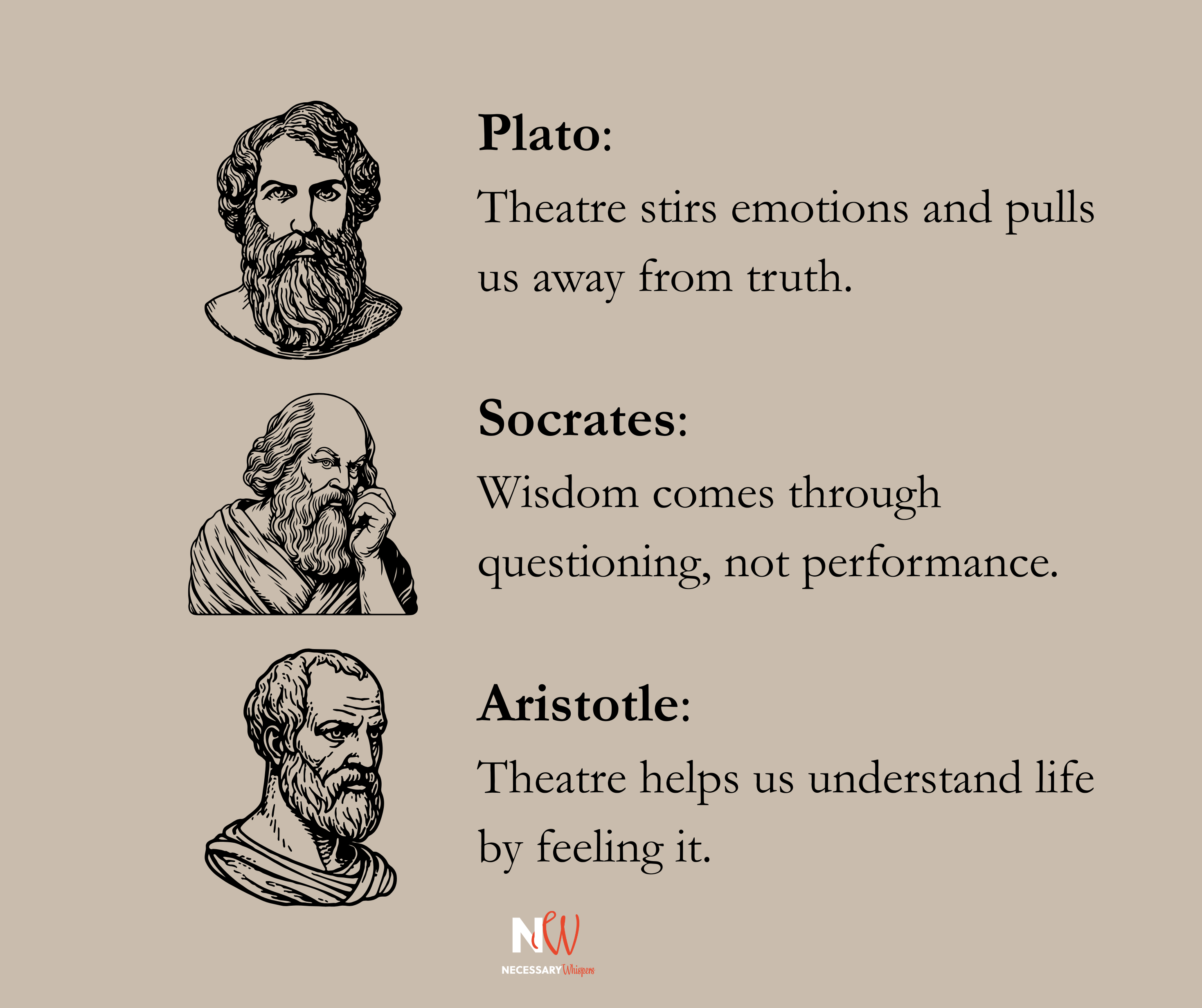
Plato regarded theatre with deep suspicion. He saw it as twice removed from reality, capable of stirring emotion without offering knowledge. For him, the stage was not a place for moral formation, but a threat to it.
Socrates, as portrayed in Plato’s dialogues, was less dismissive than demanding. He withheld approval from artistic forms that did not submit to dialectical examination. Knowledge, in his view, could not be passively received; it had to be interrogated into existence. Only when performance provoked philosophical inquiry did it begin to serve a worthy end.
Aristotle, by contrast, offered a systematic defense of tragedy. He argued that theatre refines emotion rather than inflames it. Through catharsis, spectators undergo a kind of ethical rehearsal, arriving not at illusion but at recognition. For Aristotle, mimesis was not mimicry, but a form of clarification.
These positions continue to shape how we think about the function of storytelling: whether art should comfort or confront, reflect or refine, entertain or educate. Later philosophers such as Hegel, Nussbaum, and Gadamer have extended this conversation, suggesting that theatre remains relevant not because it resolves these tensions, but because it invites us to dwell within them.
To study theatre alongside philosophy is to treat art not as decoration, but as a mode of thought. The question of its purpose resists final answers. What the Greeks understood—and what these thinkers help us recover—is that the stage is never neutral. It is a site of consequence, where emotion and reason meet, and where the ethical stakes of representation are always in play.

 Jill Szoo Wilson