
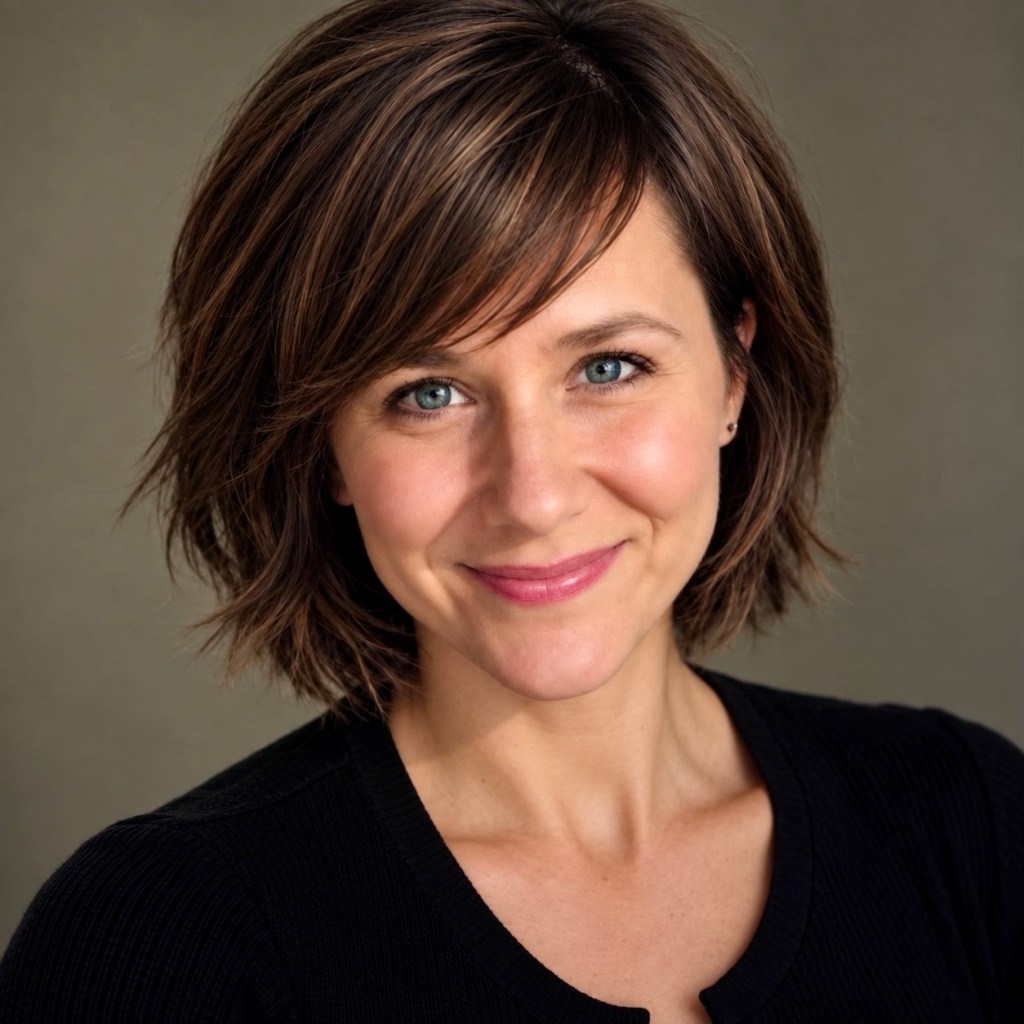
Jill Szoo Wilson holds an MFA from Regent University. She is a writer, theatre artist, and educator whose work explores the intersections of story and truth. She is drawn to the conviction that nothing is ever just one thing, and that beneath every surface lies something more complicated waiting to be named. This curiosity shapes her work across genres and disciplines.
After nearly two decades of teaching theatre and communication at the university level, Jill now works professionally as a writer while continuing to direct, coach actors, and develop performance-centered projects. She also serves as a Senior Content Specialist at Mercy, where she writes and develops patient-facing healthcare content.
Her career has spanned classrooms, professional stages, and on-screen work for more than twenty years. Her ongoing interest in how theatre reflects cultural change led her to articulate Meta-Absurdism, a theatrical framework that examines performance, identity, and meaning in the digital age. Two essays exploring the framework, The Profile and the Person and How Meta-Absurdism Works Through an Ordinary Object, are indexed by Google Scholar. Her poetry, published under the pen name Iris Lennox, carries that same attention to image, tension, voice, and ambiguity.
Her recent writing has also explored the psychological structures that shape intimate relationships and public narratives. In How Narcissism Works, a five-part essay series, Jill uses the story of a fictional couple to examine introjects, splitting, triangulation, smear campaigns, and gaslighting while drawing on psychoanalytic theory, personality research, family systems theory, and philosophy. In August 2026, Sam Vaknin, author of Malignant Self-Love: Narcissism Revisited, shared all five essays from the series with his audiences across X, LinkedIn, and YouTube, introducing Jill’s work to a wider international readership.
One of the most formative chapters of Jill’s creative life began in 2013, when she met Holocaust survivor and forgiveness advocate Eva Mozes Kor while developing a play based on Eva’s life. Over the next four years, Jill worked and traveled with Eva through Romania, Hungary, Poland, and Auschwitz-Birkenau. That collaboration shaped Throwing Stones: The Eva Mozes Kor Project and continues to inform Jill’s writing, teaching, and workshops on forgiveness, justice, memory, and accountability.
Across essays, poetry, curriculum, and performance, Jill is interested in the places where identity, memory, truth, and interpretation meet. Her work often begins with questions that do not resolve easily and with the belief that story can reveal what argument alone sometimes cannot.
Jill lives in the greater St. Louis area with her husband and is the proud “Grammy” to two energetic grandsons.
Influences & Inspirations
On the stage
Jill is drawn to the raw, restless poetry of Sam Shepard, whose plays dig beneath the surface of American life. His fractured families and haunted landscapes mirror her fascination with identity and belonging.
On the screen
She admires Lucille Ball not only for her impeccable comedic timing but also for her tenacity as a trailblazing businesswoman who reshaped the entertainment industry on her own terms. She also looks to Kenneth Branagh, whose Shakespearean craft and cinematic vision combine intelligence, passion, and emotional depth.
On the page
She often returns to George Orwell, whose clear-eyed prose and moral urgency remind her of the power of truth-telling against systems of distortion.
In theology
Joel Richardson’s work, particularly his insistence on reading the Bible through a Jewish apocalyptic framework, has sharpened her understanding of prophecy and continuity across Scripture. Viewed through that lens, the biblical narrative feels historically anchored and vividly alive.
In poetry
Emily Dickinson, today, tomorrow, and forever. Jill treasures her piercing brevity, her courage to dwell in ambiguity, and the way her words still feel alive, urgent, and unafraid of mystery.
In visual art
She is inspired by Georgia O’Keeffe, who once declared, “I have already settled it for myself, so flattery and criticism go down the same drain and I am quite free.” O’Keeffe’s fierce independence and luminous vision affirm Jill’s own belief in the freedom of artistic integrity.
In philosophy
She is drawn to thinkers who linger in paradox and metaphor. Søren Kierkegaard circles truth through irony and contradiction, unsettling easy answers. C.S. Lewis weds imagination to reason, allowing images to carry weight where argument alone cannot. Fyodor Dostoyevsky looks into the abyss of suffering and freedom, where even in the darkest corners of the soul, the possibility of grace refuses to vanish.
In her home
These days, the speakers carry the lyric depth of Emily Barker, Bonny Light Horseman, and Iron & Wine. She’s into beauty that’s a little weathered and very poetic.
A random passion
Crows. Jill finds them endlessly fascinating: clever toolmakers, problem solvers, and fiercely loyal to their kin. They’re often mistaken for ravens, but if you know what you’re listening for, the difference is clear: a crow’s call is the sharp “caw caw,” while a raven’s voice is lower and throatier, more of a “croooaak.” Basically, she has a soft spot for the world’s most opinionated bird.

