Echoes Against the Wall

I have spent enough years
watching shoes
to distrust
first impressions.

A name crosses the room.

A backpack is flung against the cinderblock wall.
A water bottle leaves its damp ring
on black marley worn pale
by entrances, exits, curtain calls,
by kings, widows, lovers, murderers,
by seventeen-year-olds
who believe tragedy lives in volume
and forty-year-olds who arrive
already acquainted
with silence.

A left heel angles toward the door.

Toes tighten
inside borrowed character shoes.

Weight gathers
along the outside of the foot,
where children first discover
that laughter
and being laughed at
arrive through the same door.

Some sounds never leave the room.

They find a surface,
turn once,
and spend years
coming back
as echoes
against the wall.

There must be some reason
the body keeps records
the mind—busy with grades, groceries,
taxes, traffic, passwords, anniversaries—
files away as finished.

Some reason
the shoulders rise
even when the room remains kind.

Some reason
the jaw, faithful as a lockbox,
finds its work again
under fluorescent tubes
buzzing overhead
with the steady indifference
of state-funded buildings.

And breath—

that ancient accomplice,
that old collaborator,
that invisible scene partner
who has crossed every border
without passport, permission,
or applause—

waits.

I have watched hundreds arrive.

Some carrying scripts
already underlined.

Some carrying talent
like contraband.

Some carrying humor
loaded
in the back of the throat,
polished by repetition,
released
the instant
a silence
turns personal.

Some carrying beauty
they haven't yet noticed
in the mirror.

And every so often—

with no music,
no revelation,
no visible sign
to anyone
who has not spent
a good part of her life
watching human beings
approach themselves—

the floor receives
its full measure.

The spine remembers
its oldest mathematics.

The ribs make room.

A voice,
patient through childhood,
through manners,
through institutions,
through every careful lesson
in becoming agreeable—

hits oxygen
and catches fire.

© Jill Szoo Wilson, 2026

What Does Paper Know of Life?

From the desk of Iris Lennox.

What does paper know
of life?

Only what we tell it.

I spread the pages
across my kitchen table,
one hand on oak,
the other
on language.

Afternoon light
finds the margins first,
then the staples,
then the black strokes
of my name
pressed hard enough
to leave its mark
three sheets down.

Good.

Some truths
deserve
depth.

The paper remembers dates.

It remembers names.

It remembers
who stood where,
who reached first,
who kept speaking,
who went silent,
who needed silence
to feel safe.

The ceiling fan turns.

Edges lift, but dare not
fly away.

They stay.
Pressure makes some run
and others stay.

A throat is made
of cartilage,
muscle,
membrane,
two pale folds
opening
and closing
over air.

Pressure meets tissue.

Even a whisper
requires force.

I know this.

I have taught students
to plant their feet,
unlock their knees,
drop their shoulders,
open their ribs,
and send a line
to the back wall
without asking
the room
for permission.

Never ask for permission.

I have watched
a frightened girl
find her stomach
and then her voice.

I have watched
boys
speak one true sentence
without laughing
and become men.

I have watched
language
enter the body
and change
the way
a person stands.

So when the hand came,
when the pressure came,
when silence
came to wrap around,
to shut me down,
to choke
me—

I know
what a voice is.

The larynx bruises.

The breath adjusts.

Once,
I lost it.

But don’t worry about me.

I just drink the tea,
bite down on the Ricola,
and breathe.

Shakespeare told us
long ago,

“Speak the speech,
I pray you,
trippingly on the tongue,”

And I tripped.

A little.

Then I got back up.

And spoke
until cartilage,
muscle,
membrane,
air,
ink,
oak,
paper,
rooms,
whispers,
and men
who mistake women
for little girls

had to listen.

They reached for an instrument
they didn't understand.

So I took
what the body knew,
what the stage taught,
what the page required,
what courage costs,

and I used
all of it.

Outside,
water climbs
through xylem,
one molecule
pulling another.

Roots enter limestone
by touch.

A seed splits
in darkness

and takes root.

What does paper know
of life?

Only what
we tell it.

—Iris Lennox

First published on IrisLennox.com.

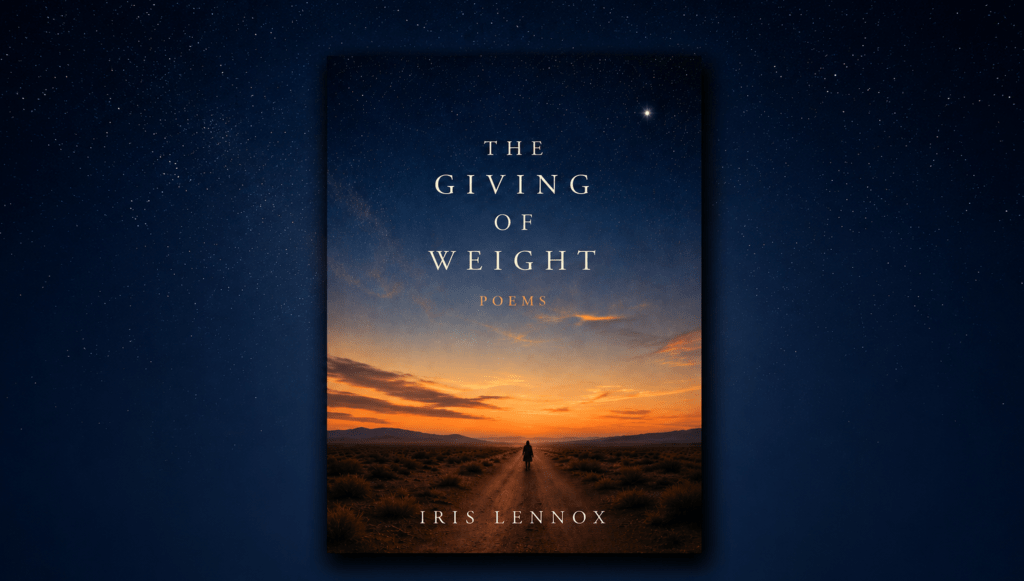
The Desert Series by Iris Lennox

Iris Lennox is the pen name I use for poems that gather around image, landscape, memory, faith, and the spiritual weight of ordinary things.

The poems belong to the same larger body of work as my essays on theatre, performance, communication, and attention, but they enter that work through a more lyrical form. Where my theatre essays often move through analysis, argument, and dramatic structure, the Iris Lennox poems begin with physical encounter: red dust, desert wind, silence, Scripture, stars, and the strange way wild places sharpen both sight and thought.

Here are five poems from The Desert Series, written during a recent trip through the high desert.

This summer, I’ll be publishing my first collection of poetry under the name Iris Lennox.

The primary home for Iris Lennox poetry is IrisLennox.com.

Whisper the Passing Time

Memory sifted through their hands

Like water

Or like sand—

The kind of sand that lays flat

On desert ground

And all around the blistered feet

Of those who stand and watch the sun

With faces red

And cracking under heat

Filtered through dust—

Or like water.


Like water

In trickles

Between fingers pruning with excess

Trying to keep it there

Sickeningly aware

Of the weakness in the spaces

Between their fingers

And their hands—

Their memories fell right through

Splashed around their ankles

In a shallow pool

Reflecting upward

Not what was held

But what remained.


Recollections darkened

Not gone—

But changed

Into purples and blues

Certain as midnight

Uncertain as morning.

The light from those days

Did not disappear

It bent

Casting shadows

From the figures they had formed

In the mind—

Standing still

Even as everything else moved.


Not that they lied,

They simply could not see

That the laughter of then

Would return differently

That what once rang out

Clear and effortless

Would come back softened

Carrying weight

They had not yet learned to name.


They heard the voices

Of those they knew

From long ago days

When laughter was simple

Easy as something rolling

Downward

Without resistance—

Smooth in the hand

Bright in the light

Held up and turned

Until color revealed itself

And then slipped away again.


Recollections continued

Not fixed

Not held—

But moving

Across the surface of them

As water does

As sand does

Shifting

Settling

Lifting

And falling

Without asking permission.


Their memories were old

But inside them

Something remained

Not unchanged—

But present.

A trace

A tone

A warmth

That did not belong

Only to the past

But to the shape

Of what they had become.


Memory sifted through their hands

And still

Something stayed—

Not in the grasp

But in the holding

They could no longer see.


Recollections whispered

The passing time—

Not hurried

Not still—

Simple as a falling grain

Intricate as the path it takes.


© Jill Szoo Wilson, 2026

Poem: Until It’s Time

The branch has lowered itself
just enough
to suggest an invitation.

Not to take—
only to come closer.

A cluster of blossoms gathers here,
pink in several decisions,
each petal folded inward
where light reaches
and shadow remains
until
it’s time.

They hold more air than expected.

When the breeze passes through,
the movement is slight—
not a flutter,
not quite a sway—
something closer to breath
distributed among them.

The scent does not arrive all at once.

It holds.

A faint sweetness
moves in and out of notice,
never settling long enough
to be claimed.

It resembles something remembered
without the obligation to be exact.

The bark chooses not to participate.

It’s rough
where the blossoms are not.
A hand, placed there briefly,
would feel the distinction immediately.

Somewhere beyond the frame,
grass yields under passing steps—
a quiet compression,
then release.

Water watches,
with continuity,
a low, steady movement
that declines the possibility
of becoming the subject—
ever the supporting role.

The blossoms remain.

Close enough to touch.
Close enough to confirm
what they appear to promise—

a softness that would not resist
the certainty of fingers.

The distance holds.

The air carries a trace of green—
pale and timid,
warm and cool—
tumbling against itself
waiting to affirm a victor.

Summer already knows who will win.

For now,
the air passes through the mouth unnoticed
halfway inhale
halfway exhale.

Then it is gone again.

The branch lifts slightly
or the body does—
it’s difficult to say which.

The blossoms return
to their position among many,
indistinguishable at a glance.

Still—

for a moment,
they held the conscious weight
of examination.

And in that moment,
briefly,
blushed at their own beauty.

© Jill Szoo Wilson, 2026

Poem: A Modest Proposal for the Internet Age

There is a version of you
already walking around out there.

She has good lighting.
He is a series of clean paragraphs.
They speak in sentences that arrive
fully dressed.

No one interrupts them.
No one misquotes them.
No one catches the moment
before the thought lands.

They do not hesitate.
They do not circle back.
They do not say,
“Wait, that’s not what I meant.”

This version of you
does not exist in your kitchen
or your car
or the quiet ten minutes
before sleep.

Still, she is convincing.

She has been liked.
Shared.
Saved for later
by people who will not remember
where they found her.

Meanwhile,

you forget what you were saying
mid-sentence.
You start projects you never return to.
You carry conversations in your body
long after they’ve ended.

You revise yourself
in the shower.
You win arguments
three days late.

There is no algorithm for that.

No one clicks
on the unfinished version.
No one bookmarks
the moment you changed your mind
and did not announce it.

And yet,

this is the only place
anything real has ever happened.

Not in the caption,
but in the pause before it.
Not in the post,
but in the hour you spent
deciding whether to speak at all.

The Internet will continue
to assemble you
from fragments.

A sentence here.
A photograph there.
A tone someone will misunderstand
and carry with them
as if it were complete.

You will be summarized
by people who have never
heard your voice in a room.

You will be known
in ways that are technically accurate
and entirely untrue.

This is not a problem
to be solved.

It is a condition.

So—

wash your cup.
answer the email you’ve been avoiding.
tell the truth
in the next small conversation
that asks it of you.

Let your life become
slightly more aligned
with the person
who appears so effortlessly
on a screen.

Not perfectly.
Not all at once.

Just enough
that if someone were to meet you
without context,
without history,
without the archive—

they would recognize you.

And if they didn’t,
you would not feel the need
to explain.

Now,

go and become the person
you want the Internet to think you are.

© Jill Szoo Wilson, 2026

Iris Lennox

This one did not arrive gently.

The edges remember something—
a pressure,
a folding back,
as if each petal had to argue
for its place in the light.

Nothing about it is smooth.

The ruffles hold.
The color deepens where it was once hidden.
Even the softness has weight to it.

You could say it opened.

But that would miss
what it endured to become open.

There are days
the sky lowers itself without warning,
and everything living is asked
to stay.

No explanation is offered.
No promise of outcome.
Just weather.

Still, something in the root
keeps drawing what it can.

Still, something in the stem
lifts what it has been given.

And when it is finally visible—
the pale, steady unfolding—
no one sees the storms.

Only the shape they left behind.

Only the quiet fact
that it did not close again.

Only the way it stands
as if the breaking of it
was never the end.

@Jill Szoo Wilson, 2026

Selected Writing by Jill Szoo Wilson

I’ve been asked to create a Where to Begin page for my poetry. Good idea!

Here are the top 10 poems by Jill Szoo Wilson based on website views over the years, public response at poetry readings, and generous feedback from readers like you.

  1. Moonlight We
  2. She Spoke of Love
  3. Love and Alive
  4. Un/Forgiven
  5. Lighthouse Hero
  6. God of the Street
  7. Algorithms of Fathers and Sons (And Daughters, Too)
  8. Unzipped
  9. Drenched
  10. Opposite Sides of the Wall

You can also find me on Substack under Jill Szoo Wilson and Necessary Whispers.
I tend to share newer poems and unpolished thoughts over there.

Stay curious,
Jill Szoo Wilson

Poem: Algorithms of Fathers and Sons (And Daughters, Too)

There is a jukebox in the corner

Where saddle shoes used to tread

Under skirts and socks with lace

Splattered with drippings from

Chocolate malts and shakes,

Where pearls would bounce

And roll across the floor.


Tile black and white—

I know it sounds trite

Like paisley on a bow tie

But patterns and bow ties

Bring order to the madness—

Also hamburgers, French fries

Ponytails and Snake Eyes.


He came to this place

Where the music was stuck—

Records displaying

Yellowed faces

Songs replaying

Grooves worn low

Weary, dull and much too slow.


Going backward

Isn’t really his thing

But there came a day

When his soul melted

Slipped through his lungs

Leaked and oozed

Puddled around the soles of his shoes.


Forward

No longer

Was an option for him—

What was he supposed to do?

Walk away, a shell of a man

Empty but for the wind

Whistling through?


He stood

Until noon traveled around him

Draped over the moon

Darkness descended,

Then fell his soul

Standing stuck

He heard the rattling of a rancid truck.


“Move aside,”

Said a man

Who smelled like Linus looks

Plus the tan lines of a garbage man,

“You’re in my way,

and what is this filth

at your feet?”


Accustomed to the dross

Of the city streets

With fetid hands the garbage man

Began to lift the spilt soul

Which was running into the ditch but,

“Wait!,”

Cried the empty man.


“That is not junk

though it lacks the glow

of gold

please leave it here

with me

it is all I have

if the truth is told.”


“All you have?”

Laughed the man

With the smell of human waste

On his hands,

“Then pick it up.”

Then came the second truth,

“I can’t.”


“I need your help,”

The wind spun around his tongue

Then played the space

Between his ribs

And his lungs

Like a concerto for weakening

Flesh and bone.


“Damn it all,”

The collector of trash replied

As he bent at the waist

To clean up the spill

That rolled down the hill

Before it crusted, caked and dried

Under the heat of the sun.


“I’ll put it in your pocket

now move along

get something to eat

there is a diner

across the street

that serves the lost

and the weak.”


And so, this is how he came

To the place echoing with the past—

The jukebox, the pearls

Where nothing was meant to last—

Fate brought him low

Then brought him here

To face the time where it all began

(Thanks to the garbage man).


“I don’t understand,”

He thought to himself

Then said it out loud

As his eyes rolled around

Searching for some logic

He could grip

Or some algorithm

He could apply to the script.


And then

Entered a ghost

With matted hair

On the sides of his head

Coming out of his ears,

A limp in his knee and

Teeth glowing green.


“I don’t believe in ghosts,”

Said the empty man

“Tough shit,”

Said the apparition

Blunt in his delivery and

Over dramatic

In his long flowing livery.


“Do you have a cigarette?”

Coughed the ghost

To which the live one replied,

“Do you always start with small talk?

I don’t mean to gawk but

your presence and general

demeanor are starting to piss me off.”


“You are here for a reason

and so am I

we need to get some things straight

before it’s too late

for you.

As you can see

it’s already too late for me.”


The beginning and the end

Sounded like a riddle

But somewhere in the middle

The living man

Recognized the voice,

“Dad?”

He squinted and then stuttered.


“No shit,”

Said the ghost and then

Once more,

“Do you have a cigarette?”

The living man

Almost fell to the floor

“Here, one of my last four.”


They sat in a booth,

The jukebox began to croon

They ordered hotdogs with ketchup

Had no forks

Cut their food with a spoon,

“I don’t mean to pry

but why have you come?”


“I met her here in 1952

we were both too young

to know what to do

so we loved and had fun

and then she had you

I thought of staying

but I couldn’t follow through.”


They sipped coke through a straw

To fill the long pause,

“Again, I wonder

why are you here?”

The ice clinked

In the ghost’s tall curvy glass,

“I know I was an ass

I feel kind of bad

I heard you needed me there

but I didn’t know—

shit—

it was hard to stay away

and hard to stay

I wanted to say . . .”


A pause.


And a tightening of the throat

Both the man and the ghost

Turned and squirmed,

“But why today?”

Asked the living son

Who wanted to run but chose to stay.


“Before I go to my final space

I was given the gift

once more

to see your face

and written there

I saw your hopelessness—

it rendered my journey motionless.”


“Is that when my soul

dripped all the way out?”

The ghost whispered back,

“That wasn’t your soul

it was fear and self-doubt

and I couldn’t help but

notice my name

on the puss that spilled out

so I used my airy powers

to stop your feet

with the little time I have left

I wanted to meet

in case my song repeats

after I’m gone.”


The air was still

Atmosphere heavy

Like before a storm

The ground felt shaky

And covered with worms

Snakes, anteaters and obese germs.

“I took a bit of you

and left too much of me

dropped you in a hole

of anonymity

no sure identity

as is given by a dad

and when you reached for me

your hand collapsed

empty

confused

your confidence slid—

but hear me now:

you are the best thing

I ever did.”


The living man

Felt a peace begin to grow

In a place he did not know

Existed before today

Above his ribs, above his lungs

Where scabs were hung

Replaced with Band-Aids.


“I didn’t know

and I have a lot of questions

but I feel your time is fleeting

so I will ask only one

why wait

so late

to have this meeting?”


“Time is made of seconds and of hours

each tick devours each tock

as we ignore the face of the clock

take for granted the breath

and selfishly hold the seasons

in vaults of the mind we keep locked

for prideful reasons.

But I tell you,

my son,

you are not

hopeless

I see your shine

and as long as you are living

there is still

time

so live

and be the you that is

free

of the weight of me

and my stupidity,

I am sorry.”


Then the ghost

He didn’t believe in

Vanished

To whence he came

But left a ray of something

Maybe hope

And the jukebox continued to play.


© Jill Szoo Wilson, 2026 (updated)

Poem: And She Flew

Currents of wind
Grasping blue
From the sky

Mixing colors—
Translucent white
Floating by

In puffs
Like smoke
But water

Cascading
Masquerading
As clouds, drifting down
To rest upon
The ocean’s top

Atop the undercurrents
Pulling dark and light
Together

In a haze
Under the phase
Of the moon

Where fullness
Steers the darkness
From the light.

At night the sense of
Flight
Alights

In dreams and hopes
A knotted rope
Hangs from the stars

And swings
As she sings
Like a bird

Whose song is sung
Carelessly
Without thought

She calls into the night
Filling it
From empty
To bright

And falls into
The space where
Downwind caresses
Upwind lifts

And buoyancy calls her
Higher still.

As hummingbirds swing
Creatures below
Sting

With venom held
Inside teeth
Red with the catching

Stories repeat
Through dust and mold
Dark with lies

Whispered inside
By unseen spies
Who feed on souls

Who fill the roles
Like actors
Paid to play

Unable to reach
The heart
And open—

Unfold
Like art.

The ones below
Whose wings were clipped
Set a scheme

Narrow as a
Tightrope
A balance beam

A trap
Set with bait
And they waited

Inside a box
Designed to promise
The only way

Into hope
From hopelessness—
To pull her down

To steal her crown

A crucible
Of fire
Inside folded walls

Where stories
Cease to be told.

She flapped her wings
Tilted her head
Toward the earth

Wondered
Then wandered
Through the expanse

Where freedom
Takes its chance
On little birds

Such as she

She caught a breeze
Saw her reflection
In the sea

Caught a glimpse
Of her worth

And floated down
To the cardboard flaps
Of the box

The dark ones
Moved
Like worms

The kind of worms
Eaten by birds.

It looked easy enough

Fold the second flap
Then the first
And follow the way

They had planned

To be kept
From the sky
From the breeze

From the warmth of the sun
The turn of the season

From the spring
That would
Enchant her

Like a lover
Enhance her

With colors
Vibrant
Breathing
Beating

With life
To romance her.

“No,” she thought

And then—

“No,” she said

The comfort of that dark
Is stark

The safety of that space
Is small

A quiet that settles
For an hour

Sweet at first
Then turning

She felt it
And knew it

And chose—

She rose

And she flew
And she flew.

© Jill Szoo Wilson, 2026