I traveled to Auschwitz, Hungary, and Romania with Holocaust survivor and Mengele Twin Eva Mozes Kor to learn her story so I could write a play about her journey toward forgiveness. I listened as she recounted her experiences, watched how she carried the weight of her past, and witnessed firsthand the strength it took to forgive. Now, I am sharing what I learned in her own words because her voice is not only history. It is a call to action, and it is more important than ever.
Before she ever considered forgiving Dr. Josef Mengele, Eva made the decision to forgive Dr. Hans Münch, a Nazi doctor who had worked at Auschwitz. Unlike other former SS officers, Münch openly acknowledged the existence of the gas chambers and signed a document confirming how they were used. For Eva, his willingness to tell the truth was significant, and she wanted to give him a meaningful gift. That decision led her to write a letter of forgiveness, a choice that changed her life forever.
Searching for the Right Gift
I did not tell anyone about my idea of thanking Dr. Hans Münch, a former Nazi doctor, because I thought people would think I was crazy. How do you thank a Nazi doctor? What kind of gift could possibly be appropriate?
I decided to start at a Hallmark store, hoping that the “Thank You” card section might offer some inspiration. But as I stood there reading card after card, I felt uneasy. I did not want anyone to know what I was looking for. I spent more than two hours searching, and twice the store employees approached me.
“Are you finding what you’re looking for?” one asked.
“Not really,” I replied.
“So what are you looking for? I’d love to help you find it.”
For just a second, I considered telling her. But I knew she would never understand. My search was not normal. Instead, I said, “Thank you for asking, but I cannot tell you,” and I left the store empty-handed.
A Life Lesson in Forgiveness
Even though I could not find a gift that day, I refused to give up. I reminded myself of the life lessons I often shared in my lectures:
- Never give up on yourself or your dreams. If I could survive Auschwitz without knowing how, then no one should ever give up on their own future.
- Treat people with respect and fairness, and judge them by their actions, not their past.
- Forgiveness is a personal power, one that no one can give or take away from you.
For ten months, I thought about what I could give Dr. Münch. Whether I was cooking, cleaning, driving, or doing laundry, the question lingered: how do you thank a Nazi doctor?
Then, in June 1994, the answer came to me. A simple but powerful idea: what if I wrote him a letter of forgiveness?
Immediately, I knew it was the right choice. It was not only a gift for him, it was a revelation for me. I discovered that I had the power to forgive. No one could grant me that power, and no one could take it away. I had spent my life reacting to what others had done to me. Now I was initiating action. I did not need permission. I was not hurting anyone. So why could I not do it?
I was trembling with excitement. For the first time, I felt like I had control, not just over my past but over my present and future. I had spent so many years holding onto pain, sadness, and anger, and now I saw a way to release it.
Writing the Letter
I sat down to write my letter of forgiveness, but it was not easy. At first, I addressed Dr. Münch as an evil monster. But I kept reminding myself of my goal: to reclaim my own power. I wanted to stop feeling like a victim. I wanted to stop yelling at my children out of misplaced anger. I wanted to be free from the weight of my past.
I worked on that letter for four months, revising it whenever I had time between my real estate appointments. I thought about reaching out to other Mengele Twins, but I was afraid they would not understand or might try to talk me out of it. I wanted to disarm my enemies in the most unexpected way, by forgiving them.
A Challenge from My Professor
Once I finished the letter, I could see that my spelling in English was poor. Not wanting to be embarrassed in front of Dr. Münch or anyone else who might read it, I reached out to Dr. Susan Kaufman, my former English professor at Eastern Illinois University. She was excited about my forgiveness ideas and helped me refine the letter, correcting my spelling and working through multiple drafts as I shaped my message.
Then, in her matter-of-fact tone, Dr. Kaufman said, “Eva, it is nice that you are forgiving Dr. Münch, but you really should forgive Dr. Mengele.”
I responded quickly, “This is just a thank-you letter for Dr. Münch!”
She did not listen. “When you get home tonight, pretend that you are talking to Dr. Mengele, telling him that you forgive him, and see how it makes you feel.”
My mind reeled back to Auschwitz. To the man in the crisp SS uniform, standing tall and expressionless as he looked down at me. I was 10 years old, a child, sitting in a makeshift examination room in Block 10. I could not move. Steel rods forced my eyelids open as he poured a burning liquid into my eyes, blinding me with pain. I could not cry, could not blink. All I could do was stare up at him as he conducted his experiment, cold and detached, as if I were nothing more than an insect pinned under glass.
That night, Dr. Kaufman’s challenge would not leave me. I closed my eyes and summoned the image of Dr. Mengele. Then I said aloud:
“You son of a gun, evil monster, Nazi doctor, I forgive you because I have power over you, and you have no power over me.”
And then I felt it. Relief.
For the first time, I was in control. Mengele had dictated so much of my suffering, but in that moment, I took something back. I was not hurting anyone by saying it. I was not rewriting history or erasing the horrors he had committed. But I was stripping him of the power he still had over me.
If I could forgive him, the worst of the worst, then what about the others?
The kids who harassed me for eleven years on Halloween, banging on my door, mocking me, tormenting me.
The Capitol police who grabbed me, tore my rotator cuff, and left me with permanent damage when they arrested me in the Capitol Rotunda on May 6, 1986. All because I stood up and demanded justice, shouting: “Memorial services are not enough. We need an open hearing on Mengele-Gate!”
If I could forgive Mengele, then what power did any of these people have over me?
That was the turning point. I rewrote my forgiveness letter, not just for Dr. Münch, but for every person who had ever hurt me.
A Historic Moment at Auschwitz
On January 27, 1995, I returned to Auschwitz with Dr. Münch. It was the 50th anniversary of the camp’s liberation. I knew other survivors would be there, but I arrived with an unusual group: Dr. Münch, his family, and my own family and friends. I was not worried about his presence; after all, he was there to document the gas chambers and provide historical confirmation of what had happened.
But I underestimated how others would react. My son, Alex, and my friend Mary Wright asked, “What do we do if someone attacks Dr. Münch?” I had not considered that possibility. I expected resistance, maybe even disapproval, but not hostility.
Security at Auschwitz was strict. We were a few minutes late, and they refused to let us in. “Fifty years ago, I was a prisoner here, and they would not let me out,” I told them. “Now, they will not let me in.” Eventually, we were allowed through.
At the ruins of Gas Chamber #2, I read my letter of forgiveness out loud. The words hung in the frozen air. Dr. Münch’s face was unreadable at first, then slowly shifted. He was stunned. Finally, he turned to me and said, simply, “Thank you.”
Throughout the day, he kept trying to walk arm-in-arm with me. I hesitated, wondering how that would look to other survivors. Later in the day, I slipped on the icy road and he caught me before I fell. Suddenly, I was grateful he was close enough to steady me. Not everything is as it appears.
That day, we handed out 400 copies of a press release about the two documents we had created, one related to Dr. Münch’s testimony about the gas chambers at Auschwitz, and one expressing forgiveness. Only six journalists showed up.
The Power of Choice
I have been criticized for my decision to forgive. Some survivors and their families have protested against me, insisting that my forgiveness was an insult to their pain. But when I asked how my choice to forgive hurt them, they could not explain.
The truth is, forgiveness is a personal choice. It is not about excusing evil or forgetting history. It is about reclaiming power over our own lives. It is about refusing to let the past dictate our future.
No one could give me that power. No one could take it away. It was mine, and mine alone, to claim, to use, and to reclaim my own freedom.
© Jill Szoo Wilson, 2025
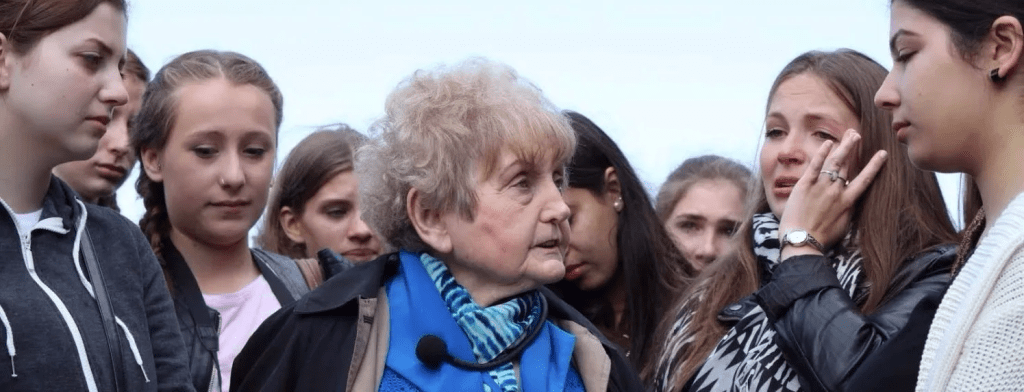
Photo credit: I am not sure who took this particular photo, but I was there when it was taken in 2013. We were standing inside Birkenau on the selection platform, near the cattle car that still stands there today. Eva was speaking to a small group that had gathered around her when this group of young German students stopped to listen from outside the circle. When Eva realized they were German, she invited them into the circle. It was then that the girls began to apologize to Eva on behalf of their ancestors. She told them they did not owe her an apology because they had done absolutely nothing wrong. She encouraged them to simply learn from their mistakes and to be light and love in the world. This was one of my favorite public moments with Eva.
Read more by Jill Szoo Wilson on Substack.

 Jill Szoo Wilson