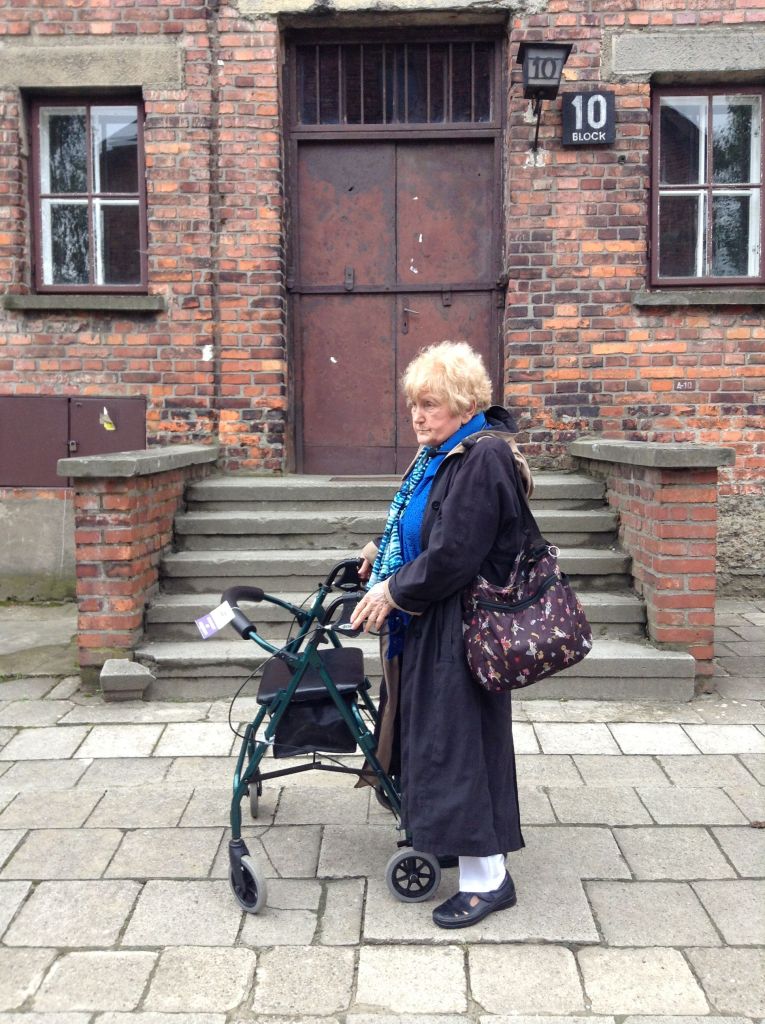
In 2015, Holocaust survivor and Mengele Twin, Eva Mozes Kor sent me an email recounting one of the most harrowing experiences of her later years: an encounter in the West Bank that left her feeling vulnerable in a way she hadn’t since Auschwitz. The email was raw, unfiltered, and deeply personal.
As I revisit her words, I have chosen to write this piece in her own voice, staying true to the way she described the events to me. It offers a glimpse into the complexities she faced, not only as a Holocaust survivor and educator but as someone who, even decades after her liberation, found herself in situations that tested her sense of safety, trust, and resilience.
This is her account.
In July 2005, I traveled to Israel as part of the filming process for Forgiving Dr. Mengele, a documentary about my journey as a Holocaust survivor and my philosophy of forgiveness. The trip was filled with emotional moments: revisiting the agricultural school in Magdiel where I lived after Auschwitz, reconnecting with my sister Miriam’s family, and filming an interview with fellow Mengele Twin survivor, Jona Laks, at the Jewish Heritage Museum. But nothing prepared me for one of the most harrowing experiences I had since liberation.
Bob and Cheri, the filmmakers, had arranged for me to meet with a group of Palestinian educators to discuss a book written collaboratively by Israeli and Palestinian teachers. The book aimed to help students from both sides better understand each other’s histories. It seemed like an interesting and worthwhile project, and I was open to hearing their perspectives. But as the meeting approached, I found myself increasingly uneasy.
I had been under the impression that we would be meeting these teachers in Jerusalem. Instead, we suddenly arrived at a border checkpoint, where we were told we had to cross into the West Bank on foot. I had no idea this was part of the plan, and panic set in. Refusing to cross would cause problems, but I couldn’t shake the feeling that I was walking into something dangerous.
On the other side, a Palestinian professor named Sami met us, surrounded by a group of young Arab men speaking in Arabic. It was clear that they were discussing me, but I couldn’t understand what they were saying. That alone made me feel incredibly vulnerable. I had dressed modestly out of respect for their customs, wearing a long skirt instead of my usual pants, but that did little to ease my growing discomfort.
Sami took me to a bombed-out building and told me, “See, this is what the Israelis did to us.” I had seen the destruction before; it had been there for three years. “Why haven’t you cleaned it up?” I asked. Sami said they didn’t have the money. “You don’t need money to clean up a site,” I replied. “You need strong young men, and you have plenty of them.” I saw what he was doing. He assumed I was a naïve, bleeding-heart liberal who would unquestioningly accept his victim narrative. But I had been an Israeli soldier. I knew the conflict was far more complicated than he wanted me to believe.
The real ordeal began when I was taken to an Arab school in Bethlehem, where I was introduced to eight Palestinian teachers and one Israeli professor. The Israeli professor, the one who had convinced Bob to set up this meeting, never showed up. I felt abandoned, surrounded by people who saw me not as a Holocaust survivor, not as an individual, but simply as an Israeli and a Jew.
As we began filming, the conversation had nothing to do with the book I had come to discuss. Instead, the teachers launched into a four-hour tirade about how Israel had made their lives miserable. I wanted to ask why the restrictions they complained about had been put in place, but I was afraid to say anything. I was in their hands. Bob and Cheri had no power to protect me. The fear was paralyzing. I felt like a hostage, unable to speak, unable to defend myself, unable to leave.
Eventually, I ran out of the room, sobbing uncontrollably. I hadn’t felt so trapped and powerless since Auschwitz. Bob and Cheri were apologetic, but it was too late. My goodwill had been exploited for a political agenda, and my trust had been shattered. The final humiliation was sitting down to eat with the teachers. I pretended to take a few bites so as not to offend them, but all I could think about was escaping.
It was nearly 10:30 p.m. before I was finally back on Israeli soil. Only then could I breathe again. Only then did I feel safe.
This experience reinforced something I have always believed: Many Holocaust survivors who live in Israel are still on the battlefield every single day. Their war did not end in 1945. The trauma of persecution never truly fades when you must still fight for your right to exist.
As for me, I survived yet again. But I will never trust so easily again.
© Jill Szoo Wilson, 2025
Read more by Jill Szoo Wilson on Substack.

 Jill Szoo Wilson