
The problem with survival is that there are other people in the world. If we were simply dropped off in the middle of this jungle called life, with a go-bag, some water, and a means to make fire, we would most certainly get through life with stressful stories but hardly any trauma. For example, if I had to wrestle a bear to the ground because he took my last piece of food, I would come out of that fight banged up but not traumatized. Nearly dead, yes, but with scratches on my arms that would eventually heal. Bears are not the problem. It is people. Wolves in sheep’s clothing.
When people get involved, survival shifts. We move from survival as an instinct (wrestling bears for food because we have to eat) to survival despite our instincts, fighting human perpetrators because the violence they bring is not just something we recover from; it is something we live with, long after the battle is over. This is where justice comes in. As humans, we have a strong need for justice. Our first instinct is not usually forgiveness, but rather to seek an equally proportional measure of punishment for those who have wronged us. “An eye for an eye,” right?
I have heard it said that forgiveness is about taking someone off your hook and putting them onto God’s hook. I believe that to be true. But for the sake of this article, let us focus on the hook itself. How can we find peace if we are still holding someone in contempt in a court of our own? How can we find peace when we are the judge, jury, and executioner?
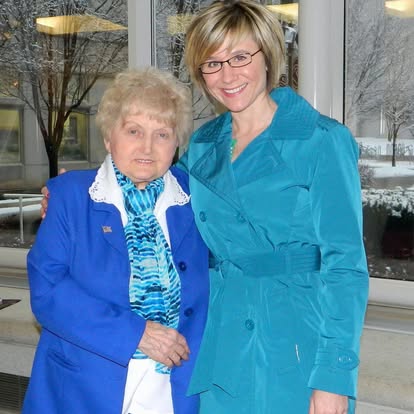
This brings us to forgiveness, a concept that can feel both impossible and liberating. It is not about erasing the past; it is about freeing ourselves from its hold. I began to understand this through my time with Holocaust survivor and Mengele Twin Eva Mozes Kor. In her words and actions, Eva taught me that forgiveness is not an act of excusing the wrongs done to us; it is about choosing to free ourselves from the weight of anger and resentment, allowing us to heal and move forward.
Eva spent her life sharing a powerful message: forgiveness can free us from the pain of the past. But forgiveness is not a simple act, nor is it always possible in the heat of survival. In candid reflections, she discussed how complex and difficult it is to find peace, not just for oneself but for future generations.
Eva was often criticized by fellow survivors for her approach to forgiveness, which she saw as a conscious decision to move beyond the traditional idea of simply “forgive and forget.” For Eva, forgiveness was not about erasing the past or excusing the wrongs committed; it was about choosing to release the grip that hatred and resentment held on her, giving herself the freedom to heal.
She also emphasized that forgiveness cannot be rushed. It is not something one can jump into in the heat of battle or while still fighting for survival. Only after we feel safe, after the danger has passed, can we even begin to consider forgiveness. This understanding was central to Eva’s belief that forgiveness is a long, deliberate process that only becomes possible when we feel secure. For her, the journey did not even begin until four decades after liberation from the camps (Kor). That delay is a testament to the time it takes to heal and to reclaim one’s sense of safety before forgiveness becomes possible.
Psychological research on trauma supports Eva’s view that forgiveness is often a complex and gradual process, particularly when individuals are still grappling with the effects of trauma. Dr. Bessel van der Kolk explains that “trauma robs you of the capacity to forgive, because forgiveness requires a sense of safety, and trauma creates a world where safety is impossible” (The Body Keeps the Score, 2014). This aligns with Eva’s belief that forgiveness only becomes possible when the individual feels secure enough to step away from the “battlefield mentality” of survival.
Similarly, Dr. Judith Herman emphasizes the critical role safety plays in the recovery process. She asserts that trauma survivors must first find safety and regain a sense of control before they can begin processing and healing their wounds (Trauma and Recovery, 1992). Only after this foundational stage can they consider forgiveness, not as an immediate reaction but as part of a longer journey toward reclaiming their emotional well-being and sense of power.
Survival First: The Battlefield Mentality
Eva’s message begins with a clear understanding of human nature. She explains that the survival instinct is innate: “We are all born to maintain life at any cost.” This survival instinct shapes our actions in profound ways, particularly when our lives are at risk.
For example, she argued that forgiving someone who is pointing a gun at your head would make no sense, because you would be dead before you could even say the words. The instinct to protect oneself overrides any consideration of forgiveness in that moment. Eva called this the “battlefield mentality.” In this context, forgiveness is impossible until the threat has passed, the battle is over, and we feel secure again. Only then can we begin to consider forgiveness.
This aligns with the fight-or-flight response, first described by Dr. Walter Cannon (Bodily Changes in Pain, Hunger, Fear and Rage, 1915). Cannon’s research explains how the body’s instinctive reaction to danger prioritizes survival over all other actions, including the cognitive decision to forgive. Only once the immediate threat has passed and we feel safe can we process our emotions and consider forgiveness.
Forgiveness After the Battle: When We Are Safe
Eva believed that for Holocaust survivors living in Israel, or those still coping with the immediate concerns of survival, forgiveness was often out of reach. Many survivors continue to face the realities of their trauma, and for some, the environment in which they live, still grappling with insecurity and violence, means they are not yet able to move beyond the pain. The challenges they face are not just historical; they are still navigating a present shaped by fear, uncertainty, and the need for protection. Eva recognized this complexity and believed that forgiveness could not be forced while survivors are still in a state of ongoing defense, where survival is still their top priority.
Historical context supports Eva’s view. The post-war period in Israel, for example, was one where many survivors faced not only the trauma of their past but also the pressures of rebuilding in a country still fighting for its survival. In such an environment, the idea of forgiveness or reconciliation often took a back seat to the immediate needs for safety and security. Scholars like Hannah Arendt (The Human Condition, 1958) and Natan P. Lasky (Holocaust and Memory, 2001) note that forgiveness in the face of unresolved trauma and ongoing conflict is incredibly difficult, if not impossible, because the wounds remain fresh and the environment does not offer the conditions for healing.
Eva also pointed to the cycle of pain that continues when survivors, unable to forgive, pass on their hatred and distrust. Survivors who choose not to forgive often reject anything related to their oppressors, such as avoiding German products, refusing to visit Germany, or not trusting Germans. This perpetuates the pain and prevents healing. Eva challenged them: “Do you want your children and grandchildren to carry and feel your pain for the rest of their lives, or would you like to give them another inheritance?”
The Inheritance of Forgiveness
Eva reflected on her own family, explaining how her two children responded differently to her philosophy of forgiveness. One embraced it, while the other did not. Despite the differences, Eva believed forgiveness was a choice that could be discovered later in life, even if not immediately embraced. She always said, “I forgive in my name only.” For Eva, forgiveness was a personal decision, one that could not be imposed on others. She recognized that each person must find their own path to healing, and that path may look different for everyone.
She urged survivors of any trauma, whether Holocaust survivors or survivors of child abuse, neglect, or molestation, to consider the possibility of forgiveness. Eva shared how the deep pain caused by betrayal can linger long after the event, but also how releasing that pain is possible. Her advice for those suffering from trauma was simple: imagine how it would feel if the pain had never occurred. Then, shift your perspective and ask, “How would you feel if you could overcome that pain by forgiving those who caused it?”
The Letter of Forgiveness: A Path Toward Freedom
For those struggling to forgive, Eva had a practical suggestion: write a letter to the person who caused the pain. The letter did not need to be sent; it was a personal act of release. Writing a letter of forgiveness allows the survivor to work through the pain, step by step, with the intention of breaking free from its grip.
Research in expressive writing supports Eva’s approach. Dr. James Pennebaker has found that writing about traumatic experiences can significantly reduce stress and improve emotional well-being (Opening Up by Writing It Down, 2016). In his studies, he demonstrated that individuals who write about their emotions and trauma often experience greater emotional clarity and a decrease in physical symptoms related to stress. This form of writing helps individuals process difficult emotions in a controlled, private way, which can be especially beneficial for survivors of trauma who may find it difficult to talk about their pain.
Eva reassured her audience: “What can this silly letter accomplish? Try it, what can you lose? Only your pain. And if you don’t like how it feels without that pain, you can always take it back, but you will not miss it.” This simple act, she believed, could free people from the constant burden of past trauma and open the door to healing. Studies have shown that writing can lead to emotional relief, helping individuals feel lighter and less burdened by their past. By putting the pain into words, survivors can begin to regain control over their emotions and take steps toward freedom.
A Call to Action
Eva’s message is about reclaiming your freedom. She taught me that forgiveness is not about excusing the past; it is about letting go of the weight that keeps you from moving forward. Traveling with her through Poland, Hungary, and Romania from 2013 to 2017, I saw how forgiveness gave her the power to heal, to find peace where pain once lived.
Her words often echoed in my mind as I confronted my own pain. “What would my life be like if I could forgive?” I realized that forgiveness is not just about releasing anger or resentment; it is about letting go of fear and the weight of trying to fix things I cannot control. I spent so much time feeling responsible for making everything right, but I realized that I cannot be in charge of justice across the world. What I can do is release my obligation to correct things beyond my reach. Forgiveness became the key to letting go of that burden, and in doing so, I was able to reclaim peace for myself.
June Hunt defines forgiveness as “a deliberate choice to release feelings of resentment or vengeance toward a person or group who has harmed you” (How to Forgive… When You Don’t Feel Like It, 2008). Hunt emphasizes that forgiveness is not about condoning the offense but choosing to release the hold that the hurt has over your life. This aligns with Eva’s perspective, where forgiveness is an act of personal freedom, not an act of excusing past wrongs. For Eva, forgiveness was about freeing herself from the weight of past pain, and choosing peace over the perpetuation of hurt.
Through her example, I understood that forgiveness is a choice, a choice that lets you take back the power lost to fear, anger, and the constant desire to control outcomes. It is not an easy choice, but it is one worth making. Because in the end, forgiveness is a powerful act of reclaiming your life, of releasing the past’s grip on your soul and embracing the peace you deserve. It is not about excusing the wrongs or forgetting the pain; it is about choosing to rise above them, to break free from the chains of resentment and fear, and to step forward into a future unburdened by what you cannot change.
© Jill Szoo Wilson, 2025
Further Reading
- Arendt, Hannah. The Human Condition. University of Chicago Press, 1958.
- Cannon, Walter. Bodily Changes in Pain, Hunger, Fear and Rage. Appleton, 1915.
- Herman, Judith. Trauma and Recovery. Basic Books, 1992.
- Hunt, June. How to Forgive… When You Don’t Feel Like It. Harvest House, 2008.
- Kor, Eva Mozes. Surviving the Angel of Death: The True Story of a Mengele Twin in Auschwitz. Tanglewood, 2009.
- Lasky, Natan P. Holocaust and Memory. Yale University Press, 2001.
- Pennebaker, James W. Opening Up by Writing It Down. Guilford Press, 2016.
- van der Kolk, Bessel. The Body Keeps the Score: Brain, Mind, and Body in the Healing of Trauma. Viking, 2014.
 Jill Szoo Wilson