
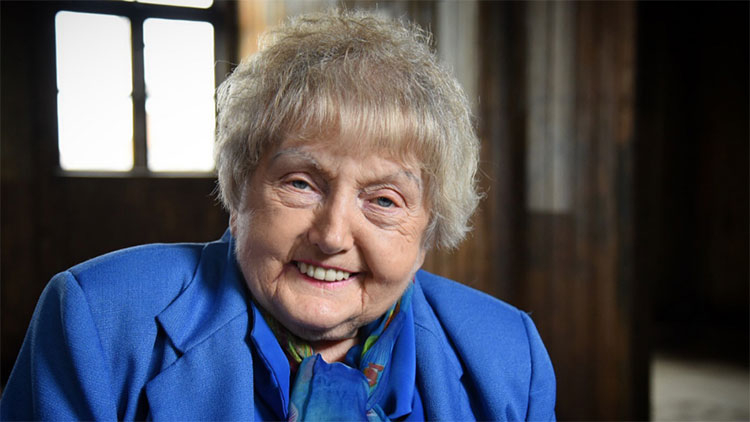
In conversations about forgiveness, Eva Mozes Kor, Holocaust Survivor and Mengele Twin, was often asked tough questions about justice, especially regarding criminals, terrorists, and those who have killed. One such question came from a UK film director, who asked, “Should we just forgive them and let them go?” This question challenged Eva’s own ideas of forgiveness and set her on a path to delve deeper into the complexities of justice and forgiveness.
Her response to this challenge was powerful: “We must decide what we want the end result to be,” she explained. If the goal is punishment, then “we just hang him/her,” because after all, she had spent her life hearing the statement, “Justice must be done.” But Eva quickly challenged that notion, pointing out that while justice sounds simple, the reality is far more complicated.
The Search for Justice: Mengele’s Escape
Eva shared her concerns about how justice was sought for the Nazis after World War II, focusing specifically on Dr. Josef Mengele, the infamous Nazi doctor who performed experiments on Eva and her twin sister, Miriam. Mengele’s arrest under his name by the American forces, only to be released a day later due to a mistake, underscored the failure of justice. Despite his heinous crimes, Mengele’s name was never included in the Nuremberg Trials, and it wasn’t until 1985 that serious efforts were made to find him.
Eva had long been suspicious of the official accounts of Mengele’s death. In 1985, after taking a group of Mengele twins to Auschwitz to mark the 40th anniversary of the camp’s liberation, the search for Mengele’s whereabouts became an international story. Governments like those of Germany and the U.S. announced that Mengele’s bones had been found in Embu, Brazil, but Eva remained skeptical. The rushed, secretive nature of the investigation raised red flags for her.
The Inquest: Investigating Mengele’s Death
Eva’s suspicions led her to take action. Determined that survivors had the right to examine the truth, she organized an inquest into Mengele’s death, inviting forensic experts, historians, and survivors of Auschwitz, including Mengele twins. Eva could not raise funds for the inquest, so she took out a second mortgage on her house to pay for the investigation. This decision highlighted Eva’s unwavering commitment to finding the truth.
Just days before the inquest was set to begin on November 15, 1985, Eva received what she said was a threatening phone call from Neal Sher, the director of the U.S. Justice Department’s Office of Special Investigations. He demanded that Eva provide the names of those who had seen Mengele alive after 1979, or face the possibility of U.S. Marshals visiting her. Eva stood firm, refusing to yield to threats and continuing with the inquest.
The Inquest Findings: The Mystery Deepens
During the three-day inquest, experts including pathologist Dr. Michael Baden, psychologist Dr. Nancy Segal, and German-educated physician Dr. Werner Loewenstein examined the evidence. Dr. Loewenstein, who had translated Mengele’s SS files, was pivotal in uncovering discrepancies in the investigation. He revealed that the bones found in Brazil could not be Mengele’s because they lacked evidence of osteomyelitis, a condition documented in Mengele’s medical history. This revelation cast doubt on the official story and bolstered Eva’s belief that the investigation had been a rushed cover-up.
The panel of experts, including Eva herself, reviewed the U.S. Justice Department’s forensic report and called for further investigation. They raised serious concerns about the findings, including discrepancies in the identification of the bones and the absence of investigations into post-1979 sightings of Mengele. Despite this, the official stance remained that Mengele had died in 1979.
The Call for Justice: Victims’ Rights and Compensation
Beyond the questions surrounding Mengele’s death, Eva also highlighted the ongoing suffering of survivors of his experiments. Many of Mengele’s victims, particularly the twins, suffered from chronic medical conditions such as kidney issues, heart problems, and spinal degeneration, all due to the unscientific and inhumane experiments Mengele conducted at Auschwitz. Despite the immense suffering, the German government had yet to offer compensation to these survivors.
Eva used her platform to call for justice for the victims of Mengele’s experiments, urging the German government to compensate them for their pain and medical costs. She made it clear that the failure to offer compensation was an embarrassment to the German government and a further injustice to those who had already endured so much.
The Power of Forgiveness: A Call to Action
Throughout her efforts, Eva remained steadfast in her belief in the power of forgiveness, a principle that had defined her personal healing since she forgave the Nazis in 1995. In the face of betrayal, deception, and injustice, Eva continued to advocate for forgiveness as a means of healing, not just for herself but for the world.
Eva’s call to action extended beyond the personal. She proposed an addendum to the Universal Declaration of Human Rights that would include the right to emotional healing, emphasizing forgiveness as a necessary act for personal and societal well-being. Through forgiveness, Eva believed that victims could transcend their suffering and reclaim their emotional freedom.
Conclusion: A Legacy of Justice and Healing
Eva’s journey to uncover the truth about Mengele’s death and the suffering of his victims was not just about seeking justice for the past. It was about ensuring a future where forgiveness, healing, and emotional freedom were recognized as fundamental human rights. Her efforts to shine a light on the long-term pain caused by atrocities and the need for healing through forgiveness resonate as deeply today as they did in 1985.
Eva Mozes Kor’s legacy continues to inspire those who seek justice, understanding, and healing, teaching us that while forgiveness is a personal journey, it also has the power to shape a more just and compassionate world.
© Jill Szoo Wilson, 2025
Read more by Jill Szoo Wilson on Substack.
 Jill Szoo Wilson