
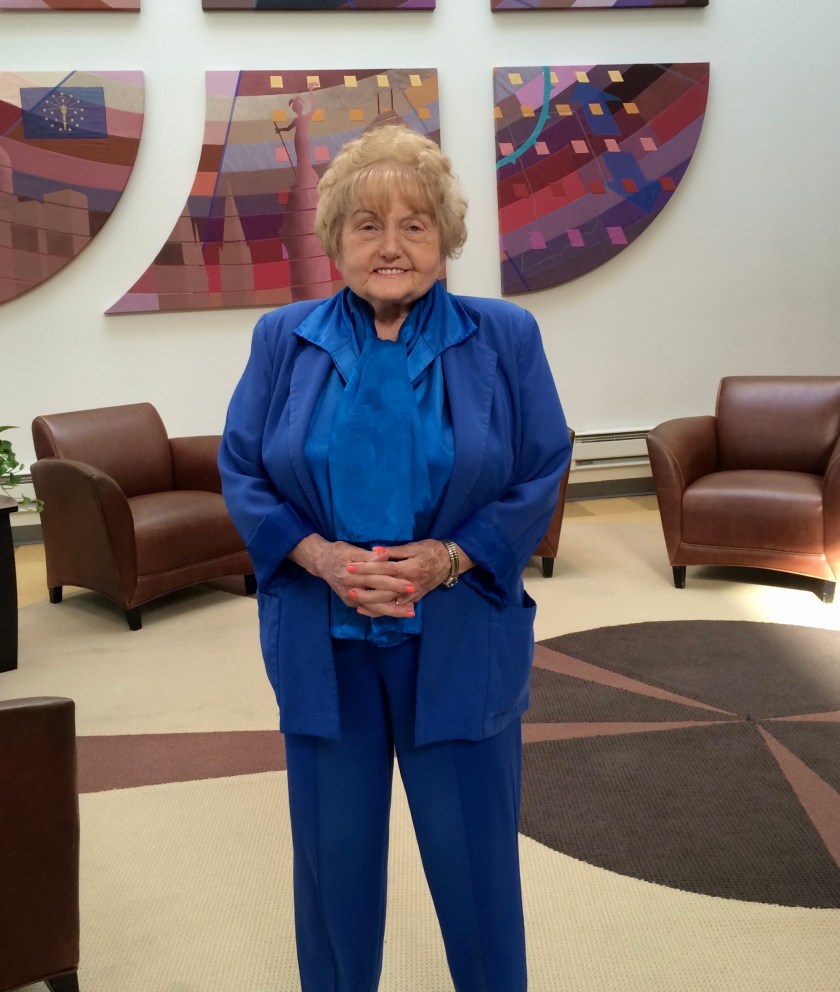
In the fall of 2006, Eva Mozes Kor, Holocaust survivor and Mengele twin, received an unexpected invitation that would set her on a new path in her journey to advocate for forgiveness as a human right. Dr. Joan Lescinski, president of Saint Mary-of-the-Woods College in Terre Haute, Indiana, invited Eva to a private lunch. Eva, ever curious, arrived dressed in her favorite bright blue suit, eager to learn more. Little did she know, this would be the beginning of an incredible journey, one that would shape not only her legacy but also the conversation around emotional healing and forgiveness on a global scale.
A Life-Changing Invitation
As Eva stepped onto the campus, the vibrant fall colors of the trees created a beautiful backdrop for the day ahead. Dr. Lescinski explained that the board of directors had voted to honor Eva with an honorary doctorate for her work in forgiveness and had chosen her to be the commencement speaker in May 2008. It was a rare and deeply meaningful recognition, one that both humbled and surprised Eva, knowing the weight of the responsibility that lay ahead of her.
But this honor would not come quickly. The process took almost a year and a half to prepare. During this time, Eva decided to dive deeper into the Universal Declaration of Human Rights (UDHR), especially since the declaration did not address the emotional pain inflicted on survivors and victims of atrocities.
The Idea of an Addendum
Eva, alongside Kiel Majewski, researched the UDHR and realized that while the declaration addressed the physical and civil rights of individuals, it failed to address the emotional trauma that people, especially victims of genocide, carry for most of their lives. This led Eva to propose an addendum to the UDHR, one that would acknowledge the human right to live free of emotional pain inflicted by others and by life itself.
A Legacy of Resilience: Saint Mother Theodore Guerin
As Eva prepared for her speech, she reflected on the perseverance and strength of those who built the foundation of the institution she was addressing. One such person was Saint Mother Theodore Guerin, the founder of Saint Mary-of-the-Woods College. Guerin’s own journey, filled with adversity and relentless determination, resonated deeply with Eva.
Saint Mother Theodore Guerin, a French nun, traveled across the Atlantic Ocean in 1840 to establish what would later become Saint Mary-of-the-Woods College in Terre Haute, Indiana. She was part of a group of Sisters of Providence sent by the Superior General of the Congregation of the Sisters of Providence in France to open a mission in the United States.
She and her fellow sisters arrived in the United States at a time when the country was still relatively young, and the area around Terre Haute was largely undeveloped. Despite facing numerous challenges, including language barriers, limited resources, and harsh conditions, Mother Theodore Guerin persevered and founded the college in 1840. Her vision and determination to provide education for women in the midwestern United States became a reality, and Saint Mary-of-the-Woods College was established.
Eva often reflected on how one person’s determination could spark lasting change. Guerin’s commitment to education, even in the face of hardship, was the very kind of perseverance Eva hoped to embody in her own work. As Guerin had never given up on her dream, Eva refused to give up on her vision for a world where emotional healing was recognized as a fundamental human right.
Eva’s Commencement Speech
In May 2008, Eva arrived at the commencement ceremony, accompanied by her son Dr. Alex Kor and her husband, Marius Kor (“Mickey”). The ceremony felt like another survival test, but Eva was resolute. She stood before the graduates, faculty, and board members, prepared to speak from her heart.
During her speech, Eva took a moment to reflect on her past, on the unimaginable horrors she endured as a ten-year-old girl in Auschwitz. Separated from her parents and two older sisters, Eva, along with her twin sister Miriam, was thrust into an environment of unspeakable cruelty. She shared the vivid memories of being shoved into filthy, overcrowded barracks, deprived of food, and subjected to the terrifying medical experiments led by Dr. Josef Mengele. But she also spoke of her defiance, the way she managed to survive after Mengele’s chilling prediction that she would be dead within two weeks following his lethal injection. Against all odds, Eva lived, and in the process, she learned the profound strength that kept her going (Kor, Surviving the Angel of Death).
Below is an excerpt from her speech:
You have come a long way, and so have I. Sixty four years ago at this time, I was a ten-year-old little girl, huddled with my twin sister, Miriam, in our filthy bunk beds crawling with lice and rats. We were starved for food, starved for human kindness, and starved for the love of the mothers and fathers we once had. We did know then that there was a United States of America. But I knew nothing about the state of Indiana, Terre Haute, Indiana, Saint-Mary-of-the-Woods-College, nor did I dream of receiving an honorary doctorate. In those days I dreamed of food and freedom, so all my energies focused on living one more day and surviving one more experiment [. . .] We arrived in Auschwitz in the Spring of 1944. Within 30 minutes we were ripped apart from my parents and two older sisters. Only my twin sister and I survived Auschwitz. I defied Mengele who said that I would be dead in two weeks after he injected me with a deadly germ, I defied Auschwitz, a factory of death, because I never gave up on myself nor on my dreams.
As she spoke to the graduates, she drew a powerful parallel between her survival and their own journeys. She reminded them that, like herself, they had persevered through challenges. The graduates had worked hard, faced their own struggles, and overcome personal obstacles to reach this moment of triumph. Eva’s words connected their achievements in the classroom to her own perseverance in the face of unspeakable violence. Both, she emphasized, were the result of relentless strength, the kind of resilience that endures and thrives even in the face of overwhelming adversity.
The Power of Forgiveness
Eva then shared a life lesson that she held dear: “Forgive your worst enemy, and forgive everybody who has hurt you. It will heal your soul and set you free.” Her journey to forgiveness, which began on January 27, 1995, was pivotal not only in her own healing but in her advocacy for others to release emotional pain through forgiveness (Kor, CANDLES Foundation).
As part of her speech, Eva called upon the students, faculty, and staff at Saint Mary-of-the-Woods College to sign an addendum to the UDHR, which would advocate for the right to emotional healing through forgiveness. This proposed addendum would be sent to the United Nations, the President of the United States, and the Helsinki Human Rights Commission. Eva felt confident that Saint Mother Theodore Guerin, the founder of the college, was smiling down in approval of this effort.
The Addendum to the Universal Declaration of Human Rights
Eva’s proposed addendum stated the following:
- Right to Freedom from Emotional Pain: Every person has the human right to live free from the emotional pain and burden imposed by others, society, or life itself.
- Forgiveness as a Path to Freedom: Forgiveness is a viable option for achieving that freedom and the human right to emotional well-being.
- Personal and Universal: Forgiveness is a personal act of self-healing, a right that every person must claim for themselves. Each person has the right to forgive in their own time and on their own terms.
- The Power of the Addendum: This addendum would serve as a beacon for anyone who has endured pain, offering them the right to transcend their suffering by choosing forgiveness.
Conclusion: A Call for Healing
As the panel of faculty and students signed the addendum, Eva felt a sense of hope. It was not just a symbolic gesture; it was a call to action for everyone who has suffered. Eva’s speech was not only about her own personal forgiveness but also about empowering others to take control of their emotional freedom.
“I did not want to carry the burden of hatred with me. I wanted to live and not just survive.” – Eva Mozes Kor
The event and the addendum were a culmination of Eva’s belief that emotional healing, through the act of forgiveness, was just as vital as any civil or political right. She challenged everyone to embrace forgiveness, not only to heal themselves but to contribute to a world that acknowledges the emotional scars we carry and the universal right to find peace.
- Kiel Majewski worked as the Director of Research at the CANDLES Holocaust Museum and Education Center. His role involved conducting research related to the Holocaust, specifically focusing on the Mengele Twins and other aspects of the museum’s mission.
© Jill Szoo Wilson, 2025
Further Reading
- Arendt, Hannah. The Human Condition. University of Chicago Press, 1958.
- Guerin, Mother Theodore. Journals and Letters. Sisters of Providence of Saint Mary-of-the-Woods, 1996.
- Kor, Eva Mozes, with Lisa Rojany Buccieri. Surviving the Angel of Death: The Story of a Mengele Twin in Auschwitz. Tanglewood, 2009.
- Kor, Eva Mozes. Echoes from Auschwitz: Dr. Mengele’s Twins. CANDLES, 2000.
- United Nations. Universal Declaration of Human Rights. United Nations, 1948.
 Jill Szoo Wilson