
By Jill Szoo Wilson
Author’s Note:
This is not an essay about forgiveness. I have written about Eva Mozes Kor, Holocaust survivor and forgiveness advocate, for years because I deeply respect her message. I honor her legacy here while condemning antisemitic violence without qualification and calling Christians to action in the present moment. Nothing in this piece is meant to soften, spiritualize, or diminish the reality of antisemitism today.
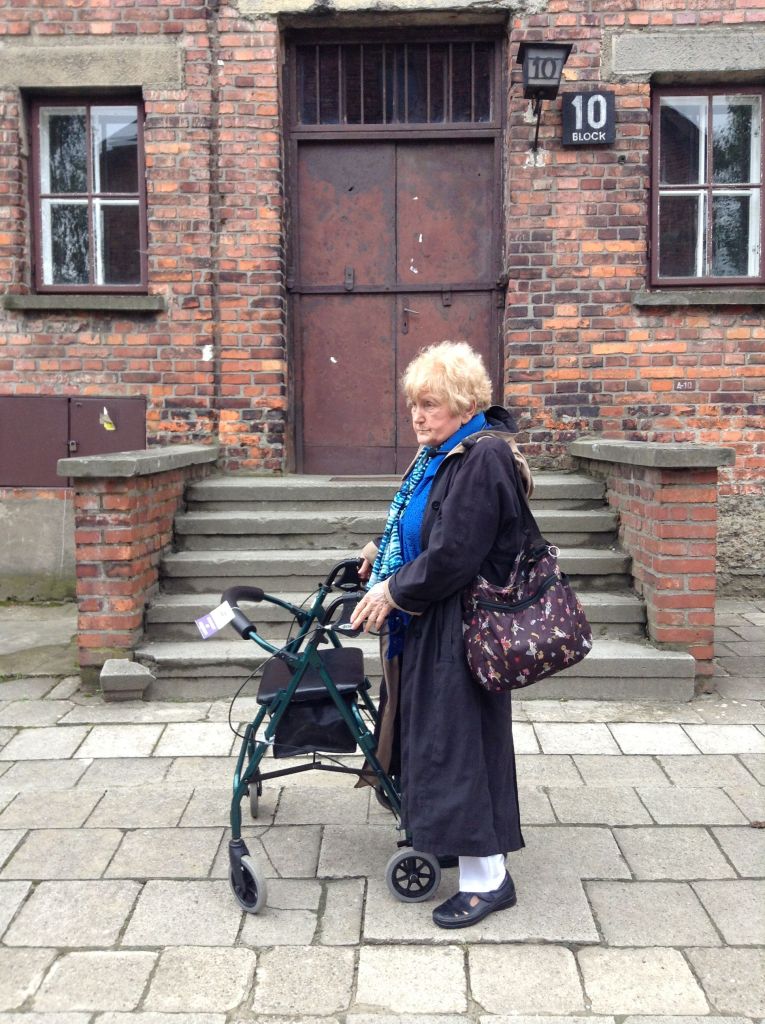
Nearly seventy years after the Holocaust, Eva Mozes Kor still looked at the world and saw a painful truth: antisemitism had not disappeared. The lessons of history, no matter how horrific, were not enough to prevent hatred from resurfacing. As a survivor of Auschwitz and a Mengele Twin, she carried both the burden of memory and the wisdom of experience. She often asked a simple but haunting question: What has changed since Auschwitz?
Eva often spoke about how Adolf Hitler rose to power not as an anomaly, but through a series of orchestrated events designed to achieve a singular goal, the extermination of the Jewish people and the establishment of an Aryan-dominated society. Hitler and his regime promoted the belief in Aryan racial superiority, claiming that Germans of “pure” Nordic descent were destined to rule over other groups they labeled as inferior. These ideas, rooted in eugenics and extreme nationalism, fueled policies that targeted Jews, Romani people, disabled individuals, Slavs, and others deemed unfit for their vision of a racially “pure” society. This ideology was systematically enforced through propaganda, education, and legislation, including the Nuremberg Race Laws of 1935.
The Nuremberg Race Laws consisted of two primary statutes:
The Reich Citizenship Law: This law declared that only individuals of German or related blood were eligible to be Reich citizens, effectively revoking Jews’ rights as citizens. It stated: A Reich citizen is a subject of the state who is of German or related blood, and proves by his conduct that he is willing and fit to faithfully serve the German people and Reich. (Source)
The Law for the Protection of German Blood and German Honor: This law prohibited marriages and extramarital relations between Jews and citizens of German or related blood, aiming to preserve the “purity” of German blood. It also forbade Jews from employing German females under 45 years of age in their households. (Source)
Germany, one of the most advanced and cultured societies of its time, fell under the influence of a leader who manipulated public fears and desires, offering promises of restoration and prosperity in exchange for obedience. Step by step, ordinary citizens became participants in a deadly machine, one that required gradual compromises until they found themselves complicit in atrocities. This transformation is hauntingly explored in the book Ordinary Men, which details how average individuals became executioners not out of inherent evil, but by following orders, rationalizing their actions, and failing to resist the system that consumed them.
Eva witnessed this transformation firsthand and spent decades ensuring people understood how easily it could happen again. She often emphasized that Hitler’s rise was not inevitable, nor was it the result of a single event. It was a gradual process, shaped by economic hardship, propaganda, and the willingness of ordinary people to accept small injustices until they became monstrous realities.
Five Factors That Allowed Hitler to Rise to Power
The Holocaust was not an accident of history. It was the result of a carefully constructed plan, built on a foundation of economic despair, propaganda, and the gradual erosion of moral resistance.
Economic Devastation: Germany faced severe unemployment, with rates soaring to 30 percent in the early 1930s. This economic turmoil created fertile ground for extremist ideologies. (encyclopedia.ushmm.org)
Scapegoating the Jews: The Nazi regime capitalized on existing antisemitic sentiments, blaming Jews for Germany’s economic and social woes and uniting the populace against a common, innocent enemy. (encyclopedia.ushmm.org)
Propaganda and Control: Through relentless propaganda, the Nazis dehumanized Jews, portraying them as subversive and dangerous, which facilitated public acceptance of discriminatory laws and actions. (encyclopedia.ushmm.org)
Apathy and Inaction: Many Germans and international observers remained passive or indifferent as antisemitic policies escalated, allowing hatred to fester unchallenged.
The Allure of Power: Hitler’s strategic political maneuvers, including exploiting democratic processes, enabled him to consolidate power and implement his radical agenda.
These historical conditions are not confined to the past. Alarmingly, antisemitism has seen a resurgence in recent years. A 2024 report highlighted a 340 percent increase in global antisemitic incidents compared to 2022. (timesofisrael.com) Furthermore, a 2025 Anti-Defamation League survey revealed that 46 percent of adults worldwide harbor significant antisemitic beliefs. (adl.org)
Despite comprising a small fraction of the global population, approximately 15 million Jews worldwide, many continue to advocate for oppressed communities, even when it entails personal risk. Eva marveled at this enduring commitment to justice and empathy.
The Ultimate Power: Forgiveness
Eva often said, “Anger is a seed for war, forgiveness is a seed for peace.” To her, forgiveness was never about excusing harm. It was about breaking the cycle of hatred.
Forgiveness does not take place on the battlefield. It is not something that happens in the midst of conflict, nor does it excuse or prevent the necessity of justice. Forgiveness comes later, when the dust has settled and when the victim is free to reclaim their own power. It is not about surrender. It is about refusing to let the past dictate the future.
While Eva never shied away from confronting the past, she was equally passionate about what came next. She believed that dwelling in anger, no matter how justified, only gave power to those who inflicted harm. “Forgiveness,” she said, “is the only power a victim has to heal, liberate, and reclaim their life.”
Eva was careful to say, “I forgive in my name only.” She never claimed to speak for other survivors, nor did she suggest that forgiveness was a requirement for healing.
Eva Mozes Kor often emphasized this declaration, reflecting both her personal journey and a deep respect for Jewish principles regarding forgiveness. In Jewish tradition, forgiveness, or mechila, is a profound process that hinges on sincere repentance from the wrongdoer. Maimonides, a preeminent Jewish scholar, outlined that true repentance (teshuva) involves the offender’s acknowledgment of wrongdoing, genuine remorse, and a committed effort to rectify the harm caused. Only after these steps is the victim encouraged to offer forgiveness.
This framework underscores that forgiveness cannot be granted on behalf of others. It is an intimate act between the victim and the penitent. In the context of the Holocaust, where six million Jews were murdered without any expression of remorse from the perpetrators, the notion of forgiveness becomes even more complex. Jewish law maintains that offenses against an individual require that individual’s forgiveness, making it impossible for survivors to forgive on behalf of those who perished. (utppublishing.com)
Eva’s careful articulation, that her forgiveness was solely her own, respected this principle. She did not presume to speak for other survivors or the deceased. Her act of forgiveness was a personal liberation, a means to free herself from the grip of anger and victimhood, without contravening the collective memory and enduring grief of the Jewish community. (candlesholocaustmuseum.org)
This distinction highlights the delicate balance between individual healing and communal responsibility. While Eva chose forgiveness as her path to peace, she acknowledged that such a choice is deeply personal and may not be appropriate or possible for others, especially when traditional avenues for repentance and atonement are absent.
Forgiveness, in her view, had nothing to do with the perpetrator. It did not condone, excuse, or endorse their actions. It was not about justice. It was about reclaiming control over one’s own life. “I call forgiveness the best revenge,” Eva said, “because once we forgive, the perpetrator no longer has any power over us, and our forgiveness overrides all their evil deeds.”
This idea was radical and not always welcomed. Many survivors could not accept it, and for good reason. Even outside the context of the Holocaust, many struggle with the idea that forgiveness does not mean forgetting or allowing injustice to continue. For Eva, forgiveness was deeply personal. It was about reclaiming power, not about absolving the guilty. But within Jewish tradition, memory itself is sacred: to remember is to bear witness, to demand justice, and to ensure that history does not repeat itself.
Am Yisrael Chai: The People of Israel Live
Throughout history, the Jewish people have faced oppression, displacement, and genocide, yet they have endured. The phrase Am Yisrael Chai, meaning “The People of Israel Live,” is more than just words. It is a declaration of survival, resilience, and hope. It is an anthem of defiance against those who have sought to erase Jewish existence and a testament to the enduring strength of a people who refuse to be defined by their suffering.
This phrase has been spoken in times of both devastation and triumph. During the Holocaust, Jews whispered it in ghettos and concentration camps, affirming that even in the darkest of times, their spirit remained unbroken. In the aftermath of World War II, it became a rallying cry for survivors who rebuilt their lives, many of whom found refuge in the newly established State of Israel in 1948.
Today, Am Yisrael Chai continues to hold deep significance. It is proclaimed at Holocaust memorials, sung in celebrations, and carried forward as a reminder that survival is not just about existing. It is about thriving, growing, and refusing to let history repeat itself. In the face of rising antisemitism, the phrase remains an unshakable affirmation that the Jewish people will continue to live, to contribute, and to stand up for justice, not only for themselves but for all who face oppression.
Remembering is an act of justice. It ensures that the past is neither erased nor repeated. Forgiveness, when chosen, does not diminish remembrance. It follows it. It does not mean forgetting, nor does it replace accountability. Instead, it allows individuals to reclaim the power to shape their own future, free from the weight of bitterness.
We’re on the Battlefield Again
We are on the battlefield again.
Now is the time to fight back. Antisemitism did not end with the Holocaust. It did not disappear with memory or education or vows of “never again.” It has returned openly and violently, and it is targeting Jewish people simply for existing. This is not abstract. It is not theoretical. It is happening now. Those of us who are not Jewish do not get to watch from the sidelines. I serve the God of Israel, the God of Abraham, Isaac, and Jacob, and I will stand with my Jewish brothers and sisters until the bitter end, or as long as God allows breath in my body. Silence is no longer neutral. To remain quiet is to abandon them on the battlefield.
Recent Antisemitic Attacks (2023–2025)
Below is a concise, verifiable list of documented incidents illustrating the resurgence of antisemitic violence and hate in recent years:
• Bondi Beach Hanukkah Shooting (Dec 14, 2025):
Gunmen opened fire during a Jewish “Chanukah by the Sea” event in Sydney, Australia, killing at least 11 and injuring dozens in what officials condemned as an antisemitic terrorist attack targeting Jews during a holiday celebration. (AP News)
• Timeline of Australian Antisemitic Incidents (2023–2025):
Jewish communities in Australia faced multiple threats including synagogue arsons, graffiti, and escalating antisemitic violence leading up to the Bondi incident. (The Forward)
• Manchester Synagogue Attack (Oct 2, 2025):
A vehicle and stabbing attack at the Heaton Park Hebrew Congregation in Manchester, England, resulted in three deaths and several injuries, confirmed by police as a terrorist targeting of Jews. (Wikipedia)
• Antisemitism Surge Worldwide (Post–Oct 7, 2023):
Global reports documented thousands of antisemitic incidents worldwide, including threats, harassment, and violent attacks in many countries, since the escalation of the Gaza conflict. (Combat Antisemitism Movement)
• Synagogue and Community Vandalism (2023–2024):
Multiple bomb threats, arson, and intimidation against synagogues were reported in Australia and elsewhere, part of a broader pattern of anti-Jewish hate following geopolitical tensions. (Wikipedia)
• Antisemitic Incidents in the UK (2023–2024):
The Community Security Trust documented thousands of antisemitic incidents in the UK, marking sustained high levels of anti-Jewish hate in recent years. (CST)
• Antisemitic Acts in the U.S. (2024):
The Anti-Defamation League’s audit reported record-high antisemitic incidents in the U.S., including harassment, threats, and violent acts occurring across all 50 states. (Congress.gov)
• Berlin Holocaust Memorial Stabbing (Feb 21, 2025):
A man attacked a person at the Holocaust Memorial in Berlin with a knife, injuring the victim in an incident with an antisemitic motive, according to police and press reporting. (Wikipedia)
Christians, What Will You Do?
For Christians, the connection between the God of Israel and the Christian faith is not symbolic, philosophical, or historical alone. It is covenantal and continuous. The God Christians worship is the same God who revealed Himself to Abraham, Isaac, and Jacob, who said, “I will establish my covenant between me and you and your offspring after you throughout their generations for an everlasting covenant” (Genesis 17:7). Scripture never records that covenant being revoked.
As Joel Richardson, a Christian author, Bible teacher, and filmmaker whose work focuses on biblical prophecy and God’s enduring covenant with Israel, has taught repeatedly, Christianity does not represent a departure from Israel’s story but its unfolding. The New Testament itself insists on this continuity. Paul writes that Gentile believers are not the root but the branches, grafted into a tree they did not plant, sustained by promises they did not originate (Romans 11:17–18). The Church, according to Scripture, does not replace Israel. It depends on her.
John Harrigan, a Christian writer and filmmaker who has examined the theological roots of Christian antisemitism, including through the documentary Covenant and Controversy, has argued that Christian antisemitism is not merely moral failure but theological collapse. Scripture bears this out. To sever Jesus from His Jewish identity is to sever Him from His genealogy, His Scriptures, and His covenantal mission. Jesus did not erase Israel’s story. He entered it. “Salvation is from the Jews,” He said plainly (John 4:22). The apostles did not preach a new God, but the fulfillment of what had already been spoken “by the mouth of all the prophets” (Acts 3:18).
Christianity does not make sense apart from Israel. The Messiah Christians proclaim was Jewish. The Scriptures they read were entrusted first to Jewish hands (Romans 3:2). The covenant they appeal to was never revoked. Paul is unequivocal: “The gifts and the calling of God are irrevocable” (Romans 11:29). Any theology that distances itself from Jewish suffering, or treats the Jewish people as spiritually obsolete, stands in direct contradiction to the very text it claims to honor.
This is why the present moment is vital. Scripture does not allow Christians to retreat into abstraction when the people of Israel are targeted. The call is older and clearer than modern politics: “I will bless those who bless you, and whoever curses you I will curse” (Genesis 12:3). Silence, in this light, is not neutrality. It is a theological choice.
Standing with the Jewish people is faithfulness to the God Christians claim to serve. It is obedience to Scripture. The God who keeps covenant does not abandon His people, and those who bear His name are called to stand with them.
So the question is no longer theoretical.
Where do you stand?
 Jill Szoo Wilson