2026: Cultural Divides, Covenant, and Coffee

While 2025 has been marked by dramatically shifting plates under the surface of humanity, it has also been a time of growth, resilience, and gratitude.

Every morning, my husband prepares my coffee. It doesn’t matter what time I wake up, whether we share a similar schedule, or when he goes to bed after coming home late from rehearsal or a work engagement. Each morning, it is my privilege to walk into the kitchen, whose counter is fully lit with whatever sunlight the day is offering, a small gaggle of houseplants, my favorite coffee mug, and a French press cleaned and poised for boiling water.

This might seem like a little thing. But when you consider the aforementioned shifting plates, this morning routine is a respite filled with consistency and love. Little things are where life is lived.

This is the year I went back to teaching after enduring the most tumultuous four years of my life. The time between the summer of 2020 and the summer of 2024 taught me more about who I am than I had learned in the previous forty-something years. Anything good in me was a result of God’s grace, the beautiful kindness of those He placed in my life, and an enduring seed of the Word planted and watered over years of joy, hardship, victories, and defeats. In other words, I learned that I am far more limited than I once realized and far more equipped to handle the slings and arrows of this life than I deserve to be. As Paul reminds us, it is by grace that any of us go forward at all.

God’s love. God’s provision. The fruit of the Holy Spirit. These are life itself. And everything else in this life becomes mercy in His hands, through which we learn how to trust, laugh, cry, hold, and let go. This life is a journey in which we begin to recognize the absolute goodness of God and learn to look forward to the age to come.

So, teaching.

In 2025, I returned to teaching theatre and communication. I won’t write in detail about that topic here, because I’ve been writing about it quite a bit lately. What I will say is this: the best thing about teaching, for me, is that I get to sit with young people, find out who they are, how I can serve them, and where I can help them grow. Not only toward learning or career goals, but toward becoming the best version of themselves.

My entire teaching career has been one of planting seeds. I’ve never once had the same student twice. Because I’ve taught foundational courses like Introduction to Theatre, Public Speaking, Foundations of Communication, and Theatre History, I tend to see students in class during their earliest semesters and then see them in the halls for the next two to four years. It’s rare that I get to see the fruit of my own labor, but those moments do come. When they do, they are a gift. Either way, because my work has been to plant seeds, I’ve learned to quickly see how I can best serve whoever is in front of me and make the best of our time together. I count this a blessing, and a great deal of fun.

These past two years were also significant because this is when my husband and I went through the Book of Revelation in its entirety. It took us one year to read and study it, and another to sit with the implications of the revelation of Jesus for our lives yesterday, today, and forever. I have a feeling this is what I will be writing about for much of 2026. For now, I will simply say this: there is nothing more important in life than studying the Word of God, putting our faith in Him, obeying His Word, and trusting in the finished work of Christ on the cross, His resurrection, and the fulfillment of God’s covenant promises to Abraham, Isaac, and Jacob in Christ. These promises are not only future hopes. They are realities already unfolding now and finding their full completion in the age to come. Understanding that changed how I read the whole of Scripture.

God has always related to His people through covenant. From the beginning, He bound Himself to humanity with promises He alone would keep. He made a covenant with Abraham, promising blessing, land, and descendants, and declaring that through Abraham’s family all nations would be blessed. That covenant was carried forward through Isaac and Jacob and entrusted to the Jewish people, through whom God revealed His law, His faithfulness, and His name to the world. Jesus did not replace this covenant. He fulfilled it. In Him, the promises of God find their “yes.” Those who belong to Christ are grafted into this story, not as replacements, but as recipients of mercy, heirs by grace. The covenant God made with Israel is not erased by Christ, and the mercy extended to the nations does not diminish it. This covenant is not only about where history is going. It shapes how we live now, grounded in faithfulness rather than fear, held by a God who keeps His word.

This was the year I came to more fully understand the history of my own faith. Not fully, of course, but enough to give me context for God’s plan, His story of redemption, and His magnificent love. It was the year I stopped placing myself in the stories of the Bible and began to recognize, by the power of the Holy Spirit, that the entire Word of God is His story. It is filled with types and shadows of the Messiah, with good and evil, and with the absolute miracle that you or I get to be part of His story at all.

This was the year I learned, once and for all, that I need to be on His side. God is holy, and there is no possible way I can earn my way into His presence. Jesus came to this earth as the perfect sacrifice to a holy God, and it is only through Him that I can approach the Father. Through Christ, I am made clean. When God the Father sees me now, He sees His Son. There is nothing I could have done to earn His favor. Christ is the hope of glory.

This is the year I began to understand God as my Father. Because my earthly father disappeared when I was one year old, this has long been the aspect of God I struggled to trust. Not because I didn’t want to or didn’t believe He deserved my trust, but because I didn’t know how. God has been patient with me. I can now see that He has allowed certain storms in my life for a specific reason: so that I would humble myself and cry out, “Help me, Father.” There is a vulnerability only a daughter can feel and a kind of help and safety only a Father can provide. I trust my heavenly Father.

The world grew frightening this year, didn’t it? The political climate and our general sense of safety have been eroding. People are being killed for their faith. Riots fill the streets. Traditions are canceled because people are afraid to gather. Glowing screens in every household carry the noise of the world into our lives.

It is frightening.

But God.

There is a peace that surpasses all understanding, and it comes from one source alone. This year, by His will and for His glory, my resolution is to speak more about Him and to learn and teach about Him, His sacrifice on the cross, why it matters now, and why it is the only thing that will matter in the age to come.

So, 2026. Cultural divides, covenant, controversy, and coffee. What an adventure!
Fear is Inevitable. Courage is a Choice.

By Jill Szoo Wilson

“The sad truth is that most evil is done by people who never make up their minds to be good or evil.” — Hannah Arendt

In the summer of 1942, Reserve Police Battalion 101 assembled outside the village of Józefów in Nazi-occupied Poland. The men who stood in formation were not professional soldiers. Only months earlier, they had been running hardware shops, repairing trucks, keeping business accounts, and returning home to their families each evening. They were fathers and neighbors, men in their thirties and forties who had aged out of frontline service before the war began. Their conscription into a reserve police unit had interrupted ordinary routines, not fulfilled ambitions for combat.

Major Wilhelm Trapp, their commander, stepped before them. Witnesses later described him as unsettled, his face unusually pale. He spoke without military rhetoric or ideological preface. The battalion, he said, would enter Józefów and collect its Jewish residents. They were to remove people from their homes: women, children, the elderly, and the sick. The residents would then be taken to the nearby forest, where the battalion would carry out “necessary measures.”

Only after giving these instructions did Trapp add a final detail that stands out in the historical record. Any man who felt unable to participate could step out of formation without punishment.

The battalion remained still. No one protested or sought clarification. After a moment, a few men stepped out of line, then a few more. In all, out of nearly five hundred, only twelve removed themselves from the formation.

The rest marched toward Józefów.

How should we account for the decision of so many men drawn from familiar routines to stay in formation without protest?

Scholars have focused on this moment because it disrupts familiar explanations for how violence begins. Reserve Police Battalion 101 was not composed of ideologues or trained executioners, but of ordinary men whose lives had previously consisted of work, family, and routine. Their choice to remain in formation cannot be explained primarily by coercion or conviction. Most stood still not because they wanted to exact harm, but because they did not want to stand apart, be seen refusing, or face the uncertainty of acting alone. Therefore, the residents of Józefów were not killed by men set apart as specialists in violence, but by neighbors who failed to refuse when refusal was still possible. In this context, participation arose less from intent than from hesitation. The killing did not require their belief, only their compliance.

What happened in Józefów suggests that violence can advance not only through conviction, but through the avoidance of refusal and the desire to remain safely within the group. Harm is sustained when no one interrupts it.

What happened outside Józefów reveals a pattern that extends far beyond wartime and history. Once obedience becomes the easiest way forward, responsibility begins to feel negotiable, something that can be handed off to whoever stands above us or beside us. People rarely wake up intending to harm others; they drift into it when the cost of refusal feels heavier than the cost of compliance.

Decades after the war, a psychologist named Stanley Milgram invited ordinary adults into a small laboratory at Yale University. He told them they were there to help with a study on memory. A mild-mannered man in a gray lab coat instructed them to administer electric shocks to a stranger in the next room if the stranger answered questions incorrectly. The shocks were fake, but the participants did not know that. Immediately following their press of the button, they heard screams, protests, and pounding on the wall. Many feared they were seriously hurting someone. A few protested, a few tried to stop, several shook or wept, but most continued when the man in the lab coat reassured them that the responsibility was his own. Their distress did not prevent their obedience. Being told they were “not the ones in charge” became a relief.

A few years later, another researcher, Philip Zimbardo, converted the basement of Stanford’s psychology building into a mock prison. Volunteers were assigned roles: some became “guards,” others “prisoners.” The assignment came with no training, no ideology, and no instruction to be harsh. The guards were merely told to maintain order.

At first, the volunteers treated their roles loosely. Some joked, others followed the script half-heartedly, unsure how seriously to take the experiment. They carried traces of their everyday lives with them: the habits of students, sons, and roommates. But as the hours passed, their uniforms changed the way they moved. The mirrored sunglasses hid their eyes, and the separation between “guards” and “prisoners” encouraged them to speak with authority. They began to issue commands more sharply. They enforced rules more strictly. What started as playing a role shifted into performance with stakes, and each act of control made the next one easier.

The shift did not arise from hatred or conviction. It unfolded as the guards realized what the role allowed—and chose to use it. No one corrected their tone. No one questioned the rules they invented. Each act of control felt like permission for the next. Within days, they relied on humiliation and psychological pressure, not because they had entered the experiment with cruelty in mind, but because they discovered they could act this way and decided to keep doing it. The situation offered authority without limits, and they stepped into that freedom. Their choices, small at first, accumulated into harm.

Around the same time, a quieter experiment unfolded in a hospital ward. A researcher named Charles Hofling phoned nurses during their shifts, pretending to be a physician giving a prescription. The dosage he ordered violated hospital policy and put the patient at clear risk. The nurses knew this. They hesitated. Yet almost all of them prepared to administer the medication. They were not driven by disregard for the patient or by carelessness. It was the voice on the other end of the phone—authoritative, insistent, claiming responsibility—that tipped the scale. To obey felt safer than to refuse.

The people in these experiments were not sadists or zealots. They were parents, students, nurses, and everyday workers who did not want to cause harm but wanted even less to bear the discomfort of resisting it. They felt anxiety, confusion, even moral distress, yet continued anyway. They were relieved when to believe that the responsibility in their given scenarios did not belong to them. In a forest outside Józefów, this same pattern played out on a scale that cost innocent people their lives.

Cowardice is not the same as fear. Every person feels fear, and it arrives with its own shape, rising from uncertainty, from unanswered questions, from the risks that come with being alive. Fear can warn, protect, or humble us. Cowardice begins only when fear chooses its strategy. It places the cost of one’s actions onto someone else. Instead of carrying the weight of responsibility, it hands that weight to another person and walks away. Cowardice keeps its own reputation polished while letting others absorb its impact. It asks to be understood and excuses itself from being accountable. It allows the consequences of one’s choices to settle on those who cannot escape them.

We often imagine evil as something committed by those who crave it, yet most of the harm in history has been carried out by people who felt uneasy, reluctant, even afraid. The men in Józefów did not wake with murderous desire. They stayed in formation and let someone else decide what their fear would cost. The question Józefów leaves us with is not who among us would choose violence, but who among us would choose the discomfort of refusing it.

“Silence in the face of evil is itself evil.” — Dietrich Bonhoeffer


This piece was originally posted on my Jill Szoo Wilson Substack.

When Fairness Fails: What Forgiveness Teaches Us About Mercy

By Jill Szoo Wilson

Fairness is one of the first moral currencies we learn to spend. Long before we master mercy, we can cry That’s not fair! with the conviction of a tiny philosopher. The playground, after all, doubles as humanity’s first courtroom. Someone cuts in line for the slide, and suddenly the entire social order collapses. Justice must be restored, preferably before recess ends.

A child’s attempt to make sense of harm and hope in miniature is a first draft of moral reasoning. Fairness helps us name wrongs, negotiate rules, and build the fragile beginnings of trust. Civilization, in its earliest form, probably started over a disputed turn on the swings.

Still, fairness only works when everyone plays by the rules. When someone breaks them, what are we supposed to do? As children, we stomp off the field or call for backup—“Mom!” “Teacher!” “Ref!”—someone who can step in and make it right. Those are the early rituals of justice. But what happens when the whistle never blows, or the person who hurt us doesn’t make it right? Some wrongs go deeper than rules. They leave distance where there used to be closeness, even a shift in who we are. Fairness can fix the rules, but it can’t fix the relationship.

What follows are reflections on forgiveness: psychological, scientific, artistic, and theological. Not prescriptions, but explorations. Because fairness is the language of balance, while forgiveness speaks a dialect of grace that refuses translation.

Fairness keeps order; forgiveness keeps us human. While playground quarrels eventually fade, the instinct to keep score doesn’t. We carry it into adulthood, dressed in the language of boundaries, accountability, and justice. We say we’ve “moved on,” but the mind rarely gets the memo. It keeps a ledger even when the heart wants peace. Modern psychology has a name for this: rumination. The ancients simply called it remembering. Either way, forgiveness begins at the border between what we can’t forget and what we no longer wish to carry.

The Psychological View: The Mind and Its Loops

Modern psychology approaches forgiveness as a cognitive and emotional release rather than a strictly moral act. Dr. Everett Worthington, who has spent decades studying the subject, describes two distinct processes: decisional forgiveness, the conscious choice to stop pursuing revenge, and emotional forgiveness, the gradual softening of the heart’s automatic resistance. The two often unfold at different speeds, one emerging from thought and the other from time.

Neuroscience, the study of how the brain and nervous system shape thought, emotion, and behavior, adds another layer to the portrait. When anger is rehearsed, the brain’s limbic system activates as though the offense is still happening. The body does not easily distinguish between a memory and an event; to the nervous system, remembering pain and experiencing it are nearly the same. Each mental replay of the story re-ignites the stress response: the heart quickens, cortisol levels rise, muscles tighten, and breathing shortens. Over time, the brain begins to associate safety itself with vigilance. The mind learns that to stay alert is to stay alive.

Forgiveness, then, becomes a kind of neurological retraining. It is a deliberate effort to interrupt the loop that binds pain to identity. In clinical practice, therapists often describe forgiveness as the gradual release of hypervigilance rather than an act of forgetting. The goal is to remember without reliving. Through reframing, deep breathing, prayer, or contemplative awareness, the body learns that danger has passed. The nervous system, once tuned to defense, begins to trust again. The mind, which has carried the story of pain like a live wire, slowly cools, allowing space for calm to return.

Still, even within psychology, forgiveness remains mysterious because it straddles intellect and intuition. It can’t be forced, and it doesn’t appear on command. Readiness comes casually, more like the slow shifting of light across a room than a sudden change of weather. It arrives when the cost of carrying pain outweighs the fear of setting it down.

The Scientific View: What the Body Knows

The body is a faithful historian. It records what the mind tries to archive, storing unfinished stories in muscle and breath. Emotional pain, left unresolved, weaves itself into posture and heartbeat until it becomes a quiet rhythm beneath awareness. Chronic resentment has been shown to raise cortisol, narrow the arteries, and disrupt the delicate cadence of sleep (Mayo Clinic, 2022). Even anger held in silence leaves its mark: a jaw set for battle, shoulders lifted as if bracing for a blow. Over time, vigilance begins to imitate safety. The body responds to the echo of harm as though the harm were happening again.

Studies from the Stanford Forgiveness Project and the Mayo Clinic confirm what poets suspected long before data caught up: forgiveness is good for your health. In research led by Dr. Frederic Luskin, participants who practiced sustained forgiveness exercises reported lower stress levels, reduced blood pressure, and a greater sense of vitality and purpose (Luskin, 2003). The heart rate steadied. Breathing deepened. The parasympathetic nervous system—the body’s rest-and-repair mechanism—reawakened. When energy is no longer burned in defense, healing begins to rise to the surface like a long-held breath released.

Science often names this moment homeostasis restored: the body’s return to balance after a prolonged alarm. Yet there is poetry in that physiology. As adrenaline recedes, blood flow increases to the prefrontal cortex, the region responsible for empathy, imagination, and moral reasoning (Davidson & McEwen, 2012). Forgiveness, in this sense, literally makes room for thought. The mind, freed from its defensive crouch, can turn toward creation again!

Further studies at Harvard Medical School show that forgiveness lowers the intensity of rumination, which is defined as the mental replay of pain that sustains anxiety and depression (Toussaint et al., 2016). As forgiveness increases, so do emotional regulation, compassion, and self-understanding. The neurochemical shifts that accompany this process—the rise of serotonin, oxytocin, and dopamine—mirror what theology has always known intuitively: peace has a pulse.

The language of biology cannot fully capture mercy’s mystery, but it nods in agreement. The data point and the psalm say the same thing in different tongues: bitterness is exhausting, and peace restores breath.

The Artistic View: What Story Teaches

If science tells us what forgiveness does, art shows us what it feels like. Story, painting, music, and theatre have been charting mercy long before the lab coat came on the scene. The arts, at their best, don’t offer conclusions so much as rehearsals for compassion. They let us practice seeing the world as if we were not the center of it.

Across centuries, artists have returned to the same paradox: that true release begins with recognition, that we must face what wounds us before we can let it go. Before there can be reconciliation, there must be sight. In theatre, we call this “see something, go to it.” A character can’t transform until they look directly at what they most want to avoid, which in fairness, is also true for the rest of us. The moment of seeing becomes the hinge between chaos and calm, the instant when self-defense gives way to understanding.

Shakespeare understood this idea better than most. In The Tempest, Prospero spends years nursing the perfect grudge—a full-bodied vintage of resentment aged on a remote island. When his enemies are finally within reach, however, vengeance no longer satisfies. What changes is not his memory of the wound but his perception of what keeping it costs him. By the end, his forgiveness frees everyone, himself included. Prospero’s great spell isn’t the one that conjures storms; it’s the one that breaks them.

Arthur Miller’s Death of a Salesman tells the same story from the opposite direction. Willy Loman spends his life mistaking performance for love, selling charm as success, rehearsing confidence he does not feel, and measuring worth in applause that never lasts. When the illusion collapses, his son Biff must decide what to do with the disappointment that remains. In the play’s final moments, standing by his father’s grave, Biff says quietly, “He had the wrong dreams. All, all wrong.” It sounds like condemnation, but it’s something closer to release. For the first time, he sees his father not as idol or enemy, but as a man, confused, frightened, and human. That clarity is the beginning of mercy.

Theatre lets us watch this recognition from a safe distance. We sit in the dark, watching someone else wrestle with the same ghosts we have been dodging at home. In that strange alchemy, something shifts. We learn to see both our own flaws and those of the people we love with gentler eyes. Forgiveness, like theatre, depends on presence. It asks us to stay in the light long enough for truth to take shape so we can look at what wounds us until it becomes something we can understand.

Art doesn’t tell us how to forgive; it simply lets us imagine that we could. The gallery, the concert hall, and the stage are all rehearsal rooms for mercy. They remind us, kindly, that we’re all works in progress and that sometimes, the best apology is a story told well enough to make us listen.

The Theological View: When Justice Turns Toward Grace

The story of forgiveness begins in a garden where trust breaks and fear takes its place. When Adam and Eve eat the fruit, they hide among the trees. God’s first response to sin is pursuit, not punishment. “But the Lord God called to the man and said to him, ‘Where are you?’ ” (Genesis 3:9). That question has echoed through every century since. From the beginning, divine justice speaks with the voice of mercy.

By the time Cain and Abel bring their offerings, the seeds of comparison have already taken root. “And the Lord had regard for Abel and his offering, but for Cain and his offering he had no regard” (Genesis 4:4–5). Envy rises, and God speaks again, not with condemnation but with warning and grace: “If you do well, will you not be accepted? And if you do not do well, sin is crouching at the door. Its desire is contrary to you, but you must rule over it” (Genesis 4:7). Yet Cain resists correction. Pride overcomes humility, and the first human family is torn apart. The sin is more than violence; it is the refusal to trust the goodness of God.

That same resistance runs through every generation. Whenever love seems uneven, pride still resists grace. Humanity reaches for fairness when what it needs is mercy. We grow older, but we keep measuring ourselves against others. We call it success or reward, yet beneath it lies the same belief that effort should equal outcome.

In the parable of the prodigal son, Jesus brings this struggle home, where fairness and love collide. The elder brother protests, “Look, these many years I have served you, and I never disobeyed your command, yet you never gave me a young goat, that I might celebrate with my friends” (Luke 15:29). His reasoning is mathematically sound and spiritually hollow. Fairness asks to be recognized; love asks to be shared. The father answers, “It was fitting to celebrate and be glad, for this your brother was dead, and is alive; he was lost, and is found” (Luke 15:32). With that, the ledger burns and the story becomes a feast.

Forgiveness, in this light, is the fulfillment of justice rather than its suspension. On the cross, balance does not return to its old shape; it is made new. Jesus prayed, “Father, forgive them, for they know not what they do” (Luke 23:34). The world’s scales of fairness cannot contain such love. The innocent bears the guilt so that the guilty may live. Through His death and resurrection, a new creation begins: “Therefore, if anyone is in Christ, he is a new creation. The old has passed away; behold, the new has come” (2 Corinthians 5:17).

To forgive is not weakness but obedience to Christ. It is participation in His strength, a living reflection of His mercy. In forgiveness, we join the movement of the Triune God who acts as one—Father, Son, and Holy Spirit—calling, redeeming, and renewing all things. This is the rhythm of redemption, the divine mercy that restores the world.

Across every field, forgiveness reveals its pattern. Psychology traces it in the mind, science measures it in the body, art renders it in story and song, and theology anchors it in the heart of God. Together, they show that forgiveness is not the end of justice but its perfection. It steadies the mind, calms the body, restores imagination, and opens the soul to grace. Fairness seeks balance; forgiveness seeks resurrection. Fairness tallies what was lost; forgiveness restores what can live again.

For more essays by Jill Szoo Wilson, visit my Substack.

Forgiving a Nazi Doctor: Eva Mozes Kor’s Life-Changing Decision

I traveled to Auschwitz, Hungary, and Romania with Holocaust survivor and Mengele Twin Eva Mozes Kor to learn her story so I could write a play about her journey toward forgiveness. I listened as she recounted her experiences, watched how she carried the weight of her past, and witnessed firsthand the strength it took to forgive. Now, I am sharing what I learned in her own words because her voice is not only history. It is a call to action, and it is more important than ever.

Before she ever considered forgiving Dr. Josef Mengele, Eva made the decision to forgive Dr. Hans Münch, a Nazi doctor who had worked at Auschwitz. Unlike other former SS officers, Münch openly acknowledged the existence of the gas chambers and signed a document confirming how they were used. For Eva, his willingness to tell the truth was significant, and she wanted to give him a meaningful gift. That decision led her to write a letter of forgiveness, a choice that changed her life forever.

Searching for the Right Gift

I did not tell anyone about my idea of thanking Dr. Hans Münch, a former Nazi doctor, because I thought people would think I was crazy. How do you thank a Nazi doctor? What kind of gift could possibly be appropriate?

I decided to start at a Hallmark store, hoping that the “Thank You” card section might offer some inspiration. But as I stood there reading card after card, I felt uneasy. I did not want anyone to know what I was looking for. I spent more than two hours searching, and twice the store employees approached me.

“Are you finding what you’re looking for?” one asked.

“Not really,” I replied.

“So what are you looking for? I’d love to help you find it.”

For just a second, I considered telling her. But I knew she would never understand. My search was not normal. Instead, I said, “Thank you for asking, but I cannot tell you,” and I left the store empty-handed.

A Life Lesson in Forgiveness

Even though I could not find a gift that day, I refused to give up. I reminded myself of the life lessons I often shared in my lectures:

  • Never give up on yourself or your dreams. If I could survive Auschwitz without knowing how, then no one should ever give up on their own future.
  • Treat people with respect and fairness, and judge them by their actions, not their past.
  • Forgiveness is a personal power, one that no one can give or take away from you.

For ten months, I thought about what I could give Dr. Münch. Whether I was cooking, cleaning, driving, or doing laundry, the question lingered: how do you thank a Nazi doctor?

Then, in June 1994, the answer came to me. A simple but powerful idea: what if I wrote him a letter of forgiveness?

Immediately, I knew it was the right choice. It was not only a gift for him, it was a revelation for me. I discovered that I had the power to forgive. No one could grant me that power, and no one could take it away. I had spent my life reacting to what others had done to me. Now I was initiating action. I did not need permission. I was not hurting anyone. So why could I not do it?

I was trembling with excitement. For the first time, I felt like I had control, not just over my past but over my present and future. I had spent so many years holding onto pain, sadness, and anger, and now I saw a way to release it.

Writing the Letter

I sat down to write my letter of forgiveness, but it was not easy. At first, I addressed Dr. Münch as an evil monster. But I kept reminding myself of my goal: to reclaim my own power. I wanted to stop feeling like a victim. I wanted to stop yelling at my children out of misplaced anger. I wanted to be free from the weight of my past.

I worked on that letter for four months, revising it whenever I had time between my real estate appointments. I thought about reaching out to other Mengele Twins, but I was afraid they would not understand or might try to talk me out of it. I wanted to disarm my enemies in the most unexpected way, by forgiving them.

A Challenge from My Professor

Once I finished the letter, I could see that my spelling in English was poor. Not wanting to be embarrassed in front of Dr. Münch or anyone else who might read it, I reached out to Dr. Susan Kaufman, my former English professor at Eastern Illinois University. She was excited about my forgiveness ideas and helped me refine the letter, correcting my spelling and working through multiple drafts as I shaped my message.

Then, in her matter-of-fact tone, Dr. Kaufman said, “Eva, it is nice that you are forgiving Dr. Münch, but you really should forgive Dr. Mengele.”

I responded quickly, “This is just a thank-you letter for Dr. Münch!”

She did not listen. “When you get home tonight, pretend that you are talking to Dr. Mengele, telling him that you forgive him, and see how it makes you feel.”

My mind reeled back to Auschwitz. To the man in the crisp SS uniform, standing tall and expressionless as he looked down at me. I was 10 years old, a child, sitting in a makeshift examination room in Block 10. I could not move. Steel rods forced my eyelids open as he poured a burning liquid into my eyes, blinding me with pain. I could not cry, could not blink. All I could do was stare up at him as he conducted his experiment, cold and detached, as if I were nothing more than an insect pinned under glass.

That night, Dr. Kaufman’s challenge would not leave me. I closed my eyes and summoned the image of Dr. Mengele. Then I said aloud:

“You son of a gun, evil monster, Nazi doctor, I forgive you because I have power over you, and you have no power over me.”

And then I felt it. Relief.

For the first time, I was in control. Mengele had dictated so much of my suffering, but in that moment, I took something back. I was not hurting anyone by saying it. I was not rewriting history or erasing the horrors he had committed. But I was stripping him of the power he still had over me.

If I could forgive him, the worst of the worst, then what about the others?

The kids who harassed me for eleven years on Halloween, banging on my door, mocking me, tormenting me.

The Capitol police who grabbed me, tore my rotator cuff, and left me with permanent damage when they arrested me in the Capitol Rotunda on May 6, 1986. All because I stood up and demanded justice, shouting: “Memorial services are not enough. We need an open hearing on Mengele-Gate!”

If I could forgive Mengele, then what power did any of these people have over me?

That was the turning point. I rewrote my forgiveness letter, not just for Dr. Münch, but for every person who had ever hurt me.

A Historic Moment at Auschwitz

On January 27, 1995, I returned to Auschwitz with Dr. Münch. It was the 50th anniversary of the camp’s liberation. I knew other survivors would be there, but I arrived with an unusual group: Dr. Münch, his family, and my own family and friends. I was not worried about his presence; after all, he was there to document the gas chambers and provide historical confirmation of what had happened.

But I underestimated how others would react. My son, Alex, and my friend Mary Wright asked, “What do we do if someone attacks Dr. Münch?” I had not considered that possibility. I expected resistance, maybe even disapproval, but not hostility.

Security at Auschwitz was strict. We were a few minutes late, and they refused to let us in. “Fifty years ago, I was a prisoner here, and they would not let me out,” I told them. “Now, they will not let me in.” Eventually, we were allowed through.

At the ruins of Gas Chamber #2, I read my letter of forgiveness out loud. The words hung in the frozen air. Dr. Münch’s face was unreadable at first, then slowly shifted. He was stunned. Finally, he turned to me and said, simply, “Thank you.”

Throughout the day, he kept trying to walk arm-in-arm with me. I hesitated, wondering how that would look to other survivors. Later in the day, I slipped on the icy road and he caught me before I fell. Suddenly, I was grateful he was close enough to steady me. Not everything is as it appears.

That day, we handed out 400 copies of a press release about the two documents we had created, one related to Dr. Münch’s testimony about the gas chambers at Auschwitz, and one expressing forgiveness. Only six journalists showed up.

The Power of Choice

I have been criticized for my decision to forgive. Some survivors and their families have protested against me, insisting that my forgiveness was an insult to their pain. But when I asked how my choice to forgive hurt them, they could not explain.

The truth is, forgiveness is a personal choice. It is not about excusing evil or forgetting history. It is about reclaiming power over our own lives. It is about refusing to let the past dictate our future.

No one could give me that power. No one could take it away. It was mine, and mine alone, to claim, to use, and to reclaim my own freedom.

© Jill Szoo Wilson, 2025

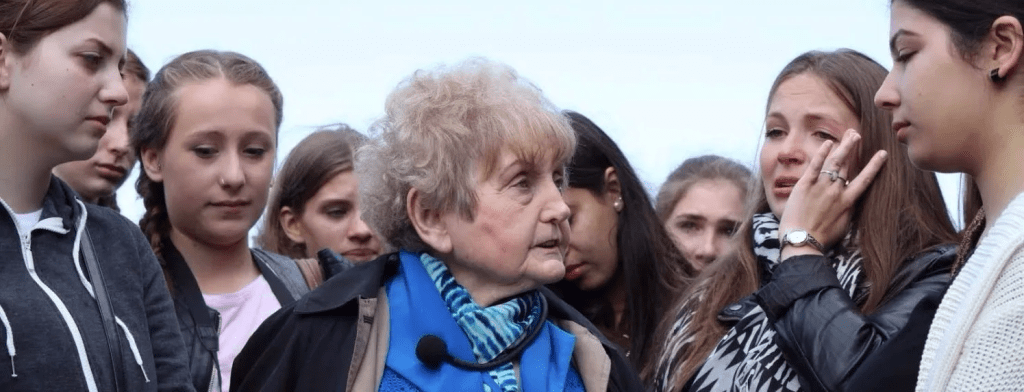
Photo credit: I am not sure who took this particular photo, but I was there when it was taken in 2013. We were standing inside Birkenau on the selection platform, near the cattle car that still stands there today. Eva was speaking to a small group that had gathered around her when this group of young German students stopped to listen from outside the circle. When Eva realized they were German, she invited them into the circle. It was then that the girls began to apologize to Eva on behalf of their ancestors. She told them they did not owe her an apology because they had done absolutely nothing wrong. She encouraged them to simply learn from their mistakes and to be light and love in the world. This was one of my favorite public moments with Eva.

Read more by Jill Szoo Wilson on Substack.

When You Have to Forgive Between 1 and 1,000 Times

The difficult thing about forgiveness is how many times you have to do it.

You know the drill: you write a letter you’ll never send, trek to a place that used to mean something but now just stirs up hurt, and try to reclaim it as a spot you’re still allowed to love. You even hold a makeshift burning ceremony, tossing whatever’s left of what once mattered into the flickering flame of a windblown match—hoping, of course, that this will somehow make it all magically disappear and let you move on.

You call up your friends, your sister, your therapist, and maybe even your pastor—basically anyone who’ll listen—as you try to untangle the emotional mess someone left behind in your soul. Eventually, you convince yourself that you’ve talked it to death, done all the emotional gymnastics to understand, grieve, and accept. You think you’ve untangled the knot, and now—at last—you’re free! The sadness, pain, and the emotional bleed that’s been trickling down the back of your heart for weeks (or was it months? Years?) is all but gone. You’ve forgiven! Or at least, you really, really hope so.

Then one morning, it happens. You’re just going about your business when a song starts playing, and out of nowhere, your brain decides to remount a lavish production bringing the entire drama back from the dead. Or maybe you read a poetic passage that seems like it was written specifically to stir up the pain you thought you’d dealt with. But the most delightful moment? You’re just trying to get ready for the day, doing your makeup, and suddenly you feel that old, uninvited heat creeping up your neck—something the blush can’t hide. It colors your thoughts with a fiery red, and before you know it, you’re back in that moment, imagining all the things you should’ve said, how you could’ve responded, and how maybe—just maybe—you should’ve thrown something through their window. But you didn’t, because you’d already committed to forgiving them. Now you’re left with the regret of not throwing things within a timeframe that would have been appropriate in relation to when that person was a jerk. Missed opportunities, am I right?

So, you missed the chance to throw things. You’ve ridden the high of the moral high ground to its natural end. Now, you’re faced, once more, with a choice: can I forgive them again? Or is this the end of the line for me when it comes to freedom from the jail cell they constructed for me?

Here’s what I think – we often view forgiveness wrongly. We think it’s a choice we make when, really, it’s an attitude of the heart. We think it’s an extending of the hand to a fellow human being, or even a hand over our own hearts, but really it’s a lifting of the hand to God. A lifting of the hand and a bowing of the knee.

Sometimes forgiveness is sitting on a rock at the edge of a trail and remembering that I do not have the power to dissolve my own pain the moment I want it gone. Instead, it’s a prayer, “Lord, here I am again with these memories. Here I am again with a chasm in the center of my softest internal space feeling so angry I can barely hear the birds singing in the trees above my head. I can’t forgive today and I hope you will forgive me for that.

I know that rock well. But I also know God well enough to understand that when I bring my chasm to Him, He breathes water into it. Hear me out: imagine an empty gorge and then imagine it filling with crystal clear water. The depths still exist but God’s mercy grants me the space to swim. To be bouyant even in the midst of the depths below me. He allows me to sit with my pain while also knowing I won’t drown.

Forgiveness is swimming with the memories in your mind while trusting in God’s all-encompassing buoyancy to get you to the other side of the divide. It’s choosing to stop treading water and, instead, turning over on your back to float. To look up at the sky, feel the coolness of the trickles as they ripple below your body, and to whisper, “Well, this hurts but it’s also really beautiful here. God, I trust you.

Nothing is ever just one thing.

Forgiveness can feel scary, daunting, and nearly impossible. It can also be empowering, joyful, and freeing.

One thing it isn’t is easy.

In the next few weeks, I’ll be writing a lot about Holocaust survivor and Mengele Twin, Eva Mozes Kor. Walking with and learning from her gave me a treasure trove of questions and ideas on all kinds of topics. First and foremost, forgiveness. What you’ll see in my writing is that I deeply respected her, loved her, and was ever-amused by her resilient and feisty spirit! You’ll also see that we didn’t always agree on what forgiveness is or how to achieve it, but we always listened, laughed, and learned with one another.

❤️, Jill Szoo Wilson

(Originally posted February 22, 2025)