Fear is Inevitable. Courage is a Choice.

By Jill Szoo Wilson

“The sad truth is that most evil is done by people who never make up their minds to be good or evil.” — Hannah Arendt

In the summer of 1942, Reserve Police Battalion 101 assembled outside the village of Józefów in Nazi-occupied Poland. The men who stood in formation were not professional soldiers. Only months earlier, they had been running hardware shops, repairing trucks, keeping business accounts, and returning home to their families each evening. They were fathers and neighbors, men in their thirties and forties who had aged out of frontline service before the war began. Their conscription into a reserve police unit had interrupted ordinary routines, not fulfilled ambitions for combat.

Major Wilhelm Trapp, their commander, stepped before them. Witnesses later described him as unsettled, his face unusually pale. He spoke without military rhetoric or ideological preface. The battalion, he said, would enter Józefów and collect its Jewish residents. They were to remove people from their homes: women, children, the elderly, and the sick. The residents would then be taken to the nearby forest, where the battalion would carry out “necessary measures.”

Only after giving these instructions did Trapp add a final detail that stands out in the historical record. Any man who felt unable to participate could step out of formation without punishment.

The battalion remained still. No one protested or sought clarification. After a moment, a few men stepped out of line, then a few more. In all, out of nearly five hundred, only twelve removed themselves from the formation.

The rest marched toward Józefów.

How should we account for the decision of so many men drawn from familiar routines to stay in formation without protest?

Scholars have focused on this moment because it disrupts familiar explanations for how violence begins. Reserve Police Battalion 101 was not composed of ideologues or trained executioners, but of ordinary men whose lives had previously consisted of work, family, and routine. Their choice to remain in formation cannot be explained primarily by coercion or conviction. Most stood still not because they wanted to exact harm, but because they did not want to stand apart, be seen refusing, or face the uncertainty of acting alone. Therefore, the residents of Józefów were not killed by men set apart as specialists in violence, but by neighbors who failed to refuse when refusal was still possible. In this context, participation arose less from intent than from hesitation. The killing did not require their belief, only their compliance.

What happened in Józefów suggests that violence can advance not only through conviction, but through the avoidance of refusal and the desire to remain safely within the group. Harm is sustained when no one interrupts it.

What happened outside Józefów reveals a pattern that extends far beyond wartime and history. Once obedience becomes the easiest way forward, responsibility begins to feel negotiable, something that can be handed off to whoever stands above us or beside us. People rarely wake up intending to harm others; they drift into it when the cost of refusal feels heavier than the cost of compliance.

Decades after the war, a psychologist named Stanley Milgram invited ordinary adults into a small laboratory at Yale University. He told them they were there to help with a study on memory. A mild-mannered man in a gray lab coat instructed them to administer electric shocks to a stranger in the next room if the stranger answered questions incorrectly. The shocks were fake, but the participants did not know that. Immediately following their press of the button, they heard screams, protests, and pounding on the wall. Many feared they were seriously hurting someone. A few protested, a few tried to stop, several shook or wept, but most continued when the man in the lab coat reassured them that the responsibility was his own. Their distress did not prevent their obedience. Being told they were “not the ones in charge” became a relief.

A few years later, another researcher, Philip Zimbardo, converted the basement of Stanford’s psychology building into a mock prison. Volunteers were assigned roles: some became “guards,” others “prisoners.” The assignment came with no training, no ideology, and no instruction to be harsh. The guards were merely told to maintain order.

At first, the volunteers treated their roles loosely. Some joked, others followed the script half-heartedly, unsure how seriously to take the experiment. They carried traces of their everyday lives with them: the habits of students, sons, and roommates. But as the hours passed, their uniforms changed the way they moved. The mirrored sunglasses hid their eyes, and the separation between “guards” and “prisoners” encouraged them to speak with authority. They began to issue commands more sharply. They enforced rules more strictly. What started as playing a role shifted into performance with stakes, and each act of control made the next one easier.

The shift did not arise from hatred or conviction. It unfolded as the guards realized what the role allowed—and chose to use it. No one corrected their tone. No one questioned the rules they invented. Each act of control felt like permission for the next. Within days, they relied on humiliation and psychological pressure, not because they had entered the experiment with cruelty in mind, but because they discovered they could act this way and decided to keep doing it. The situation offered authority without limits, and they stepped into that freedom. Their choices, small at first, accumulated into harm.

Around the same time, a quieter experiment unfolded in a hospital ward. A researcher named Charles Hofling phoned nurses during their shifts, pretending to be a physician giving a prescription. The dosage he ordered violated hospital policy and put the patient at clear risk. The nurses knew this. They hesitated. Yet almost all of them prepared to administer the medication. They were not driven by disregard for the patient or by carelessness. It was the voice on the other end of the phone—authoritative, insistent, claiming responsibility—that tipped the scale. To obey felt safer than to refuse.

The people in these experiments were not sadists or zealots. They were parents, students, nurses, and everyday workers who did not want to cause harm but wanted even less to bear the discomfort of resisting it. They felt anxiety, confusion, even moral distress, yet continued anyway. They were relieved when to believe that the responsibility in their given scenarios did not belong to them. In a forest outside Józefów, this same pattern played out on a scale that cost innocent people their lives.

Cowardice is not the same as fear. Every person feels fear, and it arrives with its own shape, rising from uncertainty, from unanswered questions, from the risks that come with being alive. Fear can warn, protect, or humble us. Cowardice begins only when fear chooses its strategy. It places the cost of one’s actions onto someone else. Instead of carrying the weight of responsibility, it hands that weight to another person and walks away. Cowardice keeps its own reputation polished while letting others absorb its impact. It asks to be understood and excuses itself from being accountable. It allows the consequences of one’s choices to settle on those who cannot escape them.

We often imagine evil as something committed by those who crave it, yet most of the harm in history has been carried out by people who felt uneasy, reluctant, even afraid. The men in Józefów did not wake with murderous desire. They stayed in formation and let someone else decide what their fear would cost. The question Józefów leaves us with is not who among us would choose violence, but who among us would choose the discomfort of refusing it.

“Silence in the face of evil is itself evil.” — Dietrich Bonhoeffer


This piece was originally posted on my Jill Szoo Wilson Substack.
Block 10 in Auschwitz

By Jill Szoo Wilson

At the end of our first day in Auschwitz I, after our hour-long bus ride back to the safety of our hotel, after a nourishing dinner shared with friends, after showers and moments of silence and feeling the safety of “the group” wrap around us like a blanket that protects not from cold but fright, we spoke. We questioned. We looked into one another’s eyes for answers that no one had—in this way, there were long stretches of time, like a ticking clock, during which the windows of the souls sharing this journey reflected both confusion and comfort back and forth. Back and forth.

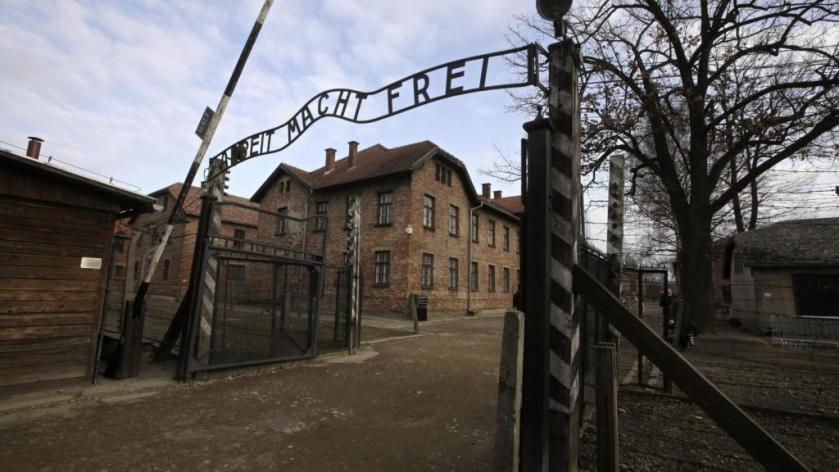
During a discussion in the hotel lobby on this particular night, I felt a shift in our collective journey. At the beginning of the trip, we all understood the events of the Holocaust, some in more detail than others, and we knew the basic story that unfolded under the trees and sky, and over the dirt through which we were treading. We had seen Schindler’s List, read books carefully penned by survivors, poured over documentaries and songs and poetry . . . even with our individual knowledge and experience acting as tent poles to our individual decisions to travel to this place, there was one thing we could have never fully anticipated: Auschwitz I looks like an idyllic place to be and there is something terrifying about that. The beauty of the camp is more reminiscent of a college campus neatly organized for the sharing of ideas than for the ripping apart of lives. It’s like a lake whose surface grabs hold of the sun in tiny mirrors of brilliant warmth but swarms with leeches in the darkness below. The hypocrisy that exists between the visual stimulus and the cognitive understanding begs the question: What other places look perfect but are not? Can we ever really know what lies behind windows, doors and walls?

While all the buildings in Auschwitz I that are open to the public have been renovated and turned into memorial museums dedicated to different groups of victims, aspects of the Holocaust and exhibits that make connections between the past and the present, there is one building through which we walked that had not been touched for almost 70 years: Block 10. Even as I type those words, my breath changes. There is heaviness in my chest that isn’t dropped there merely by the memories of the building itself but also by the disconcerting and shadowy questions that pressed my understanding against its walls, like thumb tacks of fear, bewilderment and the kind of silence that is erected by the words, “If you tell anyone, I will kill your family.” The public is not welcome into this building as a means of respecting the lives that were lost there. Because we were with Eva, we were given entrance into this building, much like a cemetery, and we all tripped over the invisible headstones that filled the space where air would otherwise reside. Only 10 of us were allowed to enter the building at a time.

Block 10 is the building in which physical experiments and autopsies were performed. Eva and her sister Miriam were made to walk from Birkenau to Auschwitz I several times a week, no matter what the weather, knowing the physical scrutiny that awaited them.

Before I go on, I feel the need to explain that this particular blog has been the most difficult for me to compose. I have gone through so many starts and stops in trying to describe Block 10 that the place itself is growing larger in my mind as I fight the discomfort with which writing about it has plagued me. I admit this to you, my reader, not as a means of justifying any inadequacies in my descriptions but as an admission of how the mere topic is one from which I want to run. I want to stop writing, again. Alas, I am going to lean into the discomfort and shine a light on the darkness I witnessed there.

Walking into block 10 was like walking into a crowd of spectators circled around a little girl who had fallen from the top of a Ferris-wheel to her death on a dirty carnival ground. Picture men with dirty hair who smell of body odor and rancid chewing tobacco; tarnished silver rings bearing the images of skulls; moldy mobile homes filled with dishes heavy laden with crusted leftovers, and pornographic magazines tattered with use. None of this existed inside Block 10 but the atmosphere inside the building reminded me of the transient, restless nature of a traveling carnival. It was unsettled, foul, dark, obscene—and it echoed—those of us who walked through the cavernous space instinctively grew quiet as children trying to hide from an intruder and yet, somehow, our voices reverberated more loudly here than they did anywhere else in the camp.

The windows on one side of Block 10 are all covered with boards—the side of the building that faces the Execution Wall. The Auschwitz guide explained to us that the reason for the boards was to shield the eyes of those inside the building from seeing the fate of those standing on the other side of the glass. “Shielding” in this case was not an act of protection or extending comfort, it was simply a means of trying to avoid a heightened and spontaneous sense of panic. What this implies is that the doctors inside the building exacted control over their subjects in as much as they controlled their bodies, but they could not control their minds, their imaginations. For a subject to sit still while her eyes were being propped open by two pieces of steel was to control her by insinuating that her cooperation might keep her alive inside this makeshift doctor’s office—to let her shift her focus to the blatant executions 5 feet from her gaze might relinquish her motivation for compliance altogether. These boards that once shielded the eyes of those whose bodies were being used for experiments now serve to cast an eerie shadow on rooms that would be dark in the midst of a million candles lit in memorial to the lives that were lost there.

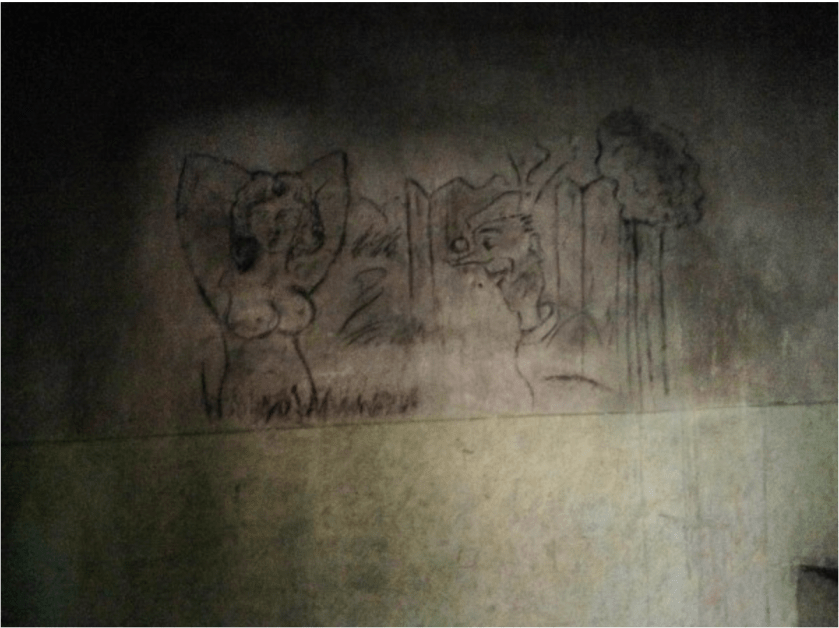
The hallways and each of the rooms have been stripped of the tables and chairs that once held prisoners there. Emptied except for one remaining table that sat, seemingly innocently at the end of one room. This table was used to conduct autopsies. The only other specific items existing in the space was a small windowless square room, about 7×7 feet, in which there was a concrete shower and what seemed to be a broken pipe hanging from the ceiling, and there were a series of drawings on the walls in two of the rooms. The first drawing I noticed was crassly drawn in the 7×7 room. It was an illustration of a man gawking at a woman’s bare chest. The second drawing I saw was of a small cottage sitting on what seemed to be a serene field. The first drawing made me angry. The second simply confused me. I could imagine the artist of the first but I had no idea whose hand to imagine as I looked at the second. This is to say that looking at the cartoonish pornography in the small square room as I felt the heaviness of evil that still rests upon that building like a fog filled with gnats and poison, the juxtaposition of the torture and the illustrated character made me feel like vomiting. I covered my mouth and squinted my eyes and shook my head and leaned back onto one of the walls . . . until I realized I was leaning back onto one of the walls. Quickly, I jolted my body away from the wall and felt dust particles and flakes of old, dead skin clawing at my back. The person who drew this image of a woman’s bare breasts was immersed in a world of bare breasts and naked bodies that were exposed to him in one of the most vulnerable and unwilling seasons of any number of women’s doomed lives—I was seeing sexual and physical abuse in its most raw form, without actually seeing it. What’s worse is that I could feel it inside that building. Even now, as I type these words my hands shake and my body feels cold. Being this close to the bawdiness of evil is an experience I will never forget. Nor should I.

The second drawing, as I stated above, simply confused me. I didn’t have any emotion left with which to interpret it after having been so repulsed by the first. I couldn’t tell whether it was drawn by a prisoner longing for home or by the same hand that had moments before drawn the naked woman. Either way, I came to hate the drawings on the walls.

There was a period of about 5 five minutes in which I stood by myself in one of the rooms whose windows were boarded. My eyes were wide as I studied the walls, the ceiling, the floor, the lighting fixtures. I noticed there was wallpaper on one side of the room. The presence of wallpaper struck me as laughable, so I laughed. Why in the world would someone find it necessary to cover this wall with wallpaper? Who were they kidding? Why decorate a room in which human souls were being stripped of their dignity and in some cases, their breath? I considered the sinful nature of man and the ways in which we paper over our own ugliness in an effort to either hide it or to numb ourselves from feeling the shame of our own indiscretions. Using the tools of my art as an actress I looked around the room as a child patient, then as an adult patient, then as a nurse, then as a doctor. I allowed the thoughts of each to build themselves in my mind—some of them constructed themselves quickly and with a strength that forced me to close my eyes. Some of these thoughts were quiet and slow—they peaked around the corners of my mind and then slid out the sides of my consciousness like children racing down laundry shoots and into dirty piles of laundry. I was inside the environment and the environment tried to force its way inside of me. The air punched me and the ghosts cried out to me for help and, eventually, the evil of the place began to laugh at me. It was in this moment, when the crescendo of reality drummed loudly in my ears that I stopped feeling the heaviness and I stood up straight, pounded my feet as I moved to the center of the room with the boarded windows and I prayed, “Jesus, I am sorry for what happened here. On behalf of humanity gone completely awry, I am sorry. You are omniscient, omnipresent and omnipotent . . . what did it do to your heart to watch all of this happen?” This was a turning point for me. Before this moment I was asking, “God, how did you let this happen? Why did you let this happen?” I wasn’t angry with God, but the deeper I walked into the horror, into the darkness, the more I looked for the Light. The more I looked for the Light, the darker the darkness became; until I stood in the darkest place in Auschwitz. That is when I tangibly felt the weight of sin and the absolute Love of God. My heart broke for the people who stood, sat, died in that room and I realized that what the Bible says is true, “God is near the broken hearted.” His heart breaks for us.

Inside Block 10, there was no hypocrisy existing between the visual stimulus and the cognitive understanding of what I saw. It was, and remains to this day, a haunted house lined with memories that shout through the revelation of pain; floorboards that creak with dried tears; walls that are shedding their floral patterns under the pressure of shame and anger; windows that shield their eyes from the sun and have lost their ability to see.

© Jill Szoo Wilson, 2024

Jill Szoo Wilson essay about Block 10 in Auschwitz
This is the entrance to Auschwitz I.
I took this photo inside Block 10