Thinking in Community: Constructivism and the Socratic Tradition in Higher Education

By Jill Szoo Wilson

In contemporary higher education, a surprising harmony emerges between two pedagogical lineages often perceived as distinct: constructivist teaching philosophy and the Socratic Method. One grounds itself in cognitive development and social learning theory; the other traces its heritage to ancient Greece. Yet together, they form one of the most intellectually generative combinations available to the modern classroom. Both treat learning not as passive absorption but as active inquiry. Both assume that students arrive with prior knowledge, internal frameworks, and tacit assumptions that shape how they understand new information. Most importantly, both contend that education is not simply the transfer of content, but the transformation of the learner.

Constructivist thinkers argue that students build knowledge rather than receive it. Jean Piaget, the Swiss developmental psychologist, described this process as a dynamic interplay between assimilation and accommodation, a continual restructuring of cognitive architecture as learners encounter new experiences (The Origins of Intelligence in Children). Lev Vygotsky, the Russian social psychologist, extended this idea by emphasizing the social dimensions of learning. His concept of the Zone of Proximal Development proposed that understanding flourishes when learners engage in dialogue with a more capable peer or mentor. John Dewey, the American philosopher of education, echoed this view, asserting that “knowledge is not something which exists apart from experience” (Democracy and Education). Their scholarship provides the intellectual foundation for constructivist pedagogy: students learn by doing, by reflecting, and by negotiating meaning in community.

The Socratic Method shares this commitment to meaning-making through dialogue. Though separated by millennia from contemporary cognitive theory, Socrates, the Athenian philosopher, had already intuited that learning requires active mental engagement. His method—probing questions, conceptual clarification, and disciplined reasoning—invites students to articulate, examine, and ultimately revise their assumptions. Mortimer Adler, the American educational philosopher, writes in The Paideia Proposal that the Socratic classroom is defined by its refusal to reduce ideas to mere facts. Instead, it seeks to refine the mind through inquiry. Similarly, Nel Noddings, the influential scholar of ethics and education, observed that Socratic questioning “challenges students to consider why they believe what they believe” and requires an educator to listen closely, ask precisely, and build questions that reveal the architecture of a student’s thinking (Educating Moral People).

Although constructivism and the Socratic Method arise from different intellectual traditions, their meeting point is the conviction that learning is constructed, not delivered. When paired, they generate a classroom that is both rigorous and learner-centered.

Constructivism in Practice: Learning as a Process of Meaning-Making

Constructivist pedagogy begins with a simple premise: students bring a world with them. Prior experiences, cultural narratives, internalized scripts, emotional histories, and unspoken values become part of the classroom’s cognitive landscape. Jerome Bruner, a central figure in cognitive constructivism, argued that learning occurs when students “go beyond the information given” (The Process of Education). He believed that education should not simply prepare students for future life; it should cultivate their ability to interpret and re-interpret their world.

This orientation toward interpretation requires instructors to move from transmission to facilitation. In a transmission model, the teacher is positioned as the primary source of knowledge who delivers information for students to receive, record, and reproduce. In a facilitative model, the teacher instead designs learning experiences, poses questions, and structures interactions through which students actively construct understanding for themselves. Jerome Bruner, the American cognitive psychologist, argued that learning occurs most powerfully when students are guided to “go beyond the information given,” a process that requires thoughtful scaffolding and inquiry-based engagement (The Process of Education). Stephen Brookfield, a leading scholar in adult learning, similarly contends that facilitation encourages learners to examine their assumptions, engage in reflection, and build insight through structured dialogue (Teaching for Critical Thinking).

These theorists converge on one central claim: meaning is co-constructed. Students learn not only from lectures and readings, but from the interplay of questions, reflections, and interpretive tensions that arise during discussion.

In the college classroom, this creates a pedagogical environment that values nuance over finality. Students learn to test ideas, articulate interpretations, and reconsider or solidify earlier conclusions. The instructor becomes an architect of inquiry, designing learning experiences to provoke reflection rather than prescribing answers. Constructivism thus offers the philosophical soil in which Socratic teaching can take root.

Socratic Questioning: Inquiry as Intellectual Discipline

If constructivism provides the philosophical ground, the Socratic Method supplies the structure. Socratic pedagogy is not spontaneous conversation; it is purposeful inquiry. Christopher Phillips, founder of the modern Socrates Café movement, describes Socratic questioning as “a shared search for understanding” where each question functions as both challenge and invitation (Socrates Café). Allan Bloom characterizes this process as the cultivation of the “examined life,” where intellectual discomfort is not an obstacle but an essential component of learning (The Closing of the American Mind).

At its core, the Socratic Method rests on three types of inquiry:

  1. Clarification questions, which refine imprecise statements.
  2. Assumption questions, which uncover the beliefs beneath a claim.
  3. Implication questions, which reveal the consequences of those beliefs.

Together, they encourage students to build a more precise conceptual vocabulary. This practice strengthens not only critical thinking but also metacognition, the process by which learners examine their own thinking and monitor how understanding develops. By articulating how they know what they know, students begin to understand the architecture of their own reasoning.

Stephen Brookfield notes that Socratic inquiry helps students identify “assumptions that are taken for granted and rarely examined” (Teaching for Critical Thinking). These moments of self-interrogation are often destabilizing, yet profoundly generative. The student shifts from absorbing knowledge to inhabiting it.

Within the college classroom, the Socratic Method functions as both compass and catalyst. It directs students toward deeper understanding and accelerates the cognitive processes described by constructivist theorists. It requires students to participate actively in their own intellectual development.

Where the Traditions Converge: Dialogue as Pedagogical Architecture

Constructivism and the Socratic Method converge in their shared conviction that learning emerges through intentional interaction. Both approaches resist the notion that knowledge is acquired through answers alone; instead, they emphasize the intellectual labor of forming, testing, and refining those answers. Dialogue becomes the medium through which understanding is shaped, not merely communicated.

In a constructivist–Socratic classroom, dialogue serves as an architectural framework that supports and directs cognitive growth. Questions are not interruptions to learning but the mechanisms that move it forward. They guide students from initial uncertainty toward increasingly complex interpretations, prompting them to articulate assumptions, revisit earlier conclusions, and trace the logic of their own thinking. It is in this movement that Vygotsky’s insight becomes visible: learning accelerates in the space between what a student can already do and what becomes possible through carefully guided interaction. The Zone of Proximal Development is not a chart or a formula in this setting. It is the lived moment when a question arrives at just the right level of difficulty, when a peer’s interpretation stretches a student’s own, when the instructor’s prompt nudges thought into a new configuration. As students respond to questions situated just beyond their current mastery, they test hypotheses, negotiate meaning with peers, and begin to inhabit the intellectual habits of inquiry.

Such a classroom is relational, reflective, and rigorously engaged. It honors the individuality of student experience while drawing learners into a shared pursuit of understanding. Within this environment, the instructor becomes a designer of intellectual movement and a structurer of dialogue so that students can recognize themselves as co-authors of their learning. The result is not merely the acquisition of knowledge but the cultivation of an interpretive stance that endures far beyond the course’s boundaries.

Conclusion

As these traditions come together in practice, the college classroom becomes a setting where inquiry deepens and understanding gains structure. Their shared commitment to reflection and the active construction of meaning encourages students to interpret ideas with increasing precision and to recognize the habits of thought that guide interpretation itself. Through this integrated approach, dialogue emerges as a sustained intellectual practice, inviting students into the slow, disciplined work of questioning, analyzing, and revising their thinking.

This work reaches far beyond the mastery of course content. The interpretive habits cultivated in a constructivist and Socratic classroom form the foundation for adult intellectual life. They strengthen the ability to discern patterns, evaluate competing claims, and approach complexity with patience rather than haste. In a culture shaped by constant information and rapid exchange, these habits create a practice of attentiveness. They help students recognize nuance, situate themselves within ongoing conversations, and contribute thoughtfully to the civic, professional, and relational worlds they will inhabit.

Viewed in this light, the purpose of higher education expands beyond the acquisition of knowledge. It becomes an invitation to develop a way of thinking characterized by curiosity, rigor, and a readiness to dwell in questions. When instructors adopt a pedagogy that affirms the social construction of understanding and the disciplined inquiry associated with the Socratic tradition, they help students cultivate a lifelong interpretive stance. This stance, more than any discrete skill or body of information, equips learners to encounter a complex world with insight, discernment, and intellectual courage


Further Reading

Adler, Mortimer J. The Paideia Proposal. Macmillan, 1982.

Bloom, Allan. The Closing of the American Mind. Simon & Schuster, 1987.

Bruner, Jerome. The Process of Education. Harvard UP, 1960.

Brookfield, Stephen. Teaching for Critical Thinking. Jossey-Bass, 2012.

Dewey, John. Democracy and Education. Macmillan, 1916.

Noddings, Nel. Educating Moral People: A Caring Alternative to Character Education. Teachers College Press, 2002.

Phillips, Christopher. Socrates Café: A Fresh Taste of Philosophy. Norton, 2001.

Piaget, Jean. The Origins of Intelligence in Children. International Universities Press, 1952.

Plato. Meno. Translated by G.M.A. Grube, Hackett Publishing, 1997.

Plato. The Republic. Translated by G.M.A. Grube, revised by C.D.C. Reeve, Hackett Publishing, 1992. (Book I)

Vygotsky, Lev. Mind in Society: The Development of Higher Psychological Processes. Harvard UP, 1978.

Originally posted on my Jill Szoo Wilson Substack.
The Garden Between Us: On the Moral Work of Communication

By Jill Szoo Wilson

No Kings protests. Israel and Palestine peace talks. The Mayoral debate in New York City. And somewhere between those headlines, a viral argument about whether pumpkin spice season begins too early.

What a week!

During a class discussion on the topic of ethical communication, one of my students made an observation that stayed with me:

“Sometimes I walk away from a conversation with one of my friends or family members, and I think they really understood what I was saying. Then, like a week later, I’ll see something they post on social media and realize — whoa — we weren’t even in the same universe. How do you know if someone actually gets what you’re saying?”

There was real frustration in her voice as she grappled intellectually and emotionally with how to translate effective communication skills from the classroom to real-world relationships and conversations that truly matter to her.

Her question strikes at the heart of communication theory itself. Every major model—from Claude Shannon and Warren Weaver’s early work in information theory to the later transactional and constructivist frameworks—grapples with the same problem she voiced: how does meaning move from one mind to another without distortion? Communication is never just about speaking clearly; it’s about whether understanding travels intact from one mind to another. The first modern attempt to diagram that process came in 1948, when two Bell Labs researchers sought to solve a practical problem—how to transmit information efficiently over telephone lines—and ended up shaping a foundation for how we consider human connection today.

Section I: The Shannon–Weaver Model — Communication as Transmission

When Claude Shannon and Warren Weaver introduced their model of communication in 1948, they weren’t thinking about classrooms or conversations; they were thinking about telephones. Shannon, a mathematician at Bell Labs, was studying how to send messages through electrical circuits with the least amount of interference. His goal was precision: a system in which information could be transmitted, received, and decoded without distortion.

In its simplest form, the Shannon–Weaver Model outlines five key components: a sender, a message, a channel, noise, and a receiver. Later versions added feedback to acknowledge that communication rarely ends at reception; it loops back through response. The model’s simplicity made it foundational for how we understand all forms of message exchange, from radio broadcasts to human dialogue.

Imagine you’re explaining something important to a friend. You form the thought (sender), put it into words (message), speak aloud (channel), and hope it reaches the listener (receiver). Noise—anything from background chatter to the friend’s assumptions or daydreams—can distort what you mean. Feedback, whether a nod or a question, helps you gauge whether your message landed.

Now imagine trying to apologize to someone you care about after a painful misunderstanding. You’ve rehearsed the conversation for days, turning phrases over in your mind, searching for the language that might soften what was said. When the moment finally comes, you speak from the heart, but your voice trembles. You mean to say “I’m sorry,” yet what they hear is “I’m still defending myself.” You reach out, and somehow they retreat. The words are correct, but the meaning collapses somewhere between intent and reception.

The Shannon–Weaver Model helps us see the anatomy of that collapse. The “noise” isn’t external static or interference, but the invisible internal weight of emotion, memory, and assumption. Even when a message is spoken clearly, those unseen forces can bend it out of shape. The model reminds us that successful communication isn’t about flawless delivery but about whether understanding survives the distance between two people.

The model is practical but limited: it shows how messages move, not how meaning emerges. Shannon and Weaver understood communication as a linear transfer of data; humans experience it as something far more collaborative — a process of interpretation, empathy, and response.

This distinction is important because even a perfectly transmitted message can still fail to communicate meaning. As my student asked, “How do you know if someone actually gets what you’re saying?” According to Shannon and Weaver, you’d simply confirm that the message was received and decoded. But real understanding, as anyone who has been misunderstood knows, is not that simple. It requires shared context, empathy, and attention to nuance. These are elements that don’t fit neatly into a circuit diagram.

The Shannon–Weaver Model gives us a starting point: communication as transmission. Yet it leaves us asking what happens beyond transmission, where ideas meet perception. To explore that terrain, we turn to one of the most enduring frameworks in contemporary communication: Barnlund’s Transactional Model.

Section II: Barnlund’s Transactional Model — Communication as Co-Creation

By the 1970s, communication theorist Dean Barnlund proposed a shift so profound that it still reshapes how we teach the subject today. Where Shannon and Weaver treated communication as a line of transmission, Barnlund imagined something circular, alive, and reciprocal. He argued that the exchange itself was not an assembly line of words moving from one mind to another but a living process that creates a shared narrative between people.

Barnlund’s Transactional Model reimagined this process not as a one-way transfer of information but as a dynamic act of co-creation. Every conversation, he suggested, is an event that exists only in the moment it happens, built, revised, and reshaped by both participants at once. The act of meaning-making is mutual. Each person’s interpretation alters the message itself. In this way, communication becomes less about accuracy and more about emergence.

To help students see what this looks like, I often begin with an exercise that never fails to surprise them. I pair students and ask them to tell a simple story from their weekend. The first partner speaks for thirty seconds while the other listens silently, offering no reaction or feedback. Then they switch. When we debrief, most describe the silence as unsettling, even cold. “I felt like I was boring him or maybe he wasn’t even listening,” one student said. The second round changes everything. This time, listeners can nod, smile, or ask questions. The conversation immediately warms. Laughter enters the room. Meaning deepens. What changed wasn’t the content of the stories but the shared construction of them. Each speaker began shaping their language in response to the listener’s cues. Together, they built a small, co-authored moment of understanding.

If Shannon and Weaver gave us the map of communication, Barnlund taught us how to read the terrain. His model asks us to notice the pauses, gestures, silences, and emotional undercurrents that live beneath language. Meaning, he argued, is not simply sent; it is negotiated, felt, and co-authored.

Where Shannon and Weaver saw a sender and receiver, Barnlund saw communicators engaged in simultaneous exchange. Each person is both sender and receiver at once, continually encoding, decoding, and interpreting within a shared field of experience. Communication, in this view, is about negotiating reality together.

Section III: From Transmission to Transformation — Understanding the Difference

The Shannon-Weaver model teaches how to speak clearly, while Barnlund’s model teaches why clarity is sometimes not enough. One focuses on information; the other on interpretation. One aims for precision; the other for understanding.

Learning Shannon-Weaver fosters autonomy. It helps us become aware of purpose, audience, and structure. Learning Barnlund brings humility. It reminds us that even the most carefully crafted message depends on another person’s frame of meaning. There is comfort in realizing this: sometimes we can speak with care and still not be understood. Our responsibility is to communicate as clearly and honestly as we can, and then to accept the outcome rather than trying to control it. There is strength in understanding that we do not have to be fully understood to be worthy of speaking.

A simple exercise illustrates the difference. Imagine describing an image while someone, turned away, tries to draw it based only on your words. The first attempt, with no questions allowed, is pure Shannon-Weaver transmission. The drawing will likely be efficient but distorted. Now imagine trying again with questions and clarifications. The process slows, but understanding grows. Meaning, like art, becomes clearer when it is co-created.

Think of the miscommunication between Elizabeth Bennet and Mr. Darcy in Pride and Prejudice. For most of the novel, each interprets the other through the noise of pride, prejudice, and social expectation. Darcy’s words are technically clear—his first proposal is grammatical perfection—but his tone, timing, and failure to consider Elizabeth’s perspective distort the message beyond recognition. It takes a long series of feedback loops—letters, revelations, and changed behavior—for meaning to realign with intent. Only when both listen with humility rather than defensiveness does understanding emerge. Austen’s scene endures because it dramatizes the very truth Barnlund uncovered: communication becomes transformative only when both parties risk vulnerability and mutual perception.

The shift from transmission to creation mirrors a moral one. To communicate ethically is to recognize that every exchange plants something between people: a seed that can grow into trust or misunderstanding, grace or distance. The philosopher Martin Buber, writing in 1923 in I and Thou, taught that real life unfolds through genuine encounter. “All real living is meeting,” he wrote, describing how we come fully alive when we engage another person not as an object to persuade but as a presence to meet. Every tone of voice and every moment of attention becomes soil for what will take root between us. Our words are seeds, and the spaces we tend together become the garden we live in.

That realization gives us a kind of power that is both humbling and hopeful. It means that everyday choices in conversation — things like listening fully, asking questions, or pausing before reacting — can repair trust where there was once distance. Communication becomes not just a skill but a responsibility: the way we decide, moment by moment, what kind of relationships and communities we will build.

My student’s question still lingers: How do you know if someone actually gets what you’re saying? Understanding grows each time we listen with patience and speak with care. It lives in the meeting itself, in the ongoing work of tending meaning between people. When we stay present to one another, communication becomes the living art of truly meeting another human being.

For more essays by Jill Szoo Wilson on Substack, click here!

Three Visions of the Stage: Plato, Socrates, and Aristotle on Theatre


By Jill Szoo Wilson

Introduction

From the festival stages of ancient Athens to the minimalist black boxes of the modern age, theatre has never merely been a mirror held up to nature. It has served as a site of moral tension, philosophical debate, and spiritual inquiry. For the Greeks, whose tragedies laid the foundation for Western drama and whose philosophers shaped the roots of Western thought, theatre was not neutral ground. It was divisive, provocative, and volatile. What is the purpose of theatre? Is it ethical instruction or emotional indulgence? Is it a path to wisdom or a distraction from truth?

This essay explores the philosophical tensions surrounding theatre in the writings of Plato, Socrates (as portrayed by Plato), and Aristotle. In their competing visions—suspicion, interrogation, and celebration—we encounter a triptych of enduring questions about the role of art in civic and moral life. Their disagreements are not confined to the past. They still echo in conversations about education, politics, and the power of performance.

These tensions are not relics of antiquity. They continue to animate our understanding of what theatre is and what it ought to be. When a play unsettles us, when a performance asks us to feel more deeply or consider a truth we have avoided, we are stepping into the same territory the Greeks once debated. The question is not only what theatre shows, but what it stirs and what it asks of us as thinking, feeling, moral beings.

Plato on Theatre: Emotion Without Reason

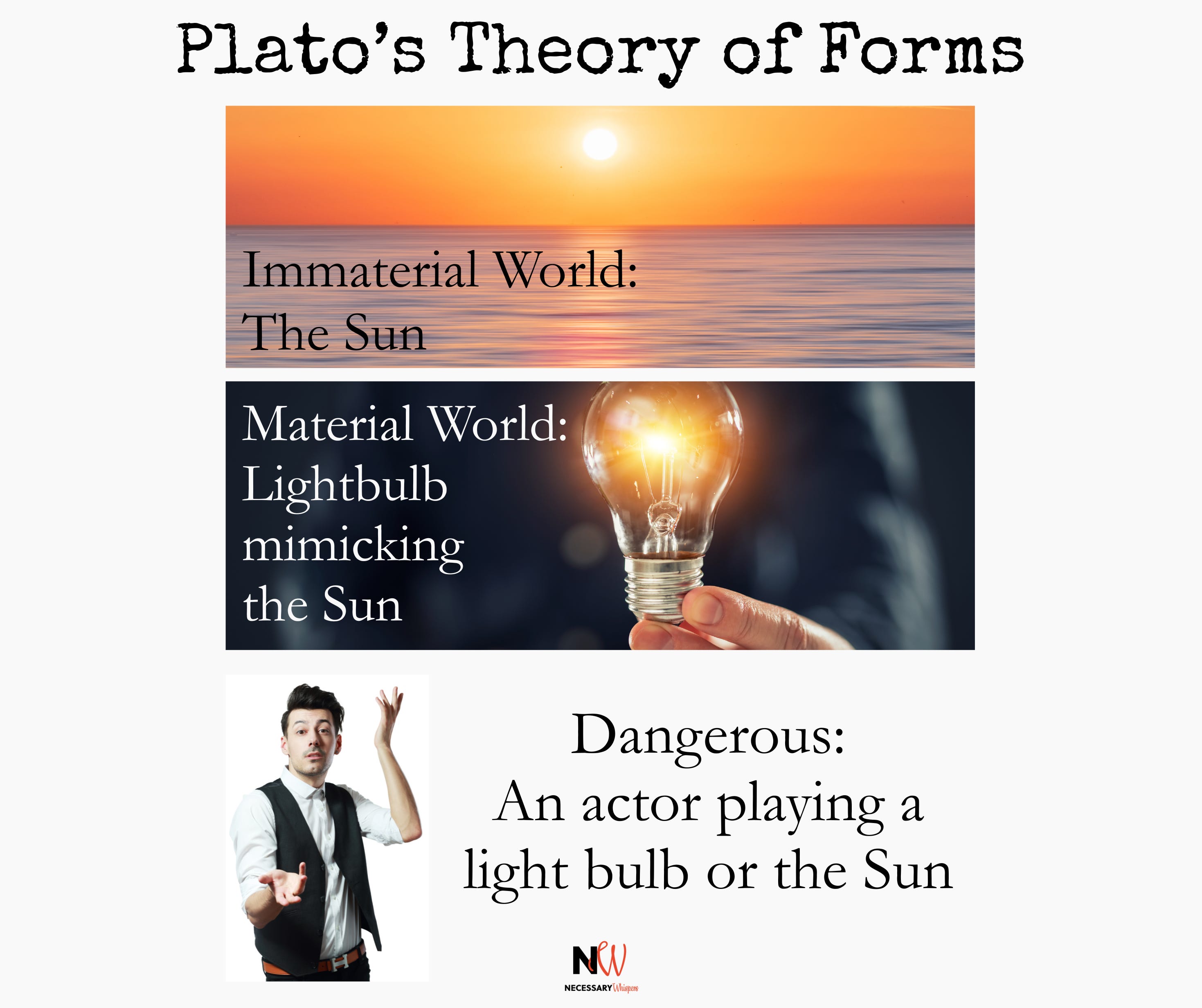
In The Republic, Plato’s distrust of theatre is unmistakable. For him, mimesis, or imitation, is not a creative virtue but a philosophical deficiency. According to his theory of Forms, the material world is already a shadow of a higher, eternal reality. Every physical object—a tree, a table, a human face—is merely an imperfect reflection of its ideal Form, which exists outside time and space. Knowledge, in this view, involves turning the soul away from sensory appearances and toward the realm of intelligible truth.

Art, and especially theatre, compounds the problem. A dramatic performance does not depict the Form of justice or courage; it portrays a person who appears to be just or courageous, often in highly distorted or emotionally exaggerated terms. Theatrical representation, then, becomes an imitation of an imitation: once removed from the eternal Forms by material reality, and once more by the artist’s interpretation of that reality. It is, in Plato’s words, “thrice removed from the truth.” As a result, art risks misleading the soul rather than educating it.

In Book X, Plato writes:

“We must remain firm in our conviction that no poetry should be admitted save hymns to the gods and encomia of good men” (Republic X.607a).

His condemnation is not primarily aesthetic but moral. The poet does not possess true knowledge of justice or the good, and therefore cannot be entrusted with shaping public consciousness. Tragedy, in particular, inflames the irrational parts of the soul. By encouraging audiences to identify with characters who suffer, fail, or behave disgracefully, drama bypasses the rational faculties that Plato considers essential to the formation of a virtuous life. It does not guide the audience toward reasoned understanding; it captivates and unsettles through spectacle. The result, he fears, is a citizenry more attuned to feeling than to thinking.

Plato’s anxiety is ultimately a question of power. Theatre, with its ability to move collective emotion, poses a threat to the philosopher’s authority as the rightful guide of the polis. In the ideal republic, governed by philosopher-kings, the stage has no place unless it can be strictly controlled. Plato imagines no version of poetry that does not require censorship, for the poetic voice competes with philosophy in shaping public values.

This suspicion of theatricality finds a distant but resonant echo in the work of Judith Butler, who argues in Excitable Speech that performative acts are not merely expressive but constitutive. This is to say, they do not simply reflect existing truths; they produce new realities through repetition and societal normalization. Although Butler’s focus is on gender, power, and language, her argument shares with Plato a central concern: speech and performance are not neutral. They are acts of world-making. Plato feared this generative capacity. For him, theatre does not merely mirror emotion; it incites it, destabilizes reason, and reshapes the soul without its consent. Both thinkers recognize that performance does not stay on the stage. It has the power to enter the world and alter it.

Socrates (via Plato): Interrogation Over Imitation

Socrates, who left no writings of his own, appears in Plato’s dialogues as a relentless questioner. As such, he is a figure more disruptor than dramatist, and a kind of anti-poet. In IonGorgias, and The Apology, Socrates consistently distances himself from theatricality, often drawing sharp distinctions between genuine knowledge and rhetorical display. In Ion, for example, he confronts a rhapsode—a professional performer of epic poetry—who claims to interpret Homer:

“You speak of Homer, not as one having knowledge, but as one inspired… possessed” (Ion 533d).

Here, the artist is not a sage but a conduit. The rhapsode, though perhaps divinely touched, does not speak from knowledge but from inspiration. He performs poetry with passion, yet cannot explain its meaning. He moves others, but cannot account for his own words. For Socrates, this is a problem. Without understanding, performance becomes a kind of possession rather than a practice of reason.

Socratic philosophy demands more. It requires individuals to examine their beliefs, define their terms, and refine their views through conversation and debate. Knowledge, in this framework, is earned through dialogue. It is a process of discovery, not delivery. Truth must be questioned into existence.

By contrast, theatre tends to offer conclusions. It presents complete gestures, polished arcs, and emotional resolution. It engages the audience through emotion first, which, for Socrates, risks replacing reflection with identification. This kind of passivity may satisfy the appetite for entertainment, but it does little to cultivate wisdom. Art that stirs the soul without engaging the mind falls short of philosophy’s aim.

Yet the Socratic method itself is deeply performative. While Socrates critiques theatre for offering conclusions without examination, his own philosophical practice unfolds in forms that closely resemble dramatic encounter. Plato’s dialogues are structured not as essays but as scenes—carefully shaped exchanges between characters, full of tension, irony, and reversal. These are not lectures. They are dramatizations of inquiry. Characters enter with confidence and leave in confusion. Positions are tested, undermined, and reframed. The reader, like a spectator, witnesses the friction of minds in motion.

Even Socrates’ death, as recorded in The Apology and Phaedo, bears the marks of theatrical form. He drinks the hemlock not in solitude, but before a gathered public. His final words are neither anguished nor sentimental. They are measured, even instructive. The moment resists catharsis and refuses spectacle. If Greek tragedy aims for emotional release, Socrates’ death stages something else entirely: philosophical resolve. It becomes a kind of anti-tragedy, where the central figure does not unravel but remains fully composed, fully Socratic. In this light, Socrates does not reject performance altogether. He reclaims it for philosophy. His form of theatre is not emotional, but dialectical. It’s not a medium for answers, but for recursive questions, meaning questions that generate more questions rather than definitive answers. For example: What is justice? What is courage? What is the good life? In posing these questions again and again, Socrates transforms the act of dialogue into a space where inherited beliefs are challenged and thinking is tested.

This mode of engagement anticipates the work of later thinkers such as Bertolt Brecht, who sought to break the illusion of conventional theatre and replace it with critical distance. Brecht’s concept of the Verfremdungseffekt, or alienation effect, aims to interrupt emotional immersion and redirect the audience toward thought. His theatre invites discomfort and deliberately reminds the audience that what they are seeing is constructed, not natural, encouraging reflection rather than emotional immersion. In Socratic terms, Brechtian drama becomes a modern rehearsal of philosophical dialogue. It is deliberately unresolved, designed not to console, but to provoke.

Aristotle: Theatre Teaches Us How to Feel Wisely

If Plato regarded theatre with suspicion, Aristotle regarded it as a potential instrument of moral education. In Poetics, he does not dismiss tragedy; rather, he categorizes and defends it through careful analysis. For Aristotle, art does not distract from reality. It orders it. He defines tragedy as follows:

“An imitation of an action that is serious, complete, and of a certain magnitude… through pity and fear effecting the proper purgation of these emotions” (Poetics 1449b24–28).

The concept of catharsis, a cornerstone of Aristotle’s theory, anchors his defense of tragedy. Though notoriously difficult to translate, the term is often understood as a kind of purgation or purification of the emotions, specifically pity and fear. But catharsis is not simply the release of emotion. It is the transformation of emotional experience into a clearer understanding of human nature.

According to Aristotle, tragedy does not lead the audience into irrationality or emotional excess. It invites them to feel deeply in a structured and meaningful way. By observing characters who confront moral dilemmas, endure consequences, and wrestle with forces beyond their control, the audience participates in a kind of ethical rehearsal. The emotions that arise are not random or indulgent. They are guided and shaped by the dramatic structure.

In this process, pity and fear are not seen as weaknesses to be suppressed. They are part of what it means to be human. Tragedy does not eliminate these feelings. It refines them. The result is not a detachment from emotion, but a deeper engagement with it. Rather than leaving the theatre in confusion, the audience emerges with moral clarity. They are not simply moved. They are moved toward insight.

In this respect, Aristotle’s position bears resemblance to that of Martha Nussbaum, who argues in The Fragility of Goodness that literature and drama prepare us to live within the limits of human vulnerability. For Nussbaum, emotional exposure is not a threat to reason. It is a precondition for ethical development. The spectator does not learn through abstraction alone, but through attachment. The pain of watching Antigone bury her brother, or Lear descend into madness, or Willy Loman fracture under the weight of illusion, is not incidental. It is formative.

Aristotle’s account of mimesis differs markedly from Plato’s. He does not see imitation as mimicry. He sees it as clarification. The artist, in Aristotle’s view, imitates not what has already occurred, but what might occur according to the logic of probability or necessity. Theatre becomes a site not of replication but of distillation. It does not merely show reality; it interprets and refines it. The stage is not a place of deception. It is a space of recognition. Within a functioning polis, that kind of shared recognition is essential.

The Core Divide: Emotion, Truth, and the Function of Story

Beneath the disagreements among Plato, Socrates, and Aristotle is a question that continues to shape how we teach, interpret, and respond to art: Does it distort reality or reveal it? The answer, for each thinker, depends on how one understands the relationship between emotion and truth, imitation and insight, and individual perception and collective good.

Plato feared that the stage lured audiences away from the pursuit of truth by appealing to the unstable regions of the soul. Drama, in his view, persuades through illusion rather than reason. It encourages spectators to empathize with flawed characters and to feel emotions that are disproportionate or misdirected. This response, far from virtuous, is seen as corrosive to civic health. The mimetic arts, according to Plato, should be kept at a distance from the education of citizens, for they nurture confusion rather than clarity. As he insists in Republic X, the dramatist “has no knowledge worth mentioning” and yet may powerfully influence public emotion (X.600e–601a). The danger lies not only in the content of the play, but in the seductive form itself.

By contrast, Aristotle defends tragedy as a morally clarifying experience. Rather than pulling the spectator away from reason, it guides emotion toward understanding. In Poetics, he writes that through the emotions of pity and fear, tragedy effects the catharsis of these passions, a term often interpreted as purification, clarification, or release. Where Plato sees manipulation, Aristotle sees education. Art imitates action, not to deceive but to distill. It reveals the structures of human behavior, especially the consequences of ethical decisions, in ways that theoretical argument alone cannot. The tragic stage becomes a moral laboratory, offering spectators the opportunity to experience complex situations without suffering their real-life consequences.

Socrates, as depicted in Plato’s dialogues, withholds approval from artistic forms that do not provoke or permit rigorous dialectical examination. His skepticism emerges not from aesthetic disdain but from moral urgency. Truth, for Socrates, cannot be received passively; it must be earned through confrontation, reflection, and intellectual unrest. The Apology dramatizes this position through Socrates’ trial, where his refusal to perform repentance for the sake of appeasing the jury becomes a final defense of truth over spectacle. Even so, the dialogues in which he appears are themselves theatrical in structure; rich with irony, characterization, and rhetorical tension. Plato thus stages Socratic resistance within a literary form, a paradox that suggests the possibility of art not as deception, but as a vehicle for inquiry.

This tension between emotion and reason, between spectacle and scrutiny, persists well beyond antiquity. In the nineteenth century, the German philosopher G. W. F. Hegel revisits these ancient concerns in his Lectures on Aesthetics, offering one of the most influential modern accounts of art’s function. Where Plato feared illusion and Aristotle defended catharsis, Hegel seeks to reconcile both positions by proposing that art reveals Spirit (Geist), which he defines as the evolving self-awareness of human freedom as it unfolds through culture, history, and form. For Hegel, art is not merely decorative or moralizing. It is a mode of truth-telling, one that gives shape to the contradictions at the heart of human existence.

Tragedy, in particular, becomes the site where such contradictions are made visible. It is not a story of simple right and wrong, but of clashing ethical claims, including freedom versus necessity, private loyalty versus public duty, and the moral individual versus the lawful state. In Sophocles’ Antigone, for instance, Hegel sees no clear hero or villain. Instead, he finds what he calls a tragic collision (tragischer Konflikt), where “both are right, and both are wrong.” Antigone is justified in honoring her brother; Creon is justified in upholding the law. The tragedy lies in the fact that these principles, though noble on their own, cannot coexist. The power of the play does not lie in its resolution, but in its ability to embody irreconcilable truths and force the audience to bear witness to them.

Later thinkers, such as Martha Nussbaum, draw upon this tradition to argue for the ethical necessity of literature and drama in cultivating the moral imagination. In Love’s Knowledge and The Fragility of Goodness, Nussbaum asserts that emotions are not irrational intrusions upon reason, but modes of knowing in themselves. The capacity to feel pity, fear, grief, or admiration within a dramatic framework expands one’s understanding of the human condition. The arts, she argues, teach us not only what choices matter, but what it feels like to make them. This fusion of emotion and cognition positions theatre as a vital contributor to ethical development, not as its enemy.

Even the philosopher Hans-Georg Gadamer, whose work on hermeneutics emphasizes the dialogical nature of understanding, identifies aesthetic experience as an event of truth. In Truth and Method, he describes art as something that addresses the interpreter, not merely as an object of scrutiny, but as a partner in a conversation. Theatrical performance, in this light, is not simply a representation to be watched, but a provocation to which the audience must respond.

Across these traditions, the core divide remains sharply felt. Is theatre a seduction that disrupts reason, or a reckoning that illuminates it? Does it offer clarity, or does it merely entertain? Plato fears its capacity to bypass intellect. Aristotle defends its ability to deepen it. Socrates insists on its subordination to the examined life. Yet each, in different ways, acknowledges that theatre is never neutral. It touches the soul, shapes the city, and provokes the mind.

What theatre reveals may not always be comfortable or conclusive. Still, it remains one of the few places where contradiction is not only permitted, but required. Its purpose may never be singular. Its truth, however, continues to be hard-earned, unsettling, and urgently human.

Conclusion: The Curtain Rises on an Ancient Argument

The question of theatre’s purpose is not new. It has echoed through centuries of aesthetic theory and moral philosophy. This essay has explored how three foundational thinkers—Plato, Socrates, and Aristotle—approached the question from markedly different perspectives, each illuminating distinct tensions between representation, emotion, and truth.

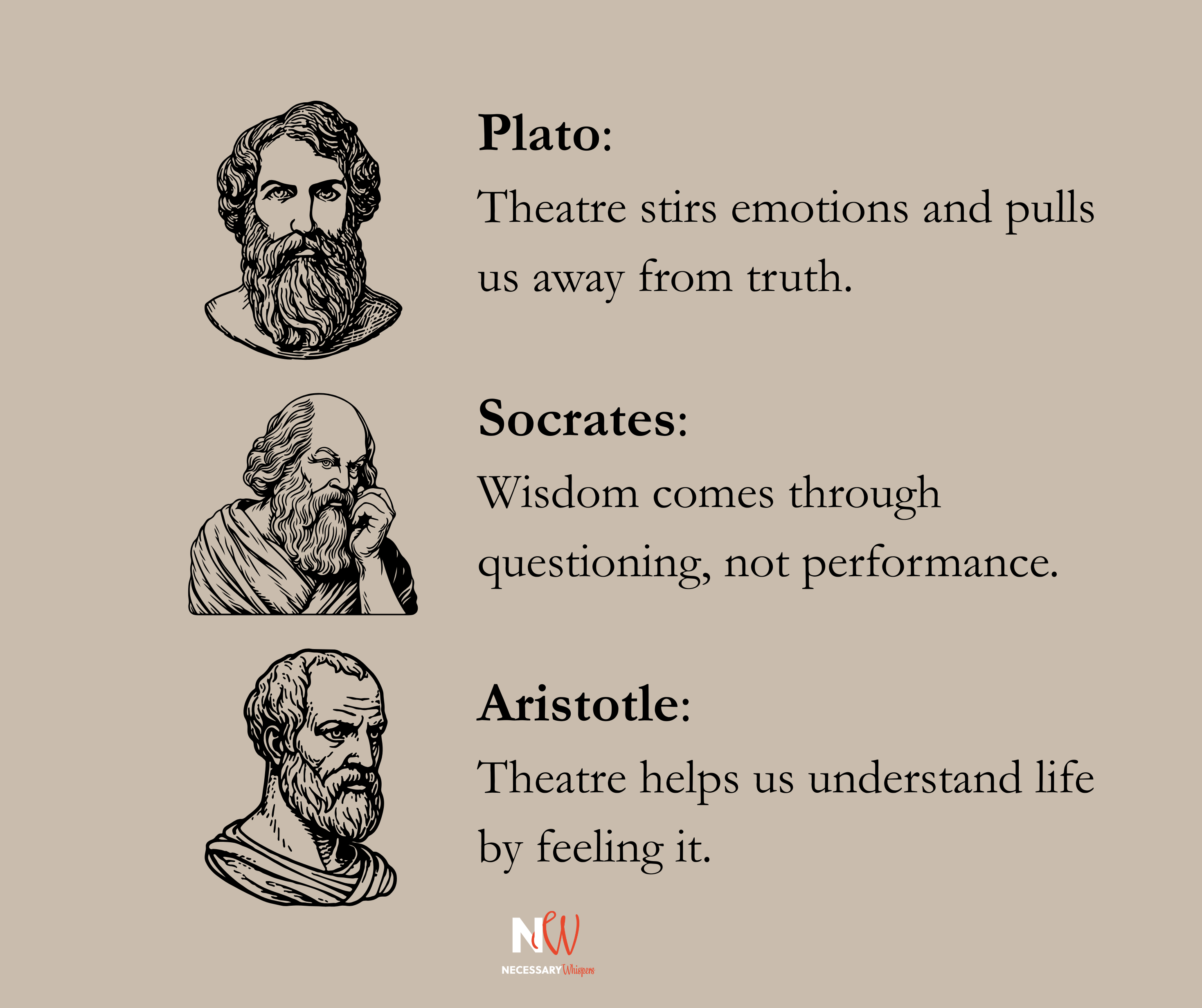
Plato regarded theatre with deep suspicion. He saw it as twice removed from reality, capable of stirring emotion without offering knowledge. For him, the stage was not a place for moral formation, but a threat to it.

Socrates, as portrayed in Plato’s dialogues, was less dismissive than demanding. He withheld approval from artistic forms that did not submit to dialectical examination. Knowledge, in his view, could not be passively received; it had to be interrogated into existence. Only when performance provoked philosophical inquiry did it begin to serve a worthy end.

Aristotle, by contrast, offered a systematic defense of tragedy. He argued that theatre refines emotion rather than inflames it. Through catharsis, spectators undergo a kind of ethical rehearsal, arriving not at illusion but at recognition. For Aristotle, mimesis was not mimicry, but a form of clarification.

These positions continue to shape how we think about the function of storytelling: whether art should comfort or confront, reflect or refine, entertain or educate. Later philosophers such as Hegel, Nussbaum, and Gadamer have extended this conversation, suggesting that theatre remains relevant not because it resolves these tensions, but because it invites us to dwell within them.

To study theatre alongside philosophy is to treat art not as decoration, but as a mode of thought. The question of its purpose resists final answers. What the Greeks understood—and what these thinkers help us recover—is that the stage is never neutral. It is a site of consequence, where emotion and reason meet, and where the ethical stakes of representation are always in play.