The Mind-Body-Emotion Circuit: Learning How to Respond on Purpose

By Jill Szoo Wilson

In acting, emotion is often treated as the goal. Many students arrive hoping to unlock a secret reservoir of feeling, as if tears or rage or heartbreak could be summoned by force of will alone. Yet experienced artists and psychological researchers alike know that emotion resists direct manipulation. The human heart refuses to be commanded. Instead, emotion tends to emerge as a consequence of the way we think and move through the world. This reality, long understood intuitively by actors, has now been documented in cognitive and behavioral science. As Meisner observed, performance becomes truthful only when the actor lives with authenticity inside imagined circumstances rather than attempting to manufacture emotional display on cue (Meisner & Longwell, 1987).

This understanding is essential in my work as an acting teacher. One of my current private students, whom I will call Paige, embodies the determination required to bridge intellect, body, and imagination. She asks thoughtful questions, listens without pretense, and possesses a grounded confidence that draws others toward her. In the studio, she is learning that the actor’s instrument is not the voice alone, nor the body alone, nor even the mind alone, but the constant interplay among them. When that interplay is disrupted, performance becomes flat and disconnected. When it flows, the actor’s work becomes alive.

To explain this interplay, I teach what I call the mind-body circuit, a cycle rooted in both performance pedagogy and psychology: thought → emotion → action → new thought → emotion → action, and so on. The sequence appears simple, yet it reveals something profound. The actor can enter it through thought or action, but rarely through emotion alone. Emotion depends on a catalyst. It responds to meaning and circumstance. This is why actors who begin with the desire to “feel sad” or “play anger” inevitably fall into generalization. They are grasping at the byproduct rather than engaging the cause.

Directors and psychologists alike recognize that embodied behavior shapes inner life. Neuroscientist Antonio Damasio describes the body as a “theater of feeling,” where emotion is both generated and displayed through motion and sensation (1999). Onstage, this principle becomes visible in dramatic form. To demonstrate this, I once handed a student a hammer and instructed him to break scrap wood in character for thirty seconds. The task was intentionally physical, forceful, and resistant, because the body cannot remain neutral when exerting strength against an object that pushes back. There was no discussion of backstory or psychology. The action demanded urgency and focus, which silenced self-consciousness and awakened the nervous system. As the student swung the hammer, his breath shifted, muscles tensed, and emotion surfaced unbidden. Within moments, he found himself articulating thoughts and personal stakes that had felt inaccessible when he tried to intellectualize his way toward feeling. Stanislavski identified this phenomenon nearly a century ago: “In the beginning, you must not settle matters of feeling. Begin with the action” (1936).

There are other occasions when thought becomes the most generative entry point into the mind-body circuit. During rehearsals for Hamlet, Paige and I worked through a scene in which Ophelia confronts a lover who, until recently, adored her. Before this scene, Hamlet has pursued Ophelia with gentle attention and romantic promise. He has spoken of love and a future together. Then suddenly, with no explanation she can understand, he turns on her. He tells her she should enter a convent, that she should never marry, never bear children, never bring more life into a world he now condemns. At first, Paige named her character’s feelings: confusion, concern, hurt. These were legitimate emotional states, but they did not yet clarify what Ophelia believed was happening or what she needed in response. We returned to the text to articulate the specific rupture: this is not Hamlet being odd or distracted; this is Hamlet erasing their entire future with a single, devastating reversal. Once Paige understood that she was experiencing rejection not only of affection but of identity, legacy, and security, her body changed. Her posture leaned forward, breath tightened, and she instinctively reached toward her scene partner, trying to recover the man she once knew. Thought created meaning. Meaning triggered emotion. Emotion propelled action. The circuit closed into a continuous chain.

Psychologist Richard Lazarus offers a framework in which emotion arises from the mind’s effort to interpret and evaluate experience. He proposed that individuals engage in a form of cognitive appraisal, a rapid assessment of what an event means for one’s safety, identity, or sense of belonging, followed by an assessment of whether one has the capacity to respond (Lazarus, 1991). Through this process, emotion becomes a reflection of significance. Fear signals the presence of danger. Grief testifies to the worth of what was lost. Anger reveals a boundary that matters. These meanings take shape first in the mind, then move through the body as behavior and physiological response. Acting technique embraces this sequence. When the actor fully recognizes the stakes—the value of the moment, the cost of failure, and the depth of desire—inner life begins to organize itself accordingly. The heartbeat quickens, posture shifts, and voice carries urgency. Stella Adler emphasized this principle in her own vocabulary, insisting that powerful performance grows from vivid circumstances and clearly drawn stakes. “You have to have a life,” she wrote, “so that you can bring something to the stage” (Adler, 2000). Through this kind of interpretation, the actor does not strive for emotion; instead, the emotional experience grows naturally from an understanding of what the story demands.

The insights found in performance theory also apply broadly to human interaction. Consider a common moment of betrayal between friends. One friend learns that another has broken confidence. Immediately, thought begins to organize meaning: She violated our trust. That thought produces feeling: anger, hurt, humiliation. The emotion then provokes action: perhaps a confrontational text or a cold withdrawal. In ordinary life, we navigate this circuit constantly, often unconsciously. Acting simply requires that we notice, name, and render the process visible.

Actors become investigators of cause and effect, tracing the thread from impulse to action with the curiosity of scientists and the sensitivity of artists. Within the rehearsal room, questions take on the weight of inquiry: What shift redefines the moment? What desire rises beneath the surface of my breath? What force complicates that desire? Which strategy carries the greatest hope of success? These questions reach beyond technique. They cultivate a heightened awareness of the subtle negotiations between inner experience and outward behavior. Through this discipline, actors recognize emotion as a current generated by the convergence of thought, intention, and physical choice. When these elements align, audiences engage instinctively with the authenticity of the performance, sensing a unified direction in every gesture and word. Emotional truth grows from coherence, and the stage becomes a place where meaning moves through a living body.

When Paige recently completed a difficult scene, she paused and said with surprise, “I finally felt something I wasn’t trying to feel! That was amazing! And terrifying.” In that moment, she encountered the paradox that defines the work. Emotion, once chased, becomes elusive. Emotion, once approached through purposeful action and clarified meaning, becomes inevitable. The mind-body circuit had connected, and she no longer had to reach for authenticity. It arrived.

Actors remind us that the human body carries intelligence of its own. Thought shapes emotion. Emotion prepares movement. Action generates new meaning. The circuit continues, alive and responsive. When actors understand this relationship, they work with the grain of their own humanity rather than pushing against it. They can shape a truthful inner life by pursuing clear objectives, taking bold physical action, and recognizing what matters in each moment of the story.

This is the heartbeat of the craft. Acting trains us to observe how feelings arise, how impulses travel, how the body communicates meaning long before words appear. Performers practice this awareness with intention, so audiences can recognize themselves in the characters before them. The mind-body circuit is not only a technique; it is a reminder of how people operate in the real world. We feel because something has happened. We respond because something matters.

Paige experienced this discovery in rehearsal. She did not demand emotion. She followed the logic of the moment, committed to the physical truth of the scene, and allowed meaning to do its work. The emotion arrived when it had something to say.

References

  • Adler, S. (2000). The Art of Acting. Applause Books.
  • Damasio, A. (1999). The Feeling of What Happens: Body and Emotion in the Making of Consciousness. Harcourt.
  • Lazarus, R. (1991). Emotion and Adaptation. Oxford University Press.
  • Meisner, S., & Longwell, D. (1987). Sanford Meisner on Acting. Vintage Books.
  • Stanislavski, K. (1936). An Actor Prepares. Theatre Arts.

When Fairness Fails: What Forgiveness Teaches Us About Mercy

By Jill Szoo Wilson

Fairness is one of the first moral currencies we learn to spend. Long before we master mercy, we can cry That’s not fair! with the conviction of a tiny philosopher. The playground, after all, doubles as humanity’s first courtroom. Someone cuts in line for the slide, and suddenly the entire social order collapses. Justice must be restored, preferably before recess ends.

A child’s attempt to make sense of harm and hope in miniature is a first draft of moral reasoning. Fairness helps us name wrongs, negotiate rules, and build the fragile beginnings of trust. Civilization, in its earliest form, probably started over a disputed turn on the swings.

Still, fairness only works when everyone plays by the rules. When someone breaks them, what are we supposed to do? As children, we stomp off the field or call for backup—“Mom!” “Teacher!” “Ref!”—someone who can step in and make it right. Those are the early rituals of justice. But what happens when the whistle never blows, or the person who hurt us doesn’t make it right? Some wrongs go deeper than rules. They leave distance where there used to be closeness, even a shift in who we are. Fairness can fix the rules, but it can’t fix the relationship.

What follows are reflections on forgiveness: psychological, scientific, artistic, and theological. Not prescriptions, but explorations. Because fairness is the language of balance, while forgiveness speaks a dialect of grace that refuses translation.

Fairness keeps order; forgiveness keeps us human. While playground quarrels eventually fade, the instinct to keep score doesn’t. We carry it into adulthood, dressed in the language of boundaries, accountability, and justice. We say we’ve “moved on,” but the mind rarely gets the memo. It keeps a ledger even when the heart wants peace. Modern psychology has a name for this: rumination. The ancients simply called it remembering. Either way, forgiveness begins at the border between what we can’t forget and what we no longer wish to carry.

The Psychological View: The Mind and Its Loops

Modern psychology approaches forgiveness as a cognitive and emotional release rather than a strictly moral act. Dr. Everett Worthington, who has spent decades studying the subject, describes two distinct processes: decisional forgiveness, the conscious choice to stop pursuing revenge, and emotional forgiveness, the gradual softening of the heart’s automatic resistance. The two often unfold at different speeds, one emerging from thought and the other from time.

Neuroscience, the study of how the brain and nervous system shape thought, emotion, and behavior, adds another layer to the portrait. When anger is rehearsed, the brain’s limbic system activates as though the offense is still happening. The body does not easily distinguish between a memory and an event; to the nervous system, remembering pain and experiencing it are nearly the same. Each mental replay of the story re-ignites the stress response: the heart quickens, cortisol levels rise, muscles tighten, and breathing shortens. Over time, the brain begins to associate safety itself with vigilance. The mind learns that to stay alert is to stay alive.

Forgiveness, then, becomes a kind of neurological retraining. It is a deliberate effort to interrupt the loop that binds pain to identity. In clinical practice, therapists often describe forgiveness as the gradual release of hypervigilance rather than an act of forgetting. The goal is to remember without reliving. Through reframing, deep breathing, prayer, or contemplative awareness, the body learns that danger has passed. The nervous system, once tuned to defense, begins to trust again. The mind, which has carried the story of pain like a live wire, slowly cools, allowing space for calm to return.

Still, even within psychology, forgiveness remains mysterious because it straddles intellect and intuition. It can’t be forced, and it doesn’t appear on command. Readiness comes casually, more like the slow shifting of light across a room than a sudden change of weather. It arrives when the cost of carrying pain outweighs the fear of setting it down.

The Scientific View: What the Body Knows

The body is a faithful historian. It records what the mind tries to archive, storing unfinished stories in muscle and breath. Emotional pain, left unresolved, weaves itself into posture and heartbeat until it becomes a quiet rhythm beneath awareness. Chronic resentment has been shown to raise cortisol, narrow the arteries, and disrupt the delicate cadence of sleep (Mayo Clinic, 2022). Even anger held in silence leaves its mark: a jaw set for battle, shoulders lifted as if bracing for a blow. Over time, vigilance begins to imitate safety. The body responds to the echo of harm as though the harm were happening again.

Studies from the Stanford Forgiveness Project and the Mayo Clinic confirm what poets suspected long before data caught up: forgiveness is good for your health. In research led by Dr. Frederic Luskin, participants who practiced sustained forgiveness exercises reported lower stress levels, reduced blood pressure, and a greater sense of vitality and purpose (Luskin, 2003). The heart rate steadied. Breathing deepened. The parasympathetic nervous system—the body’s rest-and-repair mechanism—reawakened. When energy is no longer burned in defense, healing begins to rise to the surface like a long-held breath released.

Science often names this moment homeostasis restored: the body’s return to balance after a prolonged alarm. Yet there is poetry in that physiology. As adrenaline recedes, blood flow increases to the prefrontal cortex, the region responsible for empathy, imagination, and moral reasoning (Davidson & McEwen, 2012). Forgiveness, in this sense, literally makes room for thought. The mind, freed from its defensive crouch, can turn toward creation again!

Further studies at Harvard Medical School show that forgiveness lowers the intensity of rumination, which is defined as the mental replay of pain that sustains anxiety and depression (Toussaint et al., 2016). As forgiveness increases, so do emotional regulation, compassion, and self-understanding. The neurochemical shifts that accompany this process—the rise of serotonin, oxytocin, and dopamine—mirror what theology has always known intuitively: peace has a pulse.

The language of biology cannot fully capture mercy’s mystery, but it nods in agreement. The data point and the psalm say the same thing in different tongues: bitterness is exhausting, and peace restores breath.

The Artistic View: What Story Teaches

If science tells us what forgiveness does, art shows us what it feels like. Story, painting, music, and theatre have been charting mercy long before the lab coat came on the scene. The arts, at their best, don’t offer conclusions so much as rehearsals for compassion. They let us practice seeing the world as if we were not the center of it.

Across centuries, artists have returned to the same paradox: that true release begins with recognition, that we must face what wounds us before we can let it go. Before there can be reconciliation, there must be sight. In theatre, we call this “see something, go to it.” A character can’t transform until they look directly at what they most want to avoid, which in fairness, is also true for the rest of us. The moment of seeing becomes the hinge between chaos and calm, the instant when self-defense gives way to understanding.

Shakespeare understood this idea better than most. In The Tempest, Prospero spends years nursing the perfect grudge—a full-bodied vintage of resentment aged on a remote island. When his enemies are finally within reach, however, vengeance no longer satisfies. What changes is not his memory of the wound but his perception of what keeping it costs him. By the end, his forgiveness frees everyone, himself included. Prospero’s great spell isn’t the one that conjures storms; it’s the one that breaks them.

Arthur Miller’s Death of a Salesman tells the same story from the opposite direction. Willy Loman spends his life mistaking performance for love, selling charm as success, rehearsing confidence he does not feel, and measuring worth in applause that never lasts. When the illusion collapses, his son Biff must decide what to do with the disappointment that remains. In the play’s final moments, standing by his father’s grave, Biff says quietly, “He had the wrong dreams. All, all wrong.” It sounds like condemnation, but it’s something closer to release. For the first time, he sees his father not as idol or enemy, but as a man, confused, frightened, and human. That clarity is the beginning of mercy.

Theatre lets us watch this recognition from a safe distance. We sit in the dark, watching someone else wrestle with the same ghosts we have been dodging at home. In that strange alchemy, something shifts. We learn to see both our own flaws and those of the people we love with gentler eyes. Forgiveness, like theatre, depends on presence. It asks us to stay in the light long enough for truth to take shape so we can look at what wounds us until it becomes something we can understand.

Art doesn’t tell us how to forgive; it simply lets us imagine that we could. The gallery, the concert hall, and the stage are all rehearsal rooms for mercy. They remind us, kindly, that we’re all works in progress and that sometimes, the best apology is a story told well enough to make us listen.

The Theological View: When Justice Turns Toward Grace

The story of forgiveness begins in a garden where trust breaks and fear takes its place. When Adam and Eve eat the fruit, they hide among the trees. God’s first response to sin is pursuit, not punishment. “But the Lord God called to the man and said to him, ‘Where are you?’ ” (Genesis 3:9). That question has echoed through every century since. From the beginning, divine justice speaks with the voice of mercy.

By the time Cain and Abel bring their offerings, the seeds of comparison have already taken root. “And the Lord had regard for Abel and his offering, but for Cain and his offering he had no regard” (Genesis 4:4–5). Envy rises, and God speaks again, not with condemnation but with warning and grace: “If you do well, will you not be accepted? And if you do not do well, sin is crouching at the door. Its desire is contrary to you, but you must rule over it” (Genesis 4:7). Yet Cain resists correction. Pride overcomes humility, and the first human family is torn apart. The sin is more than violence; it is the refusal to trust the goodness of God.

That same resistance runs through every generation. Whenever love seems uneven, pride still resists grace. Humanity reaches for fairness when what it needs is mercy. We grow older, but we keep measuring ourselves against others. We call it success or reward, yet beneath it lies the same belief that effort should equal outcome.

In the parable of the prodigal son, Jesus brings this struggle home, where fairness and love collide. The elder brother protests, “Look, these many years I have served you, and I never disobeyed your command, yet you never gave me a young goat, that I might celebrate with my friends” (Luke 15:29). His reasoning is mathematically sound and spiritually hollow. Fairness asks to be recognized; love asks to be shared. The father answers, “It was fitting to celebrate and be glad, for this your brother was dead, and is alive; he was lost, and is found” (Luke 15:32). With that, the ledger burns and the story becomes a feast.

Forgiveness, in this light, is the fulfillment of justice rather than its suspension. On the cross, balance does not return to its old shape; it is made new. Jesus prayed, “Father, forgive them, for they know not what they do” (Luke 23:34). The world’s scales of fairness cannot contain such love. The innocent bears the guilt so that the guilty may live. Through His death and resurrection, a new creation begins: “Therefore, if anyone is in Christ, he is a new creation. The old has passed away; behold, the new has come” (2 Corinthians 5:17).

To forgive is not weakness but obedience to Christ. It is participation in His strength, a living reflection of His mercy. In forgiveness, we join the movement of the Triune God who acts as one—Father, Son, and Holy Spirit—calling, redeeming, and renewing all things. This is the rhythm of redemption, the divine mercy that restores the world.

Across every field, forgiveness reveals its pattern. Psychology traces it in the mind, science measures it in the body, art renders it in story and song, and theology anchors it in the heart of God. Together, they show that forgiveness is not the end of justice but its perfection. It steadies the mind, calms the body, restores imagination, and opens the soul to grace. Fairness seeks balance; forgiveness seeks resurrection. Fairness tallies what was lost; forgiveness restores what can live again.

For more essays by Jill Szoo Wilson, visit my Substack.

Persuasion Vs. Manipulation

By Jill Szoo Wilson

Prologue

This semester, our incoming group of budding communicators is particularly cantankerous, in the best possible way. In twenty years of teaching, I’ve never been challenged more on the details of what I teach. Many professors lament this sort of thing, but for me, it’s pure fun. I love a good debate and always welcome the chance to sharpen my own focus as a teacher and a communicator.

Over the past few weeks, we’ve been exploring argumentation, debate, and persuasion. One of our liveliest discussions centered on a deceptively simple question: What is the difference between persuasion and manipulation?

This essay is my answer.

The Human Impulse to Persuade

Every one of us has tried, at some point, to change another person’s mind. My first experiments with persuasion began on the front lawn of my grandparents’ house with my cousin, who was two years older than me. Everything was fair game to become a competition. “I’ll race you to the car!” “I can go higher on the swing than you can!”

When speed and strength were involved, he almost always won. So I learned early to change tactics. Once he could outrun me, I turned to logic: “Since I’m two years younger than you, I should get a ten-second head start.” This rarely worked, but I admired the sound of my own reasoning. When our contests moved to an even playing field—say, over the last red popsicle—I shifted to rhetorical flair. If he grabbed red and I got orange, I would praise my orange with the conviction of a first-grade philosopher: “Orange popsicles taste sweeter, juicier, and more like the real fruit. Red popsicles don’t taste like real cherries.” What I really wanted, of course, was for him to reconsider, to see orange as the better flavor and trade with me. Sometimes it worked. Sometimes it didn’t.

Even then, I was learning something that Aristotle would later help me understand more clearly: persuasion is not a learned trick but a human instinct. From childhood onward, we use language to shape the world to our liking, to win an argument, to soften a disagreement, or to make another person see as we see. Persuasion begins as play, but it quickly becomes the architecture of human connection.

Persuasion is, at its heart, an effort to reach beyond oneself, to connect what we know with what another might come to understand. It takes shape in the meeting of reason and desire, where logic provides structure and emotion gives movement. When both work together, persuasion becomes not a contest of wills but a bridge of understanding.

Yet persuasion is never a neutral act. Every effort to influence another person carries both risk and possibility: the risk of distortion and the possibility of connection. To persuade well is not to overpower but to invite, not to dominate but to guide. Within that same impulse lies a shadow side, which is the temptation to control rather than to clarify, or engineer an agreement rather than earn it. The real difference between argumentation and manipulation begins long before the words are spoken. It begins with intent.

Communication scholars have long explored how influence operates, how ideas move from one person or group to another, and how that movement may shift from open persuasion into covert control.

Long before communication became a field of study, persuasion occupied a central place in public life. In ancient Greece, it was regarded as essential to citizenship, the means by which ideas could be tested, debated, and defended in the public square. In Rhetoric, Aristotle defined rhetoric as “the faculty of observing in any given case the available means of persuasion.” Through this definition, he presented persuasion as a disciplined process of inquiry, a practice grounded in observation and judgment rather than performance. It was, at its core, an intellectual art that sought to uncover the most fitting means of conveying truth to an audience capable of reason.

Embedded within this framework is an assumption that continues to shape the study of communication: persuasion, when practiced ethically, engages the whole person. For Aristotle, effective persuasion balanced logospathos, and ethos—reason, emotion, and character—so that intellect and feeling could work together toward understanding. Ethical persuasion, therefore, requires an awareness of the audience’s capacity for discernment and a respect for the autonomy of that discernment. To persuade is not to impose our will upon another but to participate in a shared act of reasoning.

Modern communication theory continues to explore this relationship between persuasion and ethics. Whether in classrooms, politics, or media, the complexity of contemporary discourse often obscures the distinction between persuasion and manipulation. The methods of influence have evolved, yet the moral question remains: how can a communicator move others toward action without distorting their capacity for choice?

Alan H. Monroe’s Motivated Sequence, developed at Purdue University in the 1930s, offers one of the most enduring frameworks for organizing persuasive discourse. Built on principles of human reasoning and motivation, the sequence follows five stages—Attention, Need, Satisfaction, Visualization, and Action—each corresponding to a psychological movement in the listener. The communicator first gains attention by presenting something vivid, relevant, or surprising enough to make the audience listen. The second step, need, identifies a problem or condition that requires change, prompting the audience to recognize its significance. In satisfaction, the speaker proposes a clear and reasonable solution to that need. Visualization invites the audience to imagine the outcome of adopting or rejecting the proposed solution, giving emotional dimension to the argument. Finally, action calls for a specific response that translates conviction into behavior.

Monroe’s structure endures because it mirrors the natural progression of human decision-making: perception, comprehension, evaluation, and response. Each stage engages both logic and emotion, appealing simultaneously to logos and pathos, while the speaker’s credibility, or ethos, sustains trust throughout the process. When practiced with integrity, the sequence creates a dialogue rather than a performance, guiding speaker and listener toward shared understanding. It treats persuasion as a cooperative act in which reasoning and imagination work together to illuminate truth and inspire responsible choice.

Manipulation breaks the dialogue. It turns communication into control, replacing mutual understanding with managed response. The difference between the two lies in motive. Argumentation seeks truth through participation, trusting that others can reason freely. Manipulation, by contrast, treats truth as secondary to outcome. It uses fragments of truth to steer perception toward a predetermined goal.

Understanding how argumentation fosters participation requires a closer look at how Monroe’s model translates the ethics of persuasion into structure.

Section I: Persuasion as Co-Authorship — Monroe’s Motivated Sequence

Monroe’s Motivated Sequence demonstrates that persuasion, at its best, is not an act of domination but of collaboration. As noted above, its five stages — Attention, Need, Satisfaction, Visualization, and Action — form more than a sequence of rhetorical moves; they map the cognitive and emotional rhythm through which conviction takes shape. Each step invites the audience to participate in discovery. Attention asks the listener to notice. Need prompts recognition of a problem that requires collective reasoning. Satisfaction proposes a solution, but it is the listener’s agreement that grants it coherence. Visualization engages imagination, allowing both speaker and audience to see the consequences of choice. Action completes the process, translating understanding into movement.

This progression reveals persuasion as an act of shared authorship. Meaning is not imposed but constructed in the space between communicator and audience. Monroe emphasized that persuasion “must be based upon a sincere desire to help the audience,” grounding the entire model in ethical intent (Principles and Types of Speech, 1935). The communicator’s purpose is to awaken reflection, not to engineer consent. When used with integrity, Monroe’s framework affirms the listener’s agency: it assumes that choice, not compliance, is the ultimate measure of success.

Manipulation, however, imitates this process while emptying it of reciprocity. It copies the outward form of persuasion — capturing attention, naming a need, proposing a solution — but removes the listener’s genuine role in reasoning. To clarify this distinction:

  • It imitates structure but removes exchange. Manipulation retains the stages of persuasion but strips them of dialogue. The communicator determines the desired outcome and designs the message to lead the audience there without true participation.
  • It fabricates or inflates need. Ethical persuasion identifies real problems that can be solved through evidence and reasoning; manipulation often creates or exaggerates problems to generate urgency or fear.
  • It converts reasoning into reaction. By heightening consequences and emotional charge, manipulation pressures the listener to respond quickly rather than reflect critically.
  • It transforms dialogue into design. What was once a conversation becomes a calculated system of cues meant to elicit compliance. The audience ceases to be a co-author and becomes a variable in an engineered outcome.
  • It achieves effect without understanding. Manipulation may look successful because it produces agreement or action, yet its success is hollow. True persuasion results in shared comprehension; manipulation stops at behavior.

In each of these distortions, manipulation replaces conversation with control. What appears persuasive achieves only reaction, not understanding.

This ethical structure finds its counterpart in how messages are processed. The next major framework, developed by Richard E. Petty and John T. Cacioppo, explores the psychology of reception, which is how audiences move between reflection and reaction.

Section II: The Elaboration Likelihood Model — Depth vs. Deception

Richard E. Petty and John T. Cacioppo’s Elaboration Likelihood Model of Persuasion (1986) provides one of the clearest distinctions between ethical argumentation and manipulation. The model identifies two routes to persuasion: the central route, which involves careful and thoughtful consideration of arguments, and the peripheral route, which relies on superficial cues such as attractiveness, status, or emotional appeal.

Argumentation engages the central route. It requires the audience to evaluate claims, assess evidence, and integrate the message into their existing framework of understanding. Manipulation, conversely, depends on the peripheral route, using distraction and affect to short-circuit deliberation. Political slogans, viral advertising, and disinformation campaigns often thrive in this space, much like the rapid, emotionally charged content cycles of TikTok, where engagement is driven less by reflection than by immediacy of response. Such environments reward reaction over reasoning, conditioning audiences to feel before they think.

Petty and Cacioppo note that when motivation and ability to process information are high, persuasion through the central route produces “more enduring attitude change” (Communication and Persuasion, 1986). Manipulative messages may succeed in the short term, but they erode trust over time and weaken the habits of reflection on which a democratic society depends. The communicator’s ethical duty, therefore, is to foster conditions where central processing can occur; to create clarity rather than confusion and engagement rather than reflex.

Case Study: Depth vs. Surface in Persuasion

A marketing study conducted in the 2010s applied the Elaboration Likelihood Model to a national outdoor-gear campaign that ran two versions of the same advertisement. The first appeared in specialist magazines devoted to hiking and mountaineering. It featured detailed product specifications, expert testimonials, and comparisons grounded in evidence—a clear appeal to the central route of persuasion. The second appeared in general-interest magazines, replacing technical content with striking imagery and celebrity endorsement, relying instead on the peripheral route.

The results revealed a familiar but instructive pattern. Readers of the specialist publications, who were highly motivated and able to evaluate the arguments, demonstrated deeper and longer-lasting attitude change. They could articulate why they preferred the product and were more likely to repurchase it later. Readers of the general-interest magazines responded quickly to the aesthetic and emotional appeal, but their enthusiasm faded once the novelty passed.

This contrast captures the heart of Petty and Cacioppo’s model: the central route yields durable conviction because it engages thought, whereas the peripheral route yields temporary compliance because it stimulates reaction. In an attention economy dominated by visual saturation and emotional immediacy, the study reminds communicators that persuasion built on understanding endures longer than persuasion built on impulse.

Even when persuasion engages reason, it must still contend with belief. No argument reaches a neutral audience; every listener carries a network of convictions, loyalties, and prior judgments that shape how information is received. The next framework, Social Judgment Theory, explains this terrain by examining how attitudes form zones of acceptance and rejection, and how communicators must navigate them to foster genuine understanding.

Section III: Social Judgment Theory — The Battleground of Belief

Social Judgment Theory, developed by Muzafer Sherif and Carl Hovland in the 1960s, offers one of the most psychologically elegant explanations for how persuasion interacts with belief. It begins with a simple observation: people do not approach new ideas as blank slates. Every listener carries an existing position—an anchor—against which all messages are measured. Around that anchor lie three zones of response: a latitude of acceptance, where ideas feel familiar or reasonable; a latitude of rejection, where they feel threatening or extreme; and a latitude of noncommitment, where uncertainty allows openness to change.

Persuasion succeeds when a message lands within or near the listener’s latitude of acceptance, inviting reflection and gradual movement toward a new position. When a message falls inside the latitude of rejection, it provokes resistance instead. Listeners perceive the idea as more extreme than it is—a contrast effect—and often shift their anchor even farther away, strengthening their opposition. This reaction, known as the boomerang effect, reveals that attempts to force agreement can harden belief rather than soften it.

For example, when debates arise over faith and science, persuasion often fails because it ignores these psychological zones. A scientist who declares, “Religious belief is incompatible with rational thought,” instantly activates the listener’s latitude of rejection among believers. The message feels not educational but contemptuous. The same scientist might instead begin, “Both faith and science seek truth, though they ask different questions.” That framing shifts the discussion toward the latitude of acceptance, creating cognitive room for genuine dialogue.

Ethical persuasion recognizes these boundaries. It seeks proximity, not provocation. The communicator’s task is not to overthrow conviction but to build a bridge from what is known to what is possible. Manipulation, by contrast, weaponizes these boundaries. It deliberately aims for the latitude of rejection, exploiting anger, fear, and identity to provoke outrage. The result may look persuasive—crowds mobilized, posts shared, hashtags trending—but what spreads is emotion, not understanding.

The implications for modern discourse are profound. On social media, especially within algorithm-driven platforms like TikTok or X, messages that trigger contrast and boomerang effects are rewarded with visibility. Outrage becomes currency. Ethical communicators must therefore resist the temptation to escalate in tone or oversimplify in content. The goal is not to push harder but to reach closer and to frame ideas within the hearer’s capacity for reason and reflection.

Social Judgment Theory expands what Monroe’s Motivated Sequence and the Elaboration Likelihood Model begin to show: persuasion is most powerful when it honors belief rather than assaults it. To communicate ethically is to meet others where they are, trusting that understanding, not outrage, is the ground on which lasting change is built.

Section IV: The Ethics of Intention and Transparency

If the preceding theories reveal how persuasion functions, the question of why we persuade leads us into ethics. The moral center of communication lies not in form or method but in motive. Argumentation and manipulation may share the same tools—logic, emotion, and credibility—but they diverge in intent.

Argumentation is transparent. It seeks to clarify truth, even at the risk of disagreement. Manipulation is opaque. It obscures motive to secure compliance. The ethical communicator invites listeners into the reasoning process, granting them the freedom to evaluate and, if necessary, to refuse. The manipulator withholds context, conceals purpose, and treats the listener as a means to an end.

Immanuel Kant’s moral philosophy captures this distinction: one must “act in such a way that you treat humanity… always at the same time as an end and never merely as a means.” Ethical persuasion honors the audience as capable of judgment. It respects their agency, trusts their discernment, and relies on the strength of truth rather than the fragility of control. Manipulation, by contrast, views listeners as instruments to be directed, data points to be optimized, or markets to be captured.

The most revealing marker of manipulation is concealment. Whether through selective framing, emotional overload, or false urgency, manipulation hides its motive. Argumentation does the opposite: it brings motive to light. To argue well is to trust that truth, once revealed, can persuade on its own merits.

Persuasion, then, is not merely a skill but a moral responsibility. To communicate ethically is to honor what makes us human: the ability to reason, to feel, and to choose freely between them. In an age saturated with messages competing for attention and allegiance, the task of the communicator is not only to be persuasive but to be honest. Language remains our most powerful instrument. It can heal, instruct, and inspire, but only when used with integrity can it fulfill its highest purpose: not to win, but to awaken.

In the end, the difference between persuasion and manipulation may not be so different from that childhood debate over the orange and red popsicles. I wanted my cousin to see things my way, but the best arguments were never the loudest; they were the ones that left room for him to decide for himself. Real persuasion still works that way. It trusts that others are capable of thought, taste, and choice. Whether we are children trading popsicles or adults trading ideas, the goal is the same: to reach understanding, not to win.

Read more by Jill Szoo Wilson on Substack.

Expressionism in Storytelling: The Graduate as Psychological Landscape


By Jill Szoo Wilson

The early twentieth century cracked most of us wide open. World War I had just annihilated an entire generation of young men. Empires collapsed. The old order—monarchies, religious authority, philosophical certainty—gave way to disillusionment, cynicism, and grief. In the ashes of this upheaval, Europe faced a spiritual crisis. The machine age promised progress but brought with it dehumanization. Capitalism swelled. Cities exploded. Laborers were alienated from their work, and communities from one another. Even language seemed to falter under the weight of so much loss.

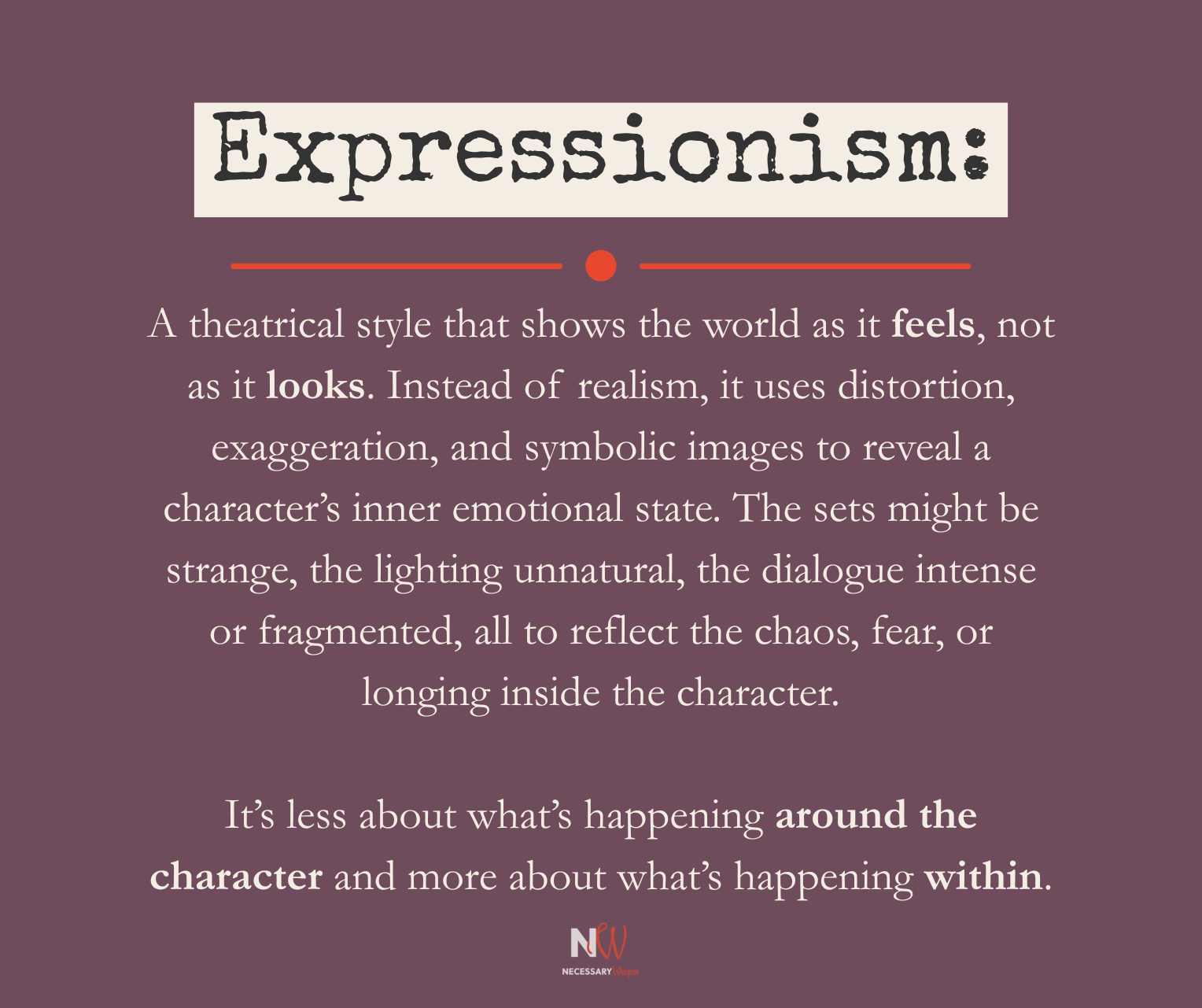
Expressionism emerged not just as an aesthetic reaction but as a psychological necessity. It rose in Germany just before and after the First World War, when artists, writers, and thinkers could no longer trust polite forms or representational art to convey the depth of their unrest. The goal was no longer to describe the world, but to reveal what it felt like to live inside its unraveling.

Expressionism didn’t aim to reflect reality. It aimed to confront it. To scream. To force the invisible into view. It distorted shape and color. It abandoned polite storytelling. It turned theatre into a site of emotional exposure. Art no longer asked to be admired. It demanded to be felt.

Playwrights like Georg Kaiser and Ernst Toller wrote not from detachment, but from fever. Their characters howled, wandered, broke open. In From Morn to Midnight, Kaiser’s bank clerk steals a fortune in search of meaning, only to spiral into surreal chaos. Toller’s Man and the Masses, written from a prison cell, thrusts its characters into revolution and despair. These weren’t dramas about individuals so much as spiritual X-rays. The characters bled longing and confusion. Their journeys didn’t resolve. They collapsed under the weight of their own yearning.

Expressionist theatre rejected realism’s comfort. Sets twisted into unnatural angles. Shadows devoured space. Costumes hinted at archetype, not personality. Actors moved like puppets or machines, tracing patterns that suggested they weren’t free but shaped, warped by invisible forces. The stage no longer depicted a living room. It became a mind under pressure, a soul under siege.

And that pressure had a point. Expressionism didn’t aim to confuse. It aimed to rupture numbness. When language failed, characters shouted. When logic failed, time fractured. These stories didn’t ask the audience to observe. They asked them to wake up.

In America, Expressionism evolved but kept its urgency. Elmer Rice’s The Adding Machine followed Mr. Zero, an accountant replaced by a machine. Rice filled the play with grotesque figures and abstract settings. Mr. Zero’s afterlife felt as soulless as the office he left behind. Rice didn’t mourn Zero’s death. He exposed the deeper loss, his humanity erased long before he died.

Eugene O’Neill pushed further. In The Hairy Ape, a laborer named Yank fights to belong. Society mocks him. His voice frays. His movements grow brutal. By the final scene, he collapses in the arms of a caged gorilla, an image that cuts through metaphor. O’Neill doesn’t leave us with an explanation. He leaves us with an ache.

Expressionism isn’t hopeless. It hungers for clarity. It distorts not to destroy but to reveal. Its jagged lines point toward the truth realism can’t hold. When a character screams, the play doesn’t collapse. It breaks open. When light slants the wrong way or dialogue shatters, the illusion doesn’t fail. The truth steps in.

We still feel Expressionism’s pulse. Sarah Kane’s ferocity. Caryl Churchill’s fragmentation. Tony Kushner’s haunted tenderness. Expressionism slips into modern theatre whenever the world grows too quiet in the face of pain, whenever the surface hides too much.

It isn’t just a style. It is a reckoning. A fever. A mirror held not to the face but to the soul. It asks: What happens when we can no longer live in the shape the world gives us?

Expressionism dares to answer.

Rather than linger in Expressionism’s most extreme forms, I turn to a work that adapts its methods into a form I deeply admire, Mike Nichols’s 1967 film The Graduate. The film’s visual style, psychological tone, and narrative dissonance make it a compelling case study in the expressionist tradition.

Expressionism in The Graduate

At first glance, The Graduate appears to follow the conventions of a coming-of-age film. A young man, freshly graduated, faces an uncertain future and becomes entangled in an ill-advised affair. Beneath this seemingly straightforward narrative, however, lies a visual and emotional language rooted in Expressionism. The film does not simply tell Benjamin Braddock’s story. It externalizes his interior confusion, dread, and alienation. The world around him is not stable, neutral, or whole. It reflects his fragmentation, and in doing so, the film belongs squarely in the lineage of Expressionistic art.

Acting: Detachment as Performance

Dustin Hoffman’s performance as Benjamin is notable for its restraint, bordering at times on paralysis. His movements are minimal. His facial expressions often remain blank or subtly off-beat. Rather than embodying a dynamic protagonist, he seems to shrink from action, as though something larger and oppressive is pressing in on him. This is not naturalism. It is stylized inertia. His presence becomes a kind of void, an anti-performance that reflects his disorientation and disengagement from the roles others assign him.

Consider the scene in which Benjamin lies motionless on a pool float, wearing dark sunglasses, while adult voices fade into indistinct murmurs. His body drifts passively, and his detachment becomes the performance itself. Rather than reacting with visible distress, he absorbs the world silently, embodying the alienation that defines expressionistic characterizations. The acting here is not a mirror to life. It is a mirror to inner collapse.

Cinematography: Psychological Dissonance in the Frame

Expressionism often distorts physical reality to convey inner emotion. The Graduate achieves this not through gothic architecture or grotesque sets, but through the camera’s choices. Director Mike Nichols and cinematographer Robert Surtees use framing, lens distortion, and mise-en-scène to make the real feel unreal. We are not merely observing Benjamin’s life. We are trapped in the geometry of his unease.

Wide-angle shots often dwarf Benjamin within sterile, oversized rooms, rendering him absurdly small in the frame. Hallways stretch unnaturally long. Mrs. Robinson is sometimes shot from above, with Benjamin framed below her knee, heightening the power imbalance and psychological tension. In one iconic transition, Benjamin jumps onto a pool raft, and without warning, the cut places him landing on top of Mrs. Robinson in bed. This dreamlike crossfade collapses time and logic. It does not follow realism. It follows Benjamin’s unmoored state of mind.

Mirrors, glass, and reflections appear frequently, creating fractured images and optical illusions that heighten the sense of internal dissonance. In one moment, Benjamin is framed through an aquarium tank, the water warping the view, the fish circling indifferently. He is submerged even when dry. He is drowning in plain air.

This moment distills Expressionism’s essence in cinematic form.

This is a brilliant moment of Expressionism in The Graduate

Story Structure: Alienation Disguised as Plot

While the plot moves forward, Benjamin does not. This, too, is expressionistic. In traditional dramatic structure, a character undergoes change. In Expressionist storytelling, the outer events expose the inner stasis. Benjamin tries to follow the story expected of him, graduate, choose a career, marry a girl, but each step is undertaken without conviction. His decisions feel reactive, almost dreamlike, more compelled than chosen. This passivity echoes the Expressionist stage tradition, in which characters function less as agents and more as vessels for existential commentary.

The film’s climax offers no catharsis. Benjamin interrupts Elaine’s wedding, they flee together, and they board a bus. But the camera lingers. Their triumphant smiles fade. The silence stretches. They look ahead, unsure of what they have actually done. This ending, unresolved, haunting, and deflated, refuses the narrative closure of romance or rebellion. It reasserts the alienation that has haunted the entire film.

As the bus carries them into an uncertain future, the film closes not with hope, but with a question. Who are we when all our roles are abandoned? What remains when we are no longer performing?

Conclusion: Expressionism’s Living Legacy

The Graduate draws from Expressionism not only in style but in spirit. It resists realism’s promise of resolution and instead immerses the viewer in a fractured world shaped by emotional truth. It belongs to the same lineage that birthed The Hairy Ape and The Adding Machine, a lineage that does not ask us to observe but to awaken. Though the techniques have evolved, the impulse remains the same. Expressionism endures wherever truth refuses to stay flat, wherever form bends to reflect feeling, and wherever art dares to reveal the soul behind the surface.

Examples of Expressionistic Set Designs

Machinal, Set Designer Miriam Buether
Dracula, Set Designer Kim A. Tolman
The Adding Machine

✨ If you’d like to keep reading more essays like this, you can also find Jill Szoo Wilson on Substack: https://substack.com/@jillszoowilson