
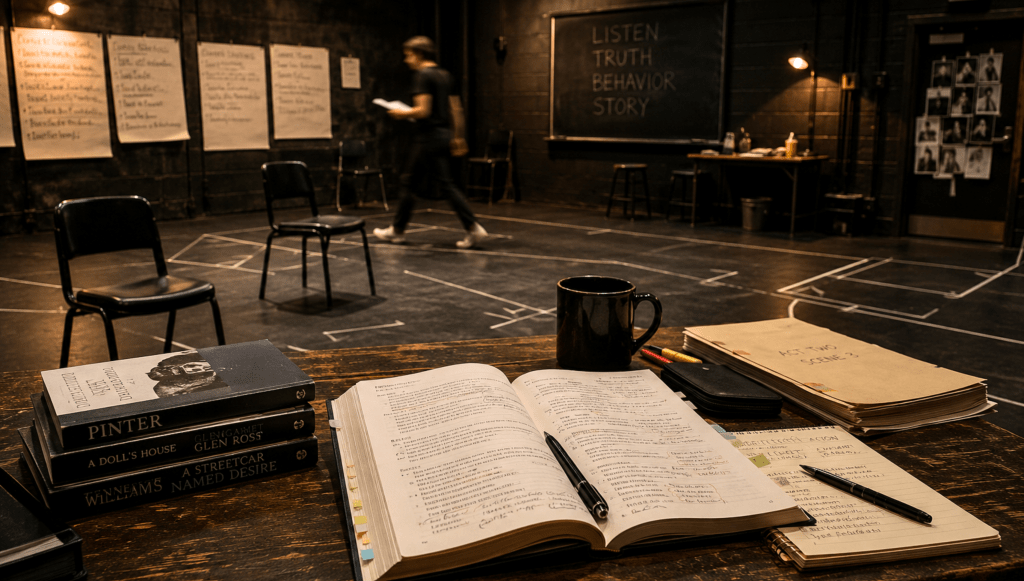
These essays explore theatre, performance, directing, acting, language, silence, identity, and contemporary culture through the lens of dramatic literature and theatrical practice. Written for students, actors, directors, educators, and readers interested in performance theory, each essay is available in downloadable PDF format for classroom, rehearsal, or personal study use.
Jill Szoo Wilson holds an undergraduate degree in Speech Communication and Theatre Education and a Master of Fine Arts degree in Acting and Directing for Theatre. From 2006 through 2017, she taught theatre in high schools, universities, performing arts academies, and private coaching environments while continuing to work professionally in performance and directing. Her essays draw from years of rehearsal-room practice, actor training, dramaturgical analysis, and classroom conversation, bringing together theatre scholarship and lived theatrical experience in a voice designed to remain intellectually rigorous while accessible to contemporary readers.
Beauty and Destruction in the Work of Sam Shepard: A Theatrical Collision
This essay explores how Sam Shepard stages beauty and destruction as intertwined forces within Buried Child, True West, and Fool for Love. Drawing on the acting theories of Sanford Meisner and Uta Hagen, the piece examines Shepard’s poetic realism, fractured family dynamics, emotional violence, and theatrical use of space through the lens of live performance, psychological inheritance, and actor presence.
Download a PDF version of this essay for classroom, rehearsal, or academic use.
The Space Between: Silence as Invitation and Rejection in the Plays of Harold Pinter
This essay explores how Harold Pinter uses silence, pauses, and beats to shape tension, power, vulnerability, and emotional distance within Betrayal, The Homecoming, and The Dumb Waiter. Drawing on performance analysis and the acting theories of Sanford Meisner and Uta Hagen, the piece examines how subtext, rhythm, and unspoken thought become central forces in theatrical performance and audience experience.
Download a PDF version of this essay for classroom, rehearsal, or academic use.
The Cost of Becoming: Willy Loman and the Collapse of the Performed Self
This essay explores how Arthur Miller’s Death of a Salesman dramatizes the psychological collapse of identity when self-worth becomes tied to performance, admiration, and external success. Drawing on the acting theories of Sanford Meisner alongside psychological and developmental theory, the piece examines memory, shame, masculinity, family inheritance, and the fragmentation of the self through the character of Willy Loman and Miller’s expressionistic theatrical structure.
Download a PDF version of this essay for classroom, rehearsal, or academic use.
Conversation as Negotiation: The Theatre of Lanford Wilson
This essay explores how Lanford Wilson builds drama through the unstable movement of conversation itself in Talley’s Folly, Fifth of July, and Burn This. Drawing on rehearsal practice and the acting methodology of Sanford Meisner, the piece examines how listening, hesitation, interruption, and shifting rhythm allow language to become a living process through which intimacy, memory, conflict, and emotional exposure gradually emerge in performance.
Download a PDF version of this essay for classroom, rehearsal, or academic use.
The Rooms Where Truth Presses In: On Tennessee Williams and the Work of Being Seen
This essay explores how Tennessee Williams builds theatrical tension through the pressure that develops between what characters say, what they withhold, and what the room itself begins to reveal in A Streetcar Named Desire, The Glass Menagerie, and Cat on a Hot Tin Roof. Written from an actor-director perspective, the piece examines how performance, physical space, silence, and subtext shape the emotional architecture of Williams’ theatre and the difficult human work of being fully seen.
Download a PDF version of this essay for classroom, rehearsal, or academic use.
Need as Dramatic Force in the Plays of David Mamet
This essay explores how David Mamet builds theatre around human beings trying to secure something essential before someone else takes it away. Through Glengarry Glen Ross, American Buffalo, and Oleanna, the piece examines how Mamet transforms ordinary conversation into a volatile struggle for dignity, territory, belonging, and control, while drawing on the acting methodology of Sanford Meisner to explore how pressure first registers in the body long before it settles into language.
Download a PDF version of this essay for classroom, rehearsal, or academic use.
The Conditions of Speech: Voice, Power, and Authorship in the Plays of Timberlake Wertenbaker
This essay explores how Timberlake Wertenbaker constructs theatre around the unstable relationship between language, power, and authorship in Our Country’s Good, The Love of the Nightingale, and After Darwin. Drawing on the acting methodologies of Sanford Meisner and Uta Hagen, the piece examines how speech is acquired, withheld, borrowed, and negotiated within systems that determine who is permitted to speak, how meaning circulates, and how identity gradually forms through language itself.
Download a PDF version of this essay for classroom, rehearsal, or academic use.
Henrik Ibsen, Moral Architecture, and the Performance of Social Identity
This essay explores how Henrik Ibsen constructs theatrical worlds in which identity forms under the pressure of family, marriage, social expectation, and moral performance in A Doll’s House, Hedda Gabler, Ghosts, and The Wild Duck. Drawing on the acting methodologies of Sanford Meisner and Uta Hagen, the piece examines how silence, behavioral adaptation, domestic space, and psychological pressure shape Ibsen’s dramaturgy, where characters gradually recognize the systems that have been organizing their lives all along.
Download a PDF version of this essay for classroom, rehearsal, or academic use.
Peter Brook and the Empty Space in an Age of Meta-Absurdism
This essay explores how Peter Brook’s theory of the “empty space” acquires renewed urgency within a contemporary culture shaped by distraction, mediated identity, and perpetual self-performance. Drawing on The Empty Space, Brook’s directing philosophy, contemporary performance culture, and the framework of Meta-Absurdism developed through classroom conversations with theatre students at St. Louis Community College–Meramec, the piece examines presence, risk, spectatorship, and theatrical immediacy in an age increasingly defined by fragmentation, self-consciousness, and digital performance.
Download a PDF version of this essay for classroom, rehearsal, or academic use.
The Meisner Technique and the Art of Paying Attention explores Sanford Meisner’s approach to actor training through observation, behavioral responsiveness, repetition, and truthful interaction under imaginary circumstances. Examining concepts such as “pinch and ouch,” emotional preparation, objective-driven behavior, and the reality of doing, the essay traces how Meisner trained actors to stop presenting emotion externally and begin responding instinctively through live exchange with another human being. This essay serves as a foundational piece within Jill Szoo Wilson’s larger theatre essay series, introducing many of the acting principles, rehearsal concepts, and behavioral frameworks that appear throughout her discussions of playwrights, scene work, performance analysis, and Uta Hagen–based actor training.
Download a PDF version of this essay and a companion vocabulary sheet for classroom, rehearsal, or academic use.
The Performing University: Assessment, Authenticity, and Meta-Absurdism in Higher Education
What happens when the demonstration of learning begins to compete with learning itself? Drawing on educational philosophy, theatre theory, and contemporary assessment scholarship, this essay argues that higher education has become an environment in which students, faculty, and institutions increasingly perform authentic work while simultaneously producing evidence of that work for expanding audiences. Introducing Meta-Absurdism as a framework for understanding this condition, the essay explores how assessment, accreditation, and institutional accountability have reshaped the lived experience of teaching and learning. Through the lens of theatre, it offers a new vocabulary for understanding authenticity, performance, and educational purpose in the modern university.
Download a PDF version of this essay and a companion vocabulary sheet for classroom, rehearsal, or academic use.
New here? Visit the About Jill Szoo Wilson page to learn more about my work, or continue exploring my essays on theatre, theology, communication, vocation, and Meta-Absurdism.

