
One layer at a time he peeled me

Like an onion

His hands wrapped around my outer skin

From top to bottom he found my flesh

And I made him cry

Like water

Running down the side of rock

In a cascade of drops becoming

A river below

Into which we jumped

His tears breaking our fall.


One page at a time he turned me

Like a book

His hands against the leather

Bound around my story, all my words

Unspoken and broken

He read and knew and studied

Like art

Smeared across a canvas

With descriptions written below

Telling of the image

Sitting still and wanting

To be known.


One note at a time he sang me

Like a song

Released from the beak of a bird

Whose daily life is filled

With music because music is

Like emotion

Strong and loud when the air is enough

And slow and soft

When there is tenderness in the touch

A balance of adagio and

A quickening of the pulse.


One sip at a time he drank me

Like wine

Held inside a carafe

Until the day my breath met his

At the edge of a glass

And stained our mouths with red

Like a flower

Vibrant with color and life

Not pulled but watered instead

By attentive hands

That understand

Petals cut or plucked

Are already dying.


Whatever the measures by which he moves

Whatever the story he tells

Whatever the words he says or unzips

I am undone

And his.

© Jill Szoo Wilson
Author: Jill Szoo Wilson
I am captivated by beauty, questions that dig to the center of things, and people who tell the truth about the human experience.
Slow Art: Unhurrying Your Mind
Museums invite looking, yet most visitors treat art the way they treat emails: a quick skim, a polite nod, and on to the next thing. We spot a recognizable subject or a pleasing color, think, “Ah yes, culture,” and keep walking. Studies suggest that viewers spend less than thirty seconds with a work of art before moving on. It is possible to tour an entire gallery without truly arriving anywhere at all.
Slow Art suggests another way to exist among masterpieces.
Rooted in the broader Slow Movement and formally organized with Slow Art Day in 2010, the practice encourages viewers to remain with a single artwork long enough for something meaningful to happen. The idea is simple: stop rushing. Stop conquering exhibitions like they’re errands. Let a painting interrupt the pace of your day.
Of course, the mind resists immediately. The moment we sit down and dare to look, our thoughts fling themselves into crisis: seventeen neglected texts, three unpurchased groceries, and the intrusive belief that productivity is our moral duty, and this bench is a crime scene. Apparently, stillness is very dramatic.
Yet if we continue to sit, the noise eventually settles. We start to notice the obvious things we missed when our thoughts were busy staging a coup: light falling across a shoulder, a line of color we would have sworn was not there a moment ago. Philosopher Maurice Merleau-Ponty argued that seeing is never passive; we do not merely observe the world. We are in conversation with it. Given time, a painting stops acting like an object and begins to behave like a presence. It answers back.
Meanwhile, neuroscience is offering evidence for what artists have always suspected. When we linger with an artwork, the brain does more than register shape and shade. Regions connected to memory, imagination, and empathy start sparking awake, as though the mind suddenly recalls it has a richer job than survival. Interpretation emerges. Emotion slips in without asking permission. You are no longer deciphering the art. You are encountering yourself.
Slow looking becomes a decision to let meaning unfold at its own pace.
It is a tiny rebellion against the cult of efficiency. Instead of demanding results from a painting — explain yourself, be profound, hurry up — we allow the experience to be unmeasurable. Sometimes revelation arrives. Sometimes quiet does. Both are victories over the museum sprint that ends with a gift shop purchase and no recollection of the gallery that preceded it.
This week, I sat with a painting of moonlit fields and distant wind. Nothing moved, yet somehow everything did. The air itself seemed to stretch across my skin, my breath eased, and the horizon widened inside me. It felt like remembering how to be a person rather than a calendar.
I answered the art’s invitation in the only way I know:
by writing.

Hush
By Jill Szoo Wilson

My dear, now hush. Unburden every care;
The silent fields invite your breath to slow.
The wind lifts strands of worry from your hair
And strokes your cheek with touches soft and low.

O moon, shine steady, hold your silver ground;
A lantern calm above the world’s unrest.
Pour down a peace too deep for any sound
And press a quiet knowing to the chest.

Kind wind — sweet wanderer — move as you will;
Let coolness glide along these open hands.
Brush thought from thought, invite my heart to still,
And ferry calm across the quiet lands.

Here, nothing strives. The wide horizon sighs—
At last, the soul grows spacious as the skies.
Block 10 in Auschwitz
By Jill Szoo Wilson
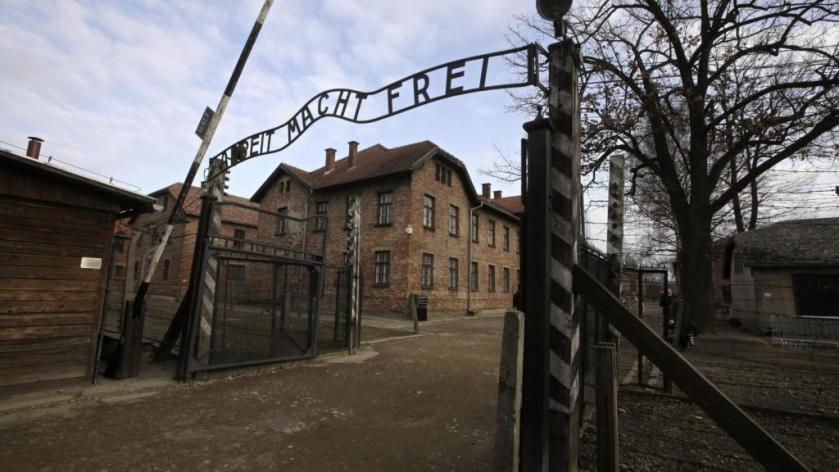
At the end of our first day in Auschwitz I, after our hour-long bus ride back to the safety of our hotel, after a nourishing dinner shared with friends, after showers and moments of silence and feeling the safety of “the group” wrap around us like a blanket that protects not from cold but fright, we spoke. We questioned. We looked into one another’s eyes for answers that no one had—in this way, there were long stretches of time, like a ticking clock, during which the windows of the souls sharing this journey reflected both confusion and comfort back and forth. Back and forth.
During a discussion in the hotel lobby on this particular night, I felt a shift in our collective journey. At the beginning of the trip, we all understood the events of the Holocaust, some in more detail than others, and we knew the basic story that unfolded under the trees and sky, and over the dirt through which we were treading. We had seen Schindler’s List, read books carefully penned by survivors, poured over documentaries and songs and poetry . . . even with our individual knowledge and experience acting as tent poles to our individual decisions to travel to this place, there was one thing we could have never fully anticipated: Auschwitz I looks like an idyllic place to be and there is something terrifying about that. The beauty of the camp is more reminiscent of a college campus neatly organized for the sharing of ideas than for the ripping apart of lives. It’s like a lake whose surface grabs hold of the sun in tiny mirrors of brilliant warmth but swarms with leeches in the darkness below. The hypocrisy that exists between the visual stimulus and the cognitive understanding begs the question: What other places look perfect but are not? Can we ever really know what lies behind windows, doors and walls?
While all the buildings in Auschwitz I that are open to the public have been renovated and turned into memorial museums dedicated to different groups of victims, aspects of the Holocaust and exhibits that make connections between the past and the present, there is one building through which we walked that had not been touched for almost 70 years: Block 10. Even as I type those words, my breath changes. There is heaviness in my chest that isn’t dropped there merely by the memories of the building itself but also by the disconcerting and shadowy questions that pressed my understanding against its walls, like thumb tacks of fear, bewilderment and the kind of silence that is erected by the words, “If you tell anyone, I will kill your family.” The public is not welcome into this building as a means of respecting the lives that were lost there. Because we were with Eva, we were given entrance into this building, much like a cemetery, and we all tripped over the invisible headstones that filled the space where air would otherwise reside. Only 10 of us were allowed to enter the building at a time.
Block 10 is the building in which physical experiments and autopsies were performed. Eva and her sister Miriam were made to walk from Birkenau to Auschwitz I several times a week, no matter what the weather, knowing the physical scrutiny that awaited them.
Before I go on, I feel the need to explain that this particular blog has been the most difficult for me to compose. I have gone through so many starts and stops in trying to describe Block 10 that the place itself is growing larger in my mind as I fight the discomfort with which writing about it has plagued me. I admit this to you, my reader, not as a means of justifying any inadequacies in my descriptions but as an admission of how the mere topic is one from which I want to run. I want to stop writing, again. Alas, I am going to lean into the discomfort and shine a light on the darkness I witnessed there.
Walking into block 10 was like walking into a crowd of spectators circled around a little girl who had fallen from the top of a Ferris-wheel to her death on a dirty carnival ground. Picture men with dirty hair who smell of body odor and rancid chewing tobacco; tarnished silver rings bearing the images of skulls; moldy mobile homes filled with dishes heavy laden with crusted leftovers, and pornographic magazines tattered with use. None of this existed inside Block 10 but the atmosphere inside the building reminded me of the transient, restless nature of a traveling carnival. It was unsettled, foul, dark, obscene—and it echoed—those of us who walked through the cavernous space instinctively grew quiet as children trying to hide from an intruder and yet, somehow, our voices reverberated more loudly here than they did anywhere else in the camp.
The windows on one side of Block 10 are all covered with boards—the side of the building that faces the Execution Wall. The Auschwitz guide explained to us that the reason for the boards was to shield the eyes of those inside the building from seeing the fate of those standing on the other side of the glass. “Shielding” in this case was not an act of protection or extending comfort, it was simply a means of trying to avoid a heightened and spontaneous sense of panic. What this implies is that the doctors inside the building exacted control over their subjects in as much as they controlled their bodies, but they could not control their minds, their imaginations. For a subject to sit still while her eyes were being propped open by two pieces of steel was to control her by insinuating that her cooperation might keep her alive inside this makeshift doctor’s office—to let her shift her focus to the blatant executions 5 feet from her gaze might relinquish her motivation for compliance altogether. These boards that once shielded the eyes of those whose bodies were being used for experiments now serve to cast an eerie shadow on rooms that would be dark in the midst of a million candles lit in memorial to the lives that were lost there.
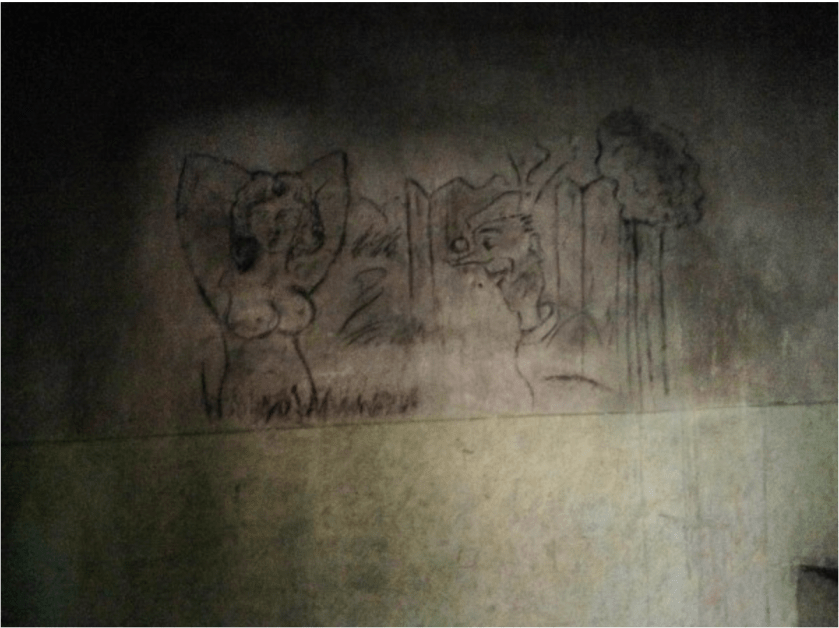
The hallways and each of the rooms have been stripped of the tables and chairs that once held prisoners there. Emptied except for one remaining table that sat, seemingly innocently at the end of one room. This table was used to conduct autopsies. The only other specific items existing in the space was a small windowless square room, about 7×7 feet, in which there was a concrete shower and what seemed to be a broken pipe hanging from the ceiling, and there were a series of drawings on the walls in two of the rooms. The first drawing I noticed was crassly drawn in the 7×7 room. It was an illustration of a man gawking at a woman’s bare chest. The second drawing I saw was of a small cottage sitting on what seemed to be a serene field. The first drawing made me angry. The second simply confused me. I could imagine the artist of the first but I had no idea whose hand to imagine as I looked at the second. This is to say that looking at the cartoonish pornography in the small square room as I felt the heaviness of evil that still rests upon that building like a fog filled with gnats and poison, the juxtaposition of the torture and the illustrated character made me feel like vomiting. I covered my mouth and squinted my eyes and shook my head and leaned back onto one of the walls . . . until I realized I was leaning back onto one of the walls. Quickly, I jolted my body away from the wall and felt dust particles and flakes of old, dead skin clawing at my back. The person who drew this image of a woman’s bare breasts was immersed in a world of bare breasts and naked bodies that were exposed to him in one of the most vulnerable and unwilling seasons of any number of women’s doomed lives—I was seeing sexual and physical abuse in its most raw form, without actually seeing it. What’s worse is that I could feel it inside that building. Even now, as I type these words my hands shake and my body feels cold. Being this close to the bawdiness of evil is an experience I will never forget. Nor should I.
The second drawing, as I stated above, simply confused me. I didn’t have any emotion left with which to interpret it after having been so repulsed by the first. I couldn’t tell whether it was drawn by a prisoner longing for home or by the same hand that had moments before drawn the naked woman. Either way, I came to hate the drawings on the walls.
There was a period of about 5 five minutes in which I stood by myself in one of the rooms whose windows were boarded. My eyes were wide as I studied the walls, the ceiling, the floor, the lighting fixtures. I noticed there was wallpaper on one side of the room. The presence of wallpaper struck me as laughable, so I laughed. Why in the world would someone find it necessary to cover this wall with wallpaper? Who were they kidding? Why decorate a room in which human souls were being stripped of their dignity and in some cases, their breath? I considered the sinful nature of man and the ways in which we paper over our own ugliness in an effort to either hide it or to numb ourselves from feeling the shame of our own indiscretions. Using the tools of my art as an actress I looked around the room as a child patient, then as an adult patient, then as a nurse, then as a doctor. I allowed the thoughts of each to build themselves in my mind—some of them constructed themselves quickly and with a strength that forced me to close my eyes. Some of these thoughts were quiet and slow—they peaked around the corners of my mind and then slid out the sides of my consciousness like children racing down laundry shoots and into dirty piles of laundry. I was inside the environment and the environment tried to force its way inside of me. The air punched me and the ghosts cried out to me for help and, eventually, the evil of the place began to laugh at me. It was in this moment, when the crescendo of reality drummed loudly in my ears that I stopped feeling the heaviness and I stood up straight, pounded my feet as I moved to the center of the room with the boarded windows and I prayed, “Jesus, I am sorry for what happened here. On behalf of humanity gone completely awry, I am sorry. You are omniscient, omnipresent and omnipotent . . . what did it do to your heart to watch all of this happen?” This was a turning point for me. Before this moment I was asking, “God, how did you let this happen? Why did you let this happen?” I wasn’t angry with God, but the deeper I walked into the horror, into the darkness, the more I looked for the Light. The more I looked for the Light, the darker the darkness became; until I stood in the darkest place in Auschwitz. That is when I tangibly felt the weight of sin and the absolute Love of God. My heart broke for the people who stood, sat, died in that room and I realized that what the Bible says is true, “God is near the broken hearted.” His heart breaks for us.
Inside Block 10, there was no hypocrisy existing between the visual stimulus and the cognitive understanding of what I saw. It was, and remains to this day, a haunted house lined with memories that shout through the revelation of pain; floorboards that creak with dried tears; walls that are shedding their floral patterns under the pressure of shame and anger; windows that shield their eyes from the sun and have lost their ability to see.
© Jill Szoo Wilson, 2024
The Mind-Body-Emotion Circuit: Learning How to Respond on Purpose
By Jill Szoo Wilson
In acting, emotion is often treated as the goal. Many students arrive hoping to unlock a secret reservoir of feeling, as if tears or rage or heartbreak could be summoned by force of will alone. Yet experienced artists and psychological researchers alike know that emotion resists direct manipulation. The human heart refuses to be commanded. Instead, emotion tends to emerge as a consequence of the way we think and move through the world. This reality, long understood intuitively by actors, has now been documented in cognitive and behavioral science. As Meisner observed, performance becomes truthful only when the actor lives with authenticity inside imagined circumstances rather than attempting to manufacture emotional display on cue (Meisner & Longwell, 1987).
This understanding is essential in my work as an acting teacher. One of my current private students, whom I will call Paige, embodies the determination required to bridge intellect, body, and imagination. She asks thoughtful questions, listens without pretense, and possesses a grounded confidence that draws others toward her. In the studio, she is learning that the actor’s instrument is not the voice alone, nor the body alone, nor even the mind alone, but the constant interplay among them. When that interplay is disrupted, performance becomes flat and disconnected. When it flows, the actor’s work becomes alive.
To explain this interplay, I teach what I call the mind-body circuit, a cycle rooted in both performance pedagogy and psychology: thought → emotion → action → new thought → emotion → action, and so on. The sequence appears simple, yet it reveals something profound. The actor can enter it through thought or action, but rarely through emotion alone. Emotion depends on a catalyst. It responds to meaning and circumstance. This is why actors who begin with the desire to “feel sad” or “play anger” inevitably fall into generalization. They are grasping at the byproduct rather than engaging the cause.
Directors and psychologists alike recognize that embodied behavior shapes inner life. Neuroscientist Antonio Damasio describes the body as a “theater of feeling,” where emotion is both generated and displayed through motion and sensation (1999). Onstage, this principle becomes visible in dramatic form. To demonstrate this, I once handed a student a hammer and instructed him to break scrap wood in character for thirty seconds. The task was intentionally physical, forceful, and resistant, because the body cannot remain neutral when exerting strength against an object that pushes back. There was no discussion of backstory or psychology. The action demanded urgency and focus, which silenced self-consciousness and awakened the nervous system. As the student swung the hammer, his breath shifted, muscles tensed, and emotion surfaced unbidden. Within moments, he found himself articulating thoughts and personal stakes that had felt inaccessible when he tried to intellectualize his way toward feeling. Stanislavski identified this phenomenon nearly a century ago: “In the beginning, you must not settle matters of feeling. Begin with the action” (1936).
There are other occasions when thought becomes the most generative entry point into the mind-body circuit. During rehearsals for Hamlet, Paige and I worked through a scene in which Ophelia confronts a lover who, until recently, adored her. Before this scene, Hamlet has pursued Ophelia with gentle attention and romantic promise. He has spoken of love and a future together. Then suddenly, with no explanation she can understand, he turns on her. He tells her she should enter a convent, that she should never marry, never bear children, never bring more life into a world he now condemns. At first, Paige named her character’s feelings: confusion, concern, hurt. These were legitimate emotional states, but they did not yet clarify what Ophelia believed was happening or what she needed in response. We returned to the text to articulate the specific rupture: this is not Hamlet being odd or distracted; this is Hamlet erasing their entire future with a single, devastating reversal. Once Paige understood that she was experiencing rejection not only of affection but of identity, legacy, and security, her body changed. Her posture leaned forward, breath tightened, and she instinctively reached toward her scene partner, trying to recover the man she once knew. Thought created meaning. Meaning triggered emotion. Emotion propelled action. The circuit closed into a continuous chain.
Psychologist Richard Lazarus offers a framework in which emotion arises from the mind’s effort to interpret and evaluate experience. He proposed that individuals engage in a form of cognitive appraisal, a rapid assessment of what an event means for one’s safety, identity, or sense of belonging, followed by an assessment of whether one has the capacity to respond (Lazarus, 1991). Through this process, emotion becomes a reflection of significance. Fear signals the presence of danger. Grief testifies to the worth of what was lost. Anger reveals a boundary that matters. These meanings take shape first in the mind, then move through the body as behavior and physiological response. Acting technique embraces this sequence. When the actor fully recognizes the stakes—the value of the moment, the cost of failure, and the depth of desire—inner life begins to organize itself accordingly. The heartbeat quickens, posture shifts, and voice carries urgency. Stella Adler emphasized this principle in her own vocabulary, insisting that powerful performance grows from vivid circumstances and clearly drawn stakes. “You have to have a life,” she wrote, “so that you can bring something to the stage” (Adler, 2000). Through this kind of interpretation, the actor does not strive for emotion; instead, the emotional experience grows naturally from an understanding of what the story demands.
The insights found in performance theory also apply broadly to human interaction. Consider a common moment of betrayal between friends. One friend learns that another has broken confidence. Immediately, thought begins to organize meaning: She violated our trust. That thought produces feeling: anger, hurt, humiliation. The emotion then provokes action: perhaps a confrontational text or a cold withdrawal. In ordinary life, we navigate this circuit constantly, often unconsciously. Acting simply requires that we notice, name, and render the process visible.
Actors become investigators of cause and effect, tracing the thread from impulse to action with the curiosity of scientists and the sensitivity of artists. Within the rehearsal room, questions take on the weight of inquiry: What shift redefines the moment? What desire rises beneath the surface of my breath? What force complicates that desire? Which strategy carries the greatest hope of success? These questions reach beyond technique. They cultivate a heightened awareness of the subtle negotiations between inner experience and outward behavior. Through this discipline, actors recognize emotion as a current generated by the convergence of thought, intention, and physical choice. When these elements align, audiences engage instinctively with the authenticity of the performance, sensing a unified direction in every gesture and word. Emotional truth grows from coherence, and the stage becomes a place where meaning moves through a living body.
When Paige recently completed a difficult scene, she paused and said with surprise, “I finally felt something I wasn’t trying to feel! That was amazing! And terrifying.” In that moment, she encountered the paradox that defines the work. Emotion, once chased, becomes elusive. Emotion, once approached through purposeful action and clarified meaning, becomes inevitable. The mind-body circuit had connected, and she no longer had to reach for authenticity. It arrived.
Actors remind us that the human body carries intelligence of its own. Thought shapes emotion. Emotion prepares movement. Action generates new meaning. The circuit continues, alive and responsive. When actors understand this relationship, they work with the grain of their own humanity rather than pushing against it. They can shape a truthful inner life by pursuing clear objectives, taking bold physical action, and recognizing what matters in each moment of the story.
This is the heartbeat of the craft. Acting trains us to observe how feelings arise, how impulses travel, how the body communicates meaning long before words appear. Performers practice this awareness with intention, so audiences can recognize themselves in the characters before them. The mind-body circuit is not only a technique; it is a reminder of how people operate in the real world. We feel because something has happened. We respond because something matters.
Paige experienced this discovery in rehearsal. She did not demand emotion. She followed the logic of the moment, committed to the physical truth of the scene, and allowed meaning to do its work. The emotion arrived when it had something to say.
References
- Adler, S. (2000). The Art of Acting. Applause Books.
- Damasio, A. (1999). The Feeling of What Happens: Body and Emotion in the Making of Consciousness. Harcourt.
- Lazarus, R. (1991). Emotion and Adaptation. Oxford University Press.
- Meisner, S., & Longwell, D. (1987). Sanford Meisner on Acting. Vintage Books.
- Stanislavski, K. (1936). An Actor Prepares. Theatre Arts.
Eva Mozes Kor and the Price of Forgiveness
By Jill Szoo Wilson
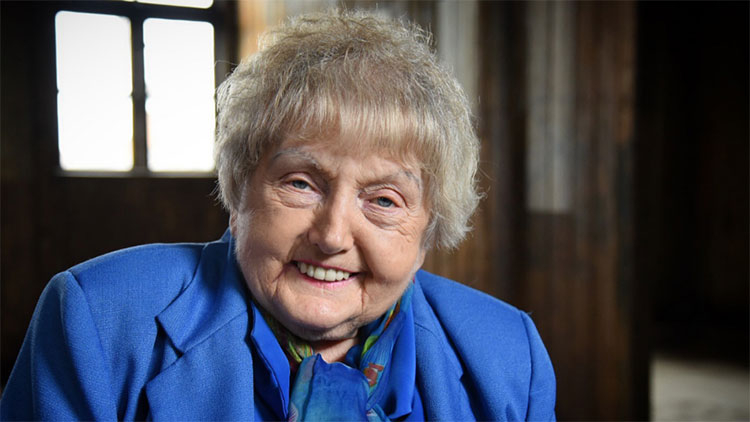
Eva Mozes Kor often said, “Anger is a seed for war, forgiveness is a seed for peace.” It was more than a slogan. It was a theology, a philosophy, and a daily discipline forged from one of the darkest chapters in human history. As a child imprisoned in Auschwitz and subjected to the medical experiments of Josef Mengele, Eva discovered that survival demanded a defiant hope. Decades later, she chose forgiveness as a form of liberation that offered survivors a path toward healing. Her decision inspired admiration and deep respect, and it also sparked fierce debate about justice, memory, and the boundaries of human compassion. The peace she pursued required extraordinary courage, because every step forward in forgiveness carried a cost.
I recently revisited one of Eva’s emails, a message filled with the kind of raw honesty that few people ever achieve. It was written in her unmistakable, unpolished style: urgent, passionate, and deeply personal. In it, she reflected on the consequences of her decision to forgive a former Nazi doctor, Dr. Hans Münch, and the relentless challenges she faced in opening CANDLES Holocaust Museum.
Reading it now, years after her passing, I am struck by how unyielding she was in the face of criticism, injustice, and personal danger. She did not simply speak about forgiveness. She lived it, even when it cost her dearly.
The Controversy Over Forgiving a Nazi
In 1995, on the 50th anniversary of the liberation of Auschwitz, Eva Mozes Kor did something unthinkable to many: she publicly forgave the Nazis. More than that, she stood beside Dr. Hans Münch, a former SS doctor at Auschwitz, and signed a declaration of forgiveness.
The backlash was immediate and fierce.
Israeli media framed the moment as a betrayal. Footage of Eva walking with Münch was broadcast again and again, without the context behind it.
A major Israeli newspaper published a scathing article, questioning whether any publicity was better than being ignored entirely.
In 1998, journalist Bruno Schirra published an interview with Münch in Der Spiegel, where the former SS doctor made remarks about his time in Auschwitz. The interview triggered a criminal investigation in Germany.
Around the same time, a French radio interview with Münch led to an even more explosive controversy. His derogatory remarks about Roma and Sinti people resulted in criminal charges in France for inciting racial hatred.
The consequences were devastating.
Münch and his family faced public scrutiny, threats, and harassment. In Germany, legal action pushed toward trial despite his diagnosis of Alzheimer’s disease.
In a personal email to me, Eva shared that Münch’s home was firebombed three times after his address was published in an article, requiring police protection for his family. I have not been able to verify this in any public record or independent source. It was her own account, offered behind the scenes, reflecting the weight she felt over what was happening to Münch and his loved ones.
Eva was horrified by what was unfolding. She had spent years advocating for justice. Now, she found herself advocating for mercy.
She sent more than 50 letters pleading with authorities to drop the lawsuits against Münch, but the legal proceedings continued.
In 2001, Münch was convicted in France. His sentence was waived due to his age and deteriorating mental state. He passed away later that year.
Eva felt a complicated kind of relief. Münch’s family was finally free from further attacks, and she no longer carried the guilt of contributing to their suffering.
The Fight to Build CANDLES Holocaust Museum
By 1995, Eva Mozes Kor had already reinvented herself many times: Holocaust survivor, public speaker, and founder of CANDLES (Children of Auschwitz Nazi Deadly Lab Experiments Survivors) in 1984. That year, she took on yet another role as a museum founder.
The CANDLES Holocaust Museum and Education Center was an extension of Eva’s mission to teach others about the Holocaust and the experiments performed on her and other Mengele Twins. She wanted to create a permanent place of education, remembrance, and dialogue.
Opening the museum was no small feat.
She found a commercial building in Terre Haute, Indiana, but it was too large and too expensive for the original client she was working with as a realtor. Instead, she made a bold and risky decision to secure financing under her own name, her husband’s name, and a partner’s name to purchase the building herself.
At 61 years old, she signed a $168,000 mortgage, despite her husband’s hesitation.
With limited funds for exhibits, she handmade decorations, including a wall of blue paper strips that read:
“LET US REMOVE ALL HATRED AND PREJUDICE IN THE WORLD, AND LET IT BEGIN WITH ME!”
When the museum opened on April 30, 1995, it quickly became a vital educational resource, drawing teachers, students, and community members eager to learn from Eva’s story.
Then everything changed after 9/11.
Her business partner, who owned a travel agency, struggled to keep her business afloat. The economic downturn was crushing. Eva was forced to buy out her partner’s share of the building at a much higher price, not to expand but simply to save the museum.
By 2002, at age 68, she and her husband took out a $222,000 mortgage to keep CANDLES alive.
The Fire That Could Not Destroy Her Mission
In November 2003, Eva Mozes Kor received a phone call in the middle of the night.
“Mrs. Kor, this is the police department. You need to come to the museum. There is a fire.”
She and her husband rushed to the scene. By the time they arrived, flames were already devouring the building. Firefighters battled the blaze, but it was too late. Everything inside was lost: photographs, historical documents, survivor testimonies, and artifacts.
She stood there watching as the place she had built with her own hands, her own money, and her own pain collapsed into smoldering rubble.
Investigators then found a message spray-painted on an exterior wall in black:
“REMEMBER TIMMY MCVEIGH.”
Timothy McVeigh, the domestic terrorist behind the 1995 Oklahoma City bombing, had been executed in Terre Haute just two years earlier. The implication was chilling. This was an act of hatred and intimidation meant to silence her.
But Eva had spent her entire life surviving the worst of humanity.
The next morning, standing in front of the ashes, she made a decision.
“We will rebuild.”
And she did.
With support from the community, from Holocaust educators, and from donors around the world, CANDLES Holocaust Museum rose from the ruins and reopened in 2005, stronger than before.
You can burn down a building. You cannot destroy a mission.
The Legacy of a Fighter
Most people would have stopped. Most would have looked at the destruction of their museum as a sign to walk away.
But Eva rebuilt.
The email she sent me that recounted this event, full of spelling errors, fragmented sentences, and scattered thoughts, perfectly reflected who she was:
Unpolished, yet utterly real.
Wounded, yet relentless.
Misunderstood, yet unwilling to back down.
Eva Mozes Kor understood something most people do not. Forgiveness does not rewrite the past. It does not fix what was broken. But it allows a person to stop carrying what cannot be undone.
She was never naive. She knew the world was cruel, unjust, indifferent.
She fought anyway.
She did not stop.
What This Means for Us
Eva’s story is not only about forgiveness. It is about resilience in the face of resistance. It is about choosing to build when the world wants to destroy.
Her words still challenge me.
Could I have made the same choices? Would I have kept going? Would I have had the courage to stand alone?
Perhaps that is the lesson she left for us.
Forgiveness is a gift. The fight for something bigger than yourself is what makes history.
© Jill Szoo Wilson, 2025
Featured Image photo credit: WFYI Indianapolis, 2021
Poem: Opposite Sides of the Wall
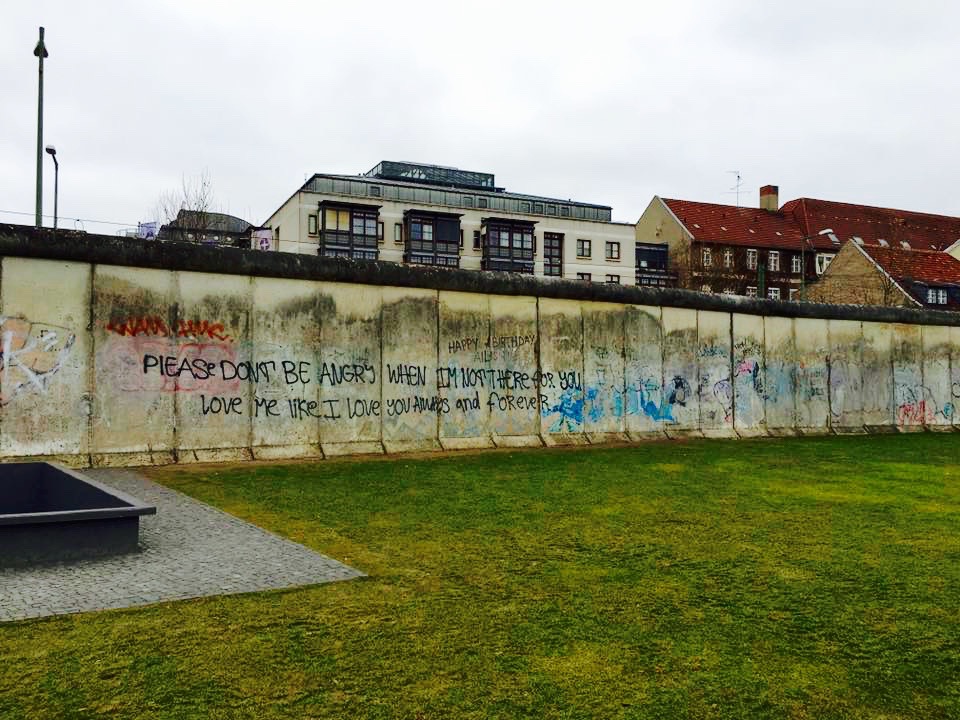
I wrote this poem after visiting Berlin in 2015, where I was fascinated by the messages people had left on the remains of the Wall. This piece was inspired by one of those messages.
From the highest story

Of a building gray and cracked

Peer two eyes

Through dusty window panes

Pestered by a mosquito

Flying along the edges.


Below the eyes

A hand

Holding tin

Filled with coffee

Cold and strong—

A cigarette burning.


The fog of stagnation

Fills the room

As one wisp of smoke

Links arms with another

A silent dirge

Circling like vultures.


Her gaze is blank

She closes her eyes

Then opens them wide

Each closing a respite

Followed by

Disappointment.


She sighs

She coughs

She smiles for a moment

As the mosquito

Bumps against the glass

Bruised and trapped.


Above her head

Noisy neighbors shout

The song of frustration

Rings out and falls

Pulled by gravity and

By doubt.


She begins to hum a tune

She has not heard

Since she held a doll

Inside chubby arms

And kissed its head

With sugary lips.


Her raspy alto

Lays itself on the notes

Her Now

Transposes the music

From major to

Minor keys.


The mosquito brushes past

Her hand

And then lands and

Sticks his needle

Into her skin—

She observes the transaction.


A flashing light—


Her gaze arrested

Handcuffed to a mirror

Reflecting the sun a

A Morse Code message

.-.. --- ...- .

Which translates, “Love.”


She dunks her cigarette

Into her mug

Shakes her hand

The mosquito falls

Disconcerted but

Full.


She strikes a match

Holds it to a candle

Thick and matted

Like a paint brush

Spotted with colors

Dried from previous use.


A thin line rises from the flame

Gentle in its approach

And dancing in the haze—

She lowers and raises her hand

.- .-.. .-- .- -.-- ...


“Always,”

She replies

In this expression

They devised

From opposite sides of

The wall.


She blows out the fire

Puts her hand to the glass

Closes her eyes and

Kisses the air

As though it is

The last kiss in the world.


He lifts his fingers

Catches her lips

In mid-air—

Hungrily brings them down

Pressing their sweetness hard

Against his own.


The moment has passed

But their love

Will last—

Reach beyond time and space

Breaking past

The Wall.

© Jill Szoo Wilson, 2015
Poem: Love and Alive
Every day he comes and goes
Like a beggar on the street,
With no way to turn
But the direction from which he came.

If the streets were carpeted—
Soft to the touch—
The tread of his soles would
Scratch holes through the path
He has
Worn.

Worn out, the man with the
Briefcase breathes heavily
Under the sun and
Under the moon,
Inhaling and
Exhaling as he travels,
Blind as he goes—
Not because he has no head,
But because he feels no pain
Or joy.
He is numb.

Numb since the day she
Walked away,
And numb when he remembers
The way
Her hips sway—
This way and that.
And numb when he
Thinks of her name but cannot
Say it—
Silent.

Silently, the bird in his soul—
The bird whose name is
Alive—
Perches at the edge of her
Cage whose name is
Life,
And wishes for the day
She might once again
Begin
To
Fly.

Flying in the air
Above the man
Is a bird whose name is
Love.
He flies up high and
Then he dips
And twirls,
Like the tail of a kite giggling
In the wind,
Awaiting the moment when
The Man
Opens his coat and
Sits on his bench
And sleeps—
Like a beggar on the street
Dreaming.

Dreaming of her face—
The only face that is
Trapped inside the Man's soul.
Love watches with a keen and
Clever eye.

In one moment—
A moment whose approach is slow,
Whose arrival is timed
By the gods,
Whose watches are synchronized
To the beating of
Bird and human hearts—
The vigilant bird
Sees
The coat fall open,
Sees
The Man sit down on his bench,
Sees
Him close his eyes and
Seizes his
Freedom.

“Freedom does not live in the sky,”
He sings.
“Freedom lives inside Alive.”

Love drifts down
Through blue and through clouds
And alights
With bars between himself and
Her—
The one who holds his
Heart
Inside of her,
Inside a cage.
The one who
Knew he would
Come.

“Come to me every day,”
She wanted to say.
But instead, she said,
“You must not waste the time
Waiting by my side,
When all the world
Sprawls before your gaze.”

Love ruffled his feathers
And looked into her eyes.
“Until you are here with
Me—
Just you and me—
I will come and sit with you
Every day.”

Every day, Love came,
Just as he said he would,
And the earth turned slowly
From summer
To autumn
To winter
To spring.

Their stories grew, and
The details they knew
Poured through the bars
Like drops of water
Flowing
From watering cans,
Growing their love,
Growing him and growing
Her.

Her days inside,
Her will to survive—
Alive and Love
Together traveled through,
Until the day
The Man stepped anew
Off his carpet of same,
Tattered and
Worn through by
His shoes—
First one and then two—
Onto a path where four
Could move:
His loafers and
Her high heels of
Blue.

Blue turned to joy,
Joy turned to alive,
And Alive for the first time
Flew.
The Man let her fly,
As his heart said
Goodbye to the
Pain that was keeping
Alive inside the cage,
Inside his
Soul.

Souls in the air,
Free with
Togetherness,
No longer bound
But soaring high,
Strengthened by
The time in the cage
And by flying
Side
By
Side.

© Jill Szoo Wilson, 2025
Poem: Ice
The moment before, he knew.
She knew it, too—but she didn’t know
What it meant.
He had spent all he had in love
And in time—
For time is all we have to spend—
Not knowing that one second would turn into
Years.

The moment before, he felt.
She felt it, too, but it was in her mind—
What it meant.
Dripping with memories, mundane,
Like coffee brewing slowly—
For love steeps one drop at a time—
Her daydreams were painted in
Love.

The moment before, he released.
She released, too, but she didn’t expect
What it meant.
Embracing and letting go, to embrace again,
Was like brushing her teeth—
For some rituals cleanse even as they return—
He knew her expectation and knew he would
Fail.

In the moment, he could smell her.
She could smell her, too—and she knew
What it meant.
He started a fire between his head
And his heart—
For the heart stokes the kindling the mind provides—
But the embers burned deeper than he
Expected.

In the moment, he could see the glow.
She could see it, too, and she knew
What it meant.
The lingering warmth of his hand on her back
Felt like ice—
For ice signals death—
The frigidity was new but not exactly
New.

In the moment, his conscience writhed.
She writhed a little, too, and she knew
What it meant.
His goodbye lingered near,
Like a rattling snake—
For snakes wait, and then they strike—
And she stiffened her heart, bracing for
The end.

The moment was gone. The seconds counted
And done.
The hem of her gown swished away;
His countenance melted
Like fire melts ice,
And ice turns to water,
And fire boils it all to steam.

The end was the beginning.
The beginning was now.
He sat on the ground.
He looked to the sky.
The moon turned out its lamp—
And he knew what it meant.

© Jill Szoo Wilson, 2025
When Fairness Fails: What Forgiveness Teaches Us About Mercy
By Jill Szoo Wilson
Fairness is one of the first moral currencies we learn to spend. Long before we master mercy, we can cry That’s not fair! with the conviction of a tiny philosopher. The playground, after all, doubles as humanity’s first courtroom. Someone cuts in line for the slide, and suddenly the entire social order collapses. Justice must be restored, preferably before recess ends.
A child’s attempt to make sense of harm and hope in miniature is a first draft of moral reasoning. Fairness helps us name wrongs, negotiate rules, and build the fragile beginnings of trust. Civilization, in its earliest form, probably started over a disputed turn on the swings.
Still, fairness only works when everyone plays by the rules. When someone breaks them, what are we supposed to do? As children, we stomp off the field or call for backup—“Mom!” “Teacher!” “Ref!”—someone who can step in and make it right. Those are the early rituals of justice. But what happens when the whistle never blows, or the person who hurt us doesn’t make it right? Some wrongs go deeper than rules. They leave distance where there used to be closeness, even a shift in who we are. Fairness can fix the rules, but it can’t fix the relationship.
What follows are reflections on forgiveness: psychological, scientific, artistic, and theological. Not prescriptions, but explorations. Because fairness is the language of balance, while forgiveness speaks a dialect of grace that refuses translation.
Fairness keeps order; forgiveness keeps us human. While playground quarrels eventually fade, the instinct to keep score doesn’t. We carry it into adulthood, dressed in the language of boundaries, accountability, and justice. We say we’ve “moved on,” but the mind rarely gets the memo. It keeps a ledger even when the heart wants peace. Modern psychology has a name for this: rumination. The ancients simply called it remembering. Either way, forgiveness begins at the border between what we can’t forget and what we no longer wish to carry.
The Psychological View: The Mind and Its Loops
Modern psychology approaches forgiveness as a cognitive and emotional release rather than a strictly moral act. Dr. Everett Worthington, who has spent decades studying the subject, describes two distinct processes: decisional forgiveness, the conscious choice to stop pursuing revenge, and emotional forgiveness, the gradual softening of the heart’s automatic resistance. The two often unfold at different speeds, one emerging from thought and the other from time.
Neuroscience, the study of how the brain and nervous system shape thought, emotion, and behavior, adds another layer to the portrait. When anger is rehearsed, the brain’s limbic system activates as though the offense is still happening. The body does not easily distinguish between a memory and an event; to the nervous system, remembering pain and experiencing it are nearly the same. Each mental replay of the story re-ignites the stress response: the heart quickens, cortisol levels rise, muscles tighten, and breathing shortens. Over time, the brain begins to associate safety itself with vigilance. The mind learns that to stay alert is to stay alive.
Forgiveness, then, becomes a kind of neurological retraining. It is a deliberate effort to interrupt the loop that binds pain to identity. In clinical practice, therapists often describe forgiveness as the gradual release of hypervigilance rather than an act of forgetting. The goal is to remember without reliving. Through reframing, deep breathing, prayer, or contemplative awareness, the body learns that danger has passed. The nervous system, once tuned to defense, begins to trust again. The mind, which has carried the story of pain like a live wire, slowly cools, allowing space for calm to return.
Still, even within psychology, forgiveness remains mysterious because it straddles intellect and intuition. It can’t be forced, and it doesn’t appear on command. Readiness comes casually, more like the slow shifting of light across a room than a sudden change of weather. It arrives when the cost of carrying pain outweighs the fear of setting it down.
The Scientific View: What the Body Knows
The body is a faithful historian. It records what the mind tries to archive, storing unfinished stories in muscle and breath. Emotional pain, left unresolved, weaves itself into posture and heartbeat until it becomes a quiet rhythm beneath awareness. Chronic resentment has been shown to raise cortisol, narrow the arteries, and disrupt the delicate cadence of sleep (Mayo Clinic, 2022). Even anger held in silence leaves its mark: a jaw set for battle, shoulders lifted as if bracing for a blow. Over time, vigilance begins to imitate safety. The body responds to the echo of harm as though the harm were happening again.
Studies from the Stanford Forgiveness Project and the Mayo Clinic confirm what poets suspected long before data caught up: forgiveness is good for your health. In research led by Dr. Frederic Luskin, participants who practiced sustained forgiveness exercises reported lower stress levels, reduced blood pressure, and a greater sense of vitality and purpose (Luskin, 2003). The heart rate steadied. Breathing deepened. The parasympathetic nervous system—the body’s rest-and-repair mechanism—reawakened. When energy is no longer burned in defense, healing begins to rise to the surface like a long-held breath released.
Science often names this moment homeostasis restored: the body’s return to balance after a prolonged alarm. Yet there is poetry in that physiology. As adrenaline recedes, blood flow increases to the prefrontal cortex, the region responsible for empathy, imagination, and moral reasoning (Davidson & McEwen, 2012). Forgiveness, in this sense, literally makes room for thought. The mind, freed from its defensive crouch, can turn toward creation again!
Further studies at Harvard Medical School show that forgiveness lowers the intensity of rumination, which is defined as the mental replay of pain that sustains anxiety and depression (Toussaint et al., 2016). As forgiveness increases, so do emotional regulation, compassion, and self-understanding. The neurochemical shifts that accompany this process—the rise of serotonin, oxytocin, and dopamine—mirror what theology has always known intuitively: peace has a pulse.
The language of biology cannot fully capture mercy’s mystery, but it nods in agreement. The data point and the psalm say the same thing in different tongues: bitterness is exhausting, and peace restores breath.
The Artistic View: What Story Teaches
If science tells us what forgiveness does, art shows us what it feels like. Story, painting, music, and theatre have been charting mercy long before the lab coat came on the scene. The arts, at their best, don’t offer conclusions so much as rehearsals for compassion. They let us practice seeing the world as if we were not the center of it.
Across centuries, artists have returned to the same paradox: that true release begins with recognition, that we must face what wounds us before we can let it go. Before there can be reconciliation, there must be sight. In theatre, we call this “see something, go to it.” A character can’t transform until they look directly at what they most want to avoid, which in fairness, is also true for the rest of us. The moment of seeing becomes the hinge between chaos and calm, the instant when self-defense gives way to understanding.
Shakespeare understood this idea better than most. In The Tempest, Prospero spends years nursing the perfect grudge—a full-bodied vintage of resentment aged on a remote island. When his enemies are finally within reach, however, vengeance no longer satisfies. What changes is not his memory of the wound but his perception of what keeping it costs him. By the end, his forgiveness frees everyone, himself included. Prospero’s great spell isn’t the one that conjures storms; it’s the one that breaks them.
Arthur Miller’s Death of a Salesman tells the same story from the opposite direction. Willy Loman spends his life mistaking performance for love, selling charm as success, rehearsing confidence he does not feel, and measuring worth in applause that never lasts. When the illusion collapses, his son Biff must decide what to do with the disappointment that remains. In the play’s final moments, standing by his father’s grave, Biff says quietly, “He had the wrong dreams. All, all wrong.” It sounds like condemnation, but it’s something closer to release. For the first time, he sees his father not as idol or enemy, but as a man, confused, frightened, and human. That clarity is the beginning of mercy.
Theatre lets us watch this recognition from a safe distance. We sit in the dark, watching someone else wrestle with the same ghosts we have been dodging at home. In that strange alchemy, something shifts. We learn to see both our own flaws and those of the people we love with gentler eyes. Forgiveness, like theatre, depends on presence. It asks us to stay in the light long enough for truth to take shape so we can look at what wounds us until it becomes something we can understand.
Art doesn’t tell us how to forgive; it simply lets us imagine that we could. The gallery, the concert hall, and the stage are all rehearsal rooms for mercy. They remind us, kindly, that we’re all works in progress and that sometimes, the best apology is a story told well enough to make us listen.
The Theological View: When Justice Turns Toward Grace
The story of forgiveness begins in a garden where trust breaks and fear takes its place. When Adam and Eve eat the fruit, they hide among the trees. God’s first response to sin is pursuit, not punishment. “But the Lord God called to the man and said to him, ‘Where are you?’ ” (Genesis 3:9). That question has echoed through every century since. From the beginning, divine justice speaks with the voice of mercy.
By the time Cain and Abel bring their offerings, the seeds of comparison have already taken root. “And the Lord had regard for Abel and his offering, but for Cain and his offering he had no regard” (Genesis 4:4–5). Envy rises, and God speaks again, not with condemnation but with warning and grace: “If you do well, will you not be accepted? And if you do not do well, sin is crouching at the door. Its desire is contrary to you, but you must rule over it” (Genesis 4:7). Yet Cain resists correction. Pride overcomes humility, and the first human family is torn apart. The sin is more than violence; it is the refusal to trust the goodness of God.
That same resistance runs through every generation. Whenever love seems uneven, pride still resists grace. Humanity reaches for fairness when what it needs is mercy. We grow older, but we keep measuring ourselves against others. We call it success or reward, yet beneath it lies the same belief that effort should equal outcome.
In the parable of the prodigal son, Jesus brings this struggle home, where fairness and love collide. The elder brother protests, “Look, these many years I have served you, and I never disobeyed your command, yet you never gave me a young goat, that I might celebrate with my friends” (Luke 15:29). His reasoning is mathematically sound and spiritually hollow. Fairness asks to be recognized; love asks to be shared. The father answers, “It was fitting to celebrate and be glad, for this your brother was dead, and is alive; he was lost, and is found” (Luke 15:32). With that, the ledger burns and the story becomes a feast.
Forgiveness, in this light, is the fulfillment of justice rather than its suspension. On the cross, balance does not return to its old shape; it is made new. Jesus prayed, “Father, forgive them, for they know not what they do” (Luke 23:34). The world’s scales of fairness cannot contain such love. The innocent bears the guilt so that the guilty may live. Through His death and resurrection, a new creation begins: “Therefore, if anyone is in Christ, he is a new creation. The old has passed away; behold, the new has come” (2 Corinthians 5:17).
To forgive is not weakness but obedience to Christ. It is participation in His strength, a living reflection of His mercy. In forgiveness, we join the movement of the Triune God who acts as one—Father, Son, and Holy Spirit—calling, redeeming, and renewing all things. This is the rhythm of redemption, the divine mercy that restores the world.
Across every field, forgiveness reveals its pattern. Psychology traces it in the mind, science measures it in the body, art renders it in story and song, and theology anchors it in the heart of God. Together, they show that forgiveness is not the end of justice but its perfection. It steadies the mind, calms the body, restores imagination, and opens the soul to grace. Fairness seeks balance; forgiveness seeks resurrection. Fairness tallies what was lost; forgiveness restores what can live again.
For more essays by Jill Szoo Wilson, visit my Substack.
Poem: Humility
Every man must

Understand the soul

Inside the body

He sees looking back

From the glass

The surface only—

Not enough—

It is the flow of

Significance

And love

Just below

That holds his All together:

Every woman too.


With oxygen rushing in

Carbon dioxide spilling out

Like a water fall

Urging the river to flow

The body,

Which holds the soul,

Is made new

Every moment of the day—

A heart receiving

Old blood and

Then rejuvenating—

But dying all the time:

Our flesh holds it in but

It does not stay.


When the frame

Which holds the true art

Inside

Receives an idol’s praise—

Achievement

Acceptance

Affluence and

Ability—

An idol’s pace becomes

The engine of a train

And chugs the smoke

Of more and

Further an

Aggrandizement

Of I or me and

Me and me

Echoing the words

He wishes he believed.


It is often

Imagined

That the head held highest

The chest that is full

The voice that charges into the room

Like a bull knocking

Hands together to

Produce his own

Applause

Deserves the loudest

Respect—

Oh no.


Instead . . .


It is the man

Who knows his soul—

The smudges of grey

The shadow applied

With a line of paint

Too thick

To hide—

Who scatters his Joy

When others

Have won and

Seeks the

Truth

Of his weakness

With no trace of Pride.


A lowering of the head—

Not to be served

But to serve—

Imbues the hues

Of the soul

With radiance

Passion

And, besides,

Brings peace and life

To his bones.

© Jill Szoo Wilson, 2025
 Jill Szoo Wilson