What Does Paper Know of Life?

From the desk of Iris Lennox.

What does paper know
of life?

Only what we tell it.

I spread the pages
across my kitchen table,
one hand on oak,
the other
on language.

Afternoon light
finds the margins first,
then the staples,
then the black strokes
of my name
pressed hard enough
to leave its mark
three sheets down.

Good.

Some truths
deserve
depth.

The paper remembers dates.

It remembers names.

It remembers
who stood where,
who reached first,
who kept speaking,
who went silent,
who needed silence
to feel safe.

The ceiling fan turns.

Edges lift, but dare not
fly away.

They stay.
Pressure makes some run
and others stay.

A throat is made
of cartilage,
muscle,
membrane,
two pale folds
opening
and closing
over air.

Pressure meets tissue.

Even a whisper
requires force.

I know this.

I have taught students
to plant their feet,
unlock their knees,
drop their shoulders,
open their ribs,
and send a line
to the back wall
without asking
the room
for permission.

Never ask for permission.

I have watched
a frightened girl
find her stomach
and then her voice.

I have watched
boys
speak one true sentence
without laughing
and become men.

I have watched
language
enter the body
and change
the way
a person stands.

So when the hand came,
when the pressure came,
when silence
came to wrap around,
to shut me down,
to choke
me—

I know
what a voice is.

The larynx bruises.

The breath adjusts.

Once,
I lost it.

But don’t worry about me.

I just drink the tea,
bite down on the Ricola,
and breathe.

Shakespeare told us
long ago,

“Speak the speech,
I pray you,
trippingly on the tongue,”

And I tripped.

A little.

Then I got back up.

And spoke
until cartilage,
muscle,
membrane,
air,
ink,
oak,
paper,
rooms,
whispers,
and men
who mistake women
for little girls

had to listen.

They reached for an instrument
they didn't understand.

So I took
what the body knew,
what the stage taught,
what the page required,
what courage costs,

and I used
all of it.

Outside,
water climbs
through xylem,
one molecule
pulling another.

Roots enter limestone
by touch.

A seed splits
in darkness

and takes root.

What does paper know
of life?

Only what
we tell it.

—Iris Lennox

First published on IrisLennox.com.

The Desert Series by Iris Lennox

Iris Lennox is the pen name I use for poems that gather around image, landscape, memory, faith, and the spiritual weight of ordinary things.

The poems belong to the same larger body of work as my essays on theatre, performance, communication, and attention, but they enter that work through a more lyrical form. Where my theatre essays often move through analysis, argument, and dramatic structure, the Iris Lennox poems begin with physical encounter: red dust, desert wind, silence, Scripture, stars, and the strange way wild places sharpen both sight and thought.

Here are five poems from The Desert Series, written during a recent trip through the high desert.

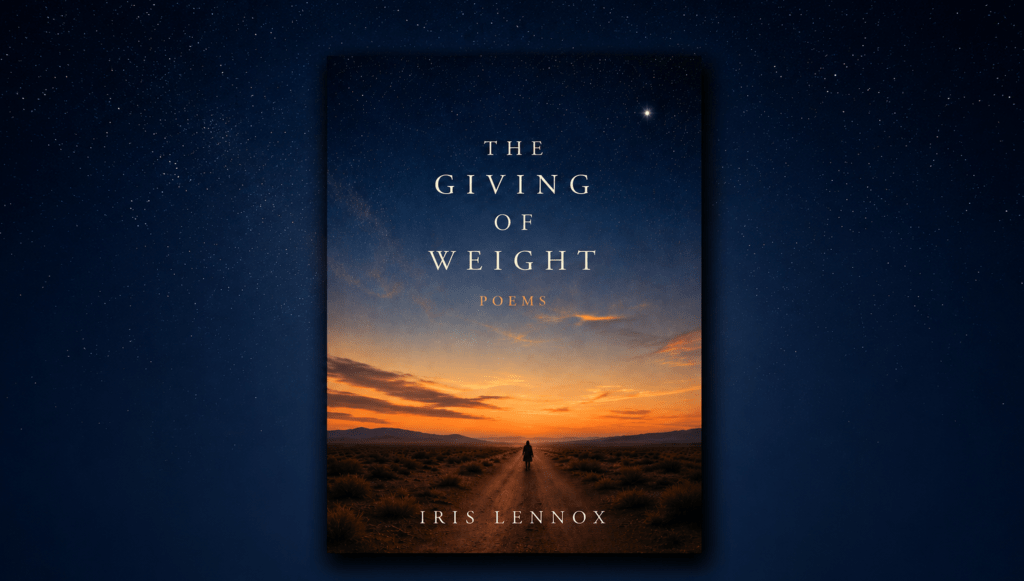
This summer, I’ll be publishing my first collection of poetry under the name Iris Lennox.

The primary home for Iris Lennox poetry is IrisLennox.com.

On Writing, Voice, and Iris Lennox

In January 2023, I made a New Year’s resolution to write more poetry. For once, I actually followed through. I wrote quite a bit that year, but most of it was just okay.

What I started to notice was that all of it sounded like me, but not in that beautifully cohesive way where you can tell a piece is by Emily Dickinson or Wisława Szymborska. There was something a little circular about it.

So the following year, I started taking poetry classes and workshops with real, working poets.

I’m not sure if I’ve gotten better, but I do know this: listening to other students’ and poets’ work in the room changed everything.

I started thinking thoughts I hadn’t thought before and feeling things I didn’t expect to feel again. Just from listening to people write about ordinary moments. The kind that light you up, or break your heart, or make you want to live, but on fire.

Life is so rich and dynamic, and also boring and mundane. And you can write about all of it.

So, I created a pen name: Iris Lennox.

This summer, I’ll be publishing a book of poetry under that name. It felt like the right time to start sharing some of that work and to give that voice a little more room to grow.

I also created a website for it:

irislennox.com

I’ll be sharing poems and short pieces there as I continue developing this side of my writing.

❤️,
Jill

Whisper the Passing Time

Memory sifted through their hands

Like water

Or like sand—

The kind of sand that lays flat

On desert ground

And all around the blistered feet

Of those who stand and watch the sun

With faces red

And cracking under heat

Filtered through dust—

Or like water.


Like water

In trickles

Between fingers pruning with excess

Trying to keep it there

Sickeningly aware

Of the weakness in the spaces

Between their fingers

And their hands—

Their memories fell right through

Splashed around their ankles

In a shallow pool

Reflecting upward

Not what was held

But what remained.


Recollections darkened

Not gone—

But changed

Into purples and blues

Certain as midnight

Uncertain as morning.

The light from those days

Did not disappear

It bent

Casting shadows

From the figures they had formed

In the mind—

Standing still

Even as everything else moved.


Not that they lied,

They simply could not see

That the laughter of then

Would return differently

That what once rang out

Clear and effortless

Would come back softened

Carrying weight

They had not yet learned to name.


They heard the voices

Of those they knew

From long ago days

When laughter was simple

Easy as something rolling

Downward

Without resistance—

Smooth in the hand

Bright in the light

Held up and turned

Until color revealed itself

And then slipped away again.


Recollections continued

Not fixed

Not held—

But moving

Across the surface of them

As water does

As sand does

Shifting

Settling

Lifting

And falling

Without asking permission.


Their memories were old

But inside them

Something remained

Not unchanged—

But present.

A trace

A tone

A warmth

That did not belong

Only to the past

But to the shape

Of what they had become.


Memory sifted through their hands

And still

Something stayed—

Not in the grasp

But in the holding

They could no longer see.


Recollections whispered

The passing time—

Not hurried

Not still—

Simple as a falling grain

Intricate as the path it takes.


© Jill Szoo Wilson, 2026

Poem: Until It’s Time

The branch has lowered itself
just enough
to suggest an invitation.

Not to take—
only to come closer.

A cluster of blossoms gathers here,
pink in several decisions,
each petal folded inward
where light reaches
and shadow remains
until
it’s time.

They hold more air than expected.

When the breeze passes through,
the movement is slight—
not a flutter,
not quite a sway—
something closer to breath
distributed among them.

The scent does not arrive all at once.

It holds.

A faint sweetness
moves in and out of notice,
never settling long enough
to be claimed.

It resembles something remembered
without the obligation to be exact.

The bark chooses not to participate.

It’s rough
where the blossoms are not.
A hand, placed there briefly,
would feel the distinction immediately.

Somewhere beyond the frame,
grass yields under passing steps—
a quiet compression,
then release.

Water watches,
with continuity,
a low, steady movement
that declines the possibility
of becoming the subject—
ever the supporting role.

The blossoms remain.

Close enough to touch.
Close enough to confirm
what they appear to promise—

a softness that would not resist
the certainty of fingers.

The distance holds.

The air carries a trace of green—
pale and timid,
warm and cool—
tumbling against itself
waiting to affirm a victor.

Summer already knows who will win.

For now,
the air passes through the mouth unnoticed
halfway inhale
halfway exhale.

Then it is gone again.

The branch lifts slightly
or the body does—
it’s difficult to say which.

The blossoms return
to their position among many,
indistinguishable at a glance.

Still—

for a moment,
they held the conscious weight
of examination.

And in that moment,
briefly,
blushed at their own beauty.

© Jill Szoo Wilson, 2026

Iris Lennox

This one did not arrive gently.

The edges remember something—
a pressure,
a folding back,
as if each petal had to argue
for its place in the light.

Nothing about it is smooth.

The ruffles hold.
The color deepens where it was once hidden.
Even the softness has weight to it.

You could say it opened.

But that would miss
what it endured to become open.

There are days
the sky lowers itself without warning,
and everything living is asked
to stay.

No explanation is offered.
No promise of outcome.
Just weather.

Still, something in the root
keeps drawing what it can.

Still, something in the stem
lifts what it has been given.

And when it is finally visible—
the pale, steady unfolding—
no one sees the storms.

Only the shape they left behind.

Only the quiet fact
that it did not close again.

Only the way it stands
as if the breaking of it
was never the end.

@Jill Szoo Wilson, 2026

Selected Writing by Jill Szoo Wilson

I’ve been asked to create a Where to Begin page for my poetry. Good idea!

Here are the top 10 poems by Jill Szoo Wilson based on website views over the years, public response at poetry readings, and generous feedback from readers like you.

  1. Moonlight We
  2. She Spoke of Love
  3. Love and Alive
  4. Un/Forgiven
  5. Lighthouse Hero
  6. God of the Street
  7. Algorithms of Fathers and Sons (And Daughters, Too)
  8. Unzipped
  9. Drenched
  10. Opposite Sides of the Wall

You can also find me on Substack under Jill Szoo Wilson and Necessary Whispers.
I tend to share newer poems and unpolished thoughts over there.

Stay curious,
Jill Szoo Wilson

Poem: And She Flew

Currents of wind
Grasping blue
From the sky

Mixing colors—
Translucent white
Floating by

In puffs
Like smoke
But water

Cascading
Masquerading
As clouds, drifting down
To rest upon
The ocean’s top

Atop the undercurrents
Pulling dark and light
Together

In a haze
Under the phase
Of the moon

Where fullness
Steers the darkness
From the light.

At night the sense of
Flight
Alights

In dreams and hopes
A knotted rope
Hangs from the stars

And swings
As she sings
Like a bird

Whose song is sung
Carelessly
Without thought

She calls into the night
Filling it
From empty
To bright

And falls into
The space where
Downwind caresses
Upwind lifts

And buoyancy calls her
Higher still.

As hummingbirds swing
Creatures below
Sting

With venom held
Inside teeth
Red with the catching

Stories repeat
Through dust and mold
Dark with lies

Whispered inside
By unseen spies
Who feed on souls

Who fill the roles
Like actors
Paid to play

Unable to reach
The heart
And open—

Unfold
Like art.

The ones below
Whose wings were clipped
Set a scheme

Narrow as a
Tightrope
A balance beam

A trap
Set with bait
And they waited

Inside a box
Designed to promise
The only way

Into hope
From hopelessness—
To pull her down

To steal her crown

A crucible
Of fire
Inside folded walls

Where stories
Cease to be told.

She flapped her wings
Tilted her head
Toward the earth

Wondered
Then wandered
Through the expanse

Where freedom
Takes its chance
On little birds

Such as she

She caught a breeze
Saw her reflection
In the sea

Caught a glimpse
Of her worth

And floated down
To the cardboard flaps
Of the box

The dark ones
Moved
Like worms

The kind of worms
Eaten by birds.

It looked easy enough

Fold the second flap
Then the first
And follow the way

They had planned

To be kept
From the sky
From the breeze

From the warmth of the sun
The turn of the season

From the spring
That would
Enchant her

Like a lover
Enhance her

With colors
Vibrant
Breathing
Beating

With life
To romance her.

“No,” she thought

And then—

“No,” she said

The comfort of that dark
Is stark

The safety of that space
Is small

A quiet that settles
For an hour

Sweet at first
Then turning

She felt it
And knew it

And chose—

She rose

And she flew
And she flew.

© Jill Szoo Wilson, 2026

Poem: Field of View

A man sits at a desk
with a telescope.

He has positioned it carefully.
The angle is correct.
The candle has been trimmed.

He is searching the sky
for something of importance.

The sky, meanwhile,
contains everything.

He believes in instruments.
He believes in narrowing the field.
He believes that what matters
will appear in the center.

The lens obliges.
It offers a disciplined circle.
Stars enter one at a time,
as if taking a number.

Then a streak of light
crosses the room.

Not through the telescope.
Beside it.

The man does not see it.
He is concentrating.

The sky has chosen
a different method of entry.

He adjusts the focus.
He notes the stability of the heavens.
He appreciates their order.

Something bright fades near the wall.

He records nothing.

In this way
the universe remains vast,
and the man remains certain.

© Jill Szoo Wilson, 2026

Come Visit Me on Substack

Hello friends,

I wanted to let you know that I’ve also been writing over on Substack. That publication is called Necessary Whispers, and it’s a bit more casual than what I tend to post here.

I just began a small series called 20-Today. The idea is simple: I write one poem or observation each day while I’m in motion — at the gym or on a trail — and I stop at twenty minutes.

That’s the only rule.

After spending much of this past year writing through heavier subjects, I’m turning toward something lighter. Writing simply for the joy of it!

If you’re curious, I’d love to have you join me there.

Here’s the link:
https://substack.com/@jillszoowilson

As always, thank you for reading, wherever you are.

❤️
Jill