

She called to him

Beneath a veil of night

When summer wore

Its hottest mask

Wax and dripping

Onto the earth

Leaving sticky puddles

Drenched and drying fast.

He was ill equipped

From skin to guts

No cape in his wardrobe

Or spectacles to hide his eyes

Paralyzed

By the fear–

No not the fear–

The knowing.

Knowing that his will

To fight for love

Was vacuum packed

And wrapped in moth balls,

It wreaked of age and of

The stench of desperate attempts

And falls–

Memories of unanswered calls.

Calls for him to be the one

The victor in the storm

Brimming to capacity

With strength enough to

Hold her heart–

At least her hand–

Across jagged tightropes

Stretching over pits of sand.

Quicksand questions

Lined with glue

Meant to close the chasm

Between expectation and

What is true–

Catechisms from the past

Never brought to light

Long enough

For queries to last.

What lasted was uncertainties

And now he paid the price

Not wanting to lose

Her

But unprepared to fight

All he could muster

Was a broken hero’s

Journey into night.

Night fell

Long past its time as

Summer solstice

Lazily drew its haze

Upon a sultry sky–

Like the afterglow

Of a camera’s flash

Imprinted behind the eye.

Eyes heavy with fatigue

Propped open by ambition

He pulled his jeans up high

Belted at the waist

Sat on the dew-drenched seat

Slicing through salt

Like he was a Sodomite Sculptor

Entering the competition.

A competition

Against himself

Against the doubt

Bubbling through

His tightening veins

Waking him from

Slumber of uncertainty to

Valor through adversity.

Adverse conditions

In the black

Gave way

As light he carried

Burned a path

Radiant as day–

Along the way he set it down

The dread that he had nothing to give.

He gave her a coordinate–

It was all he had–

A map written in the air

To help her find him

Approaching beneath a beacon

Brave and bright

Like a compass

More meticulous than starlight.

Starlight led her way

Across a stretch of sand

The edge of land

And water

Lapping against her skin

Deep and

Deeper still

She wandered toward the glow.

Glowing first as though a firefly

Small and far away

His vessel cutting through

The foam, mocking delay

For time no longer mattered

As slow their paths came near

He, soaked with ocean

She, doused in tears.

Her tears were anvils

From her soul

Releasing injured expectation

She felt her heaviness go–

Fly

Into the heavens

Where drafts outweighed

The currents swirling down below.

She never saw below

The hidden treasure trove

Inside his hidden space

The place

Where thought and emotion

Ruptured like burdened banks

To flood his heart and

Overflow–

Overflows of adrenaline

Like rain

Saturated and drowned his pain

Leaving only

In the boat

He and the lighthouse he kept

For her

A flame no longer detained.

No act of the Furies could detain

His passage toward her eyes

The two he knew without seeing

He could feel at the side of his neck,

Glimpse behind the pillow

Where once she lay

Inside his dreams

And–in the middle of day.

The glow began to grow

He rowed like a man

Pursued by death

And she

Released a laugh

That tore his heart

From two parts into one–

He dropped the oars so he could run.

He ran to just before her

Then stopped to etch her

All

Inside his mind

Where secrets forever kept

Could burrow, rest and hide,

"I came for you,"

He said–

She already knew

But she feigned a big surprise,

"I wondered at that

single point

upon the horizon growing

never knowing

whether I should run away

or stay."

"I am glad you stayed,"

He kicked some sand

Between his shoes

And cleared his tightening throat,

"Now that you have

would you allow

this reluctant pirate

to stay here, too?"

She blew out the candle

Burning above his face–

No need to keep it lit

Inside this place

Where journey’s end

Had come to rest–

"I never really lost you,” he said–

"Then I was never really lost."

© Jill Szoo Wilson, 2026
Tag: books
Poem: The Us We Can See
I am stationed at a wooden table
the size of a reasonable thought.
It does not wobble.
This feels like a small mercy
after watching my Americano
sway back and forth on the last.

Here, the Americano steams steadily
as if rehearsing confidence,
dark, uncomplicated,
uninterested in my opinions.

I wear fingerless gloves,
a compromise between dignity and survival.
My knuckles remain unconvinced.

Winter returns again and again
through the green-painted door,
carried on the backs of coats,
slipping in at ankle height,
lingering like someone
who has already said goodbye
but remains.

A woman at the counter
counts her change twice,
the last of her pennies
now a relic of a simpler time
when 1-2-3 meant something more.

A man near the window
keeps turning his cup
until the logo faces forward,
forgetting the face
with every sip,
which ends with a new turn.
A familiar dance, a waltz?
Sip-2-3, sip-2-3.

A woman with wiry white hair
removes a bright turquoise hat,
carefully crocheted,
leaving one thread to dangle
from a curl.
The thread hesitates.
So does she.

Heavy oak chairs keep their positions,
pretending not to notice
who chooses them and why,
practiced at holding
what is briefly certain.

A barista with inked forearms
wipes the same spot again,
loyal to a principle I do not know.

The clock on the wall yawns
while declining comment,
stretching its hands
in a familiar reach,
analog-2-3, sameness-2-3,
predictable without irony.

I lift the white mug,
my fingers watching and ready,
and remember how warmth
asks to be held,
while cold does not.

—Jill Szoo Wilson, 2025
Rethinking Career Paths
By Jill Szoo Wilson
Connecting Creative and Analytical Skills
“My dad has a totally different expectation for how my life should go,” one student reflected recently. “It sounds easy. He tells me to do one thing, and that that thing will lead to the next thing and the next and the next. But it’s not working that way.”
When asked to explain, he hesitated, then continued. “He told me to go to college, so I did. Two years in, I realized there weren’t enough jobs in my major, so I came back to community college to find a different path. I’m working two jobs and still live at home because I can’t afford to move out. When he tells me about his life, it all sounds easy. He went to college, got a job, bought a house, and got married. It sounds so easy.”
His words captured a generational tension I see often. Namely, the struggle to build a meaningful life in a world that no longer rewards linear scripts. The milestones that once defined adulthood — education, employment, marriage, ownership — rarely appear in sequence. The narrative has fractured, and with that fracture comes both loss and opportunity. Herminia Ibarra describes this shift clearly in Working Identity when she writes, “We learn who we are in practice, not in theory. We reinvent ourselves by doing, experimenting, and stepping into new roles.” It is a problem that calls for a new framework for understanding how work and identity evolve, one I have come to call talent clusters.
The days of the single income and the single career may well be behind us. The camera lens has widened, and with it, the way success is defined must widen too.
Students entering higher education today often inherit an outdated expectation that success depends on finding one right path and staying on it. But the modern economy no longer rewards singularity. It rewards synthesis. This is where talent clusters come in — the natural intersections of ability, curiosity, and experience that form the foundation for meaningful work. Rather than viewing careers as straight lines, these clusters invite students to see the web of connections already present in their interests and skills.
I began noticing this pattern in my own career before I had a name for it. In my life, theatre and communication have been that intersection. They didn’t compete. They conversed. Theatre taught me to listen for subtext, to inhabit perspective, and to read emotion in real time. Communication grounded me in theory and structure. It taught me how messages take shape, how persuasion works, and how to communicate ideas clearly and confidently. Together, they formed a foundation that prepared me not only to teach but also to write, to use language as both performance and connection.
When I began writing professionally, I realized I was drawing from both disciplines at once. The rhythm and tone I developed in the theatre informed my writing voice, while communication theory clarified audience, purpose, and persuasion. What looked like two paths became one integrated practice.
My experience reflects a broader truth. What seems like wandering is often a kind of weaving; the gradual merging of abilities that form something stronger than any single thread. The actor who learns to embody another person’s experience develops the empathy essential to leadership. The stage manager who coordinates complex productions gains logistical precision transferable to project management. The student who studies public speaking acquires the rhetorical awareness needed in advocacy, policy, or entrepreneurship. Each of these evolutions demonstrates the elasticity of transferable skills.
Workforce research supports this pattern. The nonprofit Jobs for the Future identifies communication, problem-solving, and creativity as “the most reliable predictors of long-term employability across industries.” The University of California, San Francisco, similarly defines portable skills as those that endure across shifting technologies and economies. Both findings affirm that artistic and professional fluency share the same core capacities: interpretation, adaptability, and disciplined imagination.
David Epstein, author of Range, writes, “The most effective people are not those who follow one path but those who explore multiple interests and connect them.” The humanities, long dismissed as soft or impractical, may therefore be among the most resilient fields of all. Theatre and communication cultivate habits of perception that remain deeply relevant: reading tone, decoding motive, and adjusting the message to the moment. They prepare students not merely to perform roles but to understand the systems in which those roles operate.
Jonathan Haidt situates this generational experience within an even wider lens. In The Anxious Generation, he notes that many young adults “feel unmoored from the stable institutions that once gave direction to their lives.” Yet that instability, while disorienting, also creates space for creative recombination. The disappearance of predetermined pathways invites a new kind of agency. It becomes the freedom to design lives that integrate multiple disciplines into meaningful coherence.
Many of my former students who began in theatre or communication now work in fields as diverse as consulting, user experience design (UX), public relations, real estate, and education. They have not abandoned their earlier training. They’ve simply translated it. The ability to connect meaning across disciplines has become a form of expertise.
Such an approach reframes the anxiety of choice. By seeking patterns, the recurring connections among their abilities and values, students can seek to define their own paths. A meaningful career, viewed through this lens, becomes a cumulative act of interpretation rather than a fixed destination. The result is not mastery of one discipline but the capacity to see how ideas speak to one another.
Translating Performance into Professional Presence
When I first began writing professionally as a content and copywriter, I noticed something familiar in the process of finding a client’s brand voice or a publication’s style. It felt like preparing a role. The work required listening for rhythm, motivation, and what I call character keys, the same instincts I practiced in the theatre for years. What I once used to understand a character, I now used to understand a brand. That connection not only helped me build continuity between theatre and writing but also gave me early confidence and, more importantly, measurable success. I knew I was on to something.
Theatre taught me that playing a character is rooted in playing action. Every moment on stage is driven by verbs: to lasso, to comfort, to resist, to reveal. Acting is not about emotion but about pursuing intention. Writing works the same way. Every effective sentence carries an action. Good copy does not describe. It moves. Whether the goal is to inform, inspire, or sell, the writer, like the actor, must choose verbs that propel intention forward. Both crafts rely on clarity of motive. The moment the action disappears, the scene or the sentence loses energy.
Theatrical training, often dismissed as niche, is an education in adaptability. It teaches how to read a room, sense emotional temperature, and adjust delivery to context. Those same instincts translate to the written page where attention and authenticity must be earned in every line. To communicate persuasively, whether on stage or in print, requires more than argument. It requires presence.
What ultimately connects these practices is the pursuit of resonance. Whether speaking to an audience or writing to a reader, the communicator’s task is to close the distance between self and other, to let recognition pass quietly between them. That moment of recognition, the shared understanding that this is true for me too, is where both art and communication do their deepest work. Acting teacher Sanford Meisner said (paraphrased), “There is something going on over there (in the other person). And something happening in here (the inner self) . . . truly paying attention is what connects the two.”
Adapting Across Roles and Redefining Success
I’ve had so many students and young people in my own life say things like, “I don’t know what my purpose is,” or “How can I learn what my purpose is supposed to be?” or even, “What is the point of all this?” Part of what they seem to be reacting to is the constant barrage of discouraging news across social media and other platforms. The other part is the same question every generation has asked, only they’re asking it in a new landscape shaped by volatility, comparison, and the pressure to define themselves early. This is where we need to pay close attention. Too often, adults respond with pity, but pity creates distance. Brené Brown says it clearly: “Empathy fuels connection. Sympathy drives disconnection.” If we feel sorry for young people, we project limitations onto them, and we can no longer help them. They don’t need pity. They need hope, presence, and leaders who will help them meet new challenges with other-focused attention.
When most students talk about “purpose,” they’re not usually describing a single calling. They are trying to articulate a desire for coherence in a life that feels connected rather than scattered. In a world of shifting roles and unstable markers of adulthood, purpose emerges from the ways students participate in their communities and apply their abilities to real situations. Jonathan Haidt captures this idea in The Happiness Hypothesis when he writes, “Happiness comes from between.” Meaning, in Haidt’s framing, grows out of the relationships between a person and the world they inhabit: their work, their commitments, and their connections. Purpose is built through engagement, not isolation.
Seen through this lens, transferable skills become essential. They allow students to discover purpose through participation. A graduate trained in theatre and communication may evolve into a writer, strategist, or educator while retaining the same internal architecture of strengths. Each role draws on the same foundation: the ability to interpret, translate, and adapt. Purpose takes shape as those skills meet real needs . . . for others and then for themselves.
For many students, this realization carries profound hope. It suggests that the search for meaning does not require narrowing the self to one direction. One discipline can open the door to another, and together they form a structure that feels cohesive, lived-in, and human.
Identifying Your Talent Clusters: A Reflective Guide
Every person carries a set of abilities that naturally intersect. Some begin as skills. Others begin as interests or instincts that, with attention and practice, develop into genuine strengths. Taken together, these patterns form the early architecture of a talent cluster. The questions below are meant to help you recognize the intersections already present in your work, interests, and habits of mind.
1. Trace your through-lines.
Which activities have consistently engaged your attention or energy across different seasons of life?
Example: Maybe you were the friend who organized school projects, planned events in college, and now color-codes work tasks. That through-line points toward a cluster involving coordination, structure, and leadership.
What themes or methods appear in everything you do, even when the contexts change?
Example: You might notice that wherever you are — school, work, or volunteering —you tend to bring people together. You create group chats, organize meetups, or help resolve tension. That pattern suggests a relationship-building cluster.
Which skills seem to travel with you from one role or discipline to another?
Example: If you have used clear communication in many settings — calming a customer, explaining a task to a teammate, or helping a friend make a decision — that mobility signals a communication cluster that strengthens almost every profession.
2. Name your complementary skills.
What comes naturally to you that others often notice or rely on?
Example: If people often come to you to translate confusing information, whether it’s a work memo, a form, or a family decision, that points toward a clarity and interpretation cluster rooted in communication.
Which strengths balance or enhance one another?
Example: If you love generating ideas but also enjoy organizing them into steps, that pairing suggests a creative-strategy cluster that is valuable in writing, design, planning, or entrepreneurship.
Are there pairings of skills that make you unusually effective or fulfilled when used together?
Example: If you listen deeply but also know how to offer direct solutions, that blend indicates a strategic empathy cluster that is powerful in leadership, counseling, coaching, and team development.
3. Observe your patterns of satisfaction.
When do you feel most alive, focused, or capable?
Example: If you feel most energized when learning something new and then immediately teaching it to someone else, that signals a learning-to-teaching cluster common to educators, trainers, and communicators.
What kinds of tasks give you a sense of both challenge and clarity?
Example: If you love tasks where you get to make something make sense, like editing, organizing, or redesigning, that aligns with a problem-solving and systems cluster.
In which environments do you feel your perspective adds value?
Example: If people often say, I did not see it that way until you explained it, you may have a perspective-shifting cluster that is useful in storytelling, analysis, user experience, and leadership.
4. Reframe your so-called detours.
Look back at past jobs, studies, or interests that seemed disconnected at the time. What common learning thread ties them together now?
Example: If working in childcare taught you patience, retail taught you communication, and volunteer work taught you compassion, the thread points toward a people-centered service cluster.
What did those experiences teach you about how you think, solve problems, or relate to others?
Example: If you notice you always jumped in to calm conflict or clarify misunderstandings, your experiences reveal a mediation and understanding cluster.
Which past experiences might not be mistakes, but the raw material of synthesis?
Example: If a past interest in photography sharpened your eye for visual detail, that experience enriches a visual communication cluster even if you no longer pursue photography itself.
5. Articulate your emerging cluster.
If you had to name the intersection of your skills and passions in one phrase, what would it be, such as creative communication, strategic empathy, or analytical storytelling?
How might this cluster of strengths apply across different fields or industries?
What kinds of work would allow all parts of this cluster to grow together rather than compete?
Get Curious!
Talent clusters are not fixed identities. They’re living relationships among your skills. They reveal what you can do and how your ways of thinking and creating naturally connect. When you recognize those patterns, your career path shifts from feeling like a maze to functioning as a map.
Further Reading
Epstein, David. Range: Why Generalists Triumph in a Specialized World. Riverhead Books, 2019.
Haidt, Jonathan. The Anxious Generation: How the Great Rewiring of Childhood is Causing an Epidemic of Mental Illness. Penguin Press, 2024.
Haidt, Jonathan. The Happiness Hypothesis: Finding Modern Truth in Ancient Wisdom. Basic Books, 2006.
Ibarra, Herminia. Working Identity: Unconventional Strategies for Reinventing Your Career. Harvard Business Review Press, 2004.
Jobs for the Future. “Essential Skills Framework.” Jobs for the Future, 2020.
Brown, Brené. “The Power of Vulnerability.” TEDxHouston, June 2010.
Originally posted on my Jill Szoo Wilson Substack. Visit me there!
From Realism to Meta-Absurdism: The Evolution of the Modern Stage
By Jill Szoo Wilson
Prologue: A New Theatre Movement
In a series of conversations on modern theatre, my students and I began to notice a pattern: the world seems to be circling back to Absurdism. Yet we agreed that the cycle could not simply repeat itself. The conditions of the twenty-first century—the digital landscape, the collapse of attention, the constant performance of self—have altered the human experience too profoundly. What was once silence has become noise; what was once absence has become overload.
Together, we set out to name what is now taking shape: a new movement of theatre and art that inherits the Absurd but transforms it. We call this emerging sensibility Meta-Absurdism. This essay traces the lineage that led to it and considers what it means for artists, audiences, and a culture learning to see itself again through performance.
This essay is dedicated to my students, whose insight and curiosity continue to make the stage—and the world—new.
Introduction: Theatre as a Record of Disenchantment
From the candlelit realism of Ibsen’s drawing rooms to the barren wastelands of Beckett’s imagination, modern theatre traces a steady movement from certainty toward fragmentation. Each major development that followed the nineteenth century—Realism, Naturalism, Expressionism, Surrealism, and Absurdism—marks both an artistic and a philosophical transformation. Theatre has always reflected what it means to be human within its own age.
In the nineteenth century, dramatists could still study human behavior with confidence. By the middle of the twentieth century, they could only endure it. Today, we stand at another threshold. Our culture’s relationship with reality, shaped by screens, fragmented by algorithms, and shadowed by irony, points toward a new theatrical age. In this context, irony does not mean humor. It means the self-conscious detachment that defines a society aware of its own performance, a way of speaking and living that protects sincerity by disguising it. We perform authenticity while knowing it is a performance.
This era mirrors Absurdism yet extends beyond it. If the theatre of the absurd revealed a world stripped of meaning, the theatre now emerging exposes a world overwhelmed by it: too much meaning, too many truths, too much noise.
This essay traces the major movements of modern theatre, from the moral candor of Realism to the existential collapse of Absurdism, and considers how these patterns have begun to repeat. The arts seem to have circled once more through the same questions—about truth, emotion, and meaning—and returned to the threshold of absurdity. Yet what emerges now is not a simple repetition but an evolution: a post-Absurd theatre that laughs at chaos while still, against all odds, searching for coherence.
I. Realism: The Mirror and the Moral Self
Approximate dates: 1870s–early 1900s
Realism developed in Europe in the late nineteenth century as artists, novelists, and playwrights grew restless with the emotional exaggeration of Romanticism and the moral simplicity of melodrama. Before Realism, melodrama had dominated the popular stage. Its world was one of pure heroes and villains, where virtue always triumphed and vice was punished. Emotion was heightened through sweeping gestures, musical underscoring, and spectacular rescues or coincidences that resolved every conflict. Such plays invited audiences to feel deeply but not to think critically. The characters embodied moral lessons rather than psychological truth. By contrast, the emerging Realists wanted to replace this emotional excess and moral certainty with complexity. They turned their attention to ordinary people whose lives unfolded in shades of gray rather than black and white, creating stories that demanded reflection rather than reassurance.
Several cultural shifts shaped this turn.
Industrialization and Urbanization. Industrialization and urbanization transformed daily life. Cities expanded, and factories restructured work, family, and community. People began to speak more openly about labor conditions, gender roles, and class disparity. Society no longer appeared as a divinely fixed hierarchy ordained from above; it now looked like a system built by human hands, and therefore one that could be questioned and changed.
The Rise of the Social Sciences. Thinkers in psychology and sociology began to treat human behavior as something that could be studied systematically rather than assumed. This new way of understanding people—as subjects shaped by environment, emotion, and motive—encouraged playwrights to create characters with psychological depth instead of relying on stock types such as the virtuous maiden, the dastardly villain, or the comic servant.
A New Appetite for Truth. Readers and audiences had grown accustomed to novels by writers like Flaubert, Tolstoy, and Dickens, who depicted ordinary people in intricate detail. Theatre began to follow that path. The stage shifted from spectacle toward scrutiny.
Realism did not simply aim to look more “real.” It made a specific argument: if theatre shows people as they actually live, then audiences can confront the real moral and social problems of their time.
Key Features of Realist Theatre
Ordinary settings. The action often unfolds in living rooms, studies, dining rooms, or modest interiors that feel lived in. These spaces suggest that important moral events happen in private life, not only in palaces or battlefields.
Complex, believable characters. Realist characters possess mixed motives. They speak in everyday language rather than in verse. They struggle with marriage, money, vocation, family loyalty, and personal integrity.
Cause and effect. The plot grows out of choices, secrets, and pressures that feel logical rather than arbitrary. When something happens, it usually has a clear reason grounded in character and circumstance.
Moral pressure. Realist plays often expose hypocrisy. They show how respectable surfaces hide injustice or denial. The question beneath many Realist plays sounds like this: “What happens when truth knocks on the door of a comfortable lie?”
Ibsen: Realism as Moral Confrontation
Henrik Ibsen (1828–1906) stands at the center of theatrical Realism.
In A Doll’s House (1879), Nora Helmer lives as the cheerful, obedient wife in a carefully ordered home. The play gradually reveals that her lightness masks a lifetime of dependence, first on her father and then on her husband, Torvald. She has learned to please, to perform, and to survive through charm rather than autonomy. When a secret loan she once took to save Torvald’s life threatens to come to light, the illusion of their marriage begins to crumble. Torvald’s reaction exposes not gratitude but possessiveness; he cares more for his reputation than her sacrifice. Confronted with the truth of her own confinement, Nora recognizes that she has never been treated as an equal or allowed to think for herself. The final scene, in which she closes the door behind her, is both literal and symbolic: a woman stepping out of her father’s and husband’s authority to begin life as her own person.
The famous ending, when Nora chooses to leave her husband and children, shocked audiences. Many saw it as scandalous, but Ibsen was not simply trying to provoke. He used a realistic situation to expose how a “good” marriage could rest on control, performance, and inequality. The play suggests that a woman cannot live as a full moral agent if she exists only as someone else’s doll.
Nora’s final choice marks a key Realist moment. She does not die in melodramatic fashion. She does not reconcile in a sentimental embrace. She walks out. The action arises from her growing awareness of herself as a thinking, responsible person. Realism turns the spotlight on that inner awakening.
Chekhov: Realism as Quiet Ruin
Anton Chekhov (1860–1904) offers a different, more subtle version of Realism.
In The Cherry Orchard (1904), Madame Ranevskaya and her family return to their estate, burdened by debt. The family clings to its memories and status. Lopakhin, the son of a former serf who has become a successful businessman, urges them to cut down the orchard and build rental cottages to survive financially. They delay, avoid, reminisce, and refuse to act. In the end, they lose the estate.
Very little “happens” in the melodramatic sense. No villain engineers their doom. No miracle saves them. The tragedy comes from inaction, denial, and nostalgia. Chekhov shows how people talk around their problems, retreat into sentiment, and fail to adapt to changing social realities.
The Cherry Orchard introduces a central Realist idea: the most devastating conflicts often unfold in interrupted conversations, small evasions, and postponed decisions. The play invites the audience to listen closely and notice what characters cannot say.
The Significance of Realism
Realism replaced the mask with the mirror. It insisted that the lives of women, workers, professionals, and families deserved serious, dramatic attention. It suggested that theatre could function as a moral and social instrument without preaching. By inviting audiences to recognize themselves in the characters, Realism created a space for self-examination.
Almost every “serious” television drama or film that focuses on believable characters in everyday settings inherits something from Realism. When audiences watch a courtroom drama, a family story, or a workplace series that treats motives and consequences seriously, they are seeing Realism’s legacy.
In the larger arc of this essay, Realism marks the last confident moment when many playwrights believed that if we looked closely enough at ordinary life, we could discover truth, make sense of behavior, and correct injustice. The movements that follow will test, fracture, and eventually abandon that confidence.
II. Naturalism: The Laboratory of Life
Approximate dates: 1880s–1910s
If Realism served as the mirror, Naturalism served as the microscope. Inspired by Charles Darwin and Émile Zola, Naturalism treated human behavior as a phenomenon shaped by heredity and environment. Life appeared not as a moral choice but as a biological outcome.
Zola called the stage a “slice of life,” demanding scientific precision from playwrights and directors. August Strindberg’s Miss Julie (1888) became a model of the form: a claustrophobic dissection of class, gender, and instinct, set on Midsummer’s Eve when social boundaries briefly dissolve. The characters act less from will than from the forces that shape them—namely, lust, resentment, and social conditioning.
Naturalism rejected the artifice of plot and heroism, seeking instead to record life with scientific accuracy. Its goal was observation rather than judgment. Playwrights treated the stage like a laboratory where heredity, class, and environment could be tested as forces shaping human behavior. Characters acted not from moral choice but from the pressures of instinct, poverty, social expectation, or desire. The playwright’s task was to show how these forces collided, not to offer solutions. Yet this commitment to objectivity created its own unease. When every action can be traced to circumstance, freedom begins to disappear. The stage, once a space of moral decision, becomes a specimen jar. Human beings are observed rather than understood. The soul, once dramatized, is diagnosed.
IV. Surrealism: Dream Logic and the Unconscious
Approximate dates: 1920s–1940s
Surrealism emerged after the devastation of World War I, when reason itself seemed to have failed. If logic could lead to such destruction, perhaps truth lay elsewhere, not in rational order but in the hidden language of dreams. Influenced by Sigmund Freud’s The Interpretation of Dreams (1900), artists and writers turned to the subconscious as a source of creativity. They believed that genuine expression came from the mind set free from social rules, logic, and moral restraint.
In his Manifesto of Surrealism (1924), André Breton defined the movement as “pure psychic automatism,” the act of letting thought flow without censorship or control. In painting, this meant spontaneous, dreamlike imagery; in theatre, it meant abandoning conventional plot and sequence. Events could unfold as they do in a dream, connected not by cause and effect but by association and emotion. Characters might shift identity, time might collapse, and familiar objects could appear strange or symbolic.
Guillaume Apollinaire’s The Breasts of Tiresias (1917) embodies this new freedom. The play reverses gender roles as its heroine transforms into a man and her husband gives birth to thousands of children. These plot points were a surreal satire on war, gender, and creativity. Nothing follows a logical sequence; instead, the play operates on metaphor and imagination. Jean Cocteau’s Orpheus (1926) takes a classical myth and renders it dreamlike: mirrors become doorways between life and death, and the poet speaks with the underworld as though in a trance.
In Surrealist theatre, logic steps aside so imagination can lead. The stage becomes a dream world where time bends, meaning shifts, and the unconscious speaks aloud. What seems strange or impossible points to deeper truths found not in reason but in symbols, emotion, and the language of dreams.
V. Absurdism: The Collapse of Meaning
Approximate dates: 1950s–1970s
After two world wars, faith in progress and reason could no longer stand. The existential philosophy of Albert Camus and Jean-Paul Sartre defined the new condition: life without inherent meaning. Theatre responded with silence, repetition, and dark humor, using pauses and empty dialogue to reflect a world where language itself had lost power.
Samuel Beckett’s Waiting for Godot (1953) redefined dramatic form. Two men wait endlessly for a figure who never arrives, filling the void with circular talk and fleeting hope. Eugène Ionesco’s The Bald Soprano (1950) turns conversation into nonsense, exposing the emptiness beneath polite language. Edward Albee’s The Zoo Story (1958) stages the brutality of human isolation in a single park bench encounter.
These plays offer no resolution. They simply continue, mirroring the endurance of life itself. Absurdism exposes the collapse of structure and certainty, showing that meaning, if it exists at all, must be created moment by moment. The laughter that arises is uneasy, the sound of people confronting despair and choosing, somehow, to keep going.
VI. The Digital Turn and the Rise of Meta-Absurdism
Approximate era: early twenty-first century to the present
If modernism once faced the silence of a world stripped of meaning, contemporary art now faces the noise of one drowning in it. For playwrights like Samuel Beckett and Eugène Ionesco, “silence” did not mean the literal absence of sound but the absence of response. After two world wars, faith in reason, progress, and even God had fractured. Humanity continued to ask the ancient questions—Why are we here? What gives life purpose?—and the universe offered no reply. The stage became the echo chamber of that unanswered search. Beckett’s tramps wait for a figure who never arrives. Ionesco’s couples speak in circles until language collapses. The silence is existential: a world that listens but does not speak back.
The modern imagination inherits Beckett’s emptiness but fills it with light: the artificial glow of phones, computers, and screens that both illuminate and distort our sense of presence. What was once shared in the immediacy of physical space now unfolds through pixels and algorithms. We watch others and are watched in return, performing our identities within the same systems that promise connection while deepening isolation.
Where Absurdism once mourned the loss of meaning, our age wrestles with its excess. Meaning now multiplies endlessly, scattered across feeds, refracted through commentary, and layered beneath irony. The result is not understanding but saturation. We no longer face an empty stage; we face one crowded with competing performances. The question is no longer What does it all mean? But which version of meaning can we trust? The existential anxiety of mid-century theatre has evolved into a distinctly digital unease, marked by overstimulation, fragmentation, and self-surveillance mistaken for participation.
The arts have begun to absorb and interpret this condition. Annie Baker’s The Flick (2013) quietly captures the loneliness of the digital age through the monotony of a failing movie theatre. The characters, three minimum-wage employees sweeping popcorn and trading fragments of conversation, inhabit a world both intimate and estranged. Their dialogue mimics the broken syntax of online life: hesitant, elliptical, punctuated by silence. Baker’s realism feels almost radical in its slowness. In a culture of constant refresh, she offers duration by way of a space to feel boredom, tenderness, and human distance without a glowing screen between the characters and their own emotional lives, or between the audience and the immediacy of human presence.
In contrast, Bo Burnham’s Inside (2021) transforms isolation itself into performance. Alone in a single room, surrounded by cameras and lights of his own making, Burnham becomes actor, director, and audience. His songs move from irony to despair to laughter, mapping the exhaustion of a generation trapped in perpetual self-broadcast. The work’s brilliance lies in its recursion: a performer trying to escape the very performance that defines him.
A similar unease unfolds in Apple TV’s Severance (2022), a television series that extends Absurdist logic into the architecture of the modern workplace. Employees undergo a surgical procedure that divides their consciousness in two—one self that exists only at work, and another that knows nothing of it. The result is a haunting allegory of digital compartmentalization: the algorithmic partitioning of identity and the surrender of autonomy to systems we barely understand. Visually, Severance resembles an Expressionist office dream, full of sterile corridors, circular routines, and bureaucratic doublespeak. Yet beneath its corporate absurdity lies a distinctly modern question: what happens when convenience and control demand the sacrifice of consciousness itself?
This emerging aesthetic might be called Meta-Absurdism. If the Absurd dramatized the impossibility of meaning, the Meta-Absurd dramatizes the impossibility of escaping it. Where the Absurd offered silence, the Meta-Absurd offers feedback loops; where Beckett’s tramps waited for revelation, our digital selves livestream the waiting in real time.
Meta-Absurdism thrives on contradiction. It acknowledges the void but fills it with data. It mocks the spectacle yet depends on it. It laughs at sincerity while longing for it. Its characters and creators understand that the stage has expanded beyond theatre walls into every public and private performance of self. We live lives that are continually streamed, curated, revised, and replayed. Every post meant to reveal something of ourselves also conceals something else. In the digital theatre of the self, confession and disguise have become the same act.
In this context, the artist’s task shifts from depicting reality to navigating mediation. The playwright no longer asks, What is real? but What is performed? The actor no longer strives only for truth but for authenticity within layers of simulation. The audience no longer gathers simply to witness but to reflect, recognize its own gaze, and its complicity in the performance of modern life.
Meta-Absurdism, then, is not an abandonment of art’s past but its synthesis. It inherits the Realist’s eye for detail, the Expressionist’s distortion of feeling, the Surrealist’s dream logic, and the Absurdist’s existential wit. Yet it places them within a new environment defined by speed, multiplicity, and hyperawareness. Its power lies in revealing what it feels like to be alive in a world that never stops performing itself.
The ultimate question this movement poses is neither moral nor metaphysical but phenomenological: what does it mean to be present when presence itself is a performance? The answer may not come through clarity but through recognition of a shared awareness that we are all both audience and actor, scrolling and watched, real and constructed, alone and connected. Yet even within that self-consciousness, the longing for truth persists. The human impulse to seek coherence, to love what is real, and to reach beyond imitation, remains the quiet rebellion at the heart of art.
The cycle has not ended; it has multiplied.
Further Reading
Beckett, Samuel. Waiting for Godot. Grove Press, 1954.
Chekhov, Anton. The Cherry Orchard. 1904.
Ibsen, Henrik. A Doll’s House. 1879.
Ionesco, Eugène. The Bald Soprano. 1950.
O’Neill, Eugene. The Hairy Ape. 1922.
Strindberg, August. Miss Julie. 1888.
Zola, Émile. Naturalism in the Theatre. 1881.
Breton, André. Manifesto of Surrealism. 1924.
Camus, Albert. The Myth of Sisyphus. 1942.
Esslin, Martin. The Theatre of the Absurd. Doubleday, 1961.
Baker, Annie. The Flick. Dramatists Play Service, 2013.
Taylor Mac. A 24-Decade History of Popular Music. 2016.
This essay was originally posted on my Jill Szoo Wilson Substack.
The Mind-Body-Emotion Circuit: Learning How to Respond on Purpose
By Jill Szoo Wilson
In acting, emotion is often treated as the goal. Many students arrive hoping to unlock a secret reservoir of feeling, as if tears or rage or heartbreak could be summoned by force of will alone. Yet experienced artists and psychological researchers alike know that emotion resists direct manipulation. The human heart refuses to be commanded. Instead, emotion tends to emerge as a consequence of the way we think and move through the world. This reality, long understood intuitively by actors, has now been documented in cognitive and behavioral science. As Meisner observed, performance becomes truthful only when the actor lives with authenticity inside imagined circumstances rather than attempting to manufacture emotional display on cue (Meisner & Longwell, 1987).
This understanding is essential in my work as an acting teacher. One of my current private students, whom I will call Paige, embodies the determination required to bridge intellect, body, and imagination. She asks thoughtful questions, listens without pretense, and possesses a grounded confidence that draws others toward her. In the studio, she is learning that the actor’s instrument is not the voice alone, nor the body alone, nor even the mind alone, but the constant interplay among them. When that interplay is disrupted, performance becomes flat and disconnected. When it flows, the actor’s work becomes alive.
To explain this interplay, I teach what I call the mind-body circuit, a cycle rooted in both performance pedagogy and psychology: thought → emotion → action → new thought → emotion → action, and so on. The sequence appears simple, yet it reveals something profound. The actor can enter it through thought or action, but rarely through emotion alone. Emotion depends on a catalyst. It responds to meaning and circumstance. This is why actors who begin with the desire to “feel sad” or “play anger” inevitably fall into generalization. They are grasping at the byproduct rather than engaging the cause.
Directors and psychologists alike recognize that embodied behavior shapes inner life. Neuroscientist Antonio Damasio describes the body as a “theater of feeling,” where emotion is both generated and displayed through motion and sensation (1999). Onstage, this principle becomes visible in dramatic form. To demonstrate this, I once handed a student a hammer and instructed him to break scrap wood in character for thirty seconds. The task was intentionally physical, forceful, and resistant, because the body cannot remain neutral when exerting strength against an object that pushes back. There was no discussion of backstory or psychology. The action demanded urgency and focus, which silenced self-consciousness and awakened the nervous system. As the student swung the hammer, his breath shifted, muscles tensed, and emotion surfaced unbidden. Within moments, he found himself articulating thoughts and personal stakes that had felt inaccessible when he tried to intellectualize his way toward feeling. Stanislavski identified this phenomenon nearly a century ago: “In the beginning, you must not settle matters of feeling. Begin with the action” (1936).
There are other occasions when thought becomes the most generative entry point into the mind-body circuit. During rehearsals for Hamlet, Paige and I worked through a scene in which Ophelia confronts a lover who, until recently, adored her. Before this scene, Hamlet has pursued Ophelia with gentle attention and romantic promise. He has spoken of love and a future together. Then suddenly, with no explanation she can understand, he turns on her. He tells her she should enter a convent, that she should never marry, never bear children, never bring more life into a world he now condemns. At first, Paige named her character’s feelings: confusion, concern, hurt. These were legitimate emotional states, but they did not yet clarify what Ophelia believed was happening or what she needed in response. We returned to the text to articulate the specific rupture: this is not Hamlet being odd or distracted; this is Hamlet erasing their entire future with a single, devastating reversal. Once Paige understood that she was experiencing rejection not only of affection but of identity, legacy, and security, her body changed. Her posture leaned forward, breath tightened, and she instinctively reached toward her scene partner, trying to recover the man she once knew. Thought created meaning. Meaning triggered emotion. Emotion propelled action. The circuit closed into a continuous chain.
Psychologist Richard Lazarus offers a framework in which emotion arises from the mind’s effort to interpret and evaluate experience. He proposed that individuals engage in a form of cognitive appraisal, a rapid assessment of what an event means for one’s safety, identity, or sense of belonging, followed by an assessment of whether one has the capacity to respond (Lazarus, 1991). Through this process, emotion becomes a reflection of significance. Fear signals the presence of danger. Grief testifies to the worth of what was lost. Anger reveals a boundary that matters. These meanings take shape first in the mind, then move through the body as behavior and physiological response. Acting technique embraces this sequence. When the actor fully recognizes the stakes—the value of the moment, the cost of failure, and the depth of desire—inner life begins to organize itself accordingly. The heartbeat quickens, posture shifts, and voice carries urgency. Stella Adler emphasized this principle in her own vocabulary, insisting that powerful performance grows from vivid circumstances and clearly drawn stakes. “You have to have a life,” she wrote, “so that you can bring something to the stage” (Adler, 2000). Through this kind of interpretation, the actor does not strive for emotion; instead, the emotional experience grows naturally from an understanding of what the story demands.
The insights found in performance theory also apply broadly to human interaction. Consider a common moment of betrayal between friends. One friend learns that another has broken confidence. Immediately, thought begins to organize meaning: She violated our trust. That thought produces feeling: anger, hurt, humiliation. The emotion then provokes action: perhaps a confrontational text or a cold withdrawal. In ordinary life, we navigate this circuit constantly, often unconsciously. Acting simply requires that we notice, name, and render the process visible.
Actors become investigators of cause and effect, tracing the thread from impulse to action with the curiosity of scientists and the sensitivity of artists. Within the rehearsal room, questions take on the weight of inquiry: What shift redefines the moment? What desire rises beneath the surface of my breath? What force complicates that desire? Which strategy carries the greatest hope of success? These questions reach beyond technique. They cultivate a heightened awareness of the subtle negotiations between inner experience and outward behavior. Through this discipline, actors recognize emotion as a current generated by the convergence of thought, intention, and physical choice. When these elements align, audiences engage instinctively with the authenticity of the performance, sensing a unified direction in every gesture and word. Emotional truth grows from coherence, and the stage becomes a place where meaning moves through a living body.
When Paige recently completed a difficult scene, she paused and said with surprise, “I finally felt something I wasn’t trying to feel! That was amazing! And terrifying.” In that moment, she encountered the paradox that defines the work. Emotion, once chased, becomes elusive. Emotion, once approached through purposeful action and clarified meaning, becomes inevitable. The mind-body circuit had connected, and she no longer had to reach for authenticity. It arrived.
Actors remind us that the human body carries intelligence of its own. Thought shapes emotion. Emotion prepares movement. Action generates new meaning. The circuit continues, alive and responsive. When actors understand this relationship, they work with the grain of their own humanity rather than pushing against it. They can shape a truthful inner life by pursuing clear objectives, taking bold physical action, and recognizing what matters in each moment of the story.
This is the heartbeat of the craft. Acting trains us to observe how feelings arise, how impulses travel, how the body communicates meaning long before words appear. Performers practice this awareness with intention, so audiences can recognize themselves in the characters before them. The mind-body circuit is not only a technique; it is a reminder of how people operate in the real world. We feel because something has happened. We respond because something matters.
Paige experienced this discovery in rehearsal. She did not demand emotion. She followed the logic of the moment, committed to the physical truth of the scene, and allowed meaning to do its work. The emotion arrived when it had something to say.
References
- Adler, S. (2000). The Art of Acting. Applause Books.
- Damasio, A. (1999). The Feeling of What Happens: Body and Emotion in the Making of Consciousness. Harcourt.
- Lazarus, R. (1991). Emotion and Adaptation. Oxford University Press.
- Meisner, S., & Longwell, D. (1987). Sanford Meisner on Acting. Vintage Books.
- Stanislavski, K. (1936). An Actor Prepares. Theatre Arts.
Eva Mozes Kor and the Price of Forgiveness
By Jill Szoo Wilson
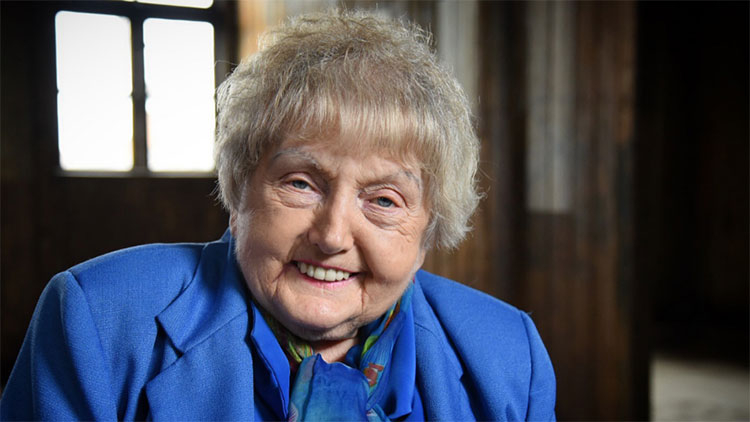
Eva Mozes Kor often said, “Anger is a seed for war, forgiveness is a seed for peace.” It was more than a slogan. It was a theology, a philosophy, and a daily discipline forged from one of the darkest chapters in human history. As a child imprisoned in Auschwitz and subjected to the medical experiments of Josef Mengele, Eva discovered that survival demanded a defiant hope. Decades later, she chose forgiveness as a form of liberation that offered survivors a path toward healing. Her decision inspired admiration and deep respect, and it also sparked fierce debate about justice, memory, and the boundaries of human compassion. The peace she pursued required extraordinary courage, because every step forward in forgiveness carried a cost.
I recently revisited one of Eva’s emails, a message filled with the kind of raw honesty that few people ever achieve. It was written in her unmistakable, unpolished style: urgent, passionate, and deeply personal. In it, she reflected on the consequences of her decision to forgive a former Nazi doctor, Dr. Hans Münch, and the relentless challenges she faced in opening CANDLES Holocaust Museum.
Reading it now, years after her passing, I am struck by how unyielding she was in the face of criticism, injustice, and personal danger. She did not simply speak about forgiveness. She lived it, even when it cost her dearly.
The Controversy Over Forgiving a Nazi
In 1995, on the 50th anniversary of the liberation of Auschwitz, Eva Mozes Kor did something unthinkable to many: she publicly forgave the Nazis. More than that, she stood beside Dr. Hans Münch, a former SS doctor at Auschwitz, and signed a declaration of forgiveness.
The backlash was immediate and fierce.
Israeli media framed the moment as a betrayal. Footage of Eva walking with Münch was broadcast again and again, without the context behind it.
A major Israeli newspaper published a scathing article, questioning whether any publicity was better than being ignored entirely.
In 1998, journalist Bruno Schirra published an interview with Münch in Der Spiegel, where the former SS doctor made remarks about his time in Auschwitz. The interview triggered a criminal investigation in Germany.
Around the same time, a French radio interview with Münch led to an even more explosive controversy. His derogatory remarks about Roma and Sinti people resulted in criminal charges in France for inciting racial hatred.
The consequences were devastating.
Münch and his family faced public scrutiny, threats, and harassment. In Germany, legal action pushed toward trial despite his diagnosis of Alzheimer’s disease.
In a personal email to me, Eva shared that Münch’s home was firebombed three times after his address was published in an article, requiring police protection for his family. I have not been able to verify this in any public record or independent source. It was her own account, offered behind the scenes, reflecting the weight she felt over what was happening to Münch and his loved ones.
Eva was horrified by what was unfolding. She had spent years advocating for justice. Now, she found herself advocating for mercy.
She sent more than 50 letters pleading with authorities to drop the lawsuits against Münch, but the legal proceedings continued.
In 2001, Münch was convicted in France. His sentence was waived due to his age and deteriorating mental state. He passed away later that year.
Eva felt a complicated kind of relief. Münch’s family was finally free from further attacks, and she no longer carried the guilt of contributing to their suffering.
The Fight to Build CANDLES Holocaust Museum
By 1995, Eva Mozes Kor had already reinvented herself many times: Holocaust survivor, public speaker, and founder of CANDLES (Children of Auschwitz Nazi Deadly Lab Experiments Survivors) in 1984. That year, she took on yet another role as a museum founder.
The CANDLES Holocaust Museum and Education Center was an extension of Eva’s mission to teach others about the Holocaust and the experiments performed on her and other Mengele Twins. She wanted to create a permanent place of education, remembrance, and dialogue.
Opening the museum was no small feat.
She found a commercial building in Terre Haute, Indiana, but it was too large and too expensive for the original client she was working with as a realtor. Instead, she made a bold and risky decision to secure financing under her own name, her husband’s name, and a partner’s name to purchase the building herself.
At 61 years old, she signed a $168,000 mortgage, despite her husband’s hesitation.
With limited funds for exhibits, she handmade decorations, including a wall of blue paper strips that read:
“LET US REMOVE ALL HATRED AND PREJUDICE IN THE WORLD, AND LET IT BEGIN WITH ME!”
When the museum opened on April 30, 1995, it quickly became a vital educational resource, drawing teachers, students, and community members eager to learn from Eva’s story.
Then everything changed after 9/11.
Her business partner, who owned a travel agency, struggled to keep her business afloat. The economic downturn was crushing. Eva was forced to buy out her partner’s share of the building at a much higher price, not to expand but simply to save the museum.
By 2002, at age 68, she and her husband took out a $222,000 mortgage to keep CANDLES alive.
The Fire That Could Not Destroy Her Mission
In November 2003, Eva Mozes Kor received a phone call in the middle of the night.
“Mrs. Kor, this is the police department. You need to come to the museum. There is a fire.”
She and her husband rushed to the scene. By the time they arrived, flames were already devouring the building. Firefighters battled the blaze, but it was too late. Everything inside was lost: photographs, historical documents, survivor testimonies, and artifacts.
She stood there watching as the place she had built with her own hands, her own money, and her own pain collapsed into smoldering rubble.
Investigators then found a message spray-painted on an exterior wall in black:
“REMEMBER TIMMY MCVEIGH.”
Timothy McVeigh, the domestic terrorist behind the 1995 Oklahoma City bombing, had been executed in Terre Haute just two years earlier. The implication was chilling. This was an act of hatred and intimidation meant to silence her.
But Eva had spent her entire life surviving the worst of humanity.
The next morning, standing in front of the ashes, she made a decision.
“We will rebuild.”
And she did.
With support from the community, from Holocaust educators, and from donors around the world, CANDLES Holocaust Museum rose from the ruins and reopened in 2005, stronger than before.
You can burn down a building. You cannot destroy a mission.
The Legacy of a Fighter
Most people would have stopped. Most would have looked at the destruction of their museum as a sign to walk away.
But Eva rebuilt.
The email she sent me that recounted this event, full of spelling errors, fragmented sentences, and scattered thoughts, perfectly reflected who she was:
Unpolished, yet utterly real.
Wounded, yet relentless.
Misunderstood, yet unwilling to back down.
Eva Mozes Kor understood something most people do not. Forgiveness does not rewrite the past. It does not fix what was broken. But it allows a person to stop carrying what cannot be undone.
She was never naive. She knew the world was cruel, unjust, indifferent.
She fought anyway.
She did not stop.
What This Means for Us
Eva’s story is not only about forgiveness. It is about resilience in the face of resistance. It is about choosing to build when the world wants to destroy.
Her words still challenge me.
Could I have made the same choices? Would I have kept going? Would I have had the courage to stand alone?
Perhaps that is the lesson she left for us.
Forgiveness is a gift. The fight for something bigger than yourself is what makes history.
© Jill Szoo Wilson, 2025
Featured Image photo credit: WFYI Indianapolis, 2021
The Question of Justice: Forgiveness vs. Accountability
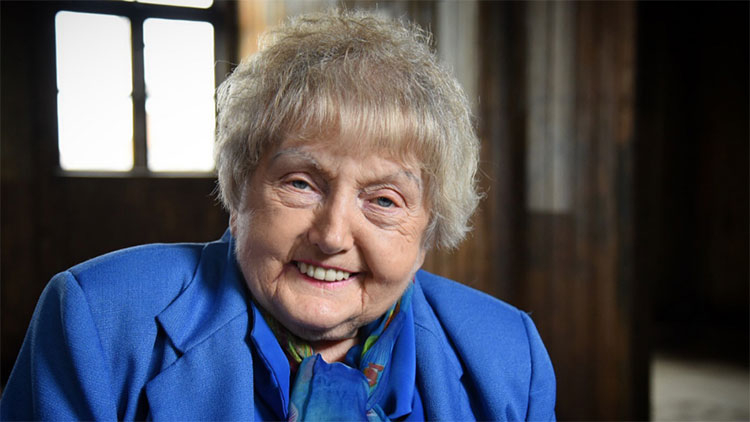
In conversations about forgiveness, Eva Mozes Kor, Holocaust Survivor and Mengele Twin, was often asked tough questions about justice, especially regarding criminals, terrorists, and those who have killed. One such question came from a UK film director, who asked, “Should we just forgive them and let them go?” This question challenged Eva’s own ideas of forgiveness and set her on a path to delve deeper into the complexities of justice and forgiveness.
Her response to this challenge was powerful: “We must decide what we want the end result to be,” she explained. If the goal is punishment, then “we just hang him/her,” because after all, she had spent her life hearing the statement, “Justice must be done.” But Eva quickly challenged that notion, pointing out that while justice sounds simple, the reality is far more complicated.
The Search for Justice: Mengele’s Escape
Eva shared her concerns about how justice was sought for the Nazis after World War II, focusing specifically on Dr. Josef Mengele, the infamous Nazi doctor who performed experiments on Eva and her twin sister, Miriam. Mengele’s arrest under his name by the American forces, only to be released a day later due to a mistake, underscored the failure of justice. Despite his heinous crimes, Mengele’s name was never included in the Nuremberg Trials, and it wasn’t until 1985 that serious efforts were made to find him.
Eva had long been suspicious of the official accounts of Mengele’s death. In 1985, after taking a group of Mengele twins to Auschwitz to mark the 40th anniversary of the camp’s liberation, the search for Mengele’s whereabouts became an international story. Governments like those of Germany and the U.S. announced that Mengele’s bones had been found in Embu, Brazil, but Eva remained skeptical. The rushed, secretive nature of the investigation raised red flags for her.
The Inquest: Investigating Mengele’s Death
Eva’s suspicions led her to take action. Determined that survivors had the right to examine the truth, she organized an inquest into Mengele’s death, inviting forensic experts, historians, and survivors of Auschwitz, including Mengele twins. Eva could not raise funds for the inquest, so she took out a second mortgage on her house to pay for the investigation. This decision highlighted Eva’s unwavering commitment to finding the truth.
Just days before the inquest was set to begin on November 15, 1985, Eva received what she said was a threatening phone call from Neal Sher, the director of the U.S. Justice Department’s Office of Special Investigations. He demanded that Eva provide the names of those who had seen Mengele alive after 1979, or face the possibility of U.S. Marshals visiting her. Eva stood firm, refusing to yield to threats and continuing with the inquest.
The Inquest Findings: The Mystery Deepens
During the three-day inquest, experts including pathologist Dr. Michael Baden, psychologist Dr. Nancy Segal, and German-educated physician Dr. Werner Loewenstein examined the evidence. Dr. Loewenstein, who had translated Mengele’s SS files, was pivotal in uncovering discrepancies in the investigation. He revealed that the bones found in Brazil could not be Mengele’s because they lacked evidence of osteomyelitis, a condition documented in Mengele’s medical history. This revelation cast doubt on the official story and bolstered Eva’s belief that the investigation had been a rushed cover-up.
The panel of experts, including Eva herself, reviewed the U.S. Justice Department’s forensic report and called for further investigation. They raised serious concerns about the findings, including discrepancies in the identification of the bones and the absence of investigations into post-1979 sightings of Mengele. Despite this, the official stance remained that Mengele had died in 1979.
The Call for Justice: Victims’ Rights and Compensation
Beyond the questions surrounding Mengele’s death, Eva also highlighted the ongoing suffering of survivors of his experiments. Many of Mengele’s victims, particularly the twins, suffered from chronic medical conditions such as kidney issues, heart problems, and spinal degeneration, all due to the unscientific and inhumane experiments Mengele conducted at Auschwitz. Despite the immense suffering, the German government had yet to offer compensation to these survivors.
Eva used her platform to call for justice for the victims of Mengele’s experiments, urging the German government to compensate them for their pain and medical costs. She made it clear that the failure to offer compensation was an embarrassment to the German government and a further injustice to those who had already endured so much.
The Power of Forgiveness: A Call to Action
Throughout her efforts, Eva remained steadfast in her belief in the power of forgiveness, a principle that had defined her personal healing since she forgave the Nazis in 1995. In the face of betrayal, deception, and injustice, Eva continued to advocate for forgiveness as a means of healing, not just for herself but for the world.
Eva’s call to action extended beyond the personal. She proposed an addendum to the Universal Declaration of Human Rights that would include the right to emotional healing, emphasizing forgiveness as a necessary act for personal and societal well-being. Through forgiveness, Eva believed that victims could transcend their suffering and reclaim their emotional freedom.
Conclusion: A Legacy of Justice and Healing
Eva’s journey to uncover the truth about Mengele’s death and the suffering of his victims was not just about seeking justice for the past. It was about ensuring a future where forgiveness, healing, and emotional freedom were recognized as fundamental human rights. Her efforts to shine a light on the long-term pain caused by atrocities and the need for healing through forgiveness resonate as deeply today as they did in 1985.
Eva Mozes Kor’s legacy continues to inspire those who seek justice, understanding, and healing, teaching us that while forgiveness is a personal journey, it also has the power to shape a more just and compassionate world.
© Jill Szoo Wilson, 2025
Read more by Jill Szoo Wilson on Substack.
The Courage to Imagine: Acting, Attention, and the Recovery of Interior Life
By Jill Szoo Wilson
Prologue
What follows are some specific thoughts on the role of the imagination and how I’m witnessing a slow decline in students’ ability to stick with a moment of “play” or creative imagination long enough to reach the truth embedded in the script.
When I began as a private acting coach a couple of decades ago, nearly all my students were either homeschooled or from Christian backgrounds. This was largely due to the environment in which I began. I had just graduated from a Christian university with my MFA in Acting and Directing for Theatre. During my time there, I helped design and launch a summer theatre camp, which drew a large following from the homeschool community. Many of those kids continued lessons with me long after camp was over.
Today, most of my students are no longer homeschooled, but many are still Christian. This is probably because many of my students already share a Christian worldview, and my teaching naturally aligns with it. I teach them how to act with technical skill, emotional honesty, and respect for the craft, as well as how to be artists and professionals in what is often a dark industry. We talk openly about integrity, boundaries, and how to navigate the pressures and temptations that come with performance culture. My goal is not just to prepare them for auditions or roles, but to help them become thoughtful, resilient artists who can carry the light of Christ into places where it’s often absent. I don’t market specifically to Christian students, but we have plenty of reasons to find each other and to enjoy working together.
That said, I do find that young Christian students tend to struggle with guilt and shame to a particularly high degree during the rehearsal process. We talk about it often. While I always choose material that is age-appropriate and content-appropriate for every student (and for myself, as I don’t enjoy lascivious or graphic pieces either), those who grew up in the church—Catholic, Lutheran, Evangelical, etc.—often feel very self-conscious as actors when they begin.
Girls are taught to be kind, service-oriented, loving, and demure. Boys are taught to be tough, heroic, good, and sensitive to the needs of others. These are all admirable traits. To be a man or woman of virtue, exhibiting the Fruit of the Spirit, should lie at the heart of our longing to be more like Christ. I could easily veer into an essay about how to marry our faith with our work, but for the sake of this particular piece, I’ll return to the central idea:
Christian students often struggle to play characters who don’t look like themselves or like those they aspire to become. Fair enough. But here’s the truth: life is full of good and evil. Villains and heroes. Builders and those who destroy. Most of us, over the course of a lifetime, are both. We’re all villains to some and heroes to others. We know what it is to build, and we know what it is to wound. To pretend otherwise is to whitewash life and ourselves, which usually leads to hiding in one way or another. So, it’s important for me to talk about redemptive stories with my students so they can confront this dichotomy rather than fearing it.
There are two kinds of redemptive stories: those that show us the good things that happen when we choose well, and those that show us the damage that occurs when we don’t.
That’s a simplified way to put it, but given that my students range in age from eight to fifty-five, the universality of this statement is often helpful to everyone for different reasons.
So, what do we do with the villains in the plays we read? What do we do when we agree to play Lady Macbeth in Macbeth, Regan in King Lear, or Medea in the title role? And what about Iago in Othello, Richard III, or Judge Turpin in Sweeney Todd? Do we flatten the character to fit inside our comfort zone? Do we avoid even considering the thought process of a conniver? Do we soften Medea’s rage to make the role more “Christian”?
I certainly hope not! If we do, we’re not being truthful. We’re pretending we never act with malice, selfishness, or harm. And if we refuse to embody those moments in a role—if we never stop to consider the villain’s position—we are denying ourselves an opportunity to understand something essential: that evil is not always monstrous or distant. Sometimes it begins with resentment. Or jealousy. Or the belief that we deserve more than we’ve received. Sometimes it begins with a wound. To engage that truth in rehearsal is not to condone it, but to confront it honestly. That kind of imaginative empathy sharpens discernment. It invites self-examination. It strengthens our ability to recognize corruption when it appears in ourselves or others. To avoid this work is not only to limit our range as actors, but to remain shallow as people.
Most of us will never seize power and destroy our father like Regan. Most of us will never seduce a woman named Lady Anne over her father-in-law’s corpse like Richard III. But if we take the time to understand the goodness of God and the brokenness of the world, we can, as Aristotle suggested, experience catharsis and reason together: I will not seduce. I will not murder. I’ve seen what happens when people do.
What follows are thoughts on the role of imagination in the life of an actor. To live truthfully in imaginary circumstances, we must first be willing to imagine.
The Studio and the Threshold of Imagination
This morning, I sat across from a college-aged student in a small studio, the kind with a well-worn rehearsal floor and no mirrors to distract. She was working through a dramatic monologue from King John, trying to locate the inner grief of Constance as she mourns the disappearance of her son, Arthur. The lines are some of Shakespeare’s most anguished:
“I am not mad; I would to heaven I were, For then ’tis like I should forget myself. O, if I could, what grief should I forget!”
My student is brilliant. She’s bright-eyed, classically educated, and emotionally intuitive. She understands the language and the circumstances. She grasps the weight of the moment intellectually. And yet, she struggles to connect with it fully. Her technique is solid. She found the beats and shifted breath and focus in the right places. The anguish, however, stayed on the surface and heightened. Her performance was more inferred than embodied, and she remained ungrounded.
So I gave her a note I’ve given many actors before her: “Particularize your son.” She nodded. She knew what I meant.
In actor training, particularly within the Meisner tradition, particularization is a foundational method for grounding performance in emotional truth, and it’s often misunderstood. Particularization in Meisner’s framework is not the same as the imaginative substitution associated with Stanislavski’s “Magic If.” The “Magic If” asks the actor to imagine themselves in the character’s situation—”What would I do if my son were taken from me?”—and then to act from that imagined scenario. This technique can be useful, as it encourages imaginative entry into a character’s world. But it relies on hypothetical identification; on asking ‘what if’ rather than anchoring the moment in lived emotional truth.
Meisner’s approach is different. It does not rely on imagining how one might feel in a fictional situation. It asks the actor to bring something real into the room. Something personal, visceral, and emotionally immediate. When I asked my student to particularize her son, I was not asking her to pretend to be a grieving mother. I was asking her to locate, in her own life, a person whose loss would pierce her. It could be a nephew, a younger brother, a godchild; anyone she has known and loved. Particularization is not fantasy. It is emotional preparation. The actor identifies a core emotional truth and allows that truth to live inside the moment.
This act is deliberate and vulnerable. It involves risk, attention, and a willingness to be seen. Because the actor is not pretending to feel, they are allowing themselves to feel. They are not trying to generate an emotion; they are giving themselves permission to respond to something that already holds weight in their inner world. Meisner insisted that acting lives in behavior, not in ideas. The words of a script are not the truth. The behavior underneath the words is where the truth resides.
When an actor says, “My son is gone,” the goal is not to deliver the line convincingly. The goal is to experience the truth of the line in real time. To say it while bearing the weight of one’s own emotional stakes. Particularization enables this. It shifts the actor from performing to being.
Still, something was missing. Despite her strong technique, something in her body remained disengaged. The truth hovered at the edges of the performance but never fully arrived. She wore the grief like a garment, but it had not yet reached her center.
This is a moment I have seen many times before. The student understands everything intellectually. The beats are there. The breath work is honest. And still, something inside hesitates. The mind approaches something emotionally risky, and the body pulls back. It happens quickly, often invisibly. A short-circuit. A retreat from vulnerability.
They stop mid-imagining. Mid-feeling. Mid-play.
This phenomenon is increasingly common. The cause appears to be cultural. We are watching a generation experience limited access to its imaginative life, not from apathy or lack of talent, but from being conditioned to remain just outside the threshold of deep interiority.
What fractures their concentration? What prevents them from crossing into full imaginative immersion?
Several things come to mind.
Sanford Meisner defined good acting as “living truthfully under imaginary circumstances.” Acting depends on entering. The actor allows themselves to be changed by what they imagine. In those moments, fiction becomes felt reality.
Meisner’s exercises do not focus on displaying emotion. They create conditions in which emotion arises organically. The goal is to engage the body before the mind intervenes with commentary or self-protection. Acting, in this view, requires attention; deep, sustained, emotional attention.
This is where the struggle appears.
Many students today experience difficulty maintaining emotional attention beyond a few seconds. Their minds are quick. Their instincts are strong. Yet under the weight of prolonged inner focus, their attention fractures. This does not stem from apathy, but from exhaustion. Their habits have been shaped by technologies and cultural rhythms that favor speed, fragmentation, and external validation over interior stillness.
A 2022 study published in Nature Communications found that global attention spans as measured by patterns of media engagement, have diminished over the past two decades. Our minds now pursue novelty more than depth. This shift influences more than productivity. It reshapes presence itself. It reconfigures the architecture of imagination.
Where actors once learned to build an imagined world and dwell in it, students today often find themselves pulled back by an invisible thread. They experience the impulse to check, to hesitate, to self-correct. Even in silence, they sense an audience. When external attention dominates, internal vision struggles to take root.
What I observe in the studio speaks to more than acting. It reflects a broader cultural wound. A drifting away from solitude. A quiet that grows more elusive. A loss of what the educator Charlotte Mason called “the habit of the reflective life.” In Mason’s view, imagination is a moral capacity. To imagine well is to love well. The capacity to enter another’s experience nurtures empathy, endurance, and attention. Like any virtue, it strengthens through practice.
How does one train imagination in a world of interruption?
This erosion of imaginative endurance presents a pressing concern. It reaches beyond the artist. It speaks to anyone seeking a meaningful existence amid constant noise. The deep spaces where empathy takes form, convictions clarify, and quiet truths surface depend on interior cultivation. A society that nurtures imagination forms individuals who respond with discernment and depth.
Classical educators have long understood the affinity between imagination and truth. Plato, though cautious of the poets, affirmed that metaphor helps the soul ascend toward the Good. Aristotle praised catharsis as a soul-cleansing process through imitation. Centuries later, C. S. Lewis called imagination the “organ of meaning.” Through it, knowledge gains emotional resonance. Facts become deeply known.
Contemporary students navigate a world full of information and comparisons. Previous generations may have asked, “Will I do something meaningful?” Today’s students often wonder, “Can I create something distinct enough to matter?”
This is the cost of saturation. So many voices, so many images, so many claims on the imagination cause silence to feel irrelevant. Stillness begins to feel misaligned with progress. In such an environment, the long breath required for full imaginative entry feels like a rarity.
And yet that long breath must return. We can help restore it.
Imagination brings shape to stories. It deepens relationships. It sustains a sense of mystery, sacredness, beauty, and possibility. Rather than vanishing, imagination waits. It remains present beneath the surface noise. It endures through fractured attention and abandoned moments of thought. It waits for breath. For solitude. For the courage to enter again.
In my work with students, I encourage them to slow down, not as a strategy, but as a way of being. They are learning to stay present inside a moment, linger with an image, and let silence stretch. Not everything needs to resolve quickly. Some truths arrive only through stillness, and meaning often deepens through sustained practice rather than polished execution.
Imagination does not pull us away from the world. It grounds us more deeply in it. It sharpens perception. It draws our focus toward what lasts. This is why Shakespeare continues to speak, and why Meisner’s invitation to live truthfully in imagined circumstances still carries weight. These are not artistic artifacts. They are instruments of renewal.
✨ If you’d like to keep reading more essays like this, you can also find me on Substack: https://substack.com/@jillszoowilson
The Cost of Becoming: Willy Loman and the Collapse of the Performed Self
By Jill Szoo Wilson
Prologue: Playing Willy Loman
Before one analyzes Willy Loman, one must attempt to inhabit him. The work of the actor offers more than interpretation; it offers a way into his psychology. The Meisner technique, which trains actors to live truthfully under imaginary circumstances, demands that a character be approached not as a symbol or a mood, but as a person with specific objectives. The actor does not play a man who is sad, but a man trying to appear happy. One does not play drunkenness, but the effort to walk in a straight line. One does not play collapse, but the relentless pursuit of control.
This approach becomes essential in performing Willy. He cannot be played as someone unraveling. He must be played as someone still trying to climb. He is not aware of his disintegration. He is fighting it. The tension in his voice, the urgency in his gait, and the rhythm of his speech can all reveal a man still chasing validation, still working to prove himself, still trying to matter.
Just as a villain does not see himself as a villain, the actor playing Willy must believe in the truth of the character’s motivations. Willy believes in the story he tells. The sales pitch is not a metaphor to him; it’s survival. Every gesture carries the imprint of past successes. Every pause contains the weight of unseen failure. His tragedy is not that he has given up, but that he cannot. His pursuit has become his identity.
The actor must approach each moment with this in mind. Willy is not asking for pity. He is asking to be heard, to be remembered, to be great. Even in his most fractured scenes, he is still performing the role of the man he once hoped to be. That performance is what ultimately breaks him.
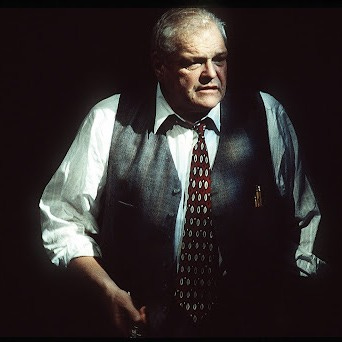
Introduction
In the years following World War II, American culture embraced the idea that prosperity would generate both comfort and cohesion: a sense of stability, belonging, and self-worth rooted in home ownership, upward mobility, and steady employment. The war had ended in victory, the suburbs were blooming, and economic expansion offered a vision of order that felt both new and enduring. This was a time of rising optimism, when the pursuit of the American Dream—embodied in hard work, domestic life, and professional success—was framed as a moral ideal. To believe in that dream was to place oneself inside a shared national story. A meaningful life, it seemed, could be earned through effort and aspiration.
Arthur Miller’s Death of a Salesman confronts the unraveling of that story. At its center stands Willy Loman, a traveling salesman whose crisis begins in the workplace and spills into the core of his identity. His crisis is not only economic but existential. As the play unfolds, we encounter a man whose inner life begins to dissolve: his memories crowd the present, his sense of time becomes unstable, and his relationships erode. Miller’s dramatic world offers more than a critique of economic pressure; it becomes a crucible in which identity itself bends and breaks.
This essay explores how Death of a Salesman dramatizes the collapse of identity when it is built on an external ideal. Through its fragmented structure, expressionist form, and intergenerational tension, the play traces the unraveling of Willy Loman, a man whose self-worth depends on a version of success shaped by visibility, wealth, and admiration. Though rooted in social realism, the play frequently breaks from naturalistic conventions, blending realism with expressionism to capture the fragmentation of Willy’s mind. Cultural messages about achievement, the burden of familial expectation, and the seductive pull of nostalgia all conspire to distort his self-concept. At its heart, Miller’s work raises a haunting question: What remains of the self when it is built on a dream that was never truly one’s own?
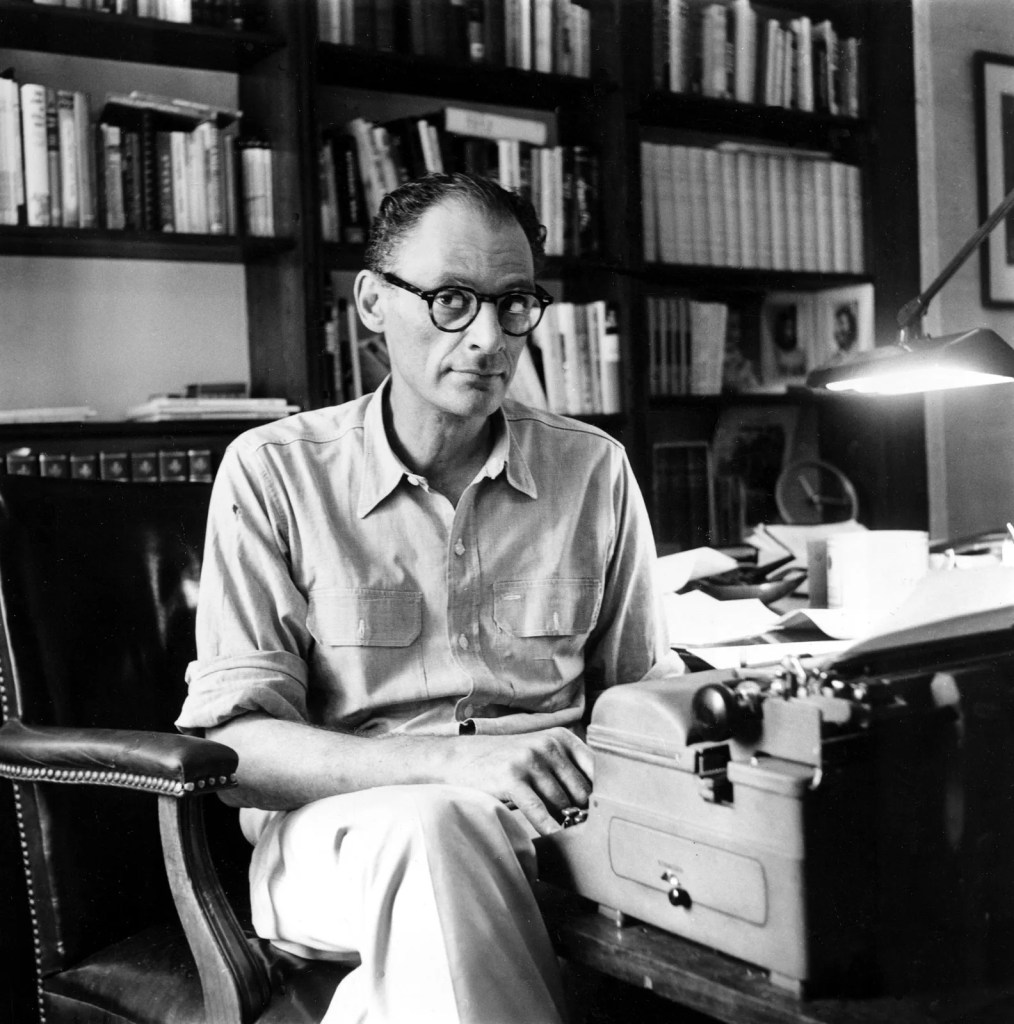
Section I: Early Formations of Selfhood
Willy Loman emerges as a man profoundly shaped by the cultural messages of postwar America. From the outset, his understanding of worth is externalized. He believes that being well-liked is the key to success, repeating the idea that popularity and personal charisma matter more than skill. This philosophy informs the way he raises his sons and evaluates his own life. Developmental psychologist Erik Erikson writes that “identity is formed through the interplay of biological givens and societal roles” (Identity: Youth and Crisis, 1968). For Willy, that interplay is dangerously out of sync. He confuses approval with value and presentation with substance.
His identity becomes performative, reliant on others’ perceptions. In his frequent recollections of his brother Ben, Willy shows how deeply he clings to mythic narratives. Ben represents everything Willy wishes he had become: wealthy, decisive, and respected. “When I walked into the jungle, I was seventeen. When I walked out, I was twenty-one. And, by God, I was rich!” (Miller 48). For Willy, this anecdote is more than family lore; it is a talisman against failure. In Ben, he sees proof that success is a singular, dazzling act, not a long process, but a moment of transformation. And so, Willy waits for his moment like a lion stalking prey already devoured by another. The instinct remains, but the opportunity has vanished. His belief in the singular triumph blinds him to the slow work of becoming.
Psychologist Carl Rogers suggests that when individuals base their self-worth on “conditions of worth” imposed by others, they lose touch with their authentic selves (On Becoming a Person, 1961). Willy embodies this distortion. Rather than cultivating a stable internal identity, he attaches his sense of self to external validation. He cannot separate his inner value from his outer performance.
Section II: The Rise and Fracture of Familial Expectations
Willy places immense hope in Biff, his eldest son. He does not dream for Biff so much as he dreams through him. Biff becomes a vessel for Willy’s projected success. In adolescence, Biff appears to mirror his father’s charisma and confidence. He is popular, athletic, and adored. Willy sees this as evidence that Biff will fulfill the dream he himself could not. “He’s liked, but not—well liked,” Willy says of Bernard, dismissing the boy’s academic seriousness in favor of Biff’s charm (23). The phrase reveals more than Willy intends. In his world, being “well liked” carries spiritual weight. It’s not just a social advantage; it’s a measure of worth. To be well liked is to be blessed, chosen, and affirmed by the invisible hand of success. Bernard’s intelligence is treated as a liability because it lacks sparkle. Biff’s charm, by contrast, is seen as currency. The line crystallizes Willy’s lifelong confusion: he mistakes attention for esteem, applause for substance.
Yet Biff’s admiration is shattered during a business trip to Boston, when he discovers his father in a hotel room with another woman. The moment of betrayal is not just personal. It is psychological. Biff loses the man he admired, and with him, the sense of self that admiration supported. “You fake! You phony little fake!” he cries (95). In that rupture, the illusion collapses. Willy is not the great man Biff thought him to be, and Biff is no longer sure who he is without that image.
Attachment theorist John Bowlby notes that disruptions in trust between parent and child can result in identity disturbance, particularly if the child has built his self-understanding on idealized images (Attachment and Loss, 1969). Biff’s identity fractures because it was co-authored by a man whose own foundation was false. The fallout of this moment ripples across the rest of the play. Biff wanders, lost in purpose and direction, while Willy clings harder to the fading vision of success.
Yet Biff’s wandering is not aimless. Unlike his father, who remains trapped in denial, Biff begins to pursue a kind of difficult truth. His disillusionment, though painful, marks the beginning of a reckoning. In the final scenes, Biff confronts the family’s illusions with unflinching honesty, declaring that they have “never told the truth for ten minutes in this house” (103). This attempt at truth-telling, however raw, becomes a redemptive thread. While Willy doubles down on fantasy, Biff reaches for clarity even if it costs him the dream.
Section III: Memory, Time, and Psychological Regression
Miller does not portray Willy’s collapse as linear. Instead, he creates a psychological architecture in which memory intrudes on the present. Walls dissolve. Characters from the past arrive as though no time has passed. This expressionist structure captures the erosion of Willy’s psychological boundaries. He no longer revisits memories; he inhabits them. They become both a refuge and a trap.
Freud’s theory of repetition compulsion provides a compelling psychological lens for understanding Willy’s psychological breakdown. Introduced in Beyond the Pleasure Principle (1920), the theory describes a phenomenon in which individuals unconsciously repeat painful or traumatic experiences, not in pursuit of pleasure, but in an attempt to gain mastery over a past that remains unresolved. The repetition is not intentional; it emerges from the psyche’s attempt to regain control by recreating the conditions of the original wound. The individual returns to the same emotional terrain again and again, hoping—without realizing it—to alter the outcome.
In Willy’s case, the past does not visit him as memory but as lived experience. He does not recall; he reinhabits. Conversations with Ben, moments with Biff, echoes of earlier days surface with increasing urgency. These scenes carry the weight of regret, but they also offer him temporary refuge. Within them, he can reassert his authority, recover the image of success, and briefly inhabit the man he once believed himself to be. Unfortunately for Willy, his compulsion to return does not resolve the trauma. It deepens it. Each reenactment sharpens the ache. The life he wants to rewrite instead writes over him.
As the play progresses, these revisitations grow more urgent. He speaks to voices no one else can hear. He replays conversations aloud. The present loses its clarity. Psychologist Aaron Beck writes that depression often leads to cognitive distortions that warp time perception and induce emotional paralysis (Cognitive Therapy of Depression, 1979). Willy exhibits these distortions. He cannot live in the now. His present is filled with regret and inadequacy. His past gleams with untouchable promise.
Section IV: The Psychology of Shame and Withdrawal
Shame is the undercurrent of Willy’s emotional decline. Though he claims to be working for his family, he increasingly isolates himself from them. Linda, his wife, tries to reach him, but he bristles at her concern. When she encourages him to ask his boss for a non-traveling job, he responds with irritation, accusing her of planting ideas in his head, as if her care undermines his dignity. Happy, his younger son, is met with indifference. Willy rarely engages him beyond superficial conversation and often overlooks him entirely in favor of Biff. Even Biff, who offers a kind of brutal honesty, is met with deflection. When Biff attempts to confront the family’s long-standing illusions, declaring that they have never told the truth for more than ten minutes in the house, Willy interrupts and retreats, unwilling to accept what his son is beginning to understand.
These fractured interactions are not just defensive. They are symptomatic of shame. Willy withdraws not out of malice but out of an internalized belief that he has failed the people he loves. The more he feels exposed, the more he distances himself.
Psychologist Brené Brown defines shame as the belief that one is unworthy of love and belonging (Daring Greatly, 2012). Willy lives inside that belief. He feels he has failed as a provider, as a father, and as a man. Rather than face these feelings directly, he retreats. He speaks more to the past than to the people around him.
This retreat mirrors what psychiatrist Thomas Joiner identifies as “perceived burdensomeness” in his theory of suicidal desire (Why People Die by Suicide, 2005). Willy begins to believe that his death will serve his family better than his life. He rationalizes that his life insurance payout will redeem him in Biff’s eyes. “That boy is going to be magnificent!” he declares, convinced that death can function as a final gift (135).
Miller frames this moment with compassion, not justification. He does not glorify Willy’s decision. Instead, he lets the audience feel the ache of a man who could not see his own worth without applause.
Section V: Aftermath and Absence
The play closes not with resolution, but with absence. Willy dies believing that his sacrifice will redeem him in the eyes of his son and secure his family’s future. The imagined narrative is one of triumph: insurance money replacing lost income, Biff transformed by grief into the man Willy hoped he would become, the family finally recognizing the value of the man who died for them. It is, in Willy’s mind, the final performance—the last act of a salesman who believes his death will sell the very life he could not live.
What unfolds instead is a quiet, almost unbearable scene. Willy’s funeral is sparsely attended. No grand send-off, no chorus of admiration. Just a few family members and Charley, the neighbor whom Willy often disdained. The world does not gather to mourn the man who chased recognition his entire life. There is no validation, no final applause. The silence speaks louder than any eulogy.
At the center of this silence is Linda. Her grief does not erupt in fury or lamentation. It arrives as confusion. As a quiet disbelief. “I made the last payment on the house today,” she says, standing at his grave. “Today, dear. And there’ll be nobody home” (139). The line is devastating in its simplicity. The home they struggled to keep is now fully theirs, but the man who fought so hard to pay for it is gone. The achievement is hollow. The security came too late. The dream was achieved, but the dreamer did not survive it.
Linda’s mourning captures the full weight of the tragedy. She has stood by Willy through every descent, every contradiction, every delusion. She believed in his goodness, even when he could not believe in himself. Her sorrow is not only for the man she lost, but for the meaning he sought and never found. She cannot understand why he chose to go. Her words are not angry. They are bewildered. “Why did you do it?” she asks into the silence. “I can’t cry. It seems to me that you’re just on another trip” (139). Her grief is suspended between denial and realization, between the role she has always played and the irrevocable truth of what has happened.
Through Linda’s final words, Miller reveals the true cost of Willy’s collapse. The tragedy is not only the loss of his life, but the emotional wreckage left behind. The dream he chased—of being remembered, admired, and secure—comes to nothing. In its place is a widow talking to a headstone, a son trying to reclaim his own name, and a home that now stands empty.
The curtain falls not on resolution, but on the unanswerable questions that linger after loss.
Conclusion: The Dreamer and the Dream
Willy Loman’s tragedy is not rooted in villainy. It is rooted in a lifelong confusion about what makes a person valuable. He sought love through achievement, identity through performance, and belonging through admiration. These ideals were not his alone; they were etched into the fabric of postwar America, offered as promises of fulfillment. Yet for Willy, they remained just out of reach. The harder he chased them, the more his sense of self unraveled.
Arthur Miller does not simply critique capitalism or expose the instability of the American Dream. He offers something more intimate: a study of how a man can lose himself in a story he did not write, a story that told him who he had to be in order to matter. Willy’s longing is not ignoble. His devotion to family, to legacy, to being remembered are deeply human impulses. What makes the play so devastating is not that he failed, but that the very metrics by which he measured success were never meant to hold the weight of a soul. Had he altered those metrics—had he measured worth by presence rather than praise, by connection rather than conquest—his life might have been marked by meaning rather than collapse.
In the end, Death of a Salesman is not only about the disintegration of one man, but the disorientation left behind. Willy’s life is marked by performance, but his death forces those who loved him to ask not only what it was all for, but who he truly was beneath the roles he played. Why wasn’t the life they shared enough? Why wasn’t he enough, as he was? Why weren’t they enough, without the illusion? The play offers no final answer, only the echo of a question: What becomes of a person whose dream was never truly his own?
✨ If you’d like to keep reading more essays like this, you can also find me on Substack: https://substack.com/@jillszoowilson
Further Reading
- Aaron T. Beck. Cognitive Therapy of Depression. Guilford Press, 1979.
- John Bowlby. Attachment and Loss, Vol. 1. Basic Books, 1969.
- Brené Brown. Daring Greatly. Gotham Books, 2012.
- Erik H. Erikson. Identity: Youth and Crisis. Norton, 1968.
- Sigmund Freud. Beyond the Pleasure Principle. Translated by James Strachey, Norton, 1961.
- Thomas Joiner. Why People Die by Suicide. Harvard University Press, 2005.
- Arthur Miller. Death of a Salesman. Penguin Books, 1998.
- Carl Rogers. On Becoming a Person. Houghton Mifflin, 1961.
Eva Mozes Kor, the Scheisskommando, and the Cost of One More Day
From 2013 to 2017, I traveled with Holocaust survivor and Mengele Twin Eva Mozes Kor, following her story across Poland, Hungary, and Romania. I wanted to learn, not just from her words, but from the places themselves. I walked the dirt roads where she grew up in Romania, stood on the concrete where her family waited to be shoved into cattle cars in Șimleu Silvaniei, and pressed my hand against the cold stone of Block 10 in Auschwitz, where Dr. Mengele once looked down at her and said, “It’s a shame she’s so young. She only has a couple weeks to live.”
Eva never told me what to think. She never tied things up neatly. She only asked me to look, to listen, to understand: survival, real survival, was never just about strength. It was in the details. The ability to step over a dead body and keep moving, because stopping meant risking your own. The skill of slipping a potato from the commissary without getting caught. The discipline to dissociate, not from the rats that scurried over her at night, but from the fear of them, because sleep was necessary, and fear could not be allowed to strip her of the strength sleep afforded her.
It’s easy to imagine survival as something straightforward, a matter of strength or willpower. But in Auschwitz, survival was a negotiation, a constant weighing of the impossible.
“What would you do to survive? You can’t really know until your life is actually in danger. It was easy to die here. Survival took every ounce of strength you could muster.”
Standing in the humid summer breeze at Auschwitz-Birkenau, I contemplated Eva Kor’s words.
It is easy to die. It is difficult to live. Life is fragile. We come from the dust and to the dust we return. Beginnings and endings are consistently marked by celebration, comedy, tragedy, and pathos. Middles are different. The middle of a thing is where the human spirit grows. Middles churn with questions, collide with conflicting purposes, strain toward progress, and wrestle with the weight of stagnation.
Birkenau was an epicenter where middles and endings met. Survival was not simply a contest won by the fittest. It was a succession of choices; choices that rang in the soul of each individual, like the sound of a train dragging its way through the countryside on tracks of steel. Some survived by cultivating their minds to be like the birds that flew above the blood and mire. Some survived by making themselves useful. Some survived by climbing into a trough of human waste to escape the eye of the enemy. Because even here, in filth, there was something worth grasping, something worth staying alive for.
Latrines: A Place of Filth and Refuge
The Nazis allowed prisoners two visits to the latrines per day, one in the morning, one in the evening. That was it. The rest of the time, men, women, and children had to relieve themselves wherever they stood. The ground they walked on bore witness to their labor, their suffering, and the last remnants of their dignity.
The air of Birkenau was thick with an unholy stench: human waste, rancid sweat, the sharp tang of blood, and the sickly-sweet rot of decay. It clung to the skin, crawled into the lungs, and settled deep in the gut like a living thing, an inescapable reminder that suffering here had a scent. And with every breath, sickness followed. Dysentery oozed through the camp, rotting stomachs from the inside out, turning each bite of watery broth into a calculated risk, each swallow a step closer to collapse.
And yet, there was an odd paradox: working in the latrines was considered one of the best jobs in the camp.
Imagine a world where standing in human waste meant protection. In Auschwitz, it did.
The Paradox of the Latrine Workers
The latrines were a guard-free zone. And so, in this rancid, airless place, there was something invaluable: privacy.
For those assigned to the latrines, the absence of guards offered a rare and fragile freedom. In the stench and shadows, prisoners bartered stolen scraps, exchanged whispered news, and conspired in low voices. Some sought fleeting moments of physical intimacy, an urgent defiance against a world that had stripped them of choice. In a place built to erase them, the latrines became one of the few spaces where prisoners could still claim their own existence.
Here, in the thick of filth, they remembered they were still human.
The Work of the Scheisskommando
Their job was simple: lift the heavy concrete slabs covering the waste pits, lower themselves inside, and scoop out the accumulated filth.
If you’ve ever gagged while cleaning out your refrigerator after leaving leftovers for too long, imagine standing waist-deep in a sea of decay. The air was thick, humid, and alive with flies. The stench coated everything, clinging to their skin and settling into the creases of their clothes like an unshakable second skin.
But for those who had this job, it was a lifeline. They weren’t being worked to death in the fields. They weren’t being lined up for random executions. They weren’t subjected to the relentless gaze of the SS officers who delighted in tormenting prisoners for sport.
The latrines, for all their horrors, offered something rare in Auschwitz: predictability.
A Dignity That Refused to Die
Powerlessness is a disease that seeps into the soul. Strip away respect, dignity, and basic rights, and two things happen: the perpetrator swells with power, and the victim shrinks.
Allowing prisoners to stand ankle-deep in their own filth was not just a byproduct of poor sanitation, it was an act of control. The SS guards didn’t have to lift their legs and urinate on the prisoners to show their dominance. They merely had to stand still while the prisoners did it to themselves.
But in the darkest places, even where dignity was supposed to die, the will to live persisted. The latrine workers of Auschwitz-Birkenau found ways to carve out a space for themselves, to steal back fragments of their humanity, to keep moving forward when everything around them said they should fall.
Consider if you will, a woman falling from the sky into the deep ocean. She is surrounded by foreign creatures, disoriented by the sounds and weight of the water. She is not a fish. She has no gills. The water is her enemy. It presses on her lungs, reminding her with each second that this place does not belong to her.
She has a choice. She can panic and sink, or she can swim.
This is the paradox of survival. This is the choice of the Scheisskommando.
The Final Question
Eva Mozes Kor once asked a group of people this question as we stood inside a latrine at Birkenau:
“How many of you could survive here? What would you do to survive?”
Survival in the death camps was never about dignity. The prisoners carried that within them, untouchable even in the face of brutality. What was at stake was something else entirely. Life in exchange for one more day. Hopelessness held at bay for a sliver of hope. The certainty of an ending deferred, just long enough to stay in the middle a little longer.
We like to think we know ourselves. That in the face of unspeakable horror, we would know what to do. That we would have a plan. A way to resist. A way to bring order to chaos.
But the truth is, we don’t know.
We can’t know.
Not until we’re the ones at the edge of the pit, staring into the void.
Not until survival is no longer a question, but the only thing left.
© Jill Szoo Wilson, 2025
 Jill Szoo Wilson