While 2025 has been marked by dramatically shifting plates under the surface of humanity, it has also been a time of growth, resilience, and gratitude.
Every morning, my husband prepares my coffee. It doesn’t matter what time I wake up, whether we share a similar schedule, or when he goes to bed after coming home late from rehearsal or a work engagement. Each morning, it is my privilege to walk into the kitchen, whose counter is fully lit with whatever sunlight the day is offering, a small gaggle of houseplants, my favorite coffee mug, and a French press cleaned and poised for boiling water.
This might seem like a little thing. But when you consider the aforementioned shifting plates, this morning routine is a respite filled with consistency and love. Little things are where life is lived.
This is the year I went back to teaching after enduring the most tumultuous four years of my life. The time between the summer of 2020 and the summer of 2024 taught me more about who I am than I had learned in the previous forty-something years. Anything good in me was a result of God’s grace, the beautiful kindness of those He placed in my life, and an enduring seed of the Word planted and watered over years of joy, hardship, victories, and defeats. In other words, I learned that I am far more limited than I once realized and far more equipped to handle the slings and arrows of this life than I deserve to be. As Paul reminds us, it is by grace that any of us go forward at all.
God’s love. God’s provision. The fruit of the Holy Spirit. These are life itself. And everything else in this life becomes mercy in His hands, through which we learn how to trust, laugh, cry, hold, and let go. This life is a journey in which we begin to recognize the absolute goodness of God and learn to look forward to the age to come.
So, teaching.
In 2025, I returned to teaching theatre and communication. I won’t write in detail about that topic here, because I’ve been writing about it quite a bit lately. What I will say is this: the best thing about teaching, for me, is that I get to sit with young people, find out who they are, how I can serve them, and where I can help them grow. Not only toward learning or career goals, but toward becoming the best version of themselves.
My entire teaching career has been one of planting seeds. I’ve never once had the same student twice. Because I’ve taught foundational courses like Introduction to Theatre, Public Speaking, Foundations of Communication, and Theatre History, I tend to see students in class during their earliest semesters and then see them in the halls for the next two to four years. It’s rare that I get to see the fruit of my own labor, but those moments do come. When they do, they are a gift. Either way, because my work has been to plant seeds, I’ve learned to quickly see how I can best serve whoever is in front of me and make the best of our time together. I count this a blessing, and a great deal of fun.
These past two years were also significant because this is when my husband and I went through the Book of Revelation in its entirety. It took us one year to read and study it, and another to sit with the implications of the revelation of Jesus for our lives yesterday, today, and forever. I have a feeling this is what I will be writing about for much of 2026. For now, I will simply say this: there is nothing more important in life than studying the Word of God, putting our faith in Him, obeying His Word, and trusting in the finished work of Christ on the cross, His resurrection, and the fulfillment of God’s covenant promises to Abraham, Isaac, and Jacob in Christ. These promises are not only future hopes. They are realities already unfolding now and finding their full completion in the age to come. Understanding that changed how I read the whole of Scripture.
God has always related to His people through covenant. From the beginning, He bound Himself to humanity with promises He alone would keep. He made a covenant with Abraham, promising blessing, land, and descendants, and declaring that through Abraham’s family all nations would be blessed. That covenant was carried forward through Isaac and Jacob and entrusted to the Jewish people, through whom God revealed His law, His faithfulness, and His name to the world. Jesus did not replace this covenant. He fulfilled it. In Him, the promises of God find their “yes.” Those who belong to Christ are grafted into this story, not as replacements, but as recipients of mercy, heirs by grace. The covenant God made with Israel is not erased by Christ, and the mercy extended to the nations does not diminish it. This covenant is not only about where history is going. It shapes how we live now, grounded in faithfulness rather than fear, held by a God who keeps His word.
This was the year I came to more fully understand the history of my own faith. Not fully, of course, but enough to give me context for God’s plan, His story of redemption, and His magnificent love. It was the year I stopped placing myself in the stories of the Bible and began to recognize, by the power of the Holy Spirit, that the entire Word of God is His story. It is filled with types and shadows of the Messiah, with good and evil, and with the absolute miracle that you or I get to be part of His story at all.
This was the year I learned, once and for all, that I need to be on His side. God is holy, and there is no possible way I can earn my way into His presence. Jesus came to this earth as the perfect sacrifice to a holy God, and it is only through Him that I can approach the Father. Through Christ, I am made clean. When God the Father sees me now, He sees His Son. There is nothing I could have done to earn His favor. Christ is the hope of glory.
This is the year I began to understand God as my Father. Because my earthly father disappeared when I was one year old, this has long been the aspect of God I struggled to trust. Not because I didn’t want to or didn’t believe He deserved my trust, but because I didn’t know how. God has been patient with me. I can now see that He has allowed certain storms in my life for a specific reason: so that I would humble myself and cry out, “Help me, Father.” There is a vulnerability only a daughter can feel and a kind of help and safety only a Father can provide. I trust my heavenly Father.
The world grew frightening this year, didn’t it? The political climate and our general sense of safety have been eroding. People are being killed for their faith. Riots fill the streets. Traditions are canceled because people are afraid to gather. Glowing screens in every household carry the noise of the world into our lives.
It is frightening.
But God.
There is a peace that surpasses all understanding, and it comes from one source alone. This year, by His will and for His glory, my resolution is to speak more about Him and to learn and teach about Him, His sacrifice on the cross, why it matters now, and why it is the only thing that will matter in the age to come.
So, 2026. Cultural divides, covenant, controversy, and coffee. What an adventure!
Author’s Note: This is not an essay about forgiveness. I have written about Eva Mozes Kor, Holocaust survivor and forgiveness advocate, for years because I deeply respect her message. I honor her legacy here while condemning antisemitic violence without qualification and calling Christians to action in the present moment. Nothing in this piece is meant to soften, spiritualize, or diminish the reality of antisemitism today.
Nearly seventy years after the Holocaust, Eva Mozes Kor still looked at the world and saw a painful truth: antisemitism had not disappeared. The lessons of history, no matter how horrific, were not enough to prevent hatred from resurfacing. As a survivor of Auschwitz and a Mengele Twin, she carried both the burden of memory and the wisdom of experience. She often asked a simple but haunting question: What has changed since Auschwitz?
Eva often spoke about how Adolf Hitler rose to power not as an anomaly, but through a series of orchestrated events designed to achieve a singular goal, the extermination of the Jewish people and the establishment of an Aryan-dominated society. Hitler and his regime promoted the belief in Aryan racial superiority, claiming that Germans of “pure” Nordic descent were destined to rule over other groups they labeled as inferior. These ideas, rooted in eugenics and extreme nationalism, fueled policies that targeted Jews, Romani people, disabled individuals, Slavs, and others deemed unfit for their vision of a racially “pure” society. This ideology was systematically enforced through propaganda, education, and legislation, including the Nuremberg Race Laws of 1935.
The Nuremberg Race Laws consisted of two primary statutes:
The Reich Citizenship Law: This law declared that only individuals of German or related blood were eligible to be Reich citizens, effectively revoking Jews’ rights as citizens. It stated: A Reich citizen is a subject of the state who is of German or related blood, and proves by his conduct that he is willing and fit to faithfully serve the German people and Reich. (Source)
The Law for the Protection of German Blood and German Honor: This law prohibited marriages and extramarital relations between Jews and citizens of German or related blood, aiming to preserve the “purity” of German blood. It also forbade Jews from employing German females under 45 years of age in their households. (Source)
Germany, one of the most advanced and cultured societies of its time, fell under the influence of a leader who manipulated public fears and desires, offering promises of restoration and prosperity in exchange for obedience. Step by step, ordinary citizens became participants in a deadly machine, one that required gradual compromises until they found themselves complicit in atrocities. This transformation is hauntingly explored in the book Ordinary Men, which details how average individuals became executioners not out of inherent evil, but by following orders, rationalizing their actions, and failing to resist the system that consumed them.
Eva witnessed this transformation firsthand and spent decades ensuring people understood how easily it could happen again. She often emphasized that Hitler’s rise was not inevitable, nor was it the result of a single event. It was a gradual process, shaped by economic hardship, propaganda, and the willingness of ordinary people to accept small injustices until they became monstrous realities.
Five Factors That Allowed Hitler to Rise to Power
The Holocaust was not an accident of history. It was the result of a carefully constructed plan, built on a foundation of economic despair, propaganda, and the gradual erosion of moral resistance.
Economic Devastation: Germany faced severe unemployment, with rates soaring to 30 percent in the early 1930s. This economic turmoil created fertile ground for extremist ideologies. (encyclopedia.ushmm.org)
Scapegoating the Jews: The Nazi regime capitalized on existing antisemitic sentiments, blaming Jews for Germany’s economic and social woes and uniting the populace against a common, innocent enemy. (encyclopedia.ushmm.org)
Propaganda and Control: Through relentless propaganda, the Nazis dehumanized Jews, portraying them as subversive and dangerous, which facilitated public acceptance of discriminatory laws and actions. (encyclopedia.ushmm.org)
Apathy and Inaction: Many Germans and international observers remained passive or indifferent as antisemitic policies escalated, allowing hatred to fester unchallenged.
The Allure of Power: Hitler’s strategic political maneuvers, including exploiting democratic processes, enabled him to consolidate power and implement his radical agenda.
These historical conditions are not confined to the past. Alarmingly, antisemitism has seen a resurgence in recent years. A 2024 report highlighted a 340 percent increase in global antisemitic incidents compared to 2022. (timesofisrael.com) Furthermore, a 2025 Anti-Defamation League survey revealed that 46 percent of adults worldwide harbor significant antisemitic beliefs. (adl.org)
Despite comprising a small fraction of the global population, approximately 15 million Jews worldwide, many continue to advocate for oppressed communities, even when it entails personal risk. Eva marveled at this enduring commitment to justice and empathy.
The Ultimate Power: Forgiveness
Eva often said, “Anger is a seed for war, forgiveness is a seed for peace.” To her, forgiveness was never about excusing harm. It was about breaking the cycle of hatred.
Forgiveness does not take place on the battlefield. It is not something that happens in the midst of conflict, nor does it excuse or prevent the necessity of justice. Forgiveness comes later, when the dust has settled and when the victim is free to reclaim their own power. It is not about surrender. It is about refusing to let the past dictate the future.
While Eva never shied away from confronting the past, she was equally passionate about what came next. She believed that dwelling in anger, no matter how justified, only gave power to those who inflicted harm. “Forgiveness,” she said, “is the only power a victim has to heal, liberate, and reclaim their life.”
Eva was careful to say, “I forgive in my name only.” She never claimed to speak for other survivors, nor did she suggest that forgiveness was a requirement for healing.
Eva Mozes Kor often emphasized this declaration, reflecting both her personal journey and a deep respect for Jewish principles regarding forgiveness. In Jewish tradition, forgiveness, or mechila, is a profound process that hinges on sincere repentance from the wrongdoer. Maimonides, a preeminent Jewish scholar, outlined that true repentance (teshuva) involves the offender’s acknowledgment of wrongdoing, genuine remorse, and a committed effort to rectify the harm caused. Only after these steps is the victim encouraged to offer forgiveness.
This framework underscores that forgiveness cannot be granted on behalf of others. It is an intimate act between the victim and the penitent. In the context of the Holocaust, where six million Jews were murdered without any expression of remorse from the perpetrators, the notion of forgiveness becomes even more complex. Jewish law maintains that offenses against an individual require that individual’s forgiveness, making it impossible for survivors to forgive on behalf of those who perished. (utppublishing.com)
Eva’s careful articulation, that her forgiveness was solely her own, respected this principle. She did not presume to speak for other survivors or the deceased. Her act of forgiveness was a personal liberation, a means to free herself from the grip of anger and victimhood, without contravening the collective memory and enduring grief of the Jewish community. (candlesholocaustmuseum.org)
This distinction highlights the delicate balance between individual healing and communal responsibility. While Eva chose forgiveness as her path to peace, she acknowledged that such a choice is deeply personal and may not be appropriate or possible for others, especially when traditional avenues for repentance and atonement are absent.
Forgiveness, in her view, had nothing to do with the perpetrator. It did not condone, excuse, or endorse their actions. It was not about justice. It was about reclaiming control over one’s own life. “I call forgiveness the best revenge,” Eva said, “because once we forgive, the perpetrator no longer has any power over us, and our forgiveness overrides all their evil deeds.”
This idea was radical and not always welcomed. Many survivors could not accept it, and for good reason. Even outside the context of the Holocaust, many struggle with the idea that forgiveness does not mean forgetting or allowing injustice to continue. For Eva, forgiveness was deeply personal. It was about reclaiming power, not about absolving the guilty. But within Jewish tradition, memory itself is sacred: to remember is to bear witness, to demand justice, and to ensure that history does not repeat itself.
Am Yisrael Chai: The People of Israel Live
Throughout history, the Jewish people have faced oppression, displacement, and genocide, yet they have endured. The phrase Am Yisrael Chai, meaning “The People of Israel Live,” is more than just words. It is a declaration of survival, resilience, and hope. It is an anthem of defiance against those who have sought to erase Jewish existence and a testament to the enduring strength of a people who refuse to be defined by their suffering.
This phrase has been spoken in times of both devastation and triumph. During the Holocaust, Jews whispered it in ghettos and concentration camps, affirming that even in the darkest of times, their spirit remained unbroken. In the aftermath of World War II, it became a rallying cry for survivors who rebuilt their lives, many of whom found refuge in the newly established State of Israel in 1948.
Today, Am Yisrael Chai continues to hold deep significance. It is proclaimed at Holocaust memorials, sung in celebrations, and carried forward as a reminder that survival is not just about existing. It is about thriving, growing, and refusing to let history repeat itself. In the face of rising antisemitism, the phrase remains an unshakable affirmation that the Jewish people will continue to live, to contribute, and to stand up for justice, not only for themselves but for all who face oppression.
Remembering is an act of justice. It ensures that the past is neither erased nor repeated. Forgiveness, when chosen, does not diminish remembrance. It follows it. It does not mean forgetting, nor does it replace accountability. Instead, it allows individuals to reclaim the power to shape their own future, free from the weight of bitterness.
We’re on the Battlefield Again
We are on the battlefield again.
Now is the time to fight back. Antisemitism did not end with the Holocaust. It did not disappear with memory or education or vows of “never again.” It has returned openly and violently, and it is targeting Jewish people simply for existing. This is not abstract. It is not theoretical. It is happening now. Those of us who are not Jewish do not get to watch from the sidelines. I serve the God of Israel, the God of Abraham, Isaac, and Jacob, and I will stand with my Jewish brothers and sisters until the bitter end, or as long as God allows breath in my body. Silence is no longer neutral. To remain quiet is to abandon them on the battlefield.
Recent Antisemitic Attacks (2023–2025)
Below is a concise, verifiable list of documented incidents illustrating the resurgence of antisemitic violence and hate in recent years:
• Bondi Beach Hanukkah Shooting (Dec 14, 2025): Gunmen opened fire during a Jewish “Chanukah by the Sea” event in Sydney, Australia, killing at least 11 and injuring dozens in what officials condemned as an antisemitic terrorist attack targeting Jews during a holiday celebration. (AP News)
• Timeline of Australian Antisemitic Incidents (2023–2025): Jewish communities in Australia faced multiple threats including synagogue arsons, graffiti, and escalating antisemitic violence leading up to the Bondi incident. (The Forward)
• Manchester Synagogue Attack (Oct 2, 2025): A vehicle and stabbing attack at the Heaton Park Hebrew Congregation in Manchester, England, resulted in three deaths and several injuries, confirmed by police as a terrorist targeting of Jews. (Wikipedia)
• Antisemitism Surge Worldwide (Post–Oct 7, 2023): Global reports documented thousands of antisemitic incidents worldwide, including threats, harassment, and violent attacks in many countries, since the escalation of the Gaza conflict. (Combat Antisemitism Movement)
• Synagogue and Community Vandalism (2023–2024): Multiple bomb threats, arson, and intimidation against synagogues were reported in Australia and elsewhere, part of a broader pattern of anti-Jewish hate following geopolitical tensions. (Wikipedia)
• Antisemitic Incidents in the UK (2023–2024): The Community Security Trust documented thousands of antisemitic incidents in the UK, marking sustained high levels of anti-Jewish hate in recent years. (CST)
• Antisemitic Acts in the U.S. (2024): The Anti-Defamation League’s audit reported record-high antisemitic incidents in the U.S., including harassment, threats, and violent acts occurring across all 50 states. (Congress.gov)
• Berlin Holocaust Memorial Stabbing (Feb 21, 2025): A man attacked a person at the Holocaust Memorial in Berlin with a knife, injuring the victim in an incident with an antisemitic motive, according to police and press reporting. (Wikipedia)
Christians, What Will You Do?
For Christians, the connection between the God of Israel and the Christian faith is not symbolic, philosophical, or historical alone. It is covenantal and continuous. The God Christians worship is the same God who revealed Himself to Abraham, Isaac, and Jacob, who said, “I will establish my covenant between me and you and your offspring after you throughout their generations for an everlasting covenant” (Genesis 17:7). Scripture never records that covenant being revoked.
As Joel Richardson, a Christian author, Bible teacher, and filmmaker whose work focuses on biblical prophecy and God’s enduring covenant with Israel, has taught repeatedly, Christianity does not represent a departure from Israel’s story but its unfolding. The New Testament itself insists on this continuity. Paul writes that Gentile believers are not the root but the branches, grafted into a tree they did not plant, sustained by promises they did not originate (Romans 11:17–18). The Church, according to Scripture, does not replace Israel. It depends on her.
John Harrigan, a Christian writer and filmmaker who has examined the theological roots of Christian antisemitism, including through the documentary Covenant and Controversy, has argued that Christian antisemitism is not merely moral failure but theological collapse. Scripture bears this out. To sever Jesus from His Jewish identity is to sever Him from His genealogy, His Scriptures, and His covenantal mission. Jesus did not erase Israel’s story. He entered it. “Salvation is from the Jews,” He said plainly (John 4:22). The apostles did not preach a new God, but the fulfillment of what had already been spoken “by the mouth of all the prophets” (Acts 3:18).
Christianity does not make sense apart from Israel. The Messiah Christians proclaim was Jewish. The Scriptures they read were entrusted first to Jewish hands (Romans 3:2). The covenant they appeal to was never revoked. Paul is unequivocal: “The gifts and the calling of God are irrevocable” (Romans 11:29). Any theology that distances itself from Jewish suffering, or treats the Jewish people as spiritually obsolete, stands in direct contradiction to the very text it claims to honor.
This is why the present moment is vital. Scripture does not allow Christians to retreat into abstraction when the people of Israel are targeted. The call is older and clearer than modern politics: “I will bless those who bless you, and whoever curses you I will curse” (Genesis 12:3). Silence, in this light, is not neutrality. It is a theological choice.
Standing with the Jewish people is faithfulness to the God Christians claim to serve. It is obedience to Scripture. The God who keeps covenant does not abandon His people, and those who bear His name are called to stand with them.
Fairness is one of the first moral currencies we learn to spend. Long before we master mercy, we can cry That’s not fair! with the conviction of a tiny philosopher. The playground, after all, doubles as humanity’s first courtroom. Someone cuts in line for the slide, and suddenly the entire social order collapses. Justice must be restored, preferably before recess ends.
A child’s attempt to make sense of harm and hope in miniature is a first draft of moral reasoning. Fairness helps us name wrongs, negotiate rules, and build the fragile beginnings of trust. Civilization, in its earliest form, probably started over a disputed turn on the swings.
Still, fairness only works when everyone plays by the rules. When someone breaks them, what are we supposed to do? As children, we stomp off the field or call for backup—“Mom!” “Teacher!” “Ref!”—someone who can step in and make it right. Those are the early rituals of justice. But what happens when the whistle never blows, or the person who hurt us doesn’t make it right? Some wrongs go deeper than rules. They leave distance where there used to be closeness, even a shift in who we are. Fairness can fix the rules, but it can’t fix the relationship.
What follows are reflections on forgiveness: psychological, scientific, artistic, and theological. Not prescriptions, but explorations. Because fairness is the language of balance, while forgiveness speaks a dialect of grace that refuses translation.
Fairness keeps order; forgiveness keeps us human. While playground quarrels eventually fade, the instinct to keep score doesn’t. We carry it into adulthood, dressed in the language of boundaries, accountability, and justice. We say we’ve “moved on,” but the mind rarely gets the memo. It keeps a ledger even when the heart wants peace. Modern psychology has a name for this: rumination. The ancients simply called it remembering. Either way, forgiveness begins at the border between what we can’t forget and what we no longer wish to carry.
The Psychological View: The Mind and Its Loops
Modern psychology approaches forgiveness as a cognitive and emotional release rather than a strictly moral act. Dr. Everett Worthington, who has spent decades studying the subject, describes two distinct processes: decisional forgiveness, the conscious choice to stop pursuing revenge, and emotional forgiveness, the gradual softening of the heart’s automatic resistance. The two often unfold at different speeds, one emerging from thought and the other from time.
Neuroscience, the study of how the brain and nervous system shape thought, emotion, and behavior, adds another layer to the portrait. When anger is rehearsed, the brain’s limbic system activates as though the offense is still happening. The body does not easily distinguish between a memory and an event; to the nervous system, remembering pain and experiencing it are nearly the same. Each mental replay of the story re-ignites the stress response: the heart quickens, cortisol levels rise, muscles tighten, and breathing shortens. Over time, the brain begins to associate safety itself with vigilance. The mind learns that to stay alert is to stay alive.
Forgiveness, then, becomes a kind of neurological retraining. It is a deliberate effort to interrupt the loop that binds pain to identity. In clinical practice, therapists often describe forgiveness as the gradual release of hypervigilance rather than an act of forgetting. The goal is to remember without reliving. Through reframing, deep breathing, prayer, or contemplative awareness, the body learns that danger has passed. The nervous system, once tuned to defense, begins to trust again. The mind, which has carried the story of pain like a live wire, slowly cools, allowing space for calm to return.
Still, even within psychology, forgiveness remains mysterious because it straddles intellect and intuition. It can’t be forced, and it doesn’t appear on command. Readiness comes casually, more like the slow shifting of light across a room than a sudden change of weather. It arrives when the cost of carrying pain outweighs the fear of setting it down.
The Scientific View: What the Body Knows
The body is a faithful historian. It records what the mind tries to archive, storing unfinished stories in muscle and breath. Emotional pain, left unresolved, weaves itself into posture and heartbeat until it becomes a quiet rhythm beneath awareness. Chronic resentment has been shown to raise cortisol, narrow the arteries, and disrupt the delicate cadence of sleep (Mayo Clinic, 2022). Even anger held in silence leaves its mark: a jaw set for battle, shoulders lifted as if bracing for a blow. Over time, vigilance begins to imitate safety. The body responds to the echo of harm as though the harm were happening again.
Studies from the Stanford Forgiveness Project and the Mayo Clinic confirm what poets suspected long before data caught up: forgiveness is good for your health. In research led by Dr. Frederic Luskin, participants who practiced sustained forgiveness exercises reported lower stress levels, reduced blood pressure, and a greater sense of vitality and purpose (Luskin, 2003). The heart rate steadied. Breathing deepened. The parasympathetic nervous system—the body’s rest-and-repair mechanism—reawakened. When energy is no longer burned in defense, healing begins to rise to the surface like a long-held breath released.
Science often names this moment homeostasis restored: the body’s return to balance after a prolonged alarm. Yet there is poetry in that physiology. As adrenaline recedes, blood flow increases to the prefrontal cortex, the region responsible for empathy, imagination, and moral reasoning (Davidson & McEwen, 2012). Forgiveness, in this sense, literally makes room for thought. The mind, freed from its defensive crouch, can turn toward creation again!
Further studies at Harvard Medical School show that forgiveness lowers the intensity of rumination, which is defined as the mental replay of pain that sustains anxiety and depression (Toussaint et al., 2016). As forgiveness increases, so do emotional regulation, compassion, and self-understanding. The neurochemical shifts that accompany this process—the rise of serotonin, oxytocin, and dopamine—mirror what theology has always known intuitively: peace has a pulse.
The language of biology cannot fully capture mercy’s mystery, but it nods in agreement. The data point and the psalm say the same thing in different tongues: bitterness is exhausting, and peace restores breath.
The Artistic View: What Story Teaches
If science tells us what forgiveness does, art shows us what it feels like. Story, painting, music, and theatre have been charting mercy long before the lab coat came on the scene. The arts, at their best, don’t offer conclusions so much as rehearsals for compassion. They let us practice seeing the world as if we were not the center of it.
Across centuries, artists have returned to the same paradox: that true release begins with recognition, that we must face what wounds us before we can let it go. Before there can be reconciliation, there must be sight. In theatre, we call this “see something, go to it.” A character can’t transform until they look directly at what they most want to avoid, which in fairness, is also true for the rest of us. The moment of seeing becomes the hinge between chaos and calm, the instant when self-defense gives way to understanding.
Shakespeare understood this idea better than most. In The Tempest, Prospero spends years nursing the perfect grudge—a full-bodied vintage of resentment aged on a remote island. When his enemies are finally within reach, however, vengeance no longer satisfies. What changes is not his memory of the wound but his perception of what keeping it costs him. By the end, his forgiveness frees everyone, himself included. Prospero’s great spell isn’t the one that conjures storms; it’s the one that breaks them.
Arthur Miller’s Death of a Salesman tells the same story from the opposite direction. Willy Loman spends his life mistaking performance for love, selling charm as success, rehearsing confidence he does not feel, and measuring worth in applause that never lasts. When the illusion collapses, his son Biff must decide what to do with the disappointment that remains. In the play’s final moments, standing by his father’s grave, Biff says quietly, “He had the wrong dreams. All, all wrong.” It sounds like condemnation, but it’s something closer to release. For the first time, he sees his father not as idol or enemy, but as a man, confused, frightened, and human. That clarity is the beginning of mercy.
Theatre lets us watch this recognition from a safe distance. We sit in the dark, watching someone else wrestle with the same ghosts we have been dodging at home. In that strange alchemy, something shifts. We learn to see both our own flaws and those of the people we love with gentler eyes. Forgiveness, like theatre, depends on presence. It asks us to stay in the light long enough for truth to take shape so we can look at what wounds us until it becomes something we can understand.
Art doesn’t tell us how to forgive; it simply lets us imagine that we could. The gallery, the concert hall, and the stage are all rehearsal rooms for mercy. They remind us, kindly, that we’re all works in progress and that sometimes, the best apology is a story told well enough to make us listen.
The Theological View: When Justice Turns Toward Grace
The story of forgiveness begins in a garden where trust breaks and fear takes its place. When Adam and Eve eat the fruit, they hide among the trees. God’s first response to sin is pursuit, not punishment. “But the Lord God called to the man and said to him, ‘Where are you?’ ” (Genesis 3:9). That question has echoed through every century since. From the beginning, divine justice speaks with the voice of mercy.
By the time Cain and Abel bring their offerings, the seeds of comparison have already taken root. “And the Lord had regard for Abel and his offering, but for Cain and his offering he had no regard” (Genesis 4:4–5). Envy rises, and God speaks again, not with condemnation but with warning and grace: “If you do well, will you not be accepted? And if you do not do well, sin is crouching at the door. Its desire is contrary to you, but you must rule over it” (Genesis 4:7). Yet Cain resists correction. Pride overcomes humility, and the first human family is torn apart. The sin is more than violence; it is the refusal to trust the goodness of God.
That same resistance runs through every generation. Whenever love seems uneven, pride still resists grace. Humanity reaches for fairness when what it needs is mercy. We grow older, but we keep measuring ourselves against others. We call it success or reward, yet beneath it lies the same belief that effort should equal outcome.
In the parable of the prodigal son, Jesus brings this struggle home, where fairness and love collide. The elder brother protests, “Look, these many years I have served you, and I never disobeyed your command, yet you never gave me a young goat, that I might celebrate with my friends” (Luke 15:29). His reasoning is mathematically sound and spiritually hollow. Fairness asks to be recognized; love asks to be shared. The father answers, “It was fitting to celebrate and be glad, for this your brother was dead, and is alive; he was lost, and is found” (Luke 15:32). With that, the ledger burns and the story becomes a feast.
Forgiveness, in this light, is the fulfillment of justice rather than its suspension. On the cross, balance does not return to its old shape; it is made new. Jesus prayed, “Father, forgive them, for they know not what they do” (Luke 23:34). The world’s scales of fairness cannot contain such love. The innocent bears the guilt so that the guilty may live. Through His death and resurrection, a new creation begins: “Therefore, if anyone is in Christ, he is a new creation. The old has passed away; behold, the new has come” (2 Corinthians 5:17).
To forgive is not weakness but obedience to Christ. It is participation in His strength, a living reflection of His mercy. In forgiveness, we join the movement of the Triune God who acts as one—Father, Son, and Holy Spirit—calling, redeeming, and renewing all things. This is the rhythm of redemption, the divine mercy that restores the world.
Across every field, forgiveness reveals its pattern. Psychology traces it in the mind, science measures it in the body, art renders it in story and song, and theology anchors it in the heart of God. Together, they show that forgiveness is not the end of justice but its perfection. It steadies the mind, calms the body, restores imagination, and opens the soul to grace. Fairness seeks balance; forgiveness seeks resurrection. Fairness tallies what was lost; forgiveness restores what can live again.
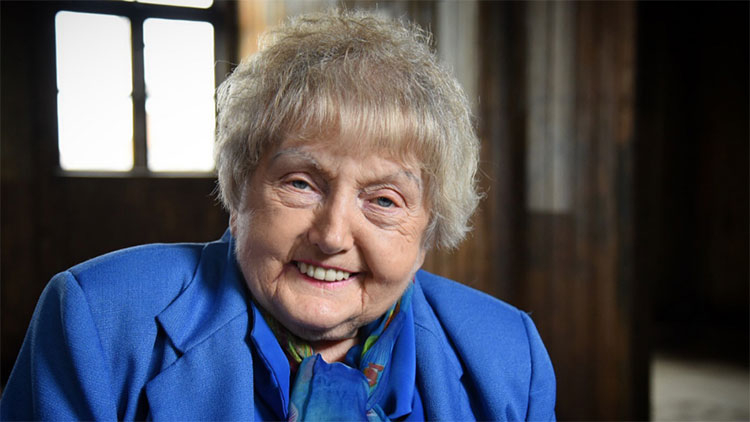
I traveled to Auschwitz, Hungary, and Romania with Holocaust survivor and Mengele Twin Eva Mozes Kor to learn her story so I could write a play about her journey toward forgiveness. I listened as she recounted her experiences, watched how she carried the weight of her past, and witnessed firsthand the strength it took to forgive. Now, I am sharing what I learned in her own words because her voice is not only history. It is a call to action, and it is more important than ever.
Before she ever considered forgiving Dr. Josef Mengele, Eva made the decision to forgive Dr. Hans Münch, a Nazi doctor who had worked at Auschwitz. Unlike other former SS officers, Münch openly acknowledged the existence of the gas chambers and signed a document confirming how they were used. For Eva, his willingness to tell the truth was significant, and she wanted to give him a meaningful gift. That decision led her to write a letter of forgiveness, a choice that changed her life forever.
Searching for the Right Gift
I did not tell anyone about my idea of thanking Dr. Hans Münch, a former Nazi doctor, because I thought people would think I was crazy. How do you thank a Nazi doctor? What kind of gift could possibly be appropriate?
I decided to start at a Hallmark store, hoping that the “Thank You” card section might offer some inspiration. But as I stood there reading card after card, I felt uneasy. I did not want anyone to know what I was looking for. I spent more than two hours searching, and twice the store employees approached me.
“Are you finding what you’re looking for?” one asked.
“Not really,” I replied.
“So what are you looking for? I’d love to help you find it.”
For just a second, I considered telling her. But I knew she would never understand. My search was not normal. Instead, I said, “Thank you for asking, but I cannot tell you,” and I left the store empty-handed.
A Life Lesson in Forgiveness
Even though I could not find a gift that day, I refused to give up. I reminded myself of the life lessons I often shared in my lectures:
Never give up on yourself or your dreams. If I could survive Auschwitz without knowing how, then no one should ever give up on their own future.
Treat people with respect and fairness, and judge them by their actions, not their past.
Forgiveness is a personal power, one that no one can give or take away from you.
For ten months, I thought about what I could give Dr. Münch. Whether I was cooking, cleaning, driving, or doing laundry, the question lingered: how do you thank a Nazi doctor?
Then, in June 1994, the answer came to me. A simple but powerful idea: what if I wrote him a letter of forgiveness?
Immediately, I knew it was the right choice. It was not only a gift for him, it was a revelation for me. I discovered that I had the power to forgive. No one could grant me that power, and no one could take it away. I had spent my life reacting to what others had done to me. Now I was initiating action. I did not need permission. I was not hurting anyone. So why could I not do it?
I was trembling with excitement. For the first time, I felt like I had control, not just over my past but over my present and future. I had spent so many years holding onto pain, sadness, and anger, and now I saw a way to release it.
Writing the Letter
I sat down to write my letter of forgiveness, but it was not easy. At first, I addressed Dr. Münch as an evil monster. But I kept reminding myself of my goal: to reclaim my own power. I wanted to stop feeling like a victim. I wanted to stop yelling at my children out of misplaced anger. I wanted to be free from the weight of my past.
I worked on that letter for four months, revising it whenever I had time between my real estate appointments. I thought about reaching out to other Mengele Twins, but I was afraid they would not understand or might try to talk me out of it. I wanted to disarm my enemies in the most unexpected way, by forgiving them.
A Challenge from My Professor
Once I finished the letter, I could see that my spelling in English was poor. Not wanting to be embarrassed in front of Dr. Münch or anyone else who might read it, I reached out to Dr. Susan Kaufman, my former English professor at Eastern Illinois University. She was excited about my forgiveness ideas and helped me refine the letter, correcting my spelling and working through multiple drafts as I shaped my message.
Then, in her matter-of-fact tone, Dr. Kaufman said, “Eva, it is nice that you are forgiving Dr. Münch, but you really should forgive Dr. Mengele.”
I responded quickly, “This is just a thank-you letter for Dr. Münch!”
She did not listen. “When you get home tonight, pretend that you are talking to Dr. Mengele, telling him that you forgive him, and see how it makes you feel.”
My mind reeled back to Auschwitz. To the man in the crisp SS uniform, standing tall and expressionless as he looked down at me. I was 10 years old, a child, sitting in a makeshift examination room in Block 10. I could not move. Steel rods forced my eyelids open as he poured a burning liquid into my eyes, blinding me with pain. I could not cry, could not blink. All I could do was stare up at him as he conducted his experiment, cold and detached, as if I were nothing more than an insect pinned under glass.
That night, Dr. Kaufman’s challenge would not leave me. I closed my eyes and summoned the image of Dr. Mengele. Then I said aloud:
“You son of a gun, evil monster, Nazi doctor, I forgive you because I have power over you, and you have no power over me.”
And then I felt it. Relief.
For the first time, I was in control. Mengele had dictated so much of my suffering, but in that moment, I took something back. I was not hurting anyone by saying it. I was not rewriting history or erasing the horrors he had committed. But I was stripping him of the power he still had over me.
If I could forgive him, the worst of the worst, then what about the others?
The kids who harassed me for eleven years on Halloween, banging on my door, mocking me, tormenting me.
The Capitol police who grabbed me, tore my rotator cuff, and left me with permanent damage when they arrested me in the Capitol Rotunda on May 6, 1986. All because I stood up and demanded justice, shouting: “Memorial services are not enough. We need an open hearing on Mengele-Gate!”
If I could forgive Mengele, then what power did any of these people have over me?
That was the turning point. I rewrote my forgiveness letter, not just for Dr. Münch, but for every person who had ever hurt me.
A Historic Moment at Auschwitz
On January 27, 1995, I returned to Auschwitz with Dr. Münch. It was the 50th anniversary of the camp’s liberation. I knew other survivors would be there, but I arrived with an unusual group: Dr. Münch, his family, and my own family and friends. I was not worried about his presence; after all, he was there to document the gas chambers and provide historical confirmation of what had happened.
But I underestimated how others would react. My son, Alex, and my friend Mary Wright asked, “What do we do if someone attacks Dr. Münch?” I had not considered that possibility. I expected resistance, maybe even disapproval, but not hostility.
Security at Auschwitz was strict. We were a few minutes late, and they refused to let us in. “Fifty years ago, I was a prisoner here, and they would not let me out,” I told them. “Now, they will not let me in.” Eventually, we were allowed through.
At the ruins of Gas Chamber #2, I read my letter of forgiveness out loud. The words hung in the frozen air. Dr. Münch’s face was unreadable at first, then slowly shifted. He was stunned. Finally, he turned to me and said, simply, “Thank you.”
Throughout the day, he kept trying to walk arm-in-arm with me. I hesitated, wondering how that would look to other survivors. Later in the day, I slipped on the icy road and he caught me before I fell. Suddenly, I was grateful he was close enough to steady me. Not everything is as it appears.
That day, we handed out 400 copies of a press release about the two documents we had created, one related to Dr. Münch’s testimony about the gas chambers at Auschwitz, and one expressing forgiveness. Only six journalists showed up.
The Power of Choice
I have been criticized for my decision to forgive. Some survivors and their families have protested against me, insisting that my forgiveness was an insult to their pain. But when I asked how my choice to forgive hurt them, they could not explain.
The truth is, forgiveness is a personal choice. It is not about excusing evil or forgetting history. It is about reclaiming power over our own lives. It is about refusing to let the past dictate our future.
No one could give me that power. No one could take it away. It was mine, and mine alone, to claim, to use, and to reclaim my own freedom.
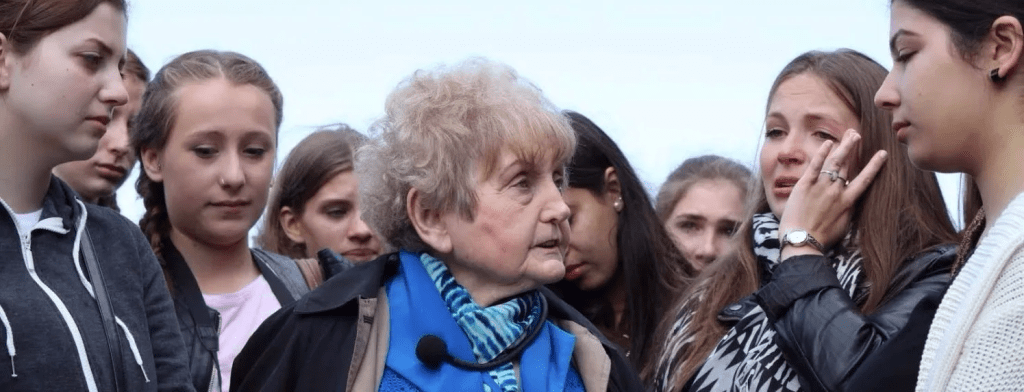
Photo credit: I am not sure who took this particular photo, but I was there when it was taken in 2013. We were standing inside Birkenau on the selection platform, near the cattle car that still stands there today. Eva was speaking to a small group that had gathered around her when this group of young German students stopped to listen from outside the circle. When Eva realized they were German, she invited them into the circle. It was then that the girls began to apologize to Eva on behalf of their ancestors. She told them they did not owe her an apology because they had done absolutely nothing wrong. She encouraged them to simply learn from their mistakes and to be light and love in the world. This was one of my favorite public moments with Eva.
In conversations about forgiveness, Eva Mozes Kor, Holocaust Survivor and Mengele Twin, was often asked tough questions about justice, especially regarding criminals, terrorists, and those who have killed. One such question came from a UK film director, who asked, “Should we just forgive them and let them go?” This question challenged Eva’s own ideas of forgiveness and set her on a path to delve deeper into the complexities of justice and forgiveness.
Her response to this challenge was powerful: “We must decide what we want the end result to be,” she explained. If the goal is punishment, then “we just hang him/her,” because after all, she had spent her life hearing the statement, “Justice must be done.” But Eva quickly challenged that notion, pointing out that while justice sounds simple, the reality is far more complicated.
Eva Mozes Kor, Holocaust Survivor and Mengele Twin
The Search for Justice: Mengele’s Escape
Eva shared her concerns about how justice was sought for the Nazis after World War II, focusing specifically on Dr. Josef Mengele, the infamous Nazi doctor who performed experiments on Eva and her twin sister, Miriam. Mengele’s arrest under his name by the American forces, only to be released a day later due to a mistake, underscored the failure of justice. Despite his heinous crimes, Mengele’s name was never included in the Nuremberg Trials, and it wasn’t until 1985 that serious efforts were made to find him.
Eva had long been suspicious of the official accounts of Mengele’s death. In 1985, after taking a group of Mengele twins to Auschwitz to mark the 40th anniversary of the camp’s liberation, the search for Mengele’s whereabouts became an international story. Governments like those of Germany and the U.S. announced that Mengele’s bones had been found in Embu, Brazil, but Eva remained skeptical. The rushed, secretive nature of the investigation raised red flags for her.
The Inquest: Investigating Mengele’s Death
Eva’s suspicions led her to take action. Determined that survivors had the right to examine the truth, she organized an inquest into Mengele’s death, inviting forensic experts, historians, and survivors of Auschwitz, including Mengele twins. Eva could not raise funds for the inquest, so she took out a second mortgage on her house to pay for the investigation. This decision highlighted Eva’s unwavering commitment to finding the truth.
Just days before the inquest was set to begin on November 15, 1985, Eva received what she said was a threatening phone call from Neal Sher, the director of the U.S. Justice Department’s Office of Special Investigations. He demanded that Eva provide the names of those who had seen Mengele alive after 1979, or face the possibility of U.S. Marshals visiting her. Eva stood firm, refusing to yield to threats and continuing with the inquest.
The Inquest Findings: The Mystery Deepens
During the three-day inquest, experts including pathologist Dr. Michael Baden, psychologist Dr. Nancy Segal, and German-educated physician Dr. Werner Loewenstein examined the evidence. Dr. Loewenstein, who had translated Mengele’s SS files, was pivotal in uncovering discrepancies in the investigation. He revealed that the bones found in Brazil could not be Mengele’s because they lacked evidence of osteomyelitis, a condition documented in Mengele’s medical history. This revelation cast doubt on the official story and bolstered Eva’s belief that the investigation had been a rushed cover-up.
The panel of experts, including Eva herself, reviewed the U.S. Justice Department’s forensic report and called for further investigation. They raised serious concerns about the findings, including discrepancies in the identification of the bones and the absence of investigations into post-1979 sightings of Mengele. Despite this, the official stance remained that Mengele had died in 1979.
The Call for Justice: Victims’ Rights and Compensation
Beyond the questions surrounding Mengele’s death, Eva also highlighted the ongoing suffering of survivors of his experiments. Many of Mengele’s victims, particularly the twins, suffered from chronic medical conditions such as kidney issues, heart problems, and spinal degeneration, all due to the unscientific and inhumane experiments Mengele conducted at Auschwitz. Despite the immense suffering, the German government had yet to offer compensation to these survivors.
Eva used her platform to call for justice for the victims of Mengele’s experiments, urging the German government to compensate them for their pain and medical costs. She made it clear that the failure to offer compensation was an embarrassment to the German government and a further injustice to those who had already endured so much.
The Power of Forgiveness: A Call to Action
Throughout her efforts, Eva remained steadfast in her belief in the power of forgiveness, a principle that had defined her personal healing since she forgave the Nazis in 1995. In the face of betrayal, deception, and injustice, Eva continued to advocate for forgiveness as a means of healing, not just for herself but for the world.
Eva’s call to action extended beyond the personal. She proposed an addendum to the Universal Declaration of Human Rights that would include the right to emotional healing, emphasizing forgiveness as a necessary act for personal and societal well-being. Through forgiveness, Eva believed that victims could transcend their suffering and reclaim their emotional freedom.
Conclusion: A Legacy of Justice and Healing
Eva’s journey to uncover the truth about Mengele’s death and the suffering of his victims was not just about seeking justice for the past. It was about ensuring a future where forgiveness, healing, and emotional freedom were recognized as fundamental human rights. Her efforts to shine a light on the long-term pain caused by atrocities and the need for healing through forgiveness resonate as deeply today as they did in 1985.
Eva Mozes Kor’s legacy continues to inspire those who seek justice, understanding, and healing, teaching us that while forgiveness is a personal journey, it also has the power to shape a more just and compassionate world.
What follows are some specific thoughts on the role of the imagination and how I’m witnessing a slow decline in students’ ability to stick with a moment of “play” or creative imagination long enough to reach the truth embedded in the script.
When I began as a private acting coach a couple of decades ago, nearly all my students were either homeschooled or from Christian backgrounds. This was largely due to the environment in which I began. I had just graduated from a Christian university with my MFA in Acting and Directing for Theatre. During my time there, I helped design and launch a summer theatre camp, which drew a large following from the homeschool community. Many of those kids continued lessons with me long after camp was over.
Today, most of my students are no longer homeschooled, but many are still Christian. This is probably because many of my students already share a Christian worldview, and my teaching naturally aligns with it. I teach them how to act with technical skill, emotional honesty, and respect for the craft, as well as how to be artists and professionals in what is often a dark industry. We talk openly about integrity, boundaries, and how to navigate the pressures and temptations that come with performance culture. My goal is not just to prepare them for auditions or roles, but to help them become thoughtful, resilient artists who can carry the light of Christ into places where it’s often absent. I don’t market specifically to Christian students, but we have plenty of reasons to find each other and to enjoy working together.
That said, I do find that young Christian students tend to struggle with guilt and shame to a particularly high degree during the rehearsal process. We talk about it often. While I always choose material that is age-appropriate and content-appropriate for every student (and for myself, as I don’t enjoy lascivious or graphic pieces either), those who grew up in the church—Catholic, Lutheran, Evangelical, etc.—often feel very self-conscious as actors when they begin.
Girls are taught to be kind, service-oriented, loving, and demure. Boys are taught to be tough, heroic, good, and sensitive to the needs of others. These are all admirable traits. To be a man or woman of virtue, exhibiting the Fruit of the Spirit, should lie at the heart of our longing to be more like Christ. I could easily veer into an essay about how to marry our faith with our work, but for the sake of this particular piece, I’ll return to the central idea:
Christian students often struggle to play characters who don’t look like themselves or like those they aspire to become. Fair enough. But here’s the truth: life is full of good and evil. Villains and heroes. Builders and those who destroy. Most of us, over the course of a lifetime, are both. We’re all villains to some and heroes to others. We know what it is to build, and we know what it is to wound. To pretend otherwise is to whitewash life and ourselves, which usually leads to hiding in one way or another. So, it’s important for me to talk about redemptive stories with my students so they can confront this dichotomy rather than fearing it.
There are two kinds of redemptive stories: those that show us the good things that happen when we choose well, and those that show us the damage that occurs when we don’t.
That’s a simplified way to put it, but given that my students range in age from eight to fifty-five, the universality of this statement is often helpful to everyone for different reasons.
So, what do we do with the villains in the plays we read? What do we do when we agree to play Lady Macbeth in Macbeth, Regan in King Lear, or Medea in the title role? And what about Iago in Othello, Richard III, or Judge Turpin in Sweeney Todd? Do we flatten the character to fit inside our comfort zone? Do we avoid even considering the thought process of a conniver? Do we soften Medea’s rage to make the role more “Christian”?
I certainly hope not! If we do, we’re not being truthful. We’re pretending we never act with malice, selfishness, or harm. And if we refuse to embody those moments in a role—if we never stop to consider the villain’s position—we are denying ourselves an opportunity to understand something essential: that evil is not always monstrous or distant. Sometimes it begins with resentment. Or jealousy. Or the belief that we deserve more than we’ve received. Sometimes it begins with a wound. To engage that truth in rehearsal is not to condone it, but to confront it honestly. That kind of imaginative empathy sharpens discernment. It invites self-examination. It strengthens our ability to recognize corruption when it appears in ourselves or others. To avoid this work is not only to limit our range as actors, but to remain shallow as people.
Most of us will never seize power and destroy our father like Regan. Most of us will never seduce a woman named Lady Anne over her father-in-law’s corpse like Richard III. But if we take the time to understand the goodness of God and the brokenness of the world, we can, as Aristotle suggested, experience catharsis and reason together: I will not seduce. I will not murder. I’ve seen what happens when people do.
What follows are thoughts on the role of imagination in the life of an actor. To live truthfully in imaginary circumstances, we must first be willing to imagine.
The Studio and the Threshold of Imagination
This morning, I sat across from a college-aged student in a small studio, the kind with a well-worn rehearsal floor and no mirrors to distract. She was working through a dramatic monologue from King John, trying to locate the inner grief of Constance as she mourns the disappearance of her son, Arthur. The lines are some of Shakespeare’s most anguished:
“I am not mad; I would to heaven I were, For then ’tis like I should forget myself. O, if I could, what grief should I forget!”
My student is brilliant. She’s bright-eyed, classically educated, and emotionally intuitive. She understands the language and the circumstances. She grasps the weight of the moment intellectually. And yet, she struggles to connect with it fully. Her technique is solid. She found the beats and shifted breath and focus in the right places. The anguish, however, stayed on the surface and heightened. Her performance was more inferred than embodied, and she remained ungrounded.
So I gave her a note I’ve given many actors before her: “Particularize your son.” She nodded. She knew what I meant.
In actor training, particularly within the Meisner tradition, particularization is a foundational method for grounding performance in emotional truth, and it’s often misunderstood. Particularization in Meisner’s framework is not the same as the imaginative substitution associated with Stanislavski’s “Magic If.” The “Magic If” asks the actor to imagine themselves in the character’s situation—”What would I do if my son were taken from me?”—and then to act from that imagined scenario. This technique can be useful, as it encourages imaginative entry into a character’s world. But it relies on hypothetical identification; on asking ‘what if’ rather than anchoring the moment in lived emotional truth.
Meisner’s approach is different. It does not rely on imagining how one might feel in a fictional situation. It asks the actor to bring something real into the room. Something personal, visceral, and emotionally immediate. When I asked my student to particularize her son, I was not asking her to pretend to be a grieving mother. I was asking her to locate, in her own life, a person whose loss would pierce her. It could be a nephew, a younger brother, a godchild; anyone she has known and loved. Particularization is not fantasy. It is emotional preparation. The actor identifies a core emotional truth and allows that truth to live inside the moment.
This act is deliberate and vulnerable. It involves risk, attention, and a willingness to be seen. Because the actor is not pretending to feel, they are allowing themselves to feel. They are not trying to generate an emotion; they are giving themselves permission to respond to something that already holds weight in their inner world. Meisner insisted that acting lives in behavior, not in ideas. The words of a script are not the truth. The behavior underneath the words is where the truth resides.
When an actor says, “My son is gone,” the goal is not to deliver the line convincingly. The goal is to experience the truth of the line in real time. To say it while bearing the weight of one’s own emotional stakes. Particularization enables this. It shifts the actor from performing to being.
Still, something was missing. Despite her strong technique, something in her body remained disengaged. The truth hovered at the edges of the performance but never fully arrived. She wore the grief like a garment, but it had not yet reached her center.
This is a moment I have seen many times before. The student understands everything intellectually. The beats are there. The breath work is honest. And still, something inside hesitates. The mind approaches something emotionally risky, and the body pulls back. It happens quickly, often invisibly. A short-circuit. A retreat from vulnerability.
They stop mid-imagining. Mid-feeling. Mid-play.
This phenomenon is increasingly common. The cause appears to be cultural. We are watching a generation experience limited access to its imaginative life, not from apathy or lack of talent, but from being conditioned to remain just outside the threshold of deep interiority.
What fractures their concentration? What prevents them from crossing into full imaginative immersion?
Several things come to mind.
Sanford Meisner defined good acting as “living truthfully under imaginary circumstances.” Acting depends on entering. The actor allows themselves to be changed by what they imagine. In those moments, fiction becomes felt reality.
Meisner’s exercises do not focus on displaying emotion. They create conditions in which emotion arises organically. The goal is to engage the body before the mind intervenes with commentary or self-protection. Acting, in this view, requires attention; deep, sustained, emotional attention.
This is where the struggle appears.
Many students today experience difficulty maintaining emotional attention beyond a few seconds. Their minds are quick. Their instincts are strong. Yet under the weight of prolonged inner focus, their attention fractures. This does not stem from apathy, but from exhaustion. Their habits have been shaped by technologies and cultural rhythms that favor speed, fragmentation, and external validation over interior stillness.
A 2022 study published in Nature Communications found that global attention spans as measured by patterns of media engagement, have diminished over the past two decades. Our minds now pursue novelty more than depth. This shift influences more than productivity. It reshapes presence itself. It reconfigures the architecture of imagination.
Where actors once learned to build an imagined world and dwell in it, students today often find themselves pulled back by an invisible thread. They experience the impulse to check, to hesitate, to self-correct. Even in silence, they sense an audience. When external attention dominates, internal vision struggles to take root.
What I observe in the studio speaks to more than acting. It reflects a broader cultural wound. A drifting away from solitude. A quiet that grows more elusive. A loss of what the educator Charlotte Mason called “the habit of the reflective life.” In Mason’s view, imagination is a moral capacity. To imagine well is to love well. The capacity to enter another’s experience nurtures empathy, endurance, and attention. Like any virtue, it strengthens through practice.
How does one train imagination in a world of interruption?
This erosion of imaginative endurance presents a pressing concern. It reaches beyond the artist. It speaks to anyone seeking a meaningful existence amid constant noise. The deep spaces where empathy takes form, convictions clarify, and quiet truths surface depend on interior cultivation. A society that nurtures imagination forms individuals who respond with discernment and depth.
Classical educators have long understood the affinity between imagination and truth. Plato, though cautious of the poets, affirmed that metaphor helps the soul ascend toward the Good. Aristotle praised catharsis as a soul-cleansing process through imitation. Centuries later, C. S. Lewis called imagination the “organ of meaning.” Through it, knowledge gains emotional resonance. Facts become deeply known.
Contemporary students navigate a world full of information and comparisons. Previous generations may have asked, “Will I do something meaningful?” Today’s students often wonder, “Can I create something distinct enough to matter?”
This is the cost of saturation. So many voices, so many images, so many claims on the imagination cause silence to feel irrelevant. Stillness begins to feel misaligned with progress. In such an environment, the long breath required for full imaginative entry feels like a rarity.
And yet that long breath must return. We can help restore it.
Imagination brings shape to stories. It deepens relationships. It sustains a sense of mystery, sacredness, beauty, and possibility. Rather than vanishing, imagination waits. It remains present beneath the surface noise. It endures through fractured attention and abandoned moments of thought. It waits for breath. For solitude. For the courage to enter again.
In my work with students, I encourage them to slow down, not as a strategy, but as a way of being. They are learning to stay present inside a moment, linger with an image, and let silence stretch. Not everything needs to resolve quickly. Some truths arrive only through stillness, and meaning often deepens through sustained practice rather than polished execution.
Imagination does not pull us away from the world. It grounds us more deeply in it. It sharpens perception. It draws our focus toward what lasts. This is why Shakespeare continues to speak, and why Meisner’s invitation to live truthfully in imagined circumstances still carries weight. These are not artistic artifacts. They are instruments of renewal.
The difficult thing about forgiveness is how many times you have to do it.
You know the drill: you write a letter you’ll never send, trek to a place that used to mean something but now just stirs up hurt, and try to reclaim it as a spot you’re still allowed to love. You even hold a makeshift burning ceremony, tossing whatever’s left of what once mattered into the flickering flame of a windblown match—hoping, of course, that this will somehow make it all magically disappear and let you move on.
You call up your friends, your sister, your therapist, and maybe even your pastor—basically anyone who’ll listen—as you try to untangle the emotional mess someone left behind in your soul. Eventually, you convince yourself that you’ve talked it to death, done all the emotional gymnastics to understand, grieve, and accept. You think you’ve untangled the knot, and now—at last—you’re free! The sadness, pain, and the emotional bleed that’s been trickling down the back of your heart for weeks (or was it months? Years?) is all but gone. You’ve forgiven! Or at least, you really, really hope so.
Then one morning, it happens. You’re just going about your business when a song starts playing, and out of nowhere, your brain decides to remount a lavish production bringing the entire drama back from the dead. Or maybe you read a poetic passage that seems like it was written specifically to stir up the pain you thought you’d dealt with. But the most delightful moment? You’re just trying to get ready for the day, doing your makeup, and suddenly you feel that old, uninvited heat creeping up your neck—something the blush can’t hide. It colors your thoughts with a fiery red, and before you know it, you’re back in that moment, imagining all the things you should’ve said, how you could’ve responded, and how maybe—just maybe—you should’ve thrown something through their window. But you didn’t, because you’d already committed to forgiving them. Now you’re left with the regret of not throwing things within a timeframe that would have been appropriate in relation to when that person was a jerk. Missed opportunities, am I right?
So, you missed the chance to throw things. You’ve ridden the high of the moral high ground to its natural end. Now, you’re faced, once more, with a choice: can I forgive them again? Or is this the end of the line for me when it comes to freedom from the jail cell they constructed for me?
Here’s what I think – we often view forgiveness wrongly. We think it’s a choice we make when, really, it’s an attitude of the heart. We think it’s an extending of the hand to a fellow human being, or even a hand over our own hearts, but really it’s a lifting of the hand to God. A lifting of the hand and a bowing of the knee.
Sometimes forgiveness is sitting on a rock at the edge of a trail and remembering that I do not have the power to dissolve my own pain the moment I want it gone. Instead, it’s a prayer, “Lord, here I am again with these memories. Here I am again with a chasm in the center of my softest internal space feeling so angry I can barely hear the birds singing in the trees above my head. I can’t forgive today and I hope you will forgive me for that.“
I know that rock well. But I also know God well enough to understand that when I bring my chasm to Him, He breathes water into it. Hear me out: imagine an empty gorge and then imagine it filling with crystal clear water. The depths still exist but God’s mercy grants me the space to swim. To be bouyant even in the midst of the depths below me. He allows me to sit with my pain while also knowing I won’t drown.
Forgiveness is swimming with the memories in your mind while trusting in God’s all-encompassing buoyancy to get you to the other side of the divide. It’s choosing to stop treading water and, instead, turning over on your back to float. To look up at the sky, feel the coolness of the trickles as they ripple below your body, and to whisper, “Well, this hurts but it’s also really beautiful here. God, I trust you.”
Nothing is ever just one thing.
Forgiveness can feel scary, daunting, and nearly impossible. It can also be empowering, joyful, and freeing.
One thing it isn’t is easy.
In the next few weeks, I’ll be writing a lot about Holocaust survivor and Mengele Twin, Eva Mozes Kor. Walking with and learning from her gave me a treasure trove of questions and ideas on all kinds of topics. First and foremost, forgiveness. What you’ll see in my writing is that I deeply respected her, loved her, and was ever-amused by her resilient and feisty spirit! You’ll also see that we didn’t always agree on what forgiveness is or how to achieve it, but we always listened, laughed, and learned with one another.


 Jill Szoo Wilson