The Stewardship of Fear: Trauma-Informed Leadership in an Age of Anxiety

By Jill Szoo Wilson

She is thoughtful, intelligent, good-humored, and consistently encouraging to her fellow students. She’s the kind of student who listens closely when others speak, offers quiet affirmation rather than competition, and seems genuinely glad when her classmates do well. She began the semester strong, delivering two solid speeches and attending every class. There was nothing tentative about her start.

Midway through the term, something changed. Her warmth toward others remained. Her generosity did not disappear. But her attendance became uneven. Absences began to grow to the extent that she missed one of her assigned speaking dates. From there, a pattern emerged that did not match her ability or her effort.

This student did not vanish or disengage as some do. Each missed class came with a morning email in which she apologized and asked what she could do to keep up with the rest of the class. Even as she struggled to be present in the room, she worked to remain connected to the course and accountable to its expectations.

On the final day of the semester, I pulled her aside before class began. This was her last opportunity to deliver the make-up speech she had missed earlier in the term. I asked a question I have asked many students before, a question meant to open a door rather than close one: “How are you doing? Are you ready to go today?” I could see the fear in her eyes drain into the rest of her body and turn into fight-or-flight level tension. Tears came first. Panic followed. We agreed that she could choose whether to deliver the speech privately, after the other students had gone, or not deliver it at all.

When the classroom emptied, we talked for a long time. In the end, she did not give the speech—she could not—and in that moment, I knew I needed to honor her choice. There are times when I will encourage a student to push through their fear. Knowing when not to is part of the work.

What unfolded in that empty room was a trauma response. Panic, dissociation, and fear overtook the student’s capacity to communicate as her nervous system shifted into a state of perceived threat. Her breathing became shallow and rapid. Her body held itself tight. Her words rushed forward, tumbling over one another as she tried to explain how desperately she wanted not to feel the way she did.

Anyone who works in a position of authority—teachers, pastors, physicians, supervisors—has seen this moment. Communication can become physically unavailable when fear takes over. The body tightens, language recedes, and access to speech narrows. When someone is in that state, it is important to remember that applying pressure to the one suffering amplifies distress. Performance returns only when the nervous system has time and space to settle.

There are moments when growth comes from learning that discomfort is not danger, and pushing through fear can be part of that work. There are other moments that call for a different response, as I will explain in the next section.


Fear, Authority, and the Return of Choice

Clinical psychologist David A. Carbonell has spent decades working with people whose lives are shaped by anxiety and panic. His work is especially instructive for those in positions of authority because it explains fear without shaming the person who experiences it and without requiring the leader to become a therapist.

Carbonell begins with a simple but destabilizing premise: anxiety is not a failure of reasoning. It is the activation of a survival system designed to move faster than thought. When fear arises, the brain’s alarm circuitry engages before the reflective systems responsible for language, planning, and explanation have time to come online. This system is meant to protect us, not to help us communicate well.

In moments of perceived threat, the nervous system does not pause to ask whether fear is reasonable or proportional. It acts. Muscles tighten. Breathing shifts into the chest. Attention focuses inward, and sometimes sight narrows. The body prepares for escape, defense, or collapse. Thought follows only if the body allows it.

This is why anxiety so often surprises both the person experiencing it and those witnessing it. A student who is prepared may suddenly freeze. A patient who understands their condition may struggle to answer basic questions. A congregant who wants to speak honestly may fall silent at precisely the moment language feels most necessary. These responses are not evidence of avoidance, deceit, or unwillingness; they’re evidence that the body has moved ahead of the mind.

Carbonell describes anxiety as a “counterintuitive problem” because the strategies people instinctively use to overcome fear often make it worse. Reasoning with fear, pushing through it, or trying to suppress it may appear sensible, but they frequently intensify the nervous system’s alarm. The body interprets urgency, control, or insistence as confirmation that danger is present. What sounds like encouragement to the leader can register as a threat to the person already struggling to regulate.

When I was struggling with heightened anxiety in 2013, I remember telling my longtime family doctor, who was familiar with my personality and profession, “Speaking exhausts me right now. I know what I want to say, but I just don’t feel like talking. It’s exhausting.”

This insight is critical for anyone in authority. When anxiety is driving the body, access to speech narrows as survival takes precedence. Communication returns as the conditions that support it are restored.


The AWARE Framework

Dr. Carbonell developed the AWARE framework while working with clients whose anxiety escalated quickly and overwhelmed their ability to stay present. Rather than asking people to conquer fear, the model offers a way to slow the moment down once fear has already arrived and to change how a person relates to that fear in real time. AWARE stands for Acknowledge, Wait, Allow, Repeat, and Engage. The sequence follows the nervous system’s own rhythm as it moves from alarm toward steadiness.

Acknowledge

Acknowledge begins by bringing attention to what is happening in the present moment. Fear often intensifies when it goes unnamed, especially when a person tries to reason their way out of it or push it away. My student described it this way: “The last time I did a speech, I kept thinking if I could run out of the classroom I would be okay, but then also telling myself I couldn’t run out of the classroom. The more I told myself to stay, the more panicked I felt.”

Acknowledgment interrupts that spiral. When fear is named as it appears, the body no longer has to work as hard to contain it. Attention shifts from escape to awareness, and the nervous system begins to loosen its grip.

In practice, acknowledging fear means noticing and naming what is present in real time: a tight chest, shallow breathing, racing thoughts, a sense of urgency. This naming does not analyze or correct the experience. It simply brings it into awareness. That attention eases the body’s demand for immediate action and signals that the moment can be tolerated rather than escaped.

Instead of asking, “How do I get out of this?” the question becomes, “Is this danger or discomfort?” When the answer is discomfort, fear can be acknowledged without being obeyed.

Acknowledgment slows the interaction and opens space for choice.

Wait

Wait introduces time into a moment that feels compressed. Fear collapses experience into urgency. Everything begins to feel as though it must happen immediately.

For my student, waiting would not have meant deciding what to do next. It would have meant staying with the sensations for a few seconds longer without acting on them. Feeling her feet on the floor. Allowing her breath to move as it could. Letting the urge to escape crest and fall rather than rushing toward resolution.

Even brief pauses give the nervous system crucial information. As seconds pass without action, the body begins to register that immediate escape is not required. Breathing steadies. Muscles soften. Attention widens enough for choice to return.

For leaders, waiting can feel counterintuitive. We are trained to move toward solutions, explanations, or outcomes. Carbonell’s work asks us to trust time itself as a regulating force. Waiting allows the body to recalibrate so that whatever comes next emerges from awareness rather than urgency.

Allow

Once fear has been acknowledged and time has been introduced, the next impulse is often to make the fear stop. This is where anxiety tends to escalate. The body senses resistance and responds by pushing harder.

In the student’s experience, this showed up as an internal struggle. She tried to calm herself, reason with herself, and override the urge to escape. Each attempt intensified her panic. Her body interpreted the struggle itself as evidence that something was wrong.

Allow changes that relationship. Instead of working against fear, the student lets the sensations exist without trying to fix them. The chest remains tight. The breath stays shallow. The urgency lingers. But the fight stops.

Allowing fear does not mean agreeing with it or surrendering to it. It means recognizing that the alarm has already sounded and does not need correction in order to settle. When resistance drops, intensity often follows. The body begins to regulate not because it was forced, but because it is no longer being fought.

Repeat

Fear rarely resolves in a single wave. It rises, softens, and often returns. When it does, the impulse is to interpret its return as failure.

Repeat offers a different response. When fear resurfaces, the student returns to the same steps without escalation. She acknowledges what she notices. She allows the sensations to exist. She waits again. Nothing new needs to be solved.

This repetition teaches the nervous system something essential: fear can come and go without requiring action. Each cycle weakens the urgency attached to the sensations. Over time, fear loses authority not because it disappears, but because it no longer controls the response.

Repeat builds tolerance, not toughness. Consistency, not control, carries the system toward regulation.

Engage

Engage comes after fear has been acknowledged, time has been allowed, and resistance has eased. The student does not wait for fear to disappear. She reenters the task while carrying the remaining sensations with her.

In the classroom, this means shifting attention outward. The student stands at the front of the room with a breath that is still shallow but workable. She looks up. She finds one face in the room. She begins with the first sentence she prepared.

Engagement does not require full calm. It requires orientation. Attention moves away from internal monitoring and toward the shared task of communication.

As the student speaks, fear may continue to rise and fall in the background. She does not evaluate it. She stays with the work in front of her. Each sentence spoken gives the nervous system new information: the body can remain visible, engaged, and unharmed.

Engage restores agency. Communication resumes not because fear vanished, but because attention found a place to rest outside the self.


What This Means for Leaders

Over the years, I have noticed that more students are arriving in my classrooms with nervous systems already shaped by repeated alarms. I see it in attendance patterns, in the way bodies brace before a speech, and in how quickly attention collapses inward once fear takes hold. This is not unique to my classroom. It is widespread and growing.

Recent data make that clear. A large national survey by the University of Michigan School of Public Health found that one in three college students reported moderate to severe anxiety symptoms, with more than a third meeting criteria for a diagnosable anxiety disorder (University of Michigan School of Public Health, 2023). The National Education Association reports similar findings, noting that anxiety now surpasses depression as the most frequently cited mental health struggle on many campuses (National Education Association, 2023). A global review in BMC Psychiatry echoes this pattern, showing that roughly one-third of college students worldwide experience elevated anxiety levels, with anxiety disorders among the most common conditions in this age group (Nguyen et al., 2023).

These are not abstract statistics. They describe the lived reality of the bodies and minds leaders stand before every day in classrooms, churches, clinics, and offices. Anxiety is shaped not only by individual history, but by cultural and academic pressures that accumulate long before people enter our spaces. For many, heightened vigilance is already the baseline.

That reality has direct consequences for communication. Bodies braced for threat do not speak as freely as bodies oriented toward engagement. When the nervous system detects danger, real or perceived, it redirects energy toward survival. Leaders trained to maintain momentum or secure outcomes may misread hesitation as resistance, silence as avoidance, or uneven performance as lack of preparation. Yet insistence on immediacy or efficiency can quietly confirm the very threat the nervous system is trying to manage.

Trauma-informed leadership begins with recognizing this dynamic. It does not require diagnosis, nor does it ask leaders to become therapists. Instead, it calls us to:

  • notice how fear shows up in the moment,
  • slow the interaction enough for regulation to begin, and
  • orient expectations around the body’s capacity before asking it to communicate under pressure.

This does not weaken standards. It strengthens people.
Honoring a student’s nervous system in a moment of acute distress does not eliminate accountability or academic standards; it ensures that evaluation reflects capacity rather than collapse.

A trauma-informed posture creates the conditions under which students and colleagues can perform to their actual ability. It allows them to remain present long enough for thinking, skill, and preparation to take shape. The goal is not to remove challenge, but to ensure that challenge does not exceed the body’s ability to participate.

When leaders understand fear as a physiological response rather than a personal failing, they interpret hesitation as information. They allow choice to reenter the moment. And they learn to meet fear not with urgency, but with timing, which is often the difference between collapse and communication.

In an era when anxiety is this pervasive, trauma-informed leadership is not an added skill. It is a necessary form of stewardship.


Afterword

This is a complicated topic to write about because so much of what we do in a classroom grows out of instinct and the kind of discernment that only time creates. It is hard to explain to a new teacher, or to a young professional in any field, when to hold a firm pedagogical line and when to let it soften in order to meet the human being in front of you. Students need different things in different moments, and those needs are often invisible until they surface in panic, silence, or retreat.

I was out of the college classroom for two years. When I returned this past semester, I noticed a marked shift in the students. I am not someone who says, “This generation is lazy” or “The kids are changing” as a complaint about the future. The students are changing, but they are responding to changes that began long before they entered our classrooms. They face a cultural landscape shaped by social media, constant comparison, economic pressure, and a world that asks them to “perform” in nearly every public and private space. Their nervous systems reflect the world that formed them.

I taught a student in 2013 who blacked out while giving a speech. He remained standing at the podium, but his words stopped. Just before he went silent, he began to stammer, and I watched fear move through him until it overtook the moment.

After class, we sat together and debriefed. I asked him what had gone through his mind just before the fear took hold. He said, “I pictured my mom in the audience. And she was telling me I would not amount to anything.”

In that moment, it was clear that no amount of pedagogy would help him. He did not need stricter deadlines or more detailed feedback. He needed encouragement. He needed someone to meet him in the present moment and remind him that the story he carried was not the story he had to live. I decided to let him give the speech again during the next class period so he could replace that frightening experience with a new one.

What happened next shaped the way I think about teaching. After he finished the second speech, the entire class stood and applauded. They were not applauding brilliance. They were applauding something much more important: courage. They had seen a peer face something that had once undone him, and they honored the strength it took to return.

That semester taught me to build classroom cultures rather than classrooms organized around performance. It taught me that skills grow best in environments where students trust that their humanity is seen and that their fear will not be used against them. I have never regretted that decision.


Further Reading

Carbonell, David A. The Panic Attacks Workbook: A Guided Program for Beating the Panic Trick. McGraw-Hill, 2004.

Carbonell, David A. The Worry Trick: How Your Brain Tricks You into Expecting the Worst and What You Can Do About It. New Harbinger Publications, 2016.

Haidt, Jonathan. The Anxious Generation: How the Great Rewiring of Childhood Is Causing an Epidemic of Mental Illness. Penguin Press, 2024.

Sapolsky, Robert M. Why Zebras Don’t Get Ulcers. 3rd ed., Holt Paperbacks, 2004.
Poem: The Path Widens

A meditation on how people grow: slowly, sideways, and almost never on schedule.

In teaching acting, you learn that most progress happens quietly.
Not in the moment a student secures a role, but in the moment she finally makes a choice no one suggested. Nothing dramatic. A shift of breath. A decision about when to look away. A line spoken with intention instead of hope.

Parents ask me when they should know whether theatre is a good path for their child. They mean well. They want a timeline, a benchmark, a sign that reassures them the world can still be predicted. Adults love prediction. It keeps the fear at a reasonable volume.

But acting doesn’t depend on prediction. It depends on attention.
A student gives more than she takes. She listens longer. She works without being asked. These are not qualities that make announcements. They don’t trend. They barely register unless you’ve been watching the way a gardener watches new growth: alert, but never frantic.

Younger students arrive full of borrowed enthusiasm.
A favorite movie. A character they memorized line for line.
At that age, the self has not yet solidified enough to have a motive.
They imitate because imitation is how they understand the world.
It’s not my job to explain their “why.”
It’s my job to give them something sturdy to push against.

I learned this long before I ever taught anyone.

When I was five, my uncle removed the floaty from my back and told me to jump into the pool. He said he would be right there. Adults often say this. Sometimes it’s true. Sometimes it’s more aspirational than factual.

The first time, he stood still.
The second time, he stepped back.
By the end of the afternoon, my floaty lay drying on the concrete like a gasping fish.

That is how learning works at its best.
You move toward someone who trusts you can manage the distance.
Then the distance widens.

A simple object left drying on the concrete carries its own questions.
What does a beached object imagine?
That this is the edge of its usefulness,
or that the next body of water will be waiting somewhere farther on?

Even a stranded object suggests the truth: every stage asks something different of us.

Parents want to know when their child is ready for the “path.”
But the path is not an announcement.
It is a series of small decisions, barely noticeable except in accumulation:
a student opens her script earlier in the week,
rehearses with a friend instead of scrolling a phone,
asks a question that requires thinking instead of guessing.

These things don’t earn applause.
But they build a life.

The work goes on.
The child grows.
The deep end waits, patient and unbothered.

And the path widens without saying why.

© Jill Szoo Wilson, 2025

The Mind-Body-Emotion Circuit: Learning How to Respond on Purpose

By Jill Szoo Wilson

In acting, emotion is often treated as the goal. Many students arrive hoping to unlock a secret reservoir of feeling, as if tears or rage or heartbreak could be summoned by force of will alone. Yet experienced artists and psychological researchers alike know that emotion resists direct manipulation. The human heart refuses to be commanded. Instead, emotion tends to emerge as a consequence of the way we think and move through the world. This reality, long understood intuitively by actors, has now been documented in cognitive and behavioral science. As Meisner observed, performance becomes truthful only when the actor lives with authenticity inside imagined circumstances rather than attempting to manufacture emotional display on cue (Meisner & Longwell, 1987).

This understanding is essential in my work as an acting teacher. One of my current private students, whom I will call Paige, embodies the determination required to bridge intellect, body, and imagination. She asks thoughtful questions, listens without pretense, and possesses a grounded confidence that draws others toward her. In the studio, she is learning that the actor’s instrument is not the voice alone, nor the body alone, nor even the mind alone, but the constant interplay among them. When that interplay is disrupted, performance becomes flat and disconnected. When it flows, the actor’s work becomes alive.

To explain this interplay, I teach what I call the mind-body circuit, a cycle rooted in both performance pedagogy and psychology: thought → emotion → action → new thought → emotion → action, and so on. The sequence appears simple, yet it reveals something profound. The actor can enter it through thought or action, but rarely through emotion alone. Emotion depends on a catalyst. It responds to meaning and circumstance. This is why actors who begin with the desire to “feel sad” or “play anger” inevitably fall into generalization. They are grasping at the byproduct rather than engaging the cause.

Directors and psychologists alike recognize that embodied behavior shapes inner life. Neuroscientist Antonio Damasio describes the body as a “theater of feeling,” where emotion is both generated and displayed through motion and sensation (1999). Onstage, this principle becomes visible in dramatic form. To demonstrate this, I once handed a student a hammer and instructed him to break scrap wood in character for thirty seconds. The task was intentionally physical, forceful, and resistant, because the body cannot remain neutral when exerting strength against an object that pushes back. There was no discussion of backstory or psychology. The action demanded urgency and focus, which silenced self-consciousness and awakened the nervous system. As the student swung the hammer, his breath shifted, muscles tensed, and emotion surfaced unbidden. Within moments, he found himself articulating thoughts and personal stakes that had felt inaccessible when he tried to intellectualize his way toward feeling. Stanislavski identified this phenomenon nearly a century ago: “In the beginning, you must not settle matters of feeling. Begin with the action” (1936).

There are other occasions when thought becomes the most generative entry point into the mind-body circuit. During rehearsals for Hamlet, Paige and I worked through a scene in which Ophelia confronts a lover who, until recently, adored her. Before this scene, Hamlet has pursued Ophelia with gentle attention and romantic promise. He has spoken of love and a future together. Then suddenly, with no explanation she can understand, he turns on her. He tells her she should enter a convent, that she should never marry, never bear children, never bring more life into a world he now condemns. At first, Paige named her character’s feelings: confusion, concern, hurt. These were legitimate emotional states, but they did not yet clarify what Ophelia believed was happening or what she needed in response. We returned to the text to articulate the specific rupture: this is not Hamlet being odd or distracted; this is Hamlet erasing their entire future with a single, devastating reversal. Once Paige understood that she was experiencing rejection not only of affection but of identity, legacy, and security, her body changed. Her posture leaned forward, breath tightened, and she instinctively reached toward her scene partner, trying to recover the man she once knew. Thought created meaning. Meaning triggered emotion. Emotion propelled action. The circuit closed into a continuous chain.

Psychologist Richard Lazarus offers a framework in which emotion arises from the mind’s effort to interpret and evaluate experience. He proposed that individuals engage in a form of cognitive appraisal, a rapid assessment of what an event means for one’s safety, identity, or sense of belonging, followed by an assessment of whether one has the capacity to respond (Lazarus, 1991). Through this process, emotion becomes a reflection of significance. Fear signals the presence of danger. Grief testifies to the worth of what was lost. Anger reveals a boundary that matters. These meanings take shape first in the mind, then move through the body as behavior and physiological response. Acting technique embraces this sequence. When the actor fully recognizes the stakes—the value of the moment, the cost of failure, and the depth of desire—inner life begins to organize itself accordingly. The heartbeat quickens, posture shifts, and voice carries urgency. Stella Adler emphasized this principle in her own vocabulary, insisting that powerful performance grows from vivid circumstances and clearly drawn stakes. “You have to have a life,” she wrote, “so that you can bring something to the stage” (Adler, 2000). Through this kind of interpretation, the actor does not strive for emotion; instead, the emotional experience grows naturally from an understanding of what the story demands.

The insights found in performance theory also apply broadly to human interaction. Consider a common moment of betrayal between friends. One friend learns that another has broken confidence. Immediately, thought begins to organize meaning: She violated our trust. That thought produces feeling: anger, hurt, humiliation. The emotion then provokes action: perhaps a confrontational text or a cold withdrawal. In ordinary life, we navigate this circuit constantly, often unconsciously. Acting simply requires that we notice, name, and render the process visible.

Actors become investigators of cause and effect, tracing the thread from impulse to action with the curiosity of scientists and the sensitivity of artists. Within the rehearsal room, questions take on the weight of inquiry: What shift redefines the moment? What desire rises beneath the surface of my breath? What force complicates that desire? Which strategy carries the greatest hope of success? These questions reach beyond technique. They cultivate a heightened awareness of the subtle negotiations between inner experience and outward behavior. Through this discipline, actors recognize emotion as a current generated by the convergence of thought, intention, and physical choice. When these elements align, audiences engage instinctively with the authenticity of the performance, sensing a unified direction in every gesture and word. Emotional truth grows from coherence, and the stage becomes a place where meaning moves through a living body.

When Paige recently completed a difficult scene, she paused and said with surprise, “I finally felt something I wasn’t trying to feel! That was amazing! And terrifying.” In that moment, she encountered the paradox that defines the work. Emotion, once chased, becomes elusive. Emotion, once approached through purposeful action and clarified meaning, becomes inevitable. The mind-body circuit had connected, and she no longer had to reach for authenticity. It arrived.

Actors remind us that the human body carries intelligence of its own. Thought shapes emotion. Emotion prepares movement. Action generates new meaning. The circuit continues, alive and responsive. When actors understand this relationship, they work with the grain of their own humanity rather than pushing against it. They can shape a truthful inner life by pursuing clear objectives, taking bold physical action, and recognizing what matters in each moment of the story.

This is the heartbeat of the craft. Acting trains us to observe how feelings arise, how impulses travel, how the body communicates meaning long before words appear. Performers practice this awareness with intention, so audiences can recognize themselves in the characters before them. The mind-body circuit is not only a technique; it is a reminder of how people operate in the real world. We feel because something has happened. We respond because something matters.

Paige experienced this discovery in rehearsal. She did not demand emotion. She followed the logic of the moment, committed to the physical truth of the scene, and allowed meaning to do its work. The emotion arrived when it had something to say.

References

  • Adler, S. (2000). The Art of Acting. Applause Books.
  • Damasio, A. (1999). The Feeling of What Happens: Body and Emotion in the Making of Consciousness. Harcourt.
  • Lazarus, R. (1991). Emotion and Adaptation. Oxford University Press.
  • Meisner, S., & Longwell, D. (1987). Sanford Meisner on Acting. Vintage Books.
  • Stanislavski, K. (1936). An Actor Prepares. Theatre Arts.

The Garden Between Us: On the Moral Work of Communication

By Jill Szoo Wilson

No Kings protests. Israel and Palestine peace talks. The Mayoral debate in New York City. And somewhere between those headlines, a viral argument about whether pumpkin spice season begins too early.

What a week!

During a class discussion on the topic of ethical communication, one of my students made an observation that stayed with me:

“Sometimes I walk away from a conversation with one of my friends or family members, and I think they really understood what I was saying. Then, like a week later, I’ll see something they post on social media and realize — whoa — we weren’t even in the same universe. How do you know if someone actually gets what you’re saying?”

There was real frustration in her voice as she grappled intellectually and emotionally with how to translate effective communication skills from the classroom to real-world relationships and conversations that truly matter to her.

Her question strikes at the heart of communication theory itself. Every major model—from Claude Shannon and Warren Weaver’s early work in information theory to the later transactional and constructivist frameworks—grapples with the same problem she voiced: how does meaning move from one mind to another without distortion? Communication is never just about speaking clearly; it’s about whether understanding travels intact from one mind to another. The first modern attempt to diagram that process came in 1948, when two Bell Labs researchers sought to solve a practical problem—how to transmit information efficiently over telephone lines—and ended up shaping a foundation for how we consider human connection today.

Section I: The Shannon–Weaver Model — Communication as Transmission

When Claude Shannon and Warren Weaver introduced their model of communication in 1948, they weren’t thinking about classrooms or conversations; they were thinking about telephones. Shannon, a mathematician at Bell Labs, was studying how to send messages through electrical circuits with the least amount of interference. His goal was precision: a system in which information could be transmitted, received, and decoded without distortion.

In its simplest form, the Shannon–Weaver Model outlines five key components: a sender, a message, a channel, noise, and a receiver. Later versions added feedback to acknowledge that communication rarely ends at reception; it loops back through response. The model’s simplicity made it foundational for how we understand all forms of message exchange, from radio broadcasts to human dialogue.

Imagine you’re explaining something important to a friend. You form the thought (sender), put it into words (message), speak aloud (channel), and hope it reaches the listener (receiver). Noise—anything from background chatter to the friend’s assumptions or daydreams—can distort what you mean. Feedback, whether a nod or a question, helps you gauge whether your message landed.

Now imagine trying to apologize to someone you care about after a painful misunderstanding. You’ve rehearsed the conversation for days, turning phrases over in your mind, searching for the language that might soften what was said. When the moment finally comes, you speak from the heart, but your voice trembles. You mean to say “I’m sorry,” yet what they hear is “I’m still defending myself.” You reach out, and somehow they retreat. The words are correct, but the meaning collapses somewhere between intent and reception.

The Shannon–Weaver Model helps us see the anatomy of that collapse. The “noise” isn’t external static or interference, but the invisible internal weight of emotion, memory, and assumption. Even when a message is spoken clearly, those unseen forces can bend it out of shape. The model reminds us that successful communication isn’t about flawless delivery but about whether understanding survives the distance between two people.

The model is practical but limited: it shows how messages move, not how meaning emerges. Shannon and Weaver understood communication as a linear transfer of data; humans experience it as something far more collaborative — a process of interpretation, empathy, and response.

This distinction is important because even a perfectly transmitted message can still fail to communicate meaning. As my student asked, “How do you know if someone actually gets what you’re saying?” According to Shannon and Weaver, you’d simply confirm that the message was received and decoded. But real understanding, as anyone who has been misunderstood knows, is not that simple. It requires shared context, empathy, and attention to nuance. These are elements that don’t fit neatly into a circuit diagram.

The Shannon–Weaver Model gives us a starting point: communication as transmission. Yet it leaves us asking what happens beyond transmission, where ideas meet perception. To explore that terrain, we turn to one of the most enduring frameworks in contemporary communication: Barnlund’s Transactional Model.

Section II: Barnlund’s Transactional Model — Communication as Co-Creation

By the 1970s, communication theorist Dean Barnlund proposed a shift so profound that it still reshapes how we teach the subject today. Where Shannon and Weaver treated communication as a line of transmission, Barnlund imagined something circular, alive, and reciprocal. He argued that the exchange itself was not an assembly line of words moving from one mind to another but a living process that creates a shared narrative between people.

Barnlund’s Transactional Model reimagined this process not as a one-way transfer of information but as a dynamic act of co-creation. Every conversation, he suggested, is an event that exists only in the moment it happens, built, revised, and reshaped by both participants at once. The act of meaning-making is mutual. Each person’s interpretation alters the message itself. In this way, communication becomes less about accuracy and more about emergence.

To help students see what this looks like, I often begin with an exercise that never fails to surprise them. I pair students and ask them to tell a simple story from their weekend. The first partner speaks for thirty seconds while the other listens silently, offering no reaction or feedback. Then they switch. When we debrief, most describe the silence as unsettling, even cold. “I felt like I was boring him or maybe he wasn’t even listening,” one student said. The second round changes everything. This time, listeners can nod, smile, or ask questions. The conversation immediately warms. Laughter enters the room. Meaning deepens. What changed wasn’t the content of the stories but the shared construction of them. Each speaker began shaping their language in response to the listener’s cues. Together, they built a small, co-authored moment of understanding.

If Shannon and Weaver gave us the map of communication, Barnlund taught us how to read the terrain. His model asks us to notice the pauses, gestures, silences, and emotional undercurrents that live beneath language. Meaning, he argued, is not simply sent; it is negotiated, felt, and co-authored.

Where Shannon and Weaver saw a sender and receiver, Barnlund saw communicators engaged in simultaneous exchange. Each person is both sender and receiver at once, continually encoding, decoding, and interpreting within a shared field of experience. Communication, in this view, is about negotiating reality together.

Section III: From Transmission to Transformation — Understanding the Difference

The Shannon-Weaver model teaches how to speak clearly, while Barnlund’s model teaches why clarity is sometimes not enough. One focuses on information; the other on interpretation. One aims for precision; the other for understanding.

Learning Shannon-Weaver fosters autonomy. It helps us become aware of purpose, audience, and structure. Learning Barnlund brings humility. It reminds us that even the most carefully crafted message depends on another person’s frame of meaning. There is comfort in realizing this: sometimes we can speak with care and still not be understood. Our responsibility is to communicate as clearly and honestly as we can, and then to accept the outcome rather than trying to control it. There is strength in understanding that we do not have to be fully understood to be worthy of speaking.

A simple exercise illustrates the difference. Imagine describing an image while someone, turned away, tries to draw it based only on your words. The first attempt, with no questions allowed, is pure Shannon-Weaver transmission. The drawing will likely be efficient but distorted. Now imagine trying again with questions and clarifications. The process slows, but understanding grows. Meaning, like art, becomes clearer when it is co-created.

Think of the miscommunication between Elizabeth Bennet and Mr. Darcy in Pride and Prejudice. For most of the novel, each interprets the other through the noise of pride, prejudice, and social expectation. Darcy’s words are technically clear—his first proposal is grammatical perfection—but his tone, timing, and failure to consider Elizabeth’s perspective distort the message beyond recognition. It takes a long series of feedback loops—letters, revelations, and changed behavior—for meaning to realign with intent. Only when both listen with humility rather than defensiveness does understanding emerge. Austen’s scene endures because it dramatizes the very truth Barnlund uncovered: communication becomes transformative only when both parties risk vulnerability and mutual perception.

The shift from transmission to creation mirrors a moral one. To communicate ethically is to recognize that every exchange plants something between people: a seed that can grow into trust or misunderstanding, grace or distance. The philosopher Martin Buber, writing in 1923 in I and Thou, taught that real life unfolds through genuine encounter. “All real living is meeting,” he wrote, describing how we come fully alive when we engage another person not as an object to persuade but as a presence to meet. Every tone of voice and every moment of attention becomes soil for what will take root between us. Our words are seeds, and the spaces we tend together become the garden we live in.

That realization gives us a kind of power that is both humbling and hopeful. It means that everyday choices in conversation — things like listening fully, asking questions, or pausing before reacting — can repair trust where there was once distance. Communication becomes not just a skill but a responsibility: the way we decide, moment by moment, what kind of relationships and communities we will build.

My student’s question still lingers: How do you know if someone actually gets what you’re saying? Understanding grows each time we listen with patience and speak with care. It lives in the meeting itself, in the ongoing work of tending meaning between people. When we stay present to one another, communication becomes the living art of truly meeting another human being.

For more essays by Jill Szoo Wilson on Substack, click here!

Poem: Slowness

There is a secret bond between slowness and memory, between speed and forgetting. A man is walking down the street. At a certain moment, he tries to recall something, but the recollection escapes him. Automatically, he slows down.

Meanwhile, a person who wants to forget a disagreeable incident he has just lived through starts unconsciously to speed up his pace, as if he were trying to distance himself from a thing still too close to him in time.

In existential mathematics that experience takes the form of two basic equations: The degree of slowness is directly proportional to the intensity of memory; the degree of speed is directly proportional to the intensity of forgetting.

Milan Kundera, Slowness

Kundera, man. This guy just knows how to pierce into and extend a metaphor.

The question his thoughts inspire in me today is this: when we travel from the present moment to our memories–or an imagined future–does the speed of life around us change? How do we move from our imaginations to our current surroundings? Slowly or with speed?

Slowness
By Jill Szoo Wilson

A breeze blows through my window
proclaims,
"I wants to write,"
as it lifts the pages of my notepad–
the crinkling sound of paper–
no–
the sound of pages running across a sidewalk
though no footsteps follow behind.

Free, the pages tumble
twist into a roll–
double back salto tucked with a triple twist–
a pigeon holds up a sign,
"7 out of 10."

It had to be the pigeon.
No one else was paying attention.


The fluttering of the notebook page
pulls me back into the moment–
how many sounds have I forgotten to hear?

Do I hear the past
more loudly than today?
How many hours echo through a chamber of disparate chatter
?

A dog is barking,
a squirrel's claws are tapping the inside of my ceramic pot,
I'm humming a song that was sung to me once,
the pigeon is bored–
he flys away.

©Jill Szoo Wilson, 2023


Forgiveness After the Battle: Eva Mozes Kor’s Path to Reclaiming Peace

The problem with survival is that there are other people in the world. If we were simply dropped off in the middle of this jungle called life, with a go-bag, some water, and a means to make fire, we would most certainly get through life with stressful stories but hardly any trauma. For example, if I had to wrestle a bear to the ground because he took my last piece of food, I would come out of that fight banged up but not traumatized. Nearly dead, yes, but with scratches on my arms that would eventually heal. Bears are not the problem. It is people. Wolves in sheep’s clothing.

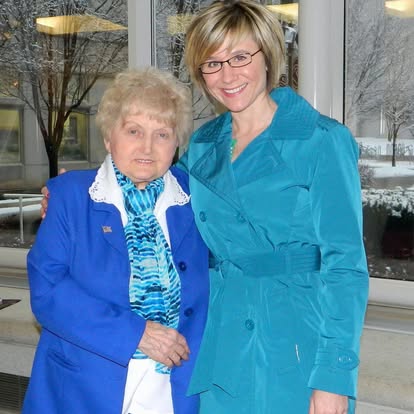
Eva Mozes Kor and Jill Szoo Wilson met for the first time in Springfield, Missouri, in 2013.

When people get involved, survival shifts. We move from survival as an instinct (wrestling bears for food because we have to eat) to survival despite our instincts, fighting human perpetrators because the violence they bring is not just something we recover from; it is something we live with, long after the battle is over. This is where justice comes in. As humans, we have a strong need for justice. Our first instinct is not usually forgiveness, but rather to seek an equally proportional measure of punishment for those who have wronged us. “An eye for an eye,” right?

I have heard it said that forgiveness is about taking someone off your hook and putting them onto God’s hook. I believe that to be true. But for the sake of this article, let us focus on the hook itself. How can we find peace if we are still holding someone in contempt in a court of our own? How can we find peace when we are the judge, jury, and executioner?

This brings us to forgiveness, a concept that can feel both impossible and liberating. It is not about erasing the past; it is about freeing ourselves from its hold. I began to understand this through my time with Holocaust survivor and Mengele Twin Eva Mozes Kor. In her words and actions, Eva taught me that forgiveness is not an act of excusing the wrongs done to us; it is about choosing to free ourselves from the weight of anger and resentment, allowing us to heal and move forward.

Eva spent her life sharing a powerful message: forgiveness can free us from the pain of the past. But forgiveness is not a simple act, nor is it always possible in the heat of survival. In candid reflections, she discussed how complex and difficult it is to find peace, not just for oneself but for future generations.

Eva was often criticized by fellow survivors for her approach to forgiveness, which she saw as a conscious decision to move beyond the traditional idea of simply “forgive and forget.” For Eva, forgiveness was not about erasing the past or excusing the wrongs committed; it was about choosing to release the grip that hatred and resentment held on her, giving herself the freedom to heal.

She also emphasized that forgiveness cannot be rushed. It is not something one can jump into in the heat of battle or while still fighting for survival. Only after we feel safe, after the danger has passed, can we even begin to consider forgiveness. This understanding was central to Eva’s belief that forgiveness is a long, deliberate process that only becomes possible when we feel secure. For her, the journey did not even begin until four decades after liberation from the camps (Kor). That delay is a testament to the time it takes to heal and to reclaim one’s sense of safety before forgiveness becomes possible.

Psychological research on trauma supports Eva’s view that forgiveness is often a complex and gradual process, particularly when individuals are still grappling with the effects of trauma. Dr. Bessel van der Kolk explains that “trauma robs you of the capacity to forgive, because forgiveness requires a sense of safety, and trauma creates a world where safety is impossible” (The Body Keeps the Score, 2014). This aligns with Eva’s belief that forgiveness only becomes possible when the individual feels secure enough to step away from the “battlefield mentality” of survival.

Similarly, Dr. Judith Herman emphasizes the critical role safety plays in the recovery process. She asserts that trauma survivors must first find safety and regain a sense of control before they can begin processing and healing their wounds (Trauma and Recovery, 1992). Only after this foundational stage can they consider forgiveness, not as an immediate reaction but as part of a longer journey toward reclaiming their emotional well-being and sense of power.

Survival First: The Battlefield Mentality

Eva’s message begins with a clear understanding of human nature. She explains that the survival instinct is innate: “We are all born to maintain life at any cost.” This survival instinct shapes our actions in profound ways, particularly when our lives are at risk.

For example, she argued that forgiving someone who is pointing a gun at your head would make no sense, because you would be dead before you could even say the words. The instinct to protect oneself overrides any consideration of forgiveness in that moment. Eva called this the “battlefield mentality.” In this context, forgiveness is impossible until the threat has passed, the battle is over, and we feel secure again. Only then can we begin to consider forgiveness.

This aligns with the fight-or-flight response, first described by Dr. Walter Cannon (Bodily Changes in Pain, Hunger, Fear and Rage, 1915). Cannon’s research explains how the body’s instinctive reaction to danger prioritizes survival over all other actions, including the cognitive decision to forgive. Only once the immediate threat has passed and we feel safe can we process our emotions and consider forgiveness.

Forgiveness After the Battle: When We Are Safe

Eva believed that for Holocaust survivors living in Israel, or those still coping with the immediate concerns of survival, forgiveness was often out of reach. Many survivors continue to face the realities of their trauma, and for some, the environment in which they live, still grappling with insecurity and violence, means they are not yet able to move beyond the pain. The challenges they face are not just historical; they are still navigating a present shaped by fear, uncertainty, and the need for protection. Eva recognized this complexity and believed that forgiveness could not be forced while survivors are still in a state of ongoing defense, where survival is still their top priority.

Historical context supports Eva’s view. The post-war period in Israel, for example, was one where many survivors faced not only the trauma of their past but also the pressures of rebuilding in a country still fighting for its survival. In such an environment, the idea of forgiveness or reconciliation often took a back seat to the immediate needs for safety and security. Scholars like Hannah Arendt (The Human Condition, 1958) and Natan P. Lasky (Holocaust and Memory, 2001) note that forgiveness in the face of unresolved trauma and ongoing conflict is incredibly difficult, if not impossible, because the wounds remain fresh and the environment does not offer the conditions for healing.

Eva also pointed to the cycle of pain that continues when survivors, unable to forgive, pass on their hatred and distrust. Survivors who choose not to forgive often reject anything related to their oppressors, such as avoiding German products, refusing to visit Germany, or not trusting Germans. This perpetuates the pain and prevents healing. Eva challenged them: “Do you want your children and grandchildren to carry and feel your pain for the rest of their lives, or would you like to give them another inheritance?”

The Inheritance of Forgiveness

Eva reflected on her own family, explaining how her two children responded differently to her philosophy of forgiveness. One embraced it, while the other did not. Despite the differences, Eva believed forgiveness was a choice that could be discovered later in life, even if not immediately embraced. She always said, “I forgive in my name only.” For Eva, forgiveness was a personal decision, one that could not be imposed on others. She recognized that each person must find their own path to healing, and that path may look different for everyone.

She urged survivors of any trauma, whether Holocaust survivors or survivors of child abuse, neglect, or molestation, to consider the possibility of forgiveness. Eva shared how the deep pain caused by betrayal can linger long after the event, but also how releasing that pain is possible. Her advice for those suffering from trauma was simple: imagine how it would feel if the pain had never occurred. Then, shift your perspective and ask, “How would you feel if you could overcome that pain by forgiving those who caused it?”

The Letter of Forgiveness: A Path Toward Freedom

For those struggling to forgive, Eva had a practical suggestion: write a letter to the person who caused the pain. The letter did not need to be sent; it was a personal act of release. Writing a letter of forgiveness allows the survivor to work through the pain, step by step, with the intention of breaking free from its grip.

Research in expressive writing supports Eva’s approach. Dr. James Pennebaker has found that writing about traumatic experiences can significantly reduce stress and improve emotional well-being (Opening Up by Writing It Down, 2016). In his studies, he demonstrated that individuals who write about their emotions and trauma often experience greater emotional clarity and a decrease in physical symptoms related to stress. This form of writing helps individuals process difficult emotions in a controlled, private way, which can be especially beneficial for survivors of trauma who may find it difficult to talk about their pain.

Eva reassured her audience: “What can this silly letter accomplish? Try it, what can you lose? Only your pain. And if you don’t like how it feels without that pain, you can always take it back, but you will not miss it.” This simple act, she believed, could free people from the constant burden of past trauma and open the door to healing. Studies have shown that writing can lead to emotional relief, helping individuals feel lighter and less burdened by their past. By putting the pain into words, survivors can begin to regain control over their emotions and take steps toward freedom.

A Call to Action

Eva’s message is about reclaiming your freedom. She taught me that forgiveness is not about excusing the past; it is about letting go of the weight that keeps you from moving forward. Traveling with her through Poland, Hungary, and Romania from 2013 to 2017, I saw how forgiveness gave her the power to heal, to find peace where pain once lived.

Her words often echoed in my mind as I confronted my own pain. “What would my life be like if I could forgive?” I realized that forgiveness is not just about releasing anger or resentment; it is about letting go of fear and the weight of trying to fix things I cannot control. I spent so much time feeling responsible for making everything right, but I realized that I cannot be in charge of justice across the world. What I can do is release my obligation to correct things beyond my reach. Forgiveness became the key to letting go of that burden, and in doing so, I was able to reclaim peace for myself.

June Hunt defines forgiveness as “a deliberate choice to release feelings of resentment or vengeance toward a person or group who has harmed you” (How to Forgive… When You Don’t Feel Like It, 2008). Hunt emphasizes that forgiveness is not about condoning the offense but choosing to release the hold that the hurt has over your life. This aligns with Eva’s perspective, where forgiveness is an act of personal freedom, not an act of excusing past wrongs. For Eva, forgiveness was about freeing herself from the weight of past pain, and choosing peace over the perpetuation of hurt.

Through her example, I understood that forgiveness is a choice, a choice that lets you take back the power lost to fear, anger, and the constant desire to control outcomes. It is not an easy choice, but it is one worth making. Because in the end, forgiveness is a powerful act of reclaiming your life, of releasing the past’s grip on your soul and embracing the peace you deserve. It is not about excusing the wrongs or forgetting the pain; it is about choosing to rise above them, to break free from the chains of resentment and fear, and to step forward into a future unburdened by what you cannot change.

© Jill Szoo Wilson, 2025


Further Reading

  • Arendt, Hannah. The Human Condition. University of Chicago Press, 1958.
  • Cannon, Walter. Bodily Changes in Pain, Hunger, Fear and Rage. Appleton, 1915.
  • Herman, Judith. Trauma and Recovery. Basic Books, 1992.
  • Hunt, June. How to Forgive… When You Don’t Feel Like It. Harvest House, 2008.
  • Kor, Eva Mozes. Surviving the Angel of Death: The True Story of a Mengele Twin in Auschwitz. Tanglewood, 2009.
  • Lasky, Natan P. Holocaust and Memory. Yale University Press, 2001.
  • Pennebaker, James W. Opening Up by Writing It Down. Guilford Press, 2016.
  • van der Kolk, Bessel. The Body Keeps the Score: Brain, Mind, and Body in the Healing of Trauma. Viking, 2014.