Caimon looked down at the dirt around his feet and noticed his shoe was untied. “Not completely, no.”
“Do you mean that we are partly unknowable? But partly knowable, too?”
He could feel his pulse in his temples as he bent down to tie his shoe, “I think we can know someone as much as they are willing to be known.”
She wondered about his answer as she leaned over to tighten the Velcro on the side of her own shoe, “Do you want me to know you?” She whispered the first part of the sentence, but the second part leapt too loudly from her mouth.
“I guess I want everyone to know me. But not really.” He could tell, right away, this wasn’t the answer she wanted to hear.
“Well,” she said, with securely fastened feet, “I think I understand.”
Caimon tried to make a joke, but it fell between his feet, “Maybe you do. But not really.”
As his paltry attempt at humor mixed in with the dirt beneath the hem of his pants, Caimon wanted her to walk away. He didn’t like the weight of her stare, and he didn’t want to feel responsible for her anymore. In a moment of desperation, Caimon turned from her—filled with the conviction that he would never look in her direction again—and he said, “Why do you always need to know? What is wrong with not knowing?”
His footsteps were slow and heavy as he could feel her blue eyes fastened to his back with long, thick ropes tied around his organs. Her eyes pulled at him and tried to stop his movement until, between one exhale and the next breath in, he felt her release. The moment of her imprisonment was the moment of his freedom, and in his freedom, he began to run. Not fast and with nowhere to go, but with the swiftness of a man whose shoes were tied and whose longest mistake grew shorter behind him.
Caimon ran with his secrets. The unknowable parts of himself were rattling around between his right ear and his left. They were sloshing back and forth between his rib cages and percolating up into his throat. The words he would never say, the feelings he could never explain, and the courage he conjured in his dreams but left stuck to the sides of his imagination were loosening with each new footstep. He wondered whether it was dangerous to allow the movement. His secrets felt like gumballs in a gumball machine and he had only ever seen one fall at a time: what would happen if the whole lot was disturbed at once?
He laughed under his breath and panted fog into the cold night air, “If only I had a quarter, I could find some courage to chew on.”
He laughed again, but this time he knew it wasn’t funny.
The words of the girl wrote themselves on the trees surrounding him, and he could hear them on the wings of the wind that fell through the leaves. He watched his shoes as they hit the ground—left, right, left, right—and he began to count the steps. Each step was further away and, somehow, closer, too. Further from her: closer to something new.
It wasn’t any one aspect of the girl Caimon needed to flee, but the anchor her whole had become. She needed Caimon, and Caimon didn’t want to be needed. She expected things from him, and he wasn’t sure he had what she was waiting to discover. He didn’t want to disappoint her, to lose her, or find her, and the girl only wanted to be found. Theirs was a connection of two negative magnets, one wanting to change her charge. She wanted to change the nature of herself so she could be pulled into Caimon and he into her, almost as though the choice no longer belonged to them.
“Unknowable,” he read as the words wrote themselves in the reflection of a lake up ahead. Caimon stopped running and never looked back, but sat on the edge of the water.
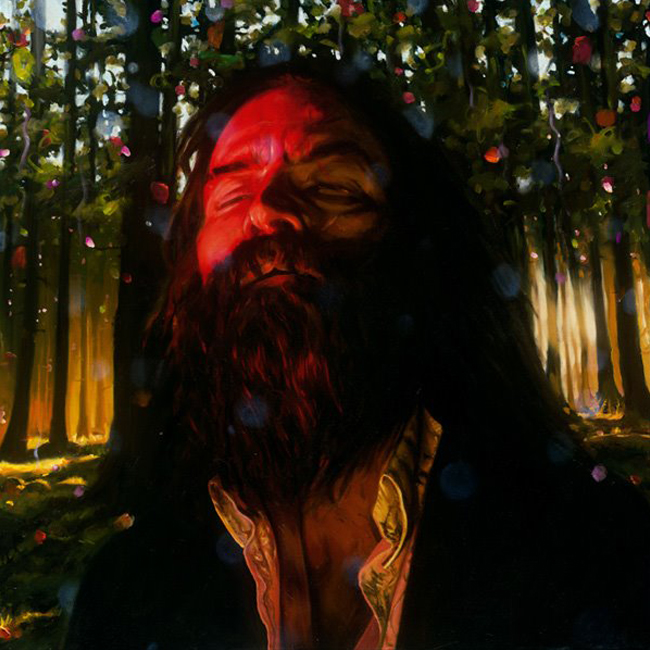
The air was so cold by then that his breath felt like crystals grabbing the edges of his lips as it was blown from his body. The forest was silent and still: the kind of stillness that lowers itself like a parachute over nature when the moon is moments away from switching places with the sun.
Caimon, tired and cold, reached into the pocket of his coat to find his book of matches. Once he was certain the matches were there, he looked near his feet for pieces of fallen wood. One by one, Caimon reached into the dirt for the wood, methodically like he was looking for pieces of a puzzle that had fallen to the floor. Once he had gathered enough wood to build a fire, he reached into his pocket and pulled out two things: the matches he knew were there and an envelope she had given him earlier, long before he tied his shoe.
Caimon crumpled the envelope—still filled with her letter—in his left hand and placed it on top of the wood. With a match in his right hand, Caimon struck the side of the matchbook and watched the flame immediately appear.
“Quickly,” Caimon thought. “It is quickly that a match is filled with fire.” Just as the flame crept dangerously close toward his fingers, Caimon leaned over and watched as the flame stretched itself from the match to the letter, like a bridge between two lovers. Or two strangers. Once the letter was lit, Caimon stood.
He closed his eyes and felt the heat of the letter begin to grow as it linked arms with the pieces of wood he had gathered from the forest floor. Soon, the fire began to melt the breath that gently rolled from between Caimon’s lips. He lightly bent his fingers into fists, his fingertips touching the inside of his own palm. He felt the skin on his hands and wondered why he hadn’t noticed before how rough that skin had become.
He could see on the inside of his eyelids the orange and red of the fire he had built: the fire made with his rough hands and matches and her letter. He didn’t want to look at it just yet but, instead, he wanted to feel it dance before him like a lover unencumbered by self-consciousness or pride. Caimon drank in the light and let the colors of the illumination paint a masterpiece inside his mind.
Enraptured by the freedom of the flames and the heat of the fire against his shoes and legs and face, Caimon leaned back his head and sighed a message that flew into the sky, “There is nothing wrong with not knowing.”
And without seeing the sun begin to rise, Caimon knew the day was new.
There is a secret bond between slowness and memory, between speed and forgetting. A man is walking down the street. At a certain moment, he tries to recall something, but the recollection escapes him. Automatically, he slows down.
Meanwhile, a person who wants to forget a disagreeable incident he has just lived through starts unconsciously to speed up his pace, as if he were trying to distance himself from a thing still too close to him in time.
In existential mathematics that experience takes the form of two basic equations: The degree of slowness is directly proportional to the intensity of memory; the degree of speed is directly proportional to the intensity of forgetting.
Milan Kundera, Slowness
Kundera, man. This guy just knows how to pierce into and extend a metaphor.
The question his thoughts inspire in me today is this: when we travel from the present moment to our memories–or an imagined future–does the speed of life around us change? How do we move from our imaginations to our current surroundings? Slowly or with speed?
Slowness By Jill Szoo Wilson
A breeze blows through my window proclaims, "I wants to write," as it lifts the pages of my notepad– the crinkling sound of paper– no– the sound of pages running across a sidewalk though no footsteps follow behind.
Free, the pages tumble twist into a roll– double back salto tucked with a triple twist– a pigeon holds up a sign, "7 out of 10."
It had to be the pigeon. No one else was paying attention.
The fluttering of the notebook page pulls me back into the moment– how many sounds have I forgotten to hear?
Do I hear the past more loudly than today? How many hours echo through a chamber of disparate chatter?
A dog is barking, a squirrel's claws are tapping the inside of my ceramic pot, I'm humming a song that was sung to me once, the pigeon is bored– he flys away.



 Jill Szoo Wilson