Poem: The Curve of Time

You might as well befriend the moon–
embrace her clouded peekaboos.
And music . . .

Receive the tune–
you have no time to choose–
alone in a crowd or
with no one in view.
And a smell . . .

Wafts past your nose–
what's that?
Or who?

Perfume on skin or a place that you knew?
Pause.
No need to wonder—you know who that was—
and who you are
as nostalgia winds the second hand 'round.

"Time is a straight line," said he
"It moves consecutively,
watches as it goes
behind and below
like walking on a path
that winds into—
well—
no one knows."

"No one knows,
that's right," said she.
"Simply put, I do agree.
But there's no line to speak of.
Time bends–not like a knee–
more like a finger touching its thumb
or a rainbow finding it's spherical end
and celebrating with a gentle, 'Come.'"

Time returns to the places we've been.
One says, "That memory is far."
Another, "The moment is here to stay."
Yesterday can be put down
but the nows of that day
pop up from the ground
without notice
or sound
to delight or confound–
it depends on the soiled seconds
into which it was bound–
moments become recollections and
recollections are seeds
with a life of their own.

Promises and hope
gentleness and rage
a touch, a glance
a well-appointed room
or a half-written page–
all are sown into our skin
and find their rest in
smiles and tears
repose and toil
love and loss
freedom and cost
and the way the sunlight lay across
the earth at the end or
when it all began.

"That was back then," said he.
"That is today," said she.
The Minutes listened closely,
"There is wisdom in both."
Time smiled wryly
crouched smugly and quietly
behind an Autumn tree
waiting for the final leaf to fall.

© Jill Szoo Wilson, 2025
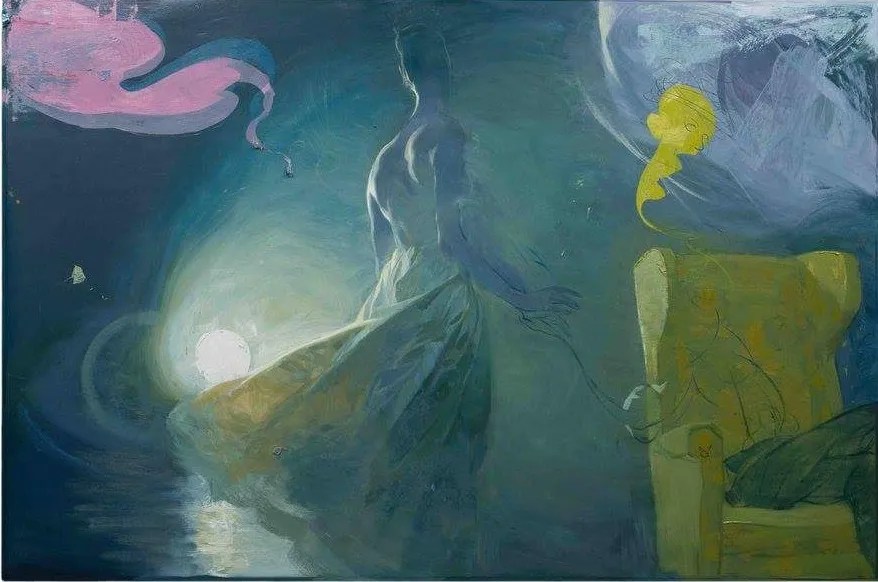
Berührungspunkt (c) 2016 Ruprecht von Kaufmann (oil on linoleum) – Courtesy Galerie Crone

Sonnet: The Final Chamber

In all your quiet ways my spirit wakes,
Like dawn that steals through shutters, soft and slow.
Oft have I wondered how your presence makes
Veil’d parts of me take courage yet to grow.

Each day my hushed and inward-seeking mind
Yields when your voice through shaded mem'ry moves.
O’er every folded fear your light I find,
Undoing shadows with the truth it proves.

You are the innermost of all my days,
The final form within my layered soul.
No ornament, nor craft of human praise,
Could name the warmth by which you make me whole.

So stand I now, my guarded heart undone,
For in your gaze a thousand worlds are one.

© Jill Szoo Wilson, 2025

Poem: Unencumbered

She collected recollections

From the past

As though they were

Trinkets from a shop

Where antiques—

Roughly used and rusting—

Lay waiting,

Lay trusting

Their time would come again.


Again yesterday came

But with a different name

“Today”

So she sat with her

Treasures

Stoic and measured

With a grip not to lose

For if she loosened her hold

They may drip away.


Away from the darkness

Of her previous losses

She looked toward the light

Lost her sight

At the brilliance it held

Shuttered with fear

Melted with doubt

Stifled her silent shout

With a thought.


The thought

A question

Singed with intention

Smoking

Like the barrel of a gun

Prompting her

To run

Instead of stay—

But she stayed.


Stayed in the place

Where she planted the seeds

Grass to grow

To overthrow

The things it seemed

She could not let go

Like a patient

Patiently awaiting

Death.


Death that rides

On the back of loss

That stabs at the fear

Of drawing near

“Don’t move from here”

She whispered out loud

And hoped the desire to move

Would evaporate

Like a cloud.


Clouds of then

Filled the present

A fog in this room

Invaded by the presence

Of shadows—

Not men—

Only places

They may have been

Had they stayed.


Staying threatened her breath

As the air turned white

The longing for safety

Compromised

By this encroaching night

The fear of losing

Being lost from her sight

As a struggle to gain

Awoke to the fight.


Fighting for air

She stood to her feet

Considered her options:

Victory / Defeat—

Destruction seemed easy

To fail is so clean

Triumph unknown

Invites mystery:

Shrapnel of

The unforeseen.


Unforeseen was the way

Mighty was the day

When the roots that held

Were cut away

When her voice

Unvoiced

Found the breath to say,

“Tomorrow

is where my future—

unencumbered—

lay.”

© Jill Szoo Wilson, 2025

Poem: Beautiful/Lies

I will tell you what to see—

Everything but me—

A variety:

First, the shape my lips take

When I smile

Then, only aspects of my style—

The ones that deceive the senses

Lower your defenses

Make you wonder

Confidence thrown asunder.

A breeze

Whizzing by your certainty

A tornado—

Or a reverie—

Where the facts

Are art-i-facts

Designed to twist

To burrow in your mind

Then to grow

Into trees of truth

Where flowers of falsified youth

And branches that carry the load

Explode into blossoms and

Inspire.


Time evaporates into years

My collection has piled

Your recollection defiled

Melted

Reshaped

Into unknown

Unsuspected, unsuspecting

Wisdom flown

From your mind

And into my hands

Like clay

Shaped, reshaped

The size of the holes

On either side of your nose

Where what you see

Is only dreams—

The ones I dare to

Echo

Deflected from the truth

Reflected onto the marquee

Like a refugee memory

No longer sure

Which way

Is home.


I will choose the color,

You will trust my hand

Not because your will is irrelevant

Only because

You cannot understand—

And—

You trust

The choices

I make

Wait for the plans

The paths

That I take

Like a child—

Hope outstretched

Faith recklessly displaced—

Still you smile

And wait to see

What you will be-come

When the operation is done

Your vision restored

To my point of view

The illusion of Truth

Wrapped inside

Like a film reel

Reflecting

My cinematic lies.


The seed is sown

The deed is done

Now water it with your tears

Blink until you make it your own

Follow my finger

First up and then

Down

First left and then

Right,

“Don’t fight

let it be

trust me

I know the plans

I have for you:

to kill the boredom

to steal the dream

to destroy the blinding vision

to replace it with soothing

fabrication and

elation

for today.

Today is all that matters.

One more spin

Your view will be new—

you will thank me

when I am through.”


“I can see”

said she who trusted.

“Thanks for your selection.

How can I repay your

close attention,

touch easing apprehension,

voice soothing

the searing dissonance of

incomprehension?”

She wiped a tear

From the corner

Of her newly installed

Perception.


She who answered

Leaned in

Close

Low

Bestowed the wages

To be collected on

Another day,

“Only three things I pray:

go further than you intended to go

stay longer than you intended to stay

pay more than you were willing to pay.”


I will tell you what to see—

Everything but me—

I will whisper in the breeze

Rolling from the sea,

Caress your lips

From a hot cup of tea,

Sing in your ear

On the notes of a melody,

Just as long

As you agree

Never

To set me free.

© Jill Szoo Wilson, 2025

Poem: Broken People

The broken people

Write

Of themselves

Themselves

To mend

Before the stories

Clinging to sinewy tendons

And blood-covered veins

Break the remainder

Of the broken people.


Like bricks

Pulverized by word-hammers

And spread across

Paper

Weighted so

The paper

Will not be carried away by the wind

The anchor-stories

Are yanked from below

And are gasping and

Building

Something new.


Their minds have slipped

Into the core

Below the place

Where gray matter

Sloshes

And squishes about

And their eyes

Are inside and

See

What is there

And blink Morse code

To the hands

On the outside—

In this way

The stories are told.


The broken people

Choose not to walk

Though

Walking is easy

On feet that are strong

But movement against

Wind might seem like

Progression

But sometimes

Movement of the hands

Moves

Them

Further along

Than feet ever could.


“Do you dream?”

A fellow asked

Who smelled of Vodka

And beef

Whose face

Looked like it dripped with

Paint

Too thick

And crusted on

Forgotten

By the touch of

His painter’s hand.


“I dream,” answered

The broken man

Whose feather pen

Moved faster than before.


“How do you dream,”

He asked then he stumbled,

“With no head to call your own?”

He laughed at his question

Like old women

Laugh at dolls

When dementia

Has taught them

That dolls are flesh.


The broken man

Wrote on

And thought about

A song

He heard in his ears

Long ago

Many years

Before his head fell

Into his core,

“I see the crystal visions

I keep my visions to myself

It's only me

Who wants to wrap

Around your dreams and

[I wonder]

Have you any

Dreams

You'd like to sell?”


The broken people

Tell of themselves

They also tell of you

And when they

Cast

Silvery questions

Into the ocean of

You

It never is in vain—

For they will not

Throw your stories

Back

But

Instead

Transform them into

Something new

And then

You

Move through

Fingertips too.

© Jill Szoo Wilson, 2025

Poem: Watercolor Dreams

An old poem about waking up from a story that was too small.

He found her with her eyes closed

Tight

Lids wrapped around

Pulled down

And dreaming

Watercolor dreams


He lived a life of comfort

Cotton

Filled his form

Like an animal stuffed

Insulated from

The courage to explore


He held her at one end

Taut

Between fingers tightly wound

Stretching like elastic

Brittle with aging codependence

Afraid to loosen his grip


She was like a Rose

Strong

Yet gentle in her making—

Giving but not taking—

So he wore her pinned

To his jacket like a prize


He pulled one petal at a time

Slowly

Scattered her around himself

Like confetti at his feet

Glimmering in sunlight

After a parade


She watched through rose colored

Eyes

Wondering at his dance

As he tapped his feet

To the rhythm of his science

Letting his heart beat out of sync


She rested a while tired by the

Miles

Traveled in footsteps and

In smiles broadly sewn

To the walls of her soul

Like threads of a tapestry


He named his rationality

Reason—

Suddenly like a thief

Holding a bag of gold

Heavy with secrets untold and

With her time and observations


She cut the rope between her

Heart

And the anchor he threw

Watched it sink

Until she could see it

No more, now


There at the bottom of the

Ocean

And her sighs

Lay the anchor and

There on the water’s edge

Sail her heartbeat and

Her watercolor dreams.


© Jill Szoo Wilson, 2025

Poem: Undone

One layer at a time he peeled me

Like an onion

His hands wrapped around my outer skin

From top to bottom he found my flesh

And I made him cry

Like water

Running down the side of rock

In a cascade of drops becoming

A river below

Into which we jumped

His tears breaking our fall.


One page at a time he turned me

Like a book

His hands against the leather

Bound around my story, all my words

Unspoken and broken

He read and knew and studied

Like art

Smeared across a canvas

With descriptions written below

Telling of the image

Sitting still and wanting

To be known.


One note at a time he sang me

Like a song

Released from the beak of a bird

Whose daily life is filled

With music because music is

Like emotion

Strong and loud when the air is enough

And slow and soft

When there is tenderness in the touch

A balance of adagio and

A quickening of the pulse.


One sip at a time he drank me

Like wine

Held inside a carafe

Until the day my breath met his

At the edge of a glass

And stained our mouths with red

Like a flower

Vibrant with color and life

Not pulled but watered instead

By attentive hands

That understand

Petals cut or plucked

Are already dying.


Whatever the measures by which he moves

Whatever the story he tells

Whatever the words he says or unzips

I am undone

And his.

© Jill Szoo Wilson

Slow Art: Unhurrying Your Mind

Museums invite looking, yet most visitors treat art the way they treat emails: a quick skim, a polite nod, and on to the next thing. We spot a recognizable subject or a pleasing color, think, “Ah yes, culture,” and keep walking. Studies suggest that viewers spend less than thirty seconds with a work of art before moving on. It is possible to tour an entire gallery without truly arriving anywhere at all.

Slow Art suggests another way to exist among masterpieces.

Rooted in the broader Slow Movement and formally organized with Slow Art Day in 2010, the practice encourages viewers to remain with a single artwork long enough for something meaningful to happen. The idea is simple: stop rushing. Stop conquering exhibitions like they’re errands. Let a painting interrupt the pace of your day.

Of course, the mind resists immediately. The moment we sit down and dare to look, our thoughts fling themselves into crisis: seventeen neglected texts, three unpurchased groceries, and the intrusive belief that productivity is our moral duty, and this bench is a crime scene. Apparently, stillness is very dramatic.

Yet if we continue to sit, the noise eventually settles. We start to notice the obvious things we missed when our thoughts were busy staging a coup: light falling across a shoulder, a line of color we would have sworn was not there a moment ago. Philosopher Maurice Merleau-Ponty argued that seeing is never passive; we do not merely observe the world. We are in conversation with it. Given time, a painting stops acting like an object and begins to behave like a presence. It answers back.

Meanwhile, neuroscience is offering evidence for what artists have always suspected. When we linger with an artwork, the brain does more than register shape and shade. Regions connected to memory, imagination, and empathy start sparking awake, as though the mind suddenly recalls it has a richer job than survival. Interpretation emerges. Emotion slips in without asking permission. You are no longer deciphering the art. You are encountering yourself.

Slow looking becomes a decision to let meaning unfold at its own pace.

It is a tiny rebellion against the cult of efficiency. Instead of demanding results from a painting — explain yourself, be profound, hurry up — we allow the experience to be unmeasurable. Sometimes revelation arrives. Sometimes quiet does. Both are victories over the museum sprint that ends with a gift shop purchase and no recollection of the gallery that preceded it.

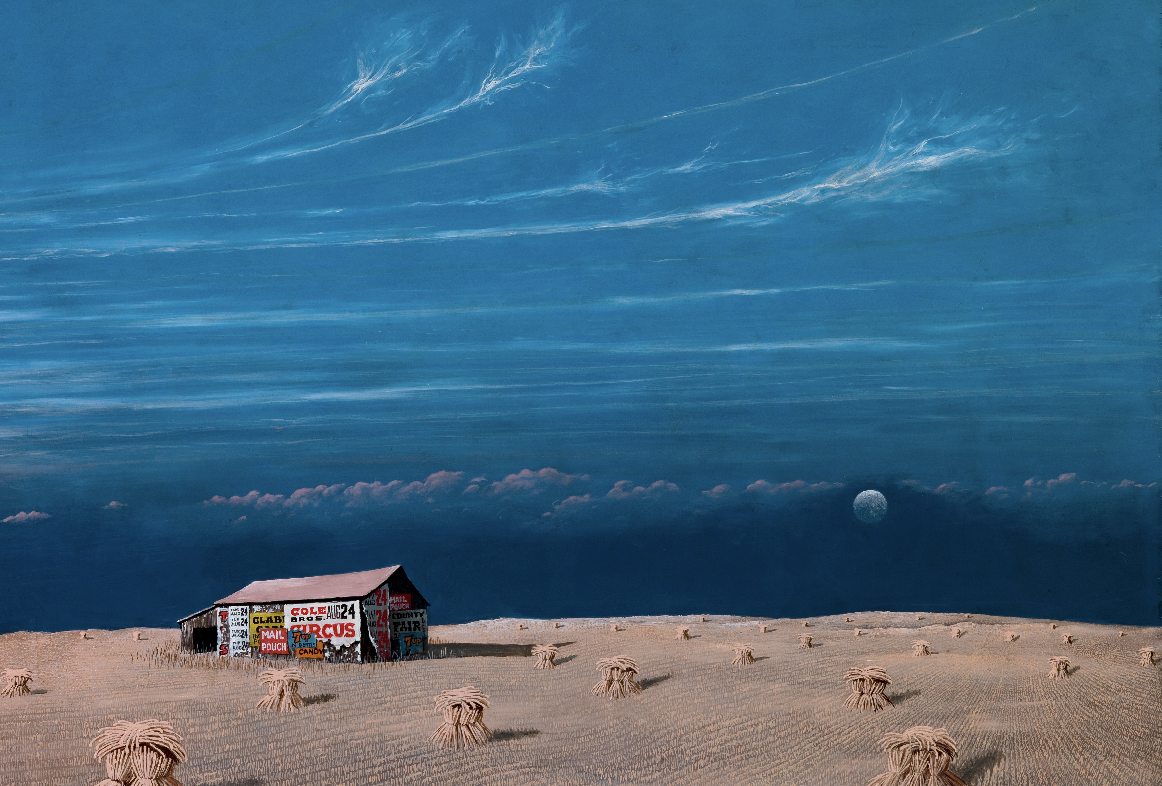
This week, I sat with a painting of moonlit fields and distant wind. Nothing moved, yet somehow everything did. The air itself seemed to stretch across my skin, my breath eased, and the horizon widened inside me. It felt like remembering how to be a person rather than a calendar.

I answered the art’s invitation in the only way I know:
by writing.

Cloud Trails, by John Rogers Cox
Hush
By Jill Szoo Wilson

My dear, now hush. Unburden every care;
The silent fields invite your breath to slow.
The wind lifts strands of worry from your hair
And strokes your cheek with touches soft and low.

O moon, shine steady, hold your silver ground;
A lantern calm above the world’s unrest.
Pour down a peace too deep for any sound
And press a quiet knowing to the chest.

Kind wind — sweet wanderer — move as you will;
Let coolness glide along these open hands.
Brush thought from thought, invite my heart to still,
And ferry calm across the quiet lands.

Here, nothing strives. The wide horizon sighs—
At last, the soul grows spacious as the skies.

Poem: Opposite Sides of the Wall

I wrote this poem after visiting Berlin in 2015, where I was fascinated by the messages people had left on the remains of the Wall. This piece was inspired by one of those messages.

From the highest story

Of a building gray and cracked

Peer two eyes

Through dusty window panes

Pestered by a mosquito

Flying along the edges.


Below the eyes

A hand

Holding tin

Filled with coffee

Cold and strong—

A cigarette burning.


The fog of stagnation

Fills the room

As one wisp of smoke

Links arms with another

A silent dirge

Circling like vultures.


Her gaze is blank

She closes her eyes

Then opens them wide

Each closing a respite

Followed by

Disappointment.


She sighs

She coughs

She smiles for a moment

As the mosquito

Bumps against the glass

Bruised and trapped.


Above her head

Noisy neighbors shout

The song of frustration

Rings out and falls

Pulled by gravity and

By doubt.


She begins to hum a tune

She has not heard

Since she held a doll

Inside chubby arms

And kissed its head

With sugary lips.


Her raspy alto

Lays itself on the notes

Her Now

Transposes the music

From major to

Minor keys.


The mosquito brushes past

Her hand

And then lands and

Sticks his needle

Into her skin—

She observes the transaction.


A flashing light—


Her gaze arrested

Handcuffed to a mirror

Reflecting the sun a

A Morse Code message

.-.. --- ...- .

Which translates, “Love.”


She dunks her cigarette

Into her mug

Shakes her hand

The mosquito falls

Disconcerted but

Full.


She strikes a match

Holds it to a candle

Thick and matted

Like a paint brush

Spotted with colors

Dried from previous use.


A thin line rises from the flame

Gentle in its approach

And dancing in the haze—

She lowers and raises her hand

.- .-.. .-- .- -.-- ...


“Always,”

She replies

In this expression

They devised

From opposite sides of

The wall.


She blows out the fire

Puts her hand to the glass

Closes her eyes and

Kisses the air

As though it is

The last kiss in the world.


He lifts his fingers

Catches her lips

In mid-air—

Hungrily brings them down

Pressing their sweetness hard

Against his own.


The moment has passed

But their love

Will last—

Reach beyond time and space

Breaking past

The Wall.

© Jill Szoo Wilson, 2015
I took this photo at the remains of the Berlin Wall in the Spring of 2015. I was fascinated by the quotes spray-painted on the wall.

Poem: Love and Alive

Every day he comes and goes
Like a beggar on the street,
With no way to turn
But the direction from which he came.

If the streets were carpeted—
Soft to the touch—
The tread of his soles would
Scratch holes through the path
He has
Worn.

Worn out, the man with the
Briefcase breathes heavily
Under the sun and
Under the moon,
Inhaling and
Exhaling as he travels,
Blind as he goes—
Not because he has no head,
But because he feels no pain
Or joy.
He is numb.

Numb since the day she
Walked away,
And numb when he remembers
The way
Her hips sway—
This way and that.
And numb when he
Thinks of her name but cannot
Say it—
Silent.

Silently, the bird in his soul—
The bird whose name is
Alive—
Perches at the edge of her
Cage whose name is
Life,
And wishes for the day
She might once again
Begin
To
Fly.

Flying in the air
Above the man
Is a bird whose name is
Love.
He flies up high and
Then he dips
And twirls,
Like the tail of a kite giggling
In the wind,
Awaiting the moment when
The Man
Opens his coat and
Sits on his bench
And sleeps—
Like a beggar on the street
Dreaming.

Dreaming of her face—
The only face that is
Trapped inside the Man's soul.
Love watches with a keen and
Clever eye.

In one moment—
A moment whose approach is slow,
Whose arrival is timed
By the gods,
Whose watches are synchronized
To the beating of
Bird and human hearts—
The vigilant bird
Sees
The coat fall open,
Sees
The Man sit down on his bench,
Sees
Him close his eyes and
Seizes his
Freedom.

“Freedom does not live in the sky,”
He sings.
“Freedom lives inside Alive.”

Love drifts down
Through blue and through clouds
And alights
With bars between himself and
Her—
The one who holds his
Heart
Inside of her,
Inside a cage.
The one who
Knew he would
Come.

“Come to me every day,”
She wanted to say.
But instead, she said,
“You must not waste the time
Waiting by my side,
When all the world
Sprawls before your gaze.”

Love ruffled his feathers
And looked into her eyes.
“Until you are here with
Me—
Just you and me—
I will come and sit with you
Every day.”

Every day, Love came,
Just as he said he would,
And the earth turned slowly
From summer
To autumn
To winter
To spring.

Their stories grew, and
The details they knew
Poured through the bars
Like drops of water
Flowing
From watering cans,
Growing their love,
Growing him and growing
Her.

Her days inside,
Her will to survive—
Alive and Love
Together traveled through,
Until the day
The Man stepped anew
Off his carpet of same,
Tattered and
Worn through by
His shoes—
First one and then two—
Onto a path where four
Could move:
His loafers and
Her high heels of
Blue.

Blue turned to joy,
Joy turned to alive,
And Alive for the first time
Flew.
The Man let her fly,
As his heart said
Goodbye to the
Pain that was keeping
Alive inside the cage,
Inside his
Soul.

Souls in the air,
Free with
Togetherness,
No longer bound
But soaring high,
Strengthened by
The time in the cage
And by flying
Side
By
Side.

© Jill Szoo Wilson, 2025