
I was asked to lead a formation for my team at work this week.
As I pondered what to share with this group of creative people from all walks of life, all of them living in the same current world climate, the idea of peace came to mind.
Naturally, I turned to the words of my dear friend and forgiveness advocate, Eva Mozes Kor.
I’m sharing those notes here for anyone who teaches, leads, mentors, facilitates, or gathers people and asks them to think.
Borrow what serves you.
Adapt what doesn’t.
Ask good questions.
Here are my notes.
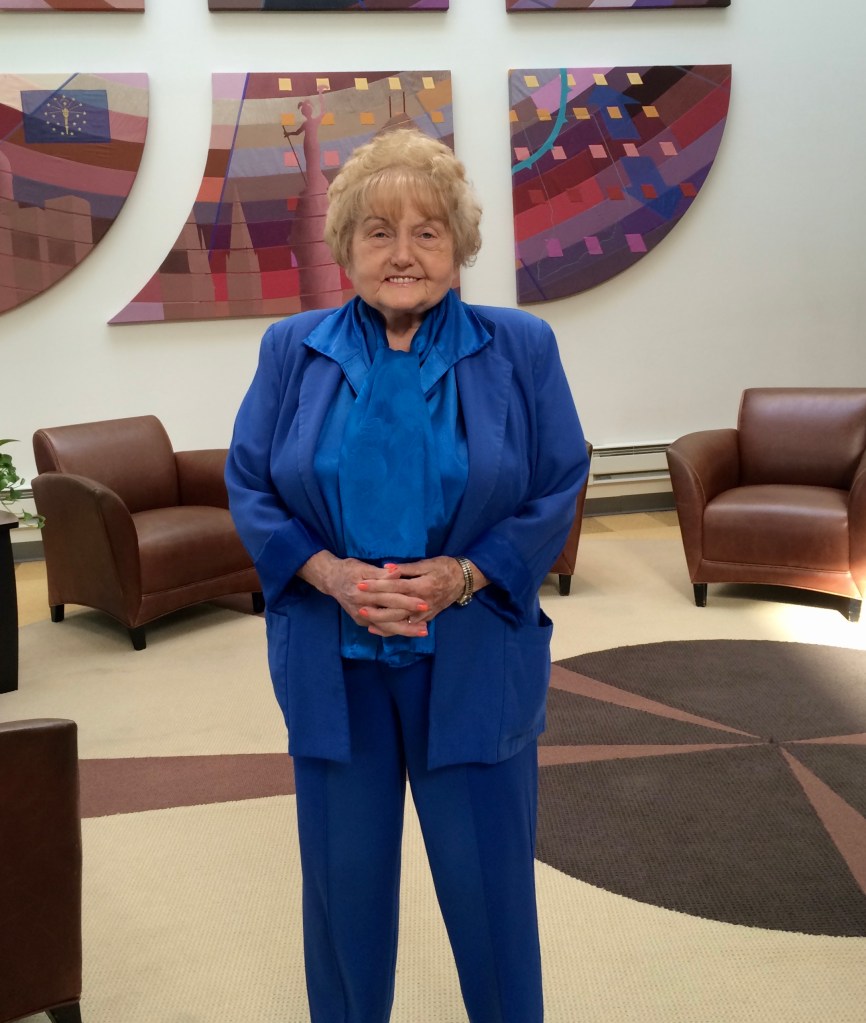
From 2013–2016, I spent most of my time interviewing and traveling with a woman who stood at 5’1″; she was in her eighties, very feisty, she called at all hours of the day or night, and she was a survivor of The Holocaust. Her name was Eva Mozes Kor.
When she was 10 years old, Eva was sent to Auschwitz II-Birkenau along with her father, mother, and twin sister, Miriam. Upon arrival, the twin girls were sent to the barracks in Birkenau that housed the twins upon whom Dr. Josef Mengele was conducting gruesome medical experiments.
The rest of her family was sent directly to the gas chambers.
In January of 1945, Eva and her sister were liberated from the death camp at the age of 11 by soviet soldiers who, as she often remembered, gave her “Chocolate, hugs, and cookies.”
Eva went on to marry and have two children. She also lived with a great deal of anger. Anger so destructive that she described it as eating her from the inside out.
So when Eva was in her fifties, she went on a trip to Germany to meet with one of the Auschwitz doctors who knew Dr. Mengele. The doctor she met with was Dr. Hans Münch.
Eva was meeting with him because she wanted to find out whether he knew what Mengele had injected into the girls when they were prisoners, because by this time, her twin sister Miriam was dying from the long-term effects of the experiments. Miriam’s kidneys had never grown beyond the size of a ten-year-old’s. Eva thought that if she could learn what harmed her sister, they might have a chance of finding a cure.
While she was there, Eva asked Dr. Münch:
“Do you remember what happened in the camps?”
To which he replied:
“Yes. It is the nightmare I must live with every day of my life.”
This response shocked Eva. A nazi doctor filled with regret? Seeing the pain, regret, fear, and humanity in Dr. Münch, Eva made a decision that shocked even her.
Over the course of their meeting, she decided to forgive Dr. Münch. And she would be very careful to also say that she forgave him in her name only. This was a personal decision.
Now, I’m leaving a lot out here, but some time later, when Eva was in her 50’s, Eva also decided to forgive Dr. Mengele, in her own name only, for the things he did to her and her sister.
She later described this act of forgiveness as an act of freedom. And seeing how much that freedom began to change her own life, and return some measure of peace and joy to it, she became a forgiveness advocate, and she began telling people about her decision.
She was met with a great deal of pushback and hatred, but also…
I personally witnessed crowds of 3,000 to 5,000 people filling stadiums to hear her tell her story, and utter silence filling the entire space. Every time.
Afterward, people of all ages came to tell Eva their own stories about the people they were having a horrible time forgiving:
Parents.
Friends.
Neighbors.
Themselves.
Her message began spreading.
She described it like this:
Each one of us has the power to, like a pebble in a pond, pursue acts of goodness that ripple outward.
And her most recognizable message is this:
“Anger is a seed for war. Forgiveness is a seed for peace.”
If I handed each of you a seed right now, and that seed could grow anything in your life, or in the lives of the people who come after you, what would you plant?
Peace?
Courage?
Truth?
Mercy?
Forgiveness?
And just as importantly, what are you already planting?
For more of Jill Szoo Wilson‘s writing about Eva Mozes Kor and forgiveness, click here.
 Jill Szoo Wilson