Poem: Broken People

The broken people

Write

Of themselves

Themselves

To mend

Before the stories

Clinging to sinewy tendons

And blood-covered veins

Break the remainder

Of the broken people.


Like bricks

Pulverized by word-hammers

And spread across

Paper

Weighted so

The paper

Will not be carried away by the wind

The anchor-stories

Are yanked from below

And are gasping and

Building

Something new.


Their minds have slipped

Into the core

Below the place

Where gray matter

Sloshes

And squishes about

And their eyes

Are inside and

See

What is there

And blink Morse code

To the hands

On the outside—

In this way

The stories are told.


The broken people

Choose not to walk

Though

Walking is easy

On feet that are strong

But movement against

Wind might seem like

Progression

But sometimes

Movement of the hands

Moves

Them

Further along

Than feet ever could.


“Do you dream?”

A fellow asked

Who smelled of Vodka

And beef

Whose face

Looked like it dripped with

Paint

Too thick

And crusted on

Forgotten

By the touch of

His painter’s hand.


“I dream,” answered

The broken man

Whose feather pen

Moved faster than before.


“How do you dream,”

He asked then he stumbled,

“With no head to call your own?”

He laughed at his question

Like old women

Laugh at dolls

When dementia

Has taught them

That dolls are flesh.


The broken man

Wrote on

And thought about

A song

He heard in his ears

Long ago

Many years

Before his head fell

Into his core,

“I see the crystal visions

I keep my visions to myself

It's only me

Who wants to wrap

Around your dreams and

[I wonder]

Have you any

Dreams

You'd like to sell?”


The broken people

Tell of themselves

They also tell of you

And when they

Cast

Silvery questions

Into the ocean of

You

It never is in vain—

For they will not

Throw your stories

Back

But

Instead

Transform them into

Something new

And then

You

Move through

Fingertips too.

© Jill Szoo Wilson, 2025

Poem: Watercolor Dreams

An old poem about waking up from a story that was too small.

He found her with her eyes closed

Tight

Lids wrapped around

Pulled down

And dreaming

Watercolor dreams


He lived a life of comfort

Cotton

Filled his form

Like an animal stuffed

Insulated from

The courage to explore


He held her at one end

Taut

Between fingers tightly wound

Stretching like elastic

Brittle with aging codependence

Afraid to loosen his grip


She was like a Rose

Strong

Yet gentle in her making—

Giving but not taking—

So he wore her pinned

To his jacket like a prize


He pulled one petal at a time

Slowly

Scattered her around himself

Like confetti at his feet

Glimmering in sunlight

After a parade


She watched through rose colored

Eyes

Wondering at his dance

As he tapped his feet

To the rhythm of his science

Letting his heart beat out of sync


She rested a while tired by the

Miles

Traveled in footsteps and

In smiles broadly sewn

To the walls of her soul

Like threads of a tapestry


He named his rationality

Reason—

Suddenly like a thief

Holding a bag of gold

Heavy with secrets untold and

With her time and observations


She cut the rope between her

Heart

And the anchor he threw

Watched it sink

Until she could see it

No more, now


There at the bottom of the

Ocean

And her sighs

Lay the anchor and

There on the water’s edge

Sail her heartbeat and

Her watercolor dreams.


© Jill Szoo Wilson, 2025

Rethinking Career Paths: Why Talent Clusters Matter More Than Majors

By Jill Szoo Wilson

Connecting Creative and Analytical Skills

“My dad has a totally different expectation for how my life should go,” one student reflected recently. “It sounds easy. He tells me to do one thing, and that that thing will lead to the next thing and the next and the next. But it’s not working that way.”

When asked to explain, he hesitated, then continued. “He told me to go to college, so I did. Two years in, I realized there weren’t enough jobs in my major, so I came back to community college to find a different path. I’m working two jobs and still live at home because I can’t afford to move out. When he tells me about his life, it all sounds easy. He went to college, got a job, bought a house, and got married. It sounds so easy.”

His words captured a generational tension I see often. Namely, the struggle to build a meaningful life in a world that no longer rewards linear scripts. The milestones that once defined adulthood — education, employment, marriage, ownership — rarely appear in sequence. The narrative has fractured, and with that fracture comes both loss and opportunity. Herminia Ibarra describes this shift clearly in Working Identity when she writes, “We learn who we are in practice, not in theory. We reinvent ourselves by doing, experimenting, and stepping into new roles.” It is a problem that calls for a new framework for understanding how work and identity evolve, one I have come to call talent clusters.

The days of the single income and the single career may well be behind us. The camera lens has widened, and with it, the way success is defined must widen too.

Students entering higher education today often inherit an outdated expectation that success depends on finding one right path and staying on it. But the modern economy no longer rewards singularity. It rewards synthesis. This is where talent clusters come in — the natural intersections of ability, curiosity, and experience that form the foundation for meaningful work. Rather than viewing careers as straight lines, these clusters invite students to see the web of connections already present in their interests and skills.

I began noticing this pattern in my own career before I had a name for it. In my life, theatre and communication have been that intersection. They didn’t compete. They conversed. Theatre taught me to listen for subtext, to inhabit perspective, and to read emotion in real time. Communication grounded me in theory and structure. It taught me how messages take shape, how persuasion works, and how to communicate ideas clearly and confidently. Together, they formed a foundation that prepared me not only to teach but also to write, to use language as both performance and connection.

When I began writing professionally, I realized I was drawing from both disciplines at once. The rhythm and tone I developed in the theatre informed my writing voice, while communication theory clarified audience, purpose, and persuasion. What looked like two paths became one integrated practice.

My experience reflects a broader truth. What seems like wandering is often a kind of weaving; the gradual merging of abilities that form something stronger than any single thread. The actor who learns to embody another person’s experience develops the empathy essential to leadership. The stage manager who coordinates complex productions gains logistical precision transferable to project management. The student who studies public speaking acquires the rhetorical awareness needed in advocacy, policy, or entrepreneurship. Each of these evolutions demonstrates the elasticity of transferable skills.

Workforce research supports this pattern. The nonprofit Jobs for the Future identifies communication, problem-solving, and creativity as “the most reliable predictors of long-term employability across industries.” The University of California, San Francisco, similarly defines portable skills as those that endure across shifting technologies and economies. Both findings affirm that artistic and professional fluency share the same core capacities: interpretation, adaptability, and disciplined imagination.

David Epstein, author of Range, writes, “The most effective people are not those who follow one path but those who explore multiple interests and connect them.” The humanities, long dismissed as soft or impractical, may therefore be among the most resilient fields of all. Theatre and communication cultivate habits of perception that remain deeply relevant: reading tone, decoding motive, and adjusting the message to the moment. They prepare students not merely to perform roles but to understand the systems in which those roles operate.

Jonathan Haidt situates this generational experience within an even wider lens. In The Anxious Generation, he notes that many young adults “feel unmoored from the stable institutions that once gave direction to their lives.” Yet that instability, while disorienting, also creates space for creative recombination. The disappearance of predetermined pathways invites a new kind of agency. It becomes the freedom to design lives that integrate multiple disciplines into meaningful coherence.

Many of my former students who began in theatre or communication now work in fields as diverse as consulting, user experience design (UX), public relations, real estate, and education. They have not abandoned their earlier training. They’ve simply translated it. The ability to connect meaning across disciplines has become a form of expertise.

Such an approach reframes the anxiety of choice. By seeking patterns, the recurring connections among their abilities and values, students can seek to define their own paths. A meaningful career, viewed through this lens, becomes a cumulative act of interpretation rather than a fixed destination. The result is not mastery of one discipline but the capacity to see how ideas speak to one another.

Translating Performance into Professional Presence

When I first began writing professionally as a content and copywriter, I noticed something familiar in the process of finding a client’s brand voice or a publication’s style. It felt like preparing a role. The work required listening for rhythm, motivation, and what I call character keys, the same instincts I practiced in the theatre for years. What I once used to understand a character, I now used to understand a brand. That connection not only helped me build continuity between theatre and writing but also gave me early confidence and, more importantly, measurable success. I knew I was on to something.

Theatre taught me that playing a character is rooted in playing action. Every moment on stage is driven by verbs: to lasso, to comfort, to resist, to reveal. Acting is not about emotion but about pursuing intention. Writing works the same way. Every effective sentence carries an action. Good copy does not describe. It moves. Whether the goal is to inform, inspire, or sell, the writer, like the actor, must choose verbs that propel intention forward. Both crafts rely on clarity of motive. The moment the action disappears, the scene or the sentence loses energy.

Theatrical training, often dismissed as niche, is an education in adaptability. It teaches how to read a room, sense emotional temperature, and adjust delivery to context. Those same instincts translate to the written page where attention and authenticity must be earned in every line. To communicate persuasively, whether on stage or in print, requires more than argument. It requires presence.

What ultimately connects these practices is the pursuit of resonance. Whether speaking to an audience or writing to a reader, the communicator’s task is to close the distance between self and other, to let recognition pass quietly between them. That moment of recognition, the shared understanding that this is true for me too, is where both art and communication do their deepest work. Acting teacher Sanford Meisner said (paraphrased), “There is something going on over there (in the other person). And something happening in here (the inner self) . . . truly paying attention is what connects the two.”

Adapting Across Roles and Redefining Success

I’ve had so many students and young people in my own life say things like, “I don’t know what my purpose is,” or “How can I learn what my purpose is supposed to be?” or even, “What is the point of all this?” Part of what they seem to be reacting to is the constant barrage of discouraging news across social media and other platforms. The other part is the same question every generation has asked, only they’re asking it in a new landscape shaped by volatility, comparison, and the pressure to define themselves early. This is where we need to pay close attention. Too often, adults respond with pity, but pity creates distance. Brené Brown says it clearly: “Empathy fuels connection. Sympathy drives disconnection.” If we feel sorry for young people, we project limitations onto them, and we can no longer help them. They don’t need pity. They need hope, presence, and leaders who will help them meet new challenges with other-focused attention.

When most students talk about “purpose,” they’re not usually describing a single calling. They are trying to articulate a desire for coherence in a life that feels connected rather than scattered. In a world of shifting roles and unstable markers of adulthood, purpose emerges from the ways students participate in their communities and apply their abilities to real situations. Jonathan Haidt captures this idea in The Happiness Hypothesis when he writes, “Happiness comes from between.” Meaning, in Haidt’s framing, grows out of the relationships between a person and the world they inhabit: their work, their commitments, and their connections. Purpose is built through engagement, not isolation.

Seen through this lens, transferable skills become essential. They allow students to discover purpose through participation. A graduate trained in theatre and communication may evolve into a writer, strategist, or educator while retaining the same internal architecture of strengths. Each role draws on the same foundation: the ability to interpret, translate, and adapt. Purpose takes shape as those skills meet real needs . . . for others and then for themselves.

For many students, this realization carries profound hope. It suggests that the search for meaning does not require narrowing the self to one direction. One discipline can open the door to another, and together they form a structure that feels cohesive, lived-in, and human.

Identifying Your Talent Clusters: A Reflective Guide

Every person carries a set of abilities that naturally intersect. Some begin as skills. Others begin as interests or instincts that, with attention and practice, develop into genuine strengths. Taken together, these patterns form the early architecture of a talent cluster. The questions below are meant to help you recognize the intersections already present in your work, interests, and habits of mind.

1. Trace your through-lines.

Which activities have consistently engaged your attention or energy across different seasons of life?
Example: Maybe you were the friend who organized school projects, planned events in college, and now color-codes work tasks. That through-line points toward a cluster involving coordination, structure, and leadership.

What themes or methods appear in everything you do, even when the contexts change?
Example: You might notice that wherever you are — school, work, or volunteering —you tend to bring people together. You create group chats, organize meetups, or help resolve tension. That pattern suggests a relationship-building cluster.

Which skills seem to travel with you from one role or discipline to another?
Example: If you have used clear communication in many settings — calming a customer, explaining a task to a teammate, or helping a friend make a decision — that mobility signals a communication cluster that strengthens almost every profession.

2. Name your complementary skills.

What comes naturally to you that others often notice or rely on?
Example: If people often come to you to translate confusing information, whether it’s a work memo, a form, or a family decision, that points toward a clarity and interpretation cluster rooted in communication.

Which strengths balance or enhance one another?
Example: If you love generating ideas but also enjoy organizing them into steps, that pairing suggests a creative-strategy cluster that is valuable in writing, design, planning, or entrepreneurship.

Are there pairings of skills that make you unusually effective or fulfilled when used together?
Example: If you listen deeply but also know how to offer direct solutions, that blend indicates a strategic empathy cluster that is powerful in leadership, counseling, coaching, and team development.

3. Observe your patterns of satisfaction.

When do you feel most alive, focused, or capable?
Example: If you feel most energized when learning something new and then immediately teaching it to someone else, that signals a learning-to-teaching cluster common to educators, trainers, and communicators.

What kinds of tasks give you a sense of both challenge and clarity?
Example: If you love tasks where you get to make something make sense, like editing, organizing, or redesigning, that aligns with a problem-solving and systems cluster.

In which environments do you feel your perspective adds value?
Example: If people often say, I did not see it that way until you explained it, you may have a perspective-shifting cluster that is useful in storytelling, analysis, user experience, and leadership.

4. Reframe your so-called detours.

Look back at past jobs, studies, or interests that seemed disconnected at the time. What common learning thread ties them together now?
Example: If working in childcare taught you patience, retail taught you communication, and volunteer work taught you compassion, the thread points toward a people-centered service cluster.

What did those experiences teach you about how you think, solve problems, or relate to others?
Example: If you notice you always jumped in to calm conflict or clarify misunderstandings, your experiences reveal a mediation and understanding cluster.

Which past experiences might not be mistakes, but the raw material of synthesis?
Example: If a past interest in photography sharpened your eye for visual detail, that experience enriches a visual communication cluster even if you no longer pursue photography itself.

5. Articulate your emerging cluster.

If you had to name the intersection of your skills and passions in one phrase, what would it be, such as creative communication, strategic empathy, or analytical storytelling?

How might this cluster of strengths apply across different fields or industries?

What kinds of work would allow all parts of this cluster to grow together rather than compete?

Get Curious!

Talent clusters are not fixed identities. They’re living relationships among your skills. They reveal what you can do and how your ways of thinking and creating naturally connect. When you recognize those patterns, your career path shifts from feeling like a maze to functioning as a map.


Further Reading

Epstein, David. Range: Why Generalists Triumph in a Specialized World. Riverhead Books, 2019.

Haidt, Jonathan. The Anxious Generation: How the Great Rewiring of Childhood is Causing an Epidemic of Mental Illness. Penguin Press, 2024.

Haidt, Jonathan. The Happiness Hypothesis: Finding Modern Truth in Ancient Wisdom. Basic Books, 2006.

Ibarra, Herminia. Working Identity: Unconventional Strategies for Reinventing Your Career. Harvard Business Review Press, 2004.

Jobs for the Future. “Essential Skills Framework.” Jobs for the Future, 2020.

Brown, Brené. “The Power of Vulnerability.” TEDxHouston, June 2010.

Originally posted on my Jill Szoo Wilson Substack. Visit me there!

The Glass Garden

By Jill Szoo Wilson

She wanders through the glass garden,
its delicate beauty responding, finger to mirrored finger’s touch.
Strange, crystalline flowers stretch toward the light,
their petals refracting into soft spectrums
that dance along smooth pathways.

Silence presses in, heavy and expectant,
as if the air itself holds its breath.

At the garden’s center, he waits. He always does.
Shadows cling to him, his form barely tethered to solidity,
a presence stitched together by longing and careful restraint.
A faint smile flickers, never quite full enough to trust,
yet just enough to draw her closer.

“You belong here,” he murmurs,
his voice gliding through the stillness
like wind through hollow reeds in minor tones.

She hesitates.
Once, she believed him.
The garden felt like a sanctuary then,
each shimmering petal a promise,
each whispered word an anchor.
He held her attention gently,
but never her truths.

Now, something has shifted.
A fissure in the glass,
a hairline chime so subtle she almost doubts it.
Light catches differently, harsh, revealing.
What once dazzled now glares too bright, too sharp.

She touches a flower, glass petals cold and rigid.
A faint metallic sigh lifts from the bloom, out of tune with everything lovely.
Smooth. Perfect. Unchanging.
It does not bend or breathe.
It is made to be admired,
not to grow.

A crack splinters outward from her fingertip.

His expression stutters.
His outline wavers,
a reflection fractured,
more silhouette than man.

“Stay,” he says, voice tightening.
“Stay as long as you like.”

But she sees the architecture now,
paths that always loop back to him,
walls that glitter like freedom
while holding her in place.

He offers comfort without courage,
intimacy without vulnerability,
presence without entrance.
He keeps her not with chains,
but with the fear
that beyond these fragile walls
nothing will care for her as he once did.

The glass beneath her feet trembles.

The garden shudders.
Light bursts into chaos,
not radiant but blinding.
Stepping stones split apart.
The sharp sound of rupture
erases memory faster than she can cling to it.

He reaches for her
but his hand halts midair.
He can summon, but not hold.
He exists only within the shimmer,
never in the world where things grow.

“You beckon,” she says,
“yet drift backward from the place you call me to.”

She inhales.
A quiet instinct rises,
not a thought, not a plan,
just the first pulse of something living.

Without another glance,
she moves beyond,
through ruin and release.

Beyond the garden,
the world stretches wild and untamed.
Sifted earth rises to meet her feet,
unsteady but real.
Wind tangles through her hair.
The scent of something alive,
dirt, leaves, wildflowers,
fills her lungs.

Behind her,
a world of tinkling glass
cascades and shatters,
a thousand tiny bells
collapsing at once.

Sharp edges melt into curves.
Memories smolder into ash.

A single birdcall,
bright and unfamiliar,
breaks open the quiet.

She pauses.
Listening.
Unsure.

The wild ahead
waits without promise
and without fear.

Poem: Things That Grow

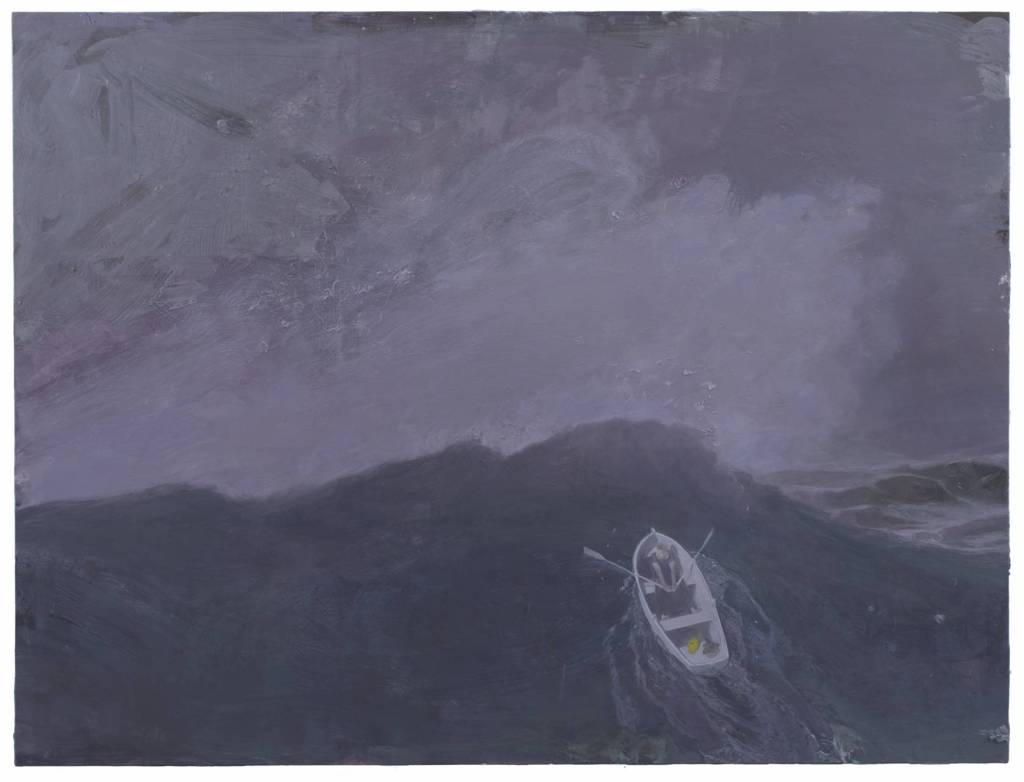
This poem was inspired by German artist Ruprecht von Kaufmann‘s piece, Die Welle.

There are things that fly

They twist and bend

Against blue sky illumined yellow

Black splattered with white

Gray interrupted by scatters of light—

Flap their wings

Or float

Like dreams

Stretching long on

Currents of wind

Winding through branches

And higher still

Playing with the stars

Before floating

Softly

Down.


There are things that stay

They cut the horizon with Always—

Mountaintops jutting high

Above valleys cradling

As seasons pass,

Children with wild hair

Wrinkle and fade

While limbs of Earth

Press toward

Eternity

Wrapping themselves

Around, holding together

The pieces that

Neither

Ascend nor

Sink.


There are things that rest

They are supple and sway

Discover stillness and move

Both in a single day—

Blades of grass yawning

Amidst beds of life,

Frogs lazy as clock towers strike

Croaking songs of love

In the dark of night,

Dogs whose paws

Chase squirrels inside dreams

Awakened

By flies frenetic

Then alighting

To sow, slowly,

Life.


There are things that fall

They rise and are pulled

Held close by the moon

Then dropped in cascades—

Swells shrouded by waves

Climbing and crashing low

Furious contrast tempered by

Mystery of falling—

Petals, eyelids, snowflakes, the sun—

Or, he whose courage inflates

Buoyant inside his soul

And on the surge

Not treading but digging

Through cold

Slicing holes in which

To plant his teardrop heart—


© Jill Szoo Wilson, 2025

Poem: Undone

One layer at a time he peeled me

Like an onion

His hands wrapped around my outer skin

From top to bottom he found my flesh

And I made him cry

Like water

Running down the side of rock

In a cascade of drops becoming

A river below

Into which we jumped

His tears breaking our fall.


One page at a time he turned me

Like a book

His hands against the leather

Bound around my story, all my words

Unspoken and broken

He read and knew and studied

Like art

Smeared across a canvas

With descriptions written below

Telling of the image

Sitting still and wanting

To be known.


One note at a time he sang me

Like a song

Released from the beak of a bird

Whose daily life is filled

With music because music is

Like emotion

Strong and loud when the air is enough

And slow and soft

When there is tenderness in the touch

A balance of adagio and

A quickening of the pulse.


One sip at a time he drank me

Like wine

Held inside a carafe

Until the day my breath met his

At the edge of a glass

And stained our mouths with red

Like a flower

Vibrant with color and life

Not pulled but watered instead

By attentive hands

That understand

Petals cut or plucked

Are already dying.


Whatever the measures by which he moves

Whatever the story he tells

Whatever the words he says or unzips

I am undone

And his.

© Jill Szoo Wilson

Block 10 in Auschwitz

By Jill Szoo Wilson

At the end of our first day in Auschwitz I, after our hour-long bus ride back to the safety of our hotel, after a nourishing dinner shared with friends, after showers and moments of silence and feeling the safety of “the group” wrap around us like a blanket that protects not from cold but fright, we spoke. We questioned. We looked into one another’s eyes for answers that no one had—in this way, there were long stretches of time, like a ticking clock, during which the windows of the souls sharing this journey reflected both confusion and comfort back and forth. Back and forth.

During a discussion in the hotel lobby on this particular night, I felt a shift in our collective journey. At the beginning of the trip, we all understood the events of the Holocaust, some in more detail than others, and we knew the basic story that unfolded under the trees and sky, and over the dirt through which we were treading. We had seen Schindler’s List, read books carefully penned by survivors, poured over documentaries and songs and poetry . . . even with our individual knowledge and experience acting as tent poles to our individual decisions to travel to this place, there was one thing we could have never fully anticipated: Auschwitz I looks like an idyllic place to be and there is something terrifying about that. The beauty of the camp is more reminiscent of a college campus neatly organized for the sharing of ideas than for the ripping apart of lives. It’s like a lake whose surface grabs hold of the sun in tiny mirrors of brilliant warmth but swarms with leeches in the darkness below. The hypocrisy that exists between the visual stimulus and the cognitive understanding begs the question: What other places look perfect but are not? Can we ever really know what lies behind windows, doors and walls?

While all the buildings in Auschwitz I that are open to the public have been renovated and turned into memorial museums dedicated to different groups of victims, aspects of the Holocaust and exhibits that make connections between the past and the present, there is one building through which we walked that had not been touched for almost 70 years: Block 10. Even as I type those words, my breath changes. There is heaviness in my chest that isn’t dropped there merely by the memories of the building itself but also by the disconcerting and shadowy questions that pressed my understanding against its walls, like thumb tacks of fear, bewilderment and the kind of silence that is erected by the words, “If you tell anyone, I will kill your family.” The public is not welcome into this building as a means of respecting the lives that were lost there. Because we were with Eva, we were given entrance into this building, much like a cemetery, and we all tripped over the invisible headstones that filled the space where air would otherwise reside. Only 10 of us were allowed to enter the building at a time.

Block 10 is the building in which physical experiments and autopsies were performed. Eva and her sister Miriam were made to walk from Birkenau to Auschwitz I several times a week, no matter what the weather, knowing the physical scrutiny that awaited them.

Before I go on, I feel the need to explain that this particular blog has been the most difficult for me to compose. I have gone through so many starts and stops in trying to describe Block 10 that the place itself is growing larger in my mind as I fight the discomfort with which writing about it has plagued me. I admit this to you, my reader, not as a means of justifying any inadequacies in my descriptions but as an admission of how the mere topic is one from which I want to run. I want to stop writing, again. Alas, I am going to lean into the discomfort and shine a light on the darkness I witnessed there.

Walking into block 10 was like walking into a crowd of spectators circled around a little girl who had fallen from the top of a Ferris-wheel to her death on a dirty carnival ground. Picture men with dirty hair who smell of body odor and rancid chewing tobacco; tarnished silver rings bearing the images of skulls; moldy mobile homes filled with dishes heavy laden with crusted leftovers, and pornographic magazines tattered with use. None of this existed inside Block 10 but the atmosphere inside the building reminded me of the transient, restless nature of a traveling carnival. It was unsettled, foul, dark, obscene—and it echoed—those of us who walked through the cavernous space instinctively grew quiet as children trying to hide from an intruder and yet, somehow, our voices reverberated more loudly here than they did anywhere else in the camp.

The windows on one side of Block 10 are all covered with boards—the side of the building that faces the Execution Wall. The Auschwitz guide explained to us that the reason for the boards was to shield the eyes of those inside the building from seeing the fate of those standing on the other side of the glass. “Shielding” in this case was not an act of protection or extending comfort, it was simply a means of trying to avoid a heightened and spontaneous sense of panic. What this implies is that the doctors inside the building exacted control over their subjects in as much as they controlled their bodies, but they could not control their minds, their imaginations. For a subject to sit still while her eyes were being propped open by two pieces of steel was to control her by insinuating that her cooperation might keep her alive inside this makeshift doctor’s office—to let her shift her focus to the blatant executions 5 feet from her gaze might relinquish her motivation for compliance altogether. These boards that once shielded the eyes of those whose bodies were being used for experiments now serve to cast an eerie shadow on rooms that would be dark in the midst of a million candles lit in memorial to the lives that were lost there.

The hallways and each of the rooms have been stripped of the tables and chairs that once held prisoners there. Emptied except for one remaining table that sat, seemingly innocently at the end of one room. This table was used to conduct autopsies. The only other specific items existing in the space was a small windowless square room, about 7×7 feet, in which there was a concrete shower and what seemed to be a broken pipe hanging from the ceiling, and there were a series of drawings on the walls in two of the rooms. The first drawing I noticed was crassly drawn in the 7×7 room. It was an illustration of a man gawking at a woman’s bare chest. The second drawing I saw was of a small cottage sitting on what seemed to be a serene field. The first drawing made me angry. The second simply confused me. I could imagine the artist of the first but I had no idea whose hand to imagine as I looked at the second. This is to say that looking at the cartoonish pornography in the small square room as I felt the heaviness of evil that still rests upon that building like a fog filled with gnats and poison, the juxtaposition of the torture and the illustrated character made me feel like vomiting. I covered my mouth and squinted my eyes and shook my head and leaned back onto one of the walls . . . until I realized I was leaning back onto one of the walls. Quickly, I jolted my body away from the wall and felt dust particles and flakes of old, dead skin clawing at my back. The person who drew this image of a woman’s bare breasts was immersed in a world of bare breasts and naked bodies that were exposed to him in one of the most vulnerable and unwilling seasons of any number of women’s doomed lives—I was seeing sexual and physical abuse in its most raw form, without actually seeing it. What’s worse is that I could feel it inside that building. Even now, as I type these words my hands shake and my body feels cold. Being this close to the bawdiness of evil is an experience I will never forget. Nor should I.

The second drawing, as I stated above, simply confused me. I didn’t have any emotion left with which to interpret it after having been so repulsed by the first. I couldn’t tell whether it was drawn by a prisoner longing for home or by the same hand that had moments before drawn the naked woman. Either way, I came to hate the drawings on the walls.

There was a period of about 5 five minutes in which I stood by myself in one of the rooms whose windows were boarded. My eyes were wide as I studied the walls, the ceiling, the floor, the lighting fixtures. I noticed there was wallpaper on one side of the room. The presence of wallpaper struck me as laughable, so I laughed. Why in the world would someone find it necessary to cover this wall with wallpaper? Who were they kidding? Why decorate a room in which human souls were being stripped of their dignity and in some cases, their breath? I considered the sinful nature of man and the ways in which we paper over our own ugliness in an effort to either hide it or to numb ourselves from feeling the shame of our own indiscretions. Using the tools of my art as an actress I looked around the room as a child patient, then as an adult patient, then as a nurse, then as a doctor. I allowed the thoughts of each to build themselves in my mind—some of them constructed themselves quickly and with a strength that forced me to close my eyes. Some of these thoughts were quiet and slow—they peaked around the corners of my mind and then slid out the sides of my consciousness like children racing down laundry shoots and into dirty piles of laundry. I was inside the environment and the environment tried to force its way inside of me. The air punched me and the ghosts cried out to me for help and, eventually, the evil of the place began to laugh at me. It was in this moment, when the crescendo of reality drummed loudly in my ears that I stopped feeling the heaviness and I stood up straight, pounded my feet as I moved to the center of the room with the boarded windows and I prayed, “Jesus, I am sorry for what happened here. On behalf of humanity gone completely awry, I am sorry. You are omniscient, omnipresent and omnipotent . . . what did it do to your heart to watch all of this happen?” This was a turning point for me. Before this moment I was asking, “God, how did you let this happen? Why did you let this happen?” I wasn’t angry with God, but the deeper I walked into the horror, into the darkness, the more I looked for the Light. The more I looked for the Light, the darker the darkness became; until I stood in the darkest place in Auschwitz. That is when I tangibly felt the weight of sin and the absolute Love of God. My heart broke for the people who stood, sat, died in that room and I realized that what the Bible says is true, “God is near the broken hearted.” His heart breaks for us.

Inside Block 10, there was no hypocrisy existing between the visual stimulus and the cognitive understanding of what I saw. It was, and remains to this day, a haunted house lined with memories that shout through the revelation of pain; floorboards that creak with dried tears; walls that are shedding their floral patterns under the pressure of shame and anger; windows that shield their eyes from the sun and have lost their ability to see.

© Jill Szoo Wilson, 2024

Jill Szoo Wilson essay about Block 10 in Auschwitz
This is the entrance to Auschwitz I.
I took this photo inside Block 10

Poem: Opposite Sides of the Wall

I wrote this poem after visiting Berlin in 2015, where I was fascinated by the messages people had left on the remains of the Wall. This piece was inspired by one of those messages.

From the highest story

Of a building gray and cracked

Peer two eyes

Through dusty window panes

Pestered by a mosquito

Flying along the edges.


Below the eyes

A hand

Holding tin

Filled with coffee

Cold and strong—

A cigarette burning.


The fog of stagnation

Fills the room

As one wisp of smoke

Links arms with another

A silent dirge

Circling like vultures.


Her gaze is blank

She closes her eyes

Then opens them wide

Each closing a respite

Followed by

Disappointment.


She sighs

She coughs

She smiles for a moment

As the mosquito

Bumps against the glass

Bruised and trapped.


Above her head

Noisy neighbors shout

The song of frustration

Rings out and falls

Pulled by gravity and

By doubt.


She begins to hum a tune

She has not heard

Since she held a doll

Inside chubby arms

And kissed its head

With sugary lips.


Her raspy alto

Lays itself on the notes

Her Now

Transposes the music

From major to

Minor keys.


The mosquito brushes past

Her hand

And then lands and

Sticks his needle

Into her skin—

She observes the transaction.


A flashing light—


Her gaze arrested

Handcuffed to a mirror

Reflecting the sun a

A Morse Code message

.-.. --- ...- .

Which translates, “Love.”


She dunks her cigarette

Into her mug

Shakes her hand

The mosquito falls

Disconcerted but

Full.


She strikes a match

Holds it to a candle

Thick and matted

Like a paint brush

Spotted with colors

Dried from previous use.


A thin line rises from the flame

Gentle in its approach

And dancing in the haze—

She lowers and raises her hand

.- .-.. .-- .- -.-- ...


“Always,”

She replies

In this expression

They devised

From opposite sides of

The wall.


She blows out the fire

Puts her hand to the glass

Closes her eyes and

Kisses the air

As though it is

The last kiss in the world.


He lifts his fingers

Catches her lips

In mid-air—

Hungrily brings them down

Pressing their sweetness hard

Against his own.


The moment has passed

But their love

Will last—

Reach beyond time and space

Breaking past

The Wall.

© Jill Szoo Wilson, 2015
I took this photo at the remains of the Berlin Wall in the Spring of 2015. I was fascinated by the quotes spray-painted on the wall.

Poem: Love and Alive

Every day he comes and goes
Like a beggar on the street,
With no way to turn
But the direction from which he came.

If the streets were carpeted—
Soft to the touch—
The tread of his soles would
Scratch holes through the path
He has
Worn.

Worn out, the man with the
Briefcase breathes heavily
Under the sun and
Under the moon,
Inhaling and
Exhaling as he travels,
Blind as he goes—
Not because he has no head,
But because he feels no pain
Or joy.
He is numb.

Numb since the day she
Walked away,
And numb when he remembers
The way
Her hips sway—
This way and that.
And numb when he
Thinks of her name but cannot
Say it—
Silent.

Silently, the bird in his soul—
The bird whose name is
Alive—
Perches at the edge of her
Cage whose name is
Life,
And wishes for the day
She might once again
Begin
To
Fly.

Flying in the air
Above the man
Is a bird whose name is
Love.
He flies up high and
Then he dips
And twirls,
Like the tail of a kite giggling
In the wind,
Awaiting the moment when
The Man
Opens his coat and
Sits on his bench
And sleeps—
Like a beggar on the street
Dreaming.

Dreaming of her face—
The only face that is
Trapped inside the Man's soul.
Love watches with a keen and
Clever eye.

In one moment—
A moment whose approach is slow,
Whose arrival is timed
By the gods,
Whose watches are synchronized
To the beating of
Bird and human hearts—
The vigilant bird
Sees
The coat fall open,
Sees
The Man sit down on his bench,
Sees
Him close his eyes and
Seizes his
Freedom.

“Freedom does not live in the sky,”
He sings.
“Freedom lives inside Alive.”

Love drifts down
Through blue and through clouds
And alights
With bars between himself and
Her—
The one who holds his
Heart
Inside of her,
Inside a cage.
The one who
Knew he would
Come.

“Come to me every day,”
She wanted to say.
But instead, she said,
“You must not waste the time
Waiting by my side,
When all the world
Sprawls before your gaze.”

Love ruffled his feathers
And looked into her eyes.
“Until you are here with
Me—
Just you and me—
I will come and sit with you
Every day.”

Every day, Love came,
Just as he said he would,
And the earth turned slowly
From summer
To autumn
To winter
To spring.

Their stories grew, and
The details they knew
Poured through the bars
Like drops of water
Flowing
From watering cans,
Growing their love,
Growing him and growing
Her.

Her days inside,
Her will to survive—
Alive and Love
Together traveled through,
Until the day
The Man stepped anew
Off his carpet of same,
Tattered and
Worn through by
His shoes—
First one and then two—
Onto a path where four
Could move:
His loafers and
Her high heels of
Blue.

Blue turned to joy,
Joy turned to alive,
And Alive for the first time
Flew.
The Man let her fly,
As his heart said
Goodbye to the
Pain that was keeping
Alive inside the cage,
Inside his
Soul.

Souls in the air,
Free with
Togetherness,
No longer bound
But soaring high,
Strengthened by
The time in the cage
And by flying
Side
By
Side.

© Jill Szoo Wilson, 2025

Poem: Ice

The moment before, he knew.
She knew it, too—but she didn’t know
What it meant.
He had spent all he had in love
And in time—
For time is all we have to spend—
Not knowing that one second would turn into
Years.

The moment before, he felt.
She felt it, too, but it was in her mind—
What it meant.
Dripping with memories, mundane,
Like coffee brewing slowly—
For love steeps one drop at a time—
Her daydreams were painted in
Love.

The moment before, he released.
She released, too, but she didn’t expect
What it meant.
Embracing and letting go, to embrace again,
Was like brushing her teeth—
For some rituals cleanse even as they return—
He knew her expectation and knew he would
Fail.

In the moment, he could smell her.
She could smell her, too—and she knew
What it meant.
He started a fire between his head
And his heart—
For the heart stokes the kindling the mind provides—
But the embers burned deeper than he
Expected.

In the moment, he could see the glow.
She could see it, too, and she knew
What it meant.
The lingering warmth of his hand on her back
Felt like ice—
For ice signals death—
The frigidity was new but not exactly
New.

In the moment, his conscience writhed.
She writhed a little, too, and she knew
What it meant.
His goodbye lingered near,
Like a rattling snake—
For snakes wait, and then they strike—
And she stiffened her heart, bracing for
The end.

The moment was gone. The seconds counted
And done.
The hem of her gown swished away;
His countenance melted
Like fire melts ice,
And ice turns to water,
And fire boils it all to steam.

The end was the beginning.
The beginning was now.
He sat on the ground.
He looked to the sky.
The moon turned out its lamp—
And he knew what it meant.

© Jill Szoo Wilson, 2025