
2026: Cultural Divides, Covenant, and Coffee

While 2025 has been marked by dramatically shifting plates under the surface of humanity, it has also been a time of growth, resilience, and gratitude.

Every morning, my husband prepares my coffee. It doesn’t matter what time I wake up, whether we share a similar schedule, or when he goes to bed after coming home late from rehearsal or a work engagement. Each morning, it is my privilege to walk into the kitchen, whose counter is fully lit with whatever sunlight the day is offering, a small gaggle of houseplants, my favorite coffee mug, and a French press cleaned and poised for boiling water.

This might seem like a little thing. But when you consider the aforementioned shifting plates, this morning routine is a respite filled with consistency and love. Little things are where life is lived.

This is the year I went back to teaching after enduring the most tumultuous four years of my life. The time between the summer of 2020 and the summer of 2024 taught me more about who I am than I had learned in the previous forty-something years. Anything good in me was a result of God’s grace, the beautiful kindness of those He placed in my life, and an enduring seed of the Word planted and watered over years of joy, hardship, victories, and defeats. In other words, I learned that I am far more limited than I once realized and far more equipped to handle the slings and arrows of this life than I deserve to be. As Paul reminds us, it is by grace that any of us go forward at all.

God’s love. God’s provision. The fruit of the Holy Spirit. These are life itself. And everything else in this life becomes mercy in His hands, through which we learn how to trust, laugh, cry, hold, and let go. This life is a journey in which we begin to recognize the absolute goodness of God and learn to look forward to the age to come.

So, teaching.

In 2025, I returned to teaching theatre and communication. I won’t write in detail about that topic here, because I’ve been writing about it quite a bit lately. What I will say is this: the best thing about teaching, for me, is that I get to sit with young people, find out who they are, how I can serve them, and where I can help them grow. Not only toward learning or career goals, but toward becoming the best version of themselves.

My entire teaching career has been one of planting seeds. I’ve never once had the same student twice. Because I’ve taught foundational courses like Introduction to Theatre, Public Speaking, Foundations of Communication, and Theatre History, I tend to see students in class during their earliest semesters and then see them in the halls for the next two to four years. It’s rare that I get to see the fruit of my own labor, but those moments do come. When they do, they are a gift. Either way, because my work has been to plant seeds, I’ve learned to quickly see how I can best serve whoever is in front of me and make the best of our time together. I count this a blessing, and a great deal of fun.

These past two years were also significant because this is when my husband and I went through the Book of Revelation in its entirety. It took us one year to read and study it, and another to sit with the implications of the revelation of Jesus for our lives yesterday, today, and forever. I have a feeling this is what I will be writing about for much of 2026. For now, I will simply say this: there is nothing more important in life than studying the Word of God, putting our faith in Him, obeying His Word, and trusting in the finished work of Christ on the cross, His resurrection, and the fulfillment of God’s covenant promises to Abraham, Isaac, and Jacob in Christ. These promises are not only future hopes. They are realities already unfolding now and finding their full completion in the age to come. Understanding that changed how I read the whole of Scripture.

God has always related to His people through covenant. From the beginning, He bound Himself to humanity with promises He alone would keep. He made a covenant with Abraham, promising blessing, land, and descendants, and declaring that through Abraham’s family all nations would be blessed. That covenant was carried forward through Isaac and Jacob and entrusted to the Jewish people, through whom God revealed His law, His faithfulness, and His name to the world. Jesus did not replace this covenant. He fulfilled it. In Him, the promises of God find their “yes.” Those who belong to Christ are grafted into this story, not as replacements, but as recipients of mercy, heirs by grace. The covenant God made with Israel is not erased by Christ, and the mercy extended to the nations does not diminish it. This covenant is not only about where history is going. It shapes how we live now, grounded in faithfulness rather than fear, held by a God who keeps His word.

This was the year I came to more fully understand the history of my own faith. Not fully, of course, but enough to give me context for God’s plan, His story of redemption, and His magnificent love. It was the year I stopped placing myself in the stories of the Bible and began to recognize, by the power of the Holy Spirit, that the entire Word of God is His story. It is filled with types and shadows of the Messiah, with good and evil, and with the absolute miracle that you or I get to be part of His story at all.

This was the year I learned, once and for all, that I need to be on His side. God is holy, and there is no possible way I can earn my way into His presence. Jesus came to this earth as the perfect sacrifice to a holy God, and it is only through Him that I can approach the Father. Through Christ, I am made clean. When God the Father sees me now, He sees His Son. There is nothing I could have done to earn His favor. Christ is the hope of glory.

This is the year I began to understand God as my Father. Because my earthly father disappeared when I was one year old, this has long been the aspect of God I struggled to trust. Not because I didn’t want to or didn’t believe He deserved my trust, but because I didn’t know how. God has been patient with me. I can now see that He has allowed certain storms in my life for a specific reason: so that I would humble myself and cry out, “Help me, Father.” There is a vulnerability only a daughter can feel and a kind of help and safety only a Father can provide. I trust my heavenly Father.

The world grew frightening this year, didn’t it? The political climate and our general sense of safety have been eroding. People are being killed for their faith. Riots fill the streets. Traditions are canceled because people are afraid to gather. Glowing screens in every household carry the noise of the world into our lives.

It is frightening.

But God.

There is a peace that surpasses all understanding, and it comes from one source alone. This year, by His will and for His glory, my resolution is to speak more about Him and to learn and teach about Him, His sacrifice on the cross, why it matters now, and why it is the only thing that will matter in the age to come.

So, 2026. Cultural divides, covenant, controversy, and coffee. What an adventure!
What My Students Taught Me This Semester

Christmas treats handed out. Goodbye hugs and handshakes extended. Grades turned in. Another semester in the books.

Moments like this remind me of what it used to feel like to drop a coin into a noisy fountain. Whatever wish I made filled my mind and hand with anticipation, with the kind of energy that moves you forward. Then came the thrust of the arm, the release, the drop, the looking through rippling water. It felt quiet. Like you had accomplished something, but wouldn’t quite know what until much later.

Where do our wishes go? Where will these students go?

Does that make sense?

This was probably my favorite semester in all my decades of teaching in higher education.

Intersections. Semesters are always intersections between me and the students, the students and one another, and the students and themselves. Who they were, who they are, and who they are becoming. But this semester felt electric, alive with points on a map charting lefts and rights, ups and downs, and ins and outs. For better and for worse.

I had students who became homeless and held on. Students who were beginning afresh and letting go. Students who started with little hope and left with direction, and others who learned quietly that school just isn’t for them. There were fights for freedom. Heated arguments about the meaning of courage, good, and knowledge. I bore witness to confusion and courage and strength and joy. Tides in an ocean of relative chaos, and ships that refused to sink.

I am so proud of my students. Every single one of them. And I am humbled by the role I have in their lives to listen, question, encourage, and challenge.

In the final summation, what I realize is that I needed them more this semester than they needed me. Or maybe it was equal. They kept me focused outside of myself, and when I wanted to despair, they met me with laughter, frivolity, complexity, and routine.

This is life. Our classrooms are microcosms of the wider world, and when we can love, negotiate disagreement, have difficult conversations, and still extend hugs and handshakes at the end, we have taken part in some of the most rewarding work this life offers.

I’ll leave you with some of the results from one of our more contentious Socratic question roundtables this semester, What Is Courage:

“Courage is the willingness to make a full, genuine attempt at overcoming an obstacle that presents a physical and/or mental danger.” —B

“The full attempt to overcome a physical and/or mental obstacle with perceived risk.” —A

“An action. Choosing to face an obstacle that presents risk in spite of those risks.” —P

“An act or mentality that allows or enables someone to overcome an obstacle despite the chance of danger or other unfavorable outcomes.” —D

“The mental and moral strength to act despite fear and danger.” —T

“Courage is doing something even when you feel afraid.” —C

“Courage is the act doing something even when you feel fear/danger/risk/ obstacle, whether is physically or mentally challenging  even when it costs you something, and even when no one is watching.” —S

“Courage is bearing up under the weight of outward and/or inward threat for the purpose of becoming who you need to be for yourself and others. All for the glory of God.” —J

“I’m not sure, but I know it’s something we do for the greater good or else it’s just self-confidence.” —L

What do you say courage is?

The Courage to Be Seen Thinking: Speaking Through Fear

By Jill Szoo Wilson

“You gain strength, courage, and confidence by every experience in which you really stop to look fear in the face.”— Eleanor Roosevelt

I teach communication courses. Public Speaking is my mainstay. I also teach theatre, but communication has taken the front seat in my heart because I can see—clearly, daily—that the younger generation longs to become confident and competent in their ability to connect with other people. It isn’t a weakness in them, as many older adults like to say. It’s a weakness in us if we don’t equip them now to adapt their unique voices to their audiences.

My generation shared this desire when I was in school, but the landscape has changed since then. We lacked information; this generation is drowning in it. Growing up, our question was “What should I say?” Theirs is closer to “Who will hear me?” They are not unsure of what to speak about as much as they are unsure whether anyone is listening in a world where voices collide, compete, and vanish into the noise.

Yesterday, as this semester wraps up, I asked my class, “Has public speaking gotten easier for you?” I fully expected the usual yes. For a couple of decades, I’ve almost always heard that answer. But this time, about 80 percent said yes, and the other 20 percent said they are more terrified than ever.

I stopped everything and asked them why.

When a student feels afraid, I take it seriously. I feel a brief window of responsibility to help them leave stronger than they arrived, so they do not carry unnecessary fear into the rest of their lives.

One student said, “I felt fine on my first speech. But then I had to miss one, and on the next speech, I felt like I was behind. My chest tightened. I felt like I needed to escape—run out the door—but I knew I couldn’t. So I felt trapped. Feeling trapped, my fear grew and soon it was like I couldn’t see anymore. It’s like my mind escaped the room, but my body had to stay here.”

What a remarkable way to describe panic:
“It’s like my mind escaped the room, but my body had to stay here.”

I won’t unpack the whole conversation we had afterward, but I share this because it highlights how essential it is to equip young people with the communication tools necessary not just to present information, but to remain present within themselves when they feel afraid. Even though these students know each other well by now, even though there’s camaraderie and safety (even in disagreement), they still confessed thoughts like:

Do I sound stupid?
Are they judging me?
What if I fail?
What if I’m not good enough?
Why didn’t I rehearse more? Now it’s too late. I’m going to crash out.
I want to disappear.

So I told them that if they remember anything from this entire semester, please let it be this:

  1. There are always a hundred things happening at once in any moment. That’s life. It’s okay. You can’t control that part.
  2. What you can control is your preparation and your focus—look outward to the audience you’re giving something to, not inward toward fear.
  3. Adapt your message to your audience (using recency, locality, psychology, physiology, and economic factors), and speak from the heart as though you’re giving, not taking.

Fear lasts because communication touches identity. No teacher can remove that for another person; we can only help them learn how to stand in it.

Speaking always involves two kinds of work: thinking and being seen. When a student puts their ideas into words, they’re not only organizing their thoughts; they’re placing those thoughts into a space where others can evaluate them. That movement from inner reasoning to public expression activates the body just as powerfully as the mind. The student feels exposed because, in a very real sense, they are. Communication invites others to witness our thinking, and the body responds as though it must protect what has just been revealed. In this light, courage is not the absence of fear in communication, but the willingness to let one’s thinking be visible while learning to stay present in that exposure.

[C]ourage is not the absence of fear in communication, but the willingness to let one’s thinking be visible while learning to stay present in that exposure.

Neuroscientist Joseph LeDoux demonstrated that the brain processes emotional threat more rapidly than conscious reasoning, producing instinctive reactions before the mind has time to interpret them (The Emotional Brain, 1996). When speaking, that instinct narrows attention and draws awareness inward. The student’s focus moves away from the audience and toward the self: What are they thinking of me saying this? In that moment, communication shifts from sharing ideas to guarding the identity that feels exposed. The body prepares to protect the thinker, even while the thinker is trying to speak.

To teach how to communicate through fear, then, is not simply to teach speaking. It’s to teach attention. Communication is an outward-facing act in which meaning is co-created between speaker and audience. The student is not performing for a passive group but participating in a shared moment of understanding. When fear sends the mind fleeing—“escaping the room while the body stays behind”—the pedagogical work is to help students return to that shared moment. This does not mean suppressing their anxiety, but retraining where they place their awareness. Instead of monitoring their own performance, they learn to notice the listeners they are addressing: how the audience responds, where clarity is needed, and where curiosity sparks. They begin to read the cues that help them stay present, such as facial expressions, body posture or stillness, eye contact, moments of confusion, or quiet signs of interest like leaning forward, nodding, or attentive silence. Attention becomes the bridge that allows the speaker to stay present long enough for communication to take shape.

You may wonder, Isn’t it scarier to notice the people in front of you? I would respond with another question: Isn’t it far more frightening to stand in front of others while constantly critiquing yourself in your own mind? When students shift their attention outward, they no longer face the audience alone. They begin to share the work of understanding with the people who are listening.

Educational theorist Parker Palmer writes that “we fear the live encounter” when speaking because we are culturally conditioned to treat knowledge as a possession to defend rather than a shared activity (The Courage to Teach, 1998). Many students come to communication believing that they must display what they know and protect it from critique. In that mindset, speaking becomes an act of performance: their ideas become something like personal property on a stage, vulnerable to judgment. Fear grows because the task feels like self-presentation rather than shared exploration. The speaker begins working to preserve an image—trying not to be wrong, trying not to be misunderstood—rather than working to illuminate a topic with others. Under this frame, communication is effort spent guarding the self rather than engaging with the subject or the audience.

Instead of treating knowledge as something we defend, we can help students see it as something we share.

A helpful metaphor I offer my students is to treat ideas like campfires. When students speak, they are tending a thought long enough for others to gather around it. The speaker’s work is to make that flame visible and to offer enough clarity for others to see by its light. The heat belongs to the concept, not to the student’s identity. Fear grows when a student imagines they themselves are being scrutinized or judged, as though they must withstand the fire. But when they learn to host others at the fire of an idea, the pressure shifts. They do not perform; they invite. Their task becomes to let the thought burn clearly enough for others to explore what its light reveals.

Hosting others at the fire of an idea becomes an act of generosity. Instead of guarding an idea to protect themselves, students learn to offer it for the sake of shared understanding. In this posture, ideas become contributions rather than possessions to defend. The goal moves toward clarity, shared reasoning, and insight that others can carry beyond the moment of speaking. The speaker intends to give something away: a perspective, a question, or an interpretation that helps others think more carefully.

This change in intention helps reshape the student’s internal experience. The audience is no longer a threat to self-image, but a group of learners who can benefit from the speaker’s effort. Fear loosens not because it vanishes, but because it now serves a different purpose. Anxiety becomes a form of care: a signal that the message matters. Instead of trying to perform without fault, the speaker begins to engage in the work of making ideas accessible to others by choosing clearer examples, inviting shared reasoning, and adjusting pace and language. The focus shifts from How do I look? to What might help them see this?

Such reframing is supported by Kenneth Burke’s foundational view of rhetoric as “the use of language as a symbolic means of inducing cooperation in beings that by nature respond to symbols” (A Rhetoric of Motives, 1950). Burke’s definition shifts attention away from persuasion as winning agreement and toward communication as building shared understanding. He calls humans “beings that respond to symbols” because we think, interpret, and act through language. Words, therefore, do more than convey information. They invite people into a coordinated way of seeing. In this light, communication becomes cooperative work. As students begin to see their speeches as something they give rather than something by which they are measured, their attention turns toward building that shared understanding. Fear becomes manageable because their purpose becomes relational, and their speech becomes purposeful because it serves a common effort.

Anxiety, then, becomes not an obstacle but a cue that communication matters. It invites awareness rather than avoidance. As Susan Cain observes, “Fear is not a flaw; it’s a sign that something is worth doing” (Quiet, 2012). In a pedagogical context, this insight reveals fear as evidence of engagement, a marker that students are entering meaningful communicative work.

When communication is taught as outward-facing rather than defensive, students learn more than technique. They develop ethical habits of attentiveness, which are central to higher education and essential to public life. In an era marked by rapid exchange, polarized discourse, and performative speech, the capacity to direct attention outward becomes an act of civic responsibility. It equips students not merely to express themselves, but to interpret contexts, consider audiences, and contribute to understanding within complex communities.

Higher education, viewed through this lens, is not simply preparing speakers. It is cultivating citizens capable of relational inquiry. To help students remain present while speaking, to keep their “mind in the room” when fear urges retreat, is to equip them for the intellectual and ethical demands of adult life. They learn to see communication not as self-display but as participation in the shared labor of meaning-making.

This reframing transforms fear from a barrier into a catalyst. Students do not conquer visibility; they inhabit it. They learn to speak with others rather than at them and to stay present in the encounter rather than disappear into self-consciousness. In doing so, they acquire a communicative stance that extends well beyond the classroom, a stance defined not by performance but by presence.

When a student says, “It feels like my mind escaped the room,” communication education becomes a way of helping them return. We can teach them to stay present with others and to participate in meaning-making even when visibility feels risky. The work of public speaking becomes ongoing preparation for shared life: learning to offer ideas with clarity, to attend to others with care, and to keep the mind in the room where understanding can grow. This practice shapes how we show up in the world, cultivating attentiveness, generosity, and a readiness to learn in community with others.

Jill Szoo Wilson is an educator, speaker, and writer who teaches communication and theatre at the college level. Her writing explores the ethical and relational possibilities of speech in public life.


Further Reading

Burke, Kenneth. A Rhetoric of Motives. University of California Press, 1969.
Cain, Susan. Quiet: The Power of Introverts in a World That Can’t Stop Talking. Crown, 2012.
LeDoux, Joseph. The Emotional Brain. Simon & Schuster, 1996.
Palmer, Parker J. The Courage to Teach. Jossey-Bass, 1998.
Rosenberg, Marshall. Nonviolent Communication. PuddleDancer Press, 2003.
Tannen, Deborah. The Argument Culture. Ballantine, 1999.

Poem: Unencumbered

She collected recollections

From the past

As though they were

Trinkets from a shop

Where antiques—

Roughly used and rusting—

Lay waiting,

Lay trusting

Their time would come again.


Again yesterday came

But with a different name

“Today”

So she sat with her

Treasures

Stoic and measured

With a grip not to lose

For if she loosened her hold

They may drip away.


Away from the darkness

Of her previous losses

She looked toward the light

Lost her sight

At the brilliance it held

Shuttered with fear

Melted with doubt

Stifled her silent shout

With a thought.


The thought

A question

Singed with intention

Smoking

Like the barrel of a gun

Prompting her

To run

Instead of stay—

But she stayed.


Stayed in the place

Where she planted the seeds

Grass to grow

To overthrow

The things it seemed

She could not let go

Like a patient

Patiently awaiting

Death.


Death that rides

On the back of loss

That stabs at the fear

Of drawing near

“Don’t move from here”

She whispered out loud

And hoped the desire to move

Would evaporate

Like a cloud.


Clouds of then

Filled the present

A fog in this room

Invaded by the presence

Of shadows—

Not men—

Only places

They may have been

Had they stayed.


Staying threatened her breath

As the air turned white

The longing for safety

Compromised

By this encroaching night

The fear of losing

Being lost from her sight

As a struggle to gain

Awoke to the fight.


Fighting for air

She stood to her feet

Considered her options:

Victory / Defeat—

Destruction seemed easy

To fail is so clean

Triumph unknown

Invites mystery:

Shrapnel of

The unforeseen.


Unforeseen was the way

Mighty was the day

When the roots that held

Were cut away

When her voice

Unvoiced

Found the breath to say,

“Tomorrow

is where my future—

unencumbered—

lay.”

© Jill Szoo Wilson, 2025

Eva Mozes Kor and the Price of Forgiveness

By Jill Szoo Wilson

Eva Mozes Kor often said, “Anger is a seed for war, forgiveness is a seed for peace.” It was more than a slogan. It was a theology, a philosophy, and a daily discipline forged from one of the darkest chapters in human history. As a child imprisoned in Auschwitz and subjected to the medical experiments of Josef Mengele, Eva discovered that survival demanded a defiant hope. Decades later, she chose forgiveness as a form of liberation that offered survivors a path toward healing. Her decision inspired admiration and deep respect, and it also sparked fierce debate about justice, memory, and the boundaries of human compassion. The peace she pursued required extraordinary courage, because every step forward in forgiveness carried a cost.

I recently revisited one of Eva’s emails, a message filled with the kind of raw honesty that few people ever achieve. It was written in her unmistakable, unpolished style: urgent, passionate, and deeply personal. In it, she reflected on the consequences of her decision to forgive a former Nazi doctor, Dr. Hans Münch, and the relentless challenges she faced in opening CANDLES Holocaust Museum.

Reading it now, years after her passing, I am struck by how unyielding she was in the face of criticism, injustice, and personal danger. She did not simply speak about forgiveness. She lived it, even when it cost her dearly.

The Controversy Over Forgiving a Nazi

In 1995, on the 50th anniversary of the liberation of Auschwitz, Eva Mozes Kor did something unthinkable to many: she publicly forgave the Nazis. More than that, she stood beside Dr. Hans Münch, a former SS doctor at Auschwitz, and signed a declaration of forgiveness.

The backlash was immediate and fierce.

Israeli media framed the moment as a betrayal. Footage of Eva walking with Münch was broadcast again and again, without the context behind it.

A major Israeli newspaper published a scathing article, questioning whether any publicity was better than being ignored entirely.

In 1998, journalist Bruno Schirra published an interview with Münch in Der Spiegel, where the former SS doctor made remarks about his time in Auschwitz. The interview triggered a criminal investigation in Germany.

Around the same time, a French radio interview with Münch led to an even more explosive controversy. His derogatory remarks about Roma and Sinti people resulted in criminal charges in France for inciting racial hatred.

The consequences were devastating.

Münch and his family faced public scrutiny, threats, and harassment. In Germany, legal action pushed toward trial despite his diagnosis of Alzheimer’s disease.

In a personal email to me, Eva shared that Münch’s home was firebombed three times after his address was published in an article, requiring police protection for his family. I have not been able to verify this in any public record or independent source. It was her own account, offered behind the scenes, reflecting the weight she felt over what was happening to Münch and his loved ones.

Eva was horrified by what was unfolding. She had spent years advocating for justice. Now, she found herself advocating for mercy.

She sent more than 50 letters pleading with authorities to drop the lawsuits against Münch, but the legal proceedings continued.

In 2001, Münch was convicted in France. His sentence was waived due to his age and deteriorating mental state. He passed away later that year.

Eva felt a complicated kind of relief. Münch’s family was finally free from further attacks, and she no longer carried the guilt of contributing to their suffering.

The Fight to Build CANDLES Holocaust Museum

By 1995, Eva Mozes Kor had already reinvented herself many times: Holocaust survivor, public speaker, and founder of CANDLES (Children of Auschwitz Nazi Deadly Lab Experiments Survivors) in 1984. That year, she took on yet another role as a museum founder.

The CANDLES Holocaust Museum and Education Center was an extension of Eva’s mission to teach others about the Holocaust and the experiments performed on her and other Mengele Twins. She wanted to create a permanent place of education, remembrance, and dialogue.

Opening the museum was no small feat.

She found a commercial building in Terre Haute, Indiana, but it was too large and too expensive for the original client she was working with as a realtor. Instead, she made a bold and risky decision to secure financing under her own name, her husband’s name, and a partner’s name to purchase the building herself.

At 61 years old, she signed a $168,000 mortgage, despite her husband’s hesitation.

With limited funds for exhibits, she handmade decorations, including a wall of blue paper strips that read:

“LET US REMOVE ALL HATRED AND PREJUDICE IN THE WORLD, AND LET IT BEGIN WITH ME!”

When the museum opened on April 30, 1995, it quickly became a vital educational resource, drawing teachers, students, and community members eager to learn from Eva’s story.

Then everything changed after 9/11.

Her business partner, who owned a travel agency, struggled to keep her business afloat. The economic downturn was crushing. Eva was forced to buy out her partner’s share of the building at a much higher price, not to expand but simply to save the museum.

By 2002, at age 68, she and her husband took out a $222,000 mortgage to keep CANDLES alive.

The Fire That Could Not Destroy Her Mission

In November 2003, Eva Mozes Kor received a phone call in the middle of the night.

“Mrs. Kor, this is the police department. You need to come to the museum. There is a fire.”

She and her husband rushed to the scene. By the time they arrived, flames were already devouring the building. Firefighters battled the blaze, but it was too late. Everything inside was lost: photographs, historical documents, survivor testimonies, and artifacts.

She stood there watching as the place she had built with her own hands, her own money, and her own pain collapsed into smoldering rubble.

Investigators then found a message spray-painted on an exterior wall in black:

“REMEMBER TIMMY MCVEIGH.”

Timothy McVeigh, the domestic terrorist behind the 1995 Oklahoma City bombing, had been executed in Terre Haute just two years earlier. The implication was chilling. This was an act of hatred and intimidation meant to silence her.

But Eva had spent her entire life surviving the worst of humanity.

The next morning, standing in front of the ashes, she made a decision.

“We will rebuild.”

And she did.

With support from the community, from Holocaust educators, and from donors around the world, CANDLES Holocaust Museum rose from the ruins and reopened in 2005, stronger than before.

You can burn down a building. You cannot destroy a mission.

The Legacy of a Fighter

Most people would have stopped. Most would have looked at the destruction of their museum as a sign to walk away.

But Eva rebuilt.

The email she sent me that recounted this event, full of spelling errors, fragmented sentences, and scattered thoughts, perfectly reflected who she was:

Unpolished, yet utterly real.
Wounded, yet relentless.
Misunderstood, yet unwilling to back down.

Eva Mozes Kor understood something most people do not. Forgiveness does not rewrite the past. It does not fix what was broken. But it allows a person to stop carrying what cannot be undone.

She was never naive. She knew the world was cruel, unjust, indifferent.

She fought anyway.

She did not stop.

What This Means for Us

Eva’s story is not only about forgiveness. It is about resilience in the face of resistance. It is about choosing to build when the world wants to destroy.

Her words still challenge me.

Could I have made the same choices? Would I have kept going? Would I have had the courage to stand alone?

Perhaps that is the lesson she left for us.

Forgiveness is a gift. The fight for something bigger than yourself is what makes history.

© Jill Szoo Wilson, 2025

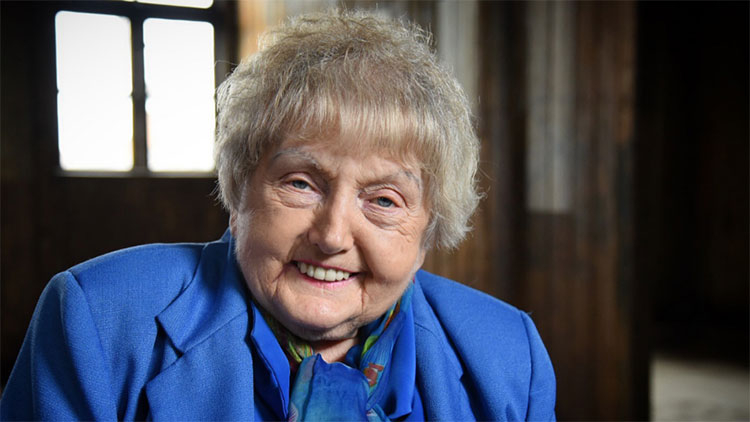
Featured Image photo credit: WFYI Indianapolis, 2021

Sonnet: The Tongue of Peace

What once was whole is splitting at the seam,
With roaring tongues that never find a word.
Each stands alone, entranced by their own dream,
While fear doth arm the gates with aim absurd.

The bridge between us withers into dust,
A chasm wide where voices fade to air.
Yet in our hearts still burns this ancient trust—
The longing for a hand extending ear.

But how to reach when dread hath drawn the line?
When walls are built of pride and weary doubt?
We stand as statues, yearning for a sign,
Yet know not how to call the silence out.

O break the curse—let all division cease,
For love still speaks the only tongue of peace.

© Jill Szoo Wilson, 2025

Read more by Jill Szoo Wilson on Substack.

Eva Mozes Kor, the Scheisskommando, and the Cost of One More Day

From 2013 to 2017, I traveled with Holocaust survivor and Mengele Twin Eva Mozes Kor, following her story across Poland, Hungary, and Romania. I wanted to learn, not just from her words, but from the places themselves. I walked the dirt roads where she grew up in Romania, stood on the concrete where her family waited to be shoved into cattle cars in Șimleu Silvaniei, and pressed my hand against the cold stone of Block 10 in Auschwitz, where Dr. Mengele once looked down at her and said, “It’s a shame she’s so young. She only has a couple weeks to live.”

Eva never told me what to think. She never tied things up neatly. She only asked me to look, to listen, to understand: survival, real survival, was never just about strength. It was in the details. The ability to step over a dead body and keep moving, because stopping meant risking your own. The skill of slipping a potato from the commissary without getting caught. The discipline to dissociate, not from the rats that scurried over her at night, but from the fear of them, because sleep was necessary, and fear could not be allowed to strip her of the strength sleep afforded her.

It’s easy to imagine survival as something straightforward, a matter of strength or willpower. But in Auschwitz, survival was a negotiation, a constant weighing of the impossible.

“What would you do to survive? You can’t really know until your life is actually in danger. It was easy to die here. Survival took every ounce of strength you could muster.”

Standing in the humid summer breeze at Auschwitz-Birkenau, I contemplated Eva Kor’s words.

It is easy to die. It is difficult to live. Life is fragile. We come from the dust and to the dust we return. Beginnings and endings are consistently marked by celebration, comedy, tragedy, and pathos. Middles are different. The middle of a thing is where the human spirit grows. Middles churn with questions, collide with conflicting purposes, strain toward progress, and wrestle with the weight of stagnation.

Birkenau was an epicenter where middles and endings met. Survival was not simply a contest won by the fittest. It was a succession of choices; choices that rang in the soul of each individual, like the sound of a train dragging its way through the countryside on tracks of steel. Some survived by cultivating their minds to be like the birds that flew above the blood and mire. Some survived by making themselves useful. Some survived by climbing into a trough of human waste to escape the eye of the enemy. Because even here, in filth, there was something worth grasping, something worth staying alive for.

Latrines: A Place of Filth and Refuge

The Nazis allowed prisoners two visits to the latrines per day, one in the morning, one in the evening. That was it. The rest of the time, men, women, and children had to relieve themselves wherever they stood. The ground they walked on bore witness to their labor, their suffering, and the last remnants of their dignity.

The air of Birkenau was thick with an unholy stench: human waste, rancid sweat, the sharp tang of blood, and the sickly-sweet rot of decay. It clung to the skin, crawled into the lungs, and settled deep in the gut like a living thing, an inescapable reminder that suffering here had a scent. And with every breath, sickness followed. Dysentery oozed through the camp, rotting stomachs from the inside out, turning each bite of watery broth into a calculated risk, each swallow a step closer to collapse.

And yet, there was an odd paradox: working in the latrines was considered one of the best jobs in the camp.

Imagine a world where standing in human waste meant protection. In Auschwitz, it did.

The Paradox of the Latrine Workers

The latrines were a guard-free zone. And so, in this rancid, airless place, there was something invaluable: privacy.

For those assigned to the latrines, the absence of guards offered a rare and fragile freedom. In the stench and shadows, prisoners bartered stolen scraps, exchanged whispered news, and conspired in low voices. Some sought fleeting moments of physical intimacy, an urgent defiance against a world that had stripped them of choice. In a place built to erase them, the latrines became one of the few spaces where prisoners could still claim their own existence.

Here, in the thick of filth, they remembered they were still human.

The Work of the Scheisskommando

Their job was simple: lift the heavy concrete slabs covering the waste pits, lower themselves inside, and scoop out the accumulated filth.

If you’ve ever gagged while cleaning out your refrigerator after leaving leftovers for too long, imagine standing waist-deep in a sea of decay. The air was thick, humid, and alive with flies. The stench coated everything, clinging to their skin and settling into the creases of their clothes like an unshakable second skin.

But for those who had this job, it was a lifeline. They weren’t being worked to death in the fields. They weren’t being lined up for random executions. They weren’t subjected to the relentless gaze of the SS officers who delighted in tormenting prisoners for sport.

The latrines, for all their horrors, offered something rare in Auschwitz: predictability.

A Dignity That Refused to Die

Powerlessness is a disease that seeps into the soul. Strip away respect, dignity, and basic rights, and two things happen: the perpetrator swells with power, and the victim shrinks.

Allowing prisoners to stand ankle-deep in their own filth was not just a byproduct of poor sanitation, it was an act of control. The SS guards didn’t have to lift their legs and urinate on the prisoners to show their dominance. They merely had to stand still while the prisoners did it to themselves.

But in the darkest places, even where dignity was supposed to die, the will to live persisted. The latrine workers of Auschwitz-Birkenau found ways to carve out a space for themselves, to steal back fragments of their humanity, to keep moving forward when everything around them said they should fall.

Consider if you will, a woman falling from the sky into the deep ocean. She is surrounded by foreign creatures, disoriented by the sounds and weight of the water. She is not a fish. She has no gills. The water is her enemy. It presses on her lungs, reminding her with each second that this place does not belong to her.

She has a choice. She can panic and sink, or she can swim.

This is the paradox of survival. This is the choice of the Scheisskommando.

The Final Question

Eva Mozes Kor once asked a group of people this question as we stood inside a latrine at Birkenau:

“How many of you could survive here? What would you do to survive?”

Survival in the death camps was never about dignity. The prisoners carried that within them, untouchable even in the face of brutality. What was at stake was something else entirely. Life in exchange for one more day. Hopelessness held at bay for a sliver of hope. The certainty of an ending deferred, just long enough to stay in the middle a little longer.

We like to think we know ourselves. That in the face of unspeakable horror, we would know what to do. That we would have a plan. A way to resist. A way to bring order to chaos.

But the truth is, we don’t know.

We can’t know.

Not until we’re the ones at the edge of the pit, staring into the void.

Not until survival is no longer a question, but the only thing left.

© Jill Szoo Wilson, 2025