Poem: The Thousand Deaths of Canton

Canton died on Monday

And then again on Friday

And in between

A thousand other deaths

All in a row—

His breathing shallow,

His passion stretched wide

Like a well dug for water supply

Now a brimming

Hole.


Canton’s misery has a name—

A she as you may have guessed

With brownish hair and

Bluish eyes

Anchored to her soul,

Her voice sounds

Like frogs chanting

In the night,

A melody Canton

Extols.


Her name is Sienna

Like the color artist’s mix

When simple red

Promises nothing of

Complexity

In its parts—

But complexity

Is the only way

To convey the

Whole.


She walked into his life—

No, she swam instead

Like a pirate

Fallen out of a ship

Whose pockets were filled,

Whose lungs nearing empty

Needed Canton’s

Breath to make it

To the shore with no

Patrol.


Canton wrapped his arms

Around her belted waist

He pulled her body

Wet with salted

Memories

To a warm and sunny

Place where

Resuscitating Sienna

Became his starring

Role.


He breathed his life

Into her lungs,

Sienna’s breast inflated

Like a blowfish

Reacting to her fear

Desperately wanting

His protection—

No, that’s not right—

His affection wrapped up in his

Soul.


Canton died when Sienna

Slept—

The world collapsed

With her unconsciousness

As though slumber

Was a distance too far to

Bare,

Not even the moon

Could console his emptied

Control.


He died when she blinked,

He could not withstand the dark

Her eyelids commanded—

Like a conductor

Setting the rhythm of

His pain and

One and two and three and

Four—

The music behind her open eyes, Canton’s

Parole.


Canton and Sienna

Clasped their fingers together

Like two pirates searching for love

Crossing a windy expanse—

They cried and laughed

And died and lived

Along the way

Two shipwrecked halves navigating

Toward one mysterious

Shoal.

© Jill Szoo Wilson, 2025

Poem: Consolation

He called her a corpse

Deflated her air

Rolled her body up

From her toes to her hair

And sat on her skin

Until her spirit

Became thin

A sweet smelling puff

Escaped her lips—


“I’m still alive”

Was

All

She said.


She lay on the earth

Drawn-on with dirt

The muscles in his arms

Dug deep beside

The crumpled she

He struggled to hide

He needed a hole

As deep as it was

Wide.


His sinews tore

His ligaments bore

The weight of

Moisture soaked mud

Sweat poured from his face

A frenetic pace

Fighting against the hole

In the ground and inside

His soul.


His arms fell to his sides—

Steel and wood

Now a finger

On his hand

An extension

A plan—

One last

Connection to she

Awake in the grave.


One inhale—

Peace

One exhale—

Release

One inhale—

Regret

One exhale—

Cold sweat

And his future stared.


He could not go back

Ahead was a trap—

Brightly lit

The way

Was clear

But illumination

Is not

The same as

Consolation.


He sat in his safety

Buoyant

Afloat

Stillness

Stagnation

Narration calling,

“I’m still alive”

Her apparition

His aberration.


Wires exposed

The path that he chose

Storm clouds above

Drowning out love

No finish to the start

Interrupted heart

No dreams to know

No nightmares bestowed

She leapt from the tomb

Alive—

© Jill Szoo Wilson, 2025
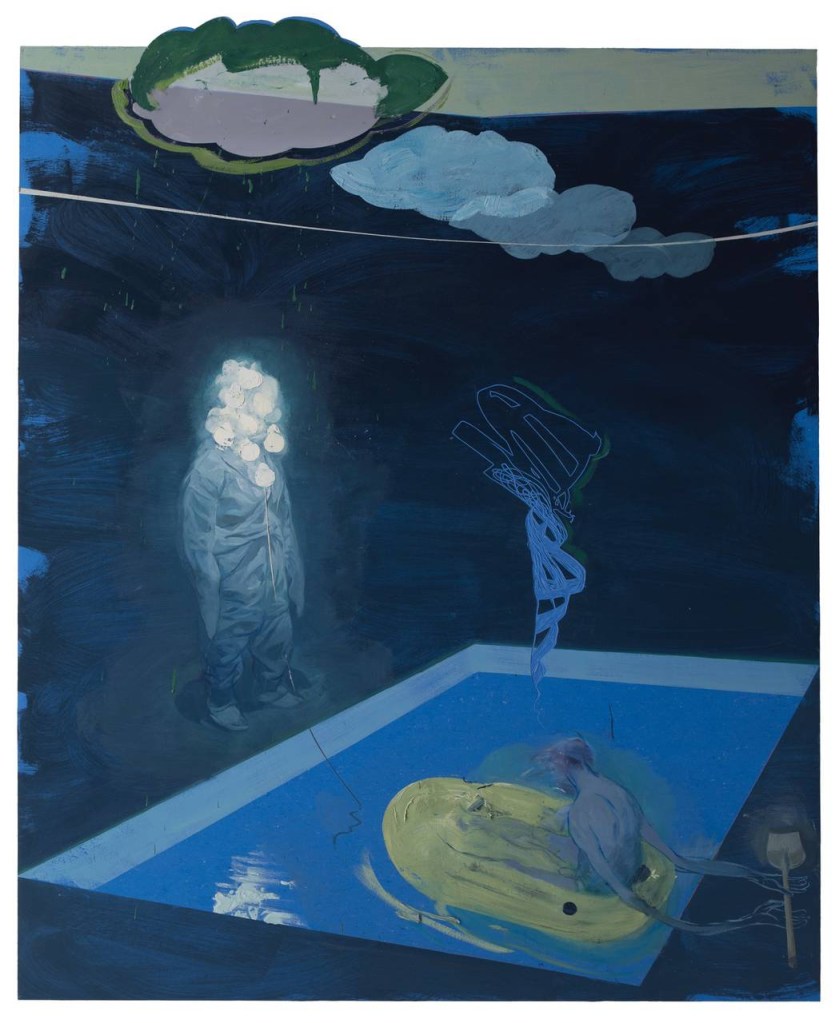
German artist Ruprecht von Kaufmann‘s piece “Irrlicht.”  http://rvonkaufmann.com/home/

Poem: The Curve of Time

You might as well befriend the moon–
embrace her clouded peekaboos.
And music . . .

Receive the tune–
you have no time to choose–
alone in a crowd or
with no one in view.
And a smell . . .

Wafts past your nose–
what's that?
Or who?

Perfume on skin or a place that you knew?
Pause.
No need to wonder—you know who that was—
and who you are
as nostalgia winds the second hand 'round.

"Time is a straight line," said he
"It moves consecutively,
watches as it goes
behind and below
like walking on a path
that winds into—
well—
no one knows."

"No one knows,
that's right," said she.
"Simply put, I do agree.
But there's no line to speak of.
Time bends–not like a knee–
more like a finger touching its thumb
or a rainbow finding it's spherical end
and celebrating with a gentle, 'Come.'"

Time returns to the places we've been.
One says, "That memory is far."
Another, "The moment is here to stay."
Yesterday can be put down
but the nows of that day
pop up from the ground
without notice
or sound
to delight or confound–
it depends on the soiled seconds
into which it was bound–
moments become recollections and
recollections are seeds
with a life of their own.

Promises and hope
gentleness and rage
a touch, a glance
a well-appointed room
or a half-written page–
all are sown into our skin
and find their rest in
smiles and tears
repose and toil
love and loss
freedom and cost
and the way the sunlight lay across
the earth at the end or
when it all began.

"That was back then," said he.
"That is today," said she.
The Minutes listened closely,
"There is wisdom in both."
Time smiled wryly
crouched smugly and quietly
behind an Autumn tree
waiting for the final leaf to fall.

© Jill Szoo Wilson, 2025
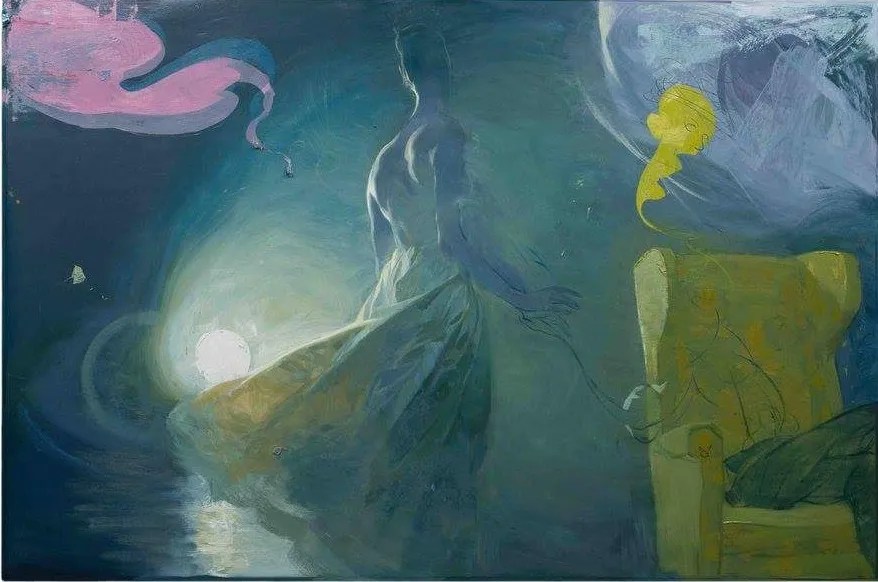
Berührungspunkt (c) 2016 Ruprecht von Kaufmann (oil on linoleum) – Courtesy Galerie Crone

Sonnet: The Final Chamber

In all your quiet ways my spirit wakes,
Like dawn that steals through shutters, soft and slow.
Oft have I wondered how your presence makes
Veil’d parts of me take courage yet to grow.

Each day my hushed and inward-seeking mind
Yields when your voice through shaded mem'ry moves.
O’er every folded fear your light I find,
Undoing shadows with the truth it proves.

You are the innermost of all my days,
The final form within my layered soul.
No ornament, nor craft of human praise,
Could name the warmth by which you make me whole.

So stand I now, my guarded heart undone,
For in your gaze a thousand worlds are one.

© Jill Szoo Wilson, 2025

Poem: Unencumbered

She collected recollections

From the past

As though they were

Trinkets from a shop

Where antiques—

Roughly used and rusting—

Lay waiting,

Lay trusting

Their time would come again.


Again yesterday came

But with a different name

“Today”

So she sat with her

Treasures

Stoic and measured

With a grip not to lose

For if she loosened her hold

They may drip away.


Away from the darkness

Of her previous losses

She looked toward the light

Lost her sight

At the brilliance it held

Shuttered with fear

Melted with doubt

Stifled her silent shout

With a thought.


The thought

A question

Singed with intention

Smoking

Like the barrel of a gun

Prompting her

To run

Instead of stay—

But she stayed.


Stayed in the place

Where she planted the seeds

Grass to grow

To overthrow

The things it seemed

She could not let go

Like a patient

Patiently awaiting

Death.


Death that rides

On the back of loss

That stabs at the fear

Of drawing near

“Don’t move from here”

She whispered out loud

And hoped the desire to move

Would evaporate

Like a cloud.


Clouds of then

Filled the present

A fog in this room

Invaded by the presence

Of shadows—

Not men—

Only places

They may have been

Had they stayed.


Staying threatened her breath

As the air turned white

The longing for safety

Compromised

By this encroaching night

The fear of losing

Being lost from her sight

As a struggle to gain

Awoke to the fight.


Fighting for air

She stood to her feet

Considered her options:

Victory / Defeat—

Destruction seemed easy

To fail is so clean

Triumph unknown

Invites mystery:

Shrapnel of

The unforeseen.


Unforeseen was the way

Mighty was the day

When the roots that held

Were cut away

When her voice

Unvoiced

Found the breath to say,

“Tomorrow

is where my future—

unencumbered—

lay.”

© Jill Szoo Wilson, 2025

Poem: Beautiful/Lies

I will tell you what to see—

Everything but me—

A variety:

First, the shape my lips take

When I smile

Then, only aspects of my style—

The ones that deceive the senses

Lower your defenses

Make you wonder

Confidence thrown asunder.

A breeze

Whizzing by your certainty

A tornado—

Or a reverie—

Where the facts

Are art-i-facts

Designed to twist

To burrow in your mind

Then to grow

Into trees of truth

Where flowers of falsified youth

And branches that carry the load

Explode into blossoms and

Inspire.


Time evaporates into years

My collection has piled

Your recollection defiled

Melted

Reshaped

Into unknown

Unsuspected, unsuspecting

Wisdom flown

From your mind

And into my hands

Like clay

Shaped, reshaped

The size of the holes

On either side of your nose

Where what you see

Is only dreams—

The ones I dare to

Echo

Deflected from the truth

Reflected onto the marquee

Like a refugee memory

No longer sure

Which way

Is home.


I will choose the color,

You will trust my hand

Not because your will is irrelevant

Only because

You cannot understand—

And—

You trust

The choices

I make

Wait for the plans

The paths

That I take

Like a child—

Hope outstretched

Faith recklessly displaced—

Still you smile

And wait to see

What you will be-come

When the operation is done

Your vision restored

To my point of view

The illusion of Truth

Wrapped inside

Like a film reel

Reflecting

My cinematic lies.


The seed is sown

The deed is done

Now water it with your tears

Blink until you make it your own

Follow my finger

First up and then

Down

First left and then

Right,

“Don’t fight

let it be

trust me

I know the plans

I have for you:

to kill the boredom

to steal the dream

to destroy the blinding vision

to replace it with soothing

fabrication and

elation

for today.

Today is all that matters.

One more spin

Your view will be new—

you will thank me

when I am through.”


“I can see”

said she who trusted.

“Thanks for your selection.

How can I repay your

close attention,

touch easing apprehension,

voice soothing

the searing dissonance of

incomprehension?”

She wiped a tear

From the corner

Of her newly installed

Perception.


She who answered

Leaned in

Close

Low

Bestowed the wages

To be collected on

Another day,

“Only three things I pray:

go further than you intended to go

stay longer than you intended to stay

pay more than you were willing to pay.”


I will tell you what to see—

Everything but me—

I will whisper in the breeze

Rolling from the sea,

Caress your lips

From a hot cup of tea,

Sing in your ear

On the notes of a melody,

Just as long

As you agree

Never

To set me free.

© Jill Szoo Wilson, 2025

Poem: Broken People

The broken people

Write

Of themselves

Themselves

To mend

Before the stories

Clinging to sinewy tendons

And blood-covered veins

Break the remainder

Of the broken people.


Like bricks

Pulverized by word-hammers

And spread across

Paper

Weighted so

The paper

Will not be carried away by the wind

The anchor-stories

Are yanked from below

And are gasping and

Building

Something new.


Their minds have slipped

Into the core

Below the place

Where gray matter

Sloshes

And squishes about

And their eyes

Are inside and

See

What is there

And blink Morse code

To the hands

On the outside—

In this way

The stories are told.


The broken people

Choose not to walk

Though

Walking is easy

On feet that are strong

But movement against

Wind might seem like

Progression

But sometimes

Movement of the hands

Moves

Them

Further along

Than feet ever could.


“Do you dream?”

A fellow asked

Who smelled of Vodka

And beef

Whose face

Looked like it dripped with

Paint

Too thick

And crusted on

Forgotten

By the touch of

His painter’s hand.


“I dream,” answered

The broken man

Whose feather pen

Moved faster than before.


“How do you dream,”

He asked then he stumbled,

“With no head to call your own?”

He laughed at his question

Like old women

Laugh at dolls

When dementia

Has taught them

That dolls are flesh.


The broken man

Wrote on

And thought about

A song

He heard in his ears

Long ago

Many years

Before his head fell

Into his core,

“I see the crystal visions

I keep my visions to myself

It's only me

Who wants to wrap

Around your dreams and

[I wonder]

Have you any

Dreams

You'd like to sell?”


The broken people

Tell of themselves

They also tell of you

And when they

Cast

Silvery questions

Into the ocean of

You

It never is in vain—

For they will not

Throw your stories

Back

But

Instead

Transform them into

Something new

And then

You

Move through

Fingertips too.

© Jill Szoo Wilson, 2025

Rethinking Career Paths

By Jill Szoo Wilson

Connecting Creative and Analytical Skills

“My dad has a totally different expectation for how my life should go,” one student reflected recently. “It sounds easy. He tells me to do one thing, and that that thing will lead to the next thing and the next and the next. But it’s not working that way.”

When asked to explain, he hesitated, then continued. “He told me to go to college, so I did. Two years in, I realized there weren’t enough jobs in my major, so I came back to community college to find a different path. I’m working two jobs and still live at home because I can’t afford to move out. When he tells me about his life, it all sounds easy. He went to college, got a job, bought a house, and got married. It sounds so easy.”

His words captured a generational tension I see often. Namely, the struggle to build a meaningful life in a world that no longer rewards linear scripts. The milestones that once defined adulthood — education, employment, marriage, ownership — rarely appear in sequence. The narrative has fractured, and with that fracture comes both loss and opportunity. Herminia Ibarra describes this shift clearly in Working Identity when she writes, “We learn who we are in practice, not in theory. We reinvent ourselves by doing, experimenting, and stepping into new roles.” It is a problem that calls for a new framework for understanding how work and identity evolve, one I have come to call talent clusters.

The days of the single income and the single career may well be behind us. The camera lens has widened, and with it, the way success is defined must widen too.

Students entering higher education today often inherit an outdated expectation that success depends on finding one right path and staying on it. But the modern economy no longer rewards singularity. It rewards synthesis. This is where talent clusters come in — the natural intersections of ability, curiosity, and experience that form the foundation for meaningful work. Rather than viewing careers as straight lines, these clusters invite students to see the web of connections already present in their interests and skills.

I began noticing this pattern in my own career before I had a name for it. In my life, theatre and communication have been that intersection. They didn’t compete. They conversed. Theatre taught me to listen for subtext, to inhabit perspective, and to read emotion in real time. Communication grounded me in theory and structure. It taught me how messages take shape, how persuasion works, and how to communicate ideas clearly and confidently. Together, they formed a foundation that prepared me not only to teach but also to write, to use language as both performance and connection.

When I began writing professionally, I realized I was drawing from both disciplines at once. The rhythm and tone I developed in the theatre informed my writing voice, while communication theory clarified audience, purpose, and persuasion. What looked like two paths became one integrated practice.

My experience reflects a broader truth. What seems like wandering is often a kind of weaving; the gradual merging of abilities that form something stronger than any single thread. The actor who learns to embody another person’s experience develops the empathy essential to leadership. The stage manager who coordinates complex productions gains logistical precision transferable to project management. The student who studies public speaking acquires the rhetorical awareness needed in advocacy, policy, or entrepreneurship. Each of these evolutions demonstrates the elasticity of transferable skills.

Workforce research supports this pattern. The nonprofit Jobs for the Future identifies communication, problem-solving, and creativity as “the most reliable predictors of long-term employability across industries.” The University of California, San Francisco, similarly defines portable skills as those that endure across shifting technologies and economies. Both findings affirm that artistic and professional fluency share the same core capacities: interpretation, adaptability, and disciplined imagination.

David Epstein, author of Range, writes, “The most effective people are not those who follow one path but those who explore multiple interests and connect them.” The humanities, long dismissed as soft or impractical, may therefore be among the most resilient fields of all. Theatre and communication cultivate habits of perception that remain deeply relevant: reading tone, decoding motive, and adjusting the message to the moment. They prepare students not merely to perform roles but to understand the systems in which those roles operate.

Jonathan Haidt situates this generational experience within an even wider lens. In The Anxious Generation, he notes that many young adults “feel unmoored from the stable institutions that once gave direction to their lives.” Yet that instability, while disorienting, also creates space for creative recombination. The disappearance of predetermined pathways invites a new kind of agency. It becomes the freedom to design lives that integrate multiple disciplines into meaningful coherence.

Many of my former students who began in theatre or communication now work in fields as diverse as consulting, user experience design (UX), public relations, real estate, and education. They have not abandoned their earlier training. They’ve simply translated it. The ability to connect meaning across disciplines has become a form of expertise.

Such an approach reframes the anxiety of choice. By seeking patterns, the recurring connections among their abilities and values, students can seek to define their own paths. A meaningful career, viewed through this lens, becomes a cumulative act of interpretation rather than a fixed destination. The result is not mastery of one discipline but the capacity to see how ideas speak to one another.

Translating Performance into Professional Presence

When I first began writing professionally as a content and copywriter, I noticed something familiar in the process of finding a client’s brand voice or a publication’s style. It felt like preparing a role. The work required listening for rhythm, motivation, and what I call character keys, the same instincts I practiced in the theatre for years. What I once used to understand a character, I now used to understand a brand. That connection not only helped me build continuity between theatre and writing but also gave me early confidence and, more importantly, measurable success. I knew I was on to something.

Theatre taught me that playing a character is rooted in playing action. Every moment on stage is driven by verbs: to lasso, to comfort, to resist, to reveal. Acting is not about emotion but about pursuing intention. Writing works the same way. Every effective sentence carries an action. Good copy does not describe. It moves. Whether the goal is to inform, inspire, or sell, the writer, like the actor, must choose verbs that propel intention forward. Both crafts rely on clarity of motive. The moment the action disappears, the scene or the sentence loses energy.

Theatrical training, often dismissed as niche, is an education in adaptability. It teaches how to read a room, sense emotional temperature, and adjust delivery to context. Those same instincts translate to the written page where attention and authenticity must be earned in every line. To communicate persuasively, whether on stage or in print, requires more than argument. It requires presence.

What ultimately connects these practices is the pursuit of resonance. Whether speaking to an audience or writing to a reader, the communicator’s task is to close the distance between self and other, to let recognition pass quietly between them. That moment of recognition, the shared understanding that this is true for me too, is where both art and communication do their deepest work. Acting teacher Sanford Meisner said (paraphrased), “There is something going on over there (in the other person). And something happening in here (the inner self) . . . truly paying attention is what connects the two.”

Adapting Across Roles and Redefining Success

I’ve had so many students and young people in my own life say things like, “I don’t know what my purpose is,” or “How can I learn what my purpose is supposed to be?” or even, “What is the point of all this?” Part of what they seem to be reacting to is the constant barrage of discouraging news across social media and other platforms. The other part is the same question every generation has asked, only they’re asking it in a new landscape shaped by volatility, comparison, and the pressure to define themselves early. This is where we need to pay close attention. Too often, adults respond with pity, but pity creates distance. Brené Brown says it clearly: “Empathy fuels connection. Sympathy drives disconnection.” If we feel sorry for young people, we project limitations onto them, and we can no longer help them. They don’t need pity. They need hope, presence, and leaders who will help them meet new challenges with other-focused attention.

When most students talk about “purpose,” they’re not usually describing a single calling. They are trying to articulate a desire for coherence in a life that feels connected rather than scattered. In a world of shifting roles and unstable markers of adulthood, purpose emerges from the ways students participate in their communities and apply their abilities to real situations. Jonathan Haidt captures this idea in The Happiness Hypothesis when he writes, “Happiness comes from between.” Meaning, in Haidt’s framing, grows out of the relationships between a person and the world they inhabit: their work, their commitments, and their connections. Purpose is built through engagement, not isolation.

Seen through this lens, transferable skills become essential. They allow students to discover purpose through participation. A graduate trained in theatre and communication may evolve into a writer, strategist, or educator while retaining the same internal architecture of strengths. Each role draws on the same foundation: the ability to interpret, translate, and adapt. Purpose takes shape as those skills meet real needs . . . for others and then for themselves.

For many students, this realization carries profound hope. It suggests that the search for meaning does not require narrowing the self to one direction. One discipline can open the door to another, and together they form a structure that feels cohesive, lived-in, and human.

Identifying Your Talent Clusters: A Reflective Guide

Every person carries a set of abilities that naturally intersect. Some begin as skills. Others begin as interests or instincts that, with attention and practice, develop into genuine strengths. Taken together, these patterns form the early architecture of a talent cluster. The questions below are meant to help you recognize the intersections already present in your work, interests, and habits of mind.

1. Trace your through-lines.

Which activities have consistently engaged your attention or energy across different seasons of life?
Example: Maybe you were the friend who organized school projects, planned events in college, and now color-codes work tasks. That through-line points toward a cluster involving coordination, structure, and leadership.

What themes or methods appear in everything you do, even when the contexts change?
Example: You might notice that wherever you are — school, work, or volunteering —you tend to bring people together. You create group chats, organize meetups, or help resolve tension. That pattern suggests a relationship-building cluster.

Which skills seem to travel with you from one role or discipline to another?
Example: If you have used clear communication in many settings — calming a customer, explaining a task to a teammate, or helping a friend make a decision — that mobility signals a communication cluster that strengthens almost every profession.

2. Name your complementary skills.

What comes naturally to you that others often notice or rely on?
Example: If people often come to you to translate confusing information, whether it’s a work memo, a form, or a family decision, that points toward a clarity and interpretation cluster rooted in communication.

Which strengths balance or enhance one another?
Example: If you love generating ideas but also enjoy organizing them into steps, that pairing suggests a creative-strategy cluster that is valuable in writing, design, planning, or entrepreneurship.

Are there pairings of skills that make you unusually effective or fulfilled when used together?
Example: If you listen deeply but also know how to offer direct solutions, that blend indicates a strategic empathy cluster that is powerful in leadership, counseling, coaching, and team development.

3. Observe your patterns of satisfaction.

When do you feel most alive, focused, or capable?
Example: If you feel most energized when learning something new and then immediately teaching it to someone else, that signals a learning-to-teaching cluster common to educators, trainers, and communicators.

What kinds of tasks give you a sense of both challenge and clarity?
Example: If you love tasks where you get to make something make sense, like editing, organizing, or redesigning, that aligns with a problem-solving and systems cluster.

In which environments do you feel your perspective adds value?
Example: If people often say, I did not see it that way until you explained it, you may have a perspective-shifting cluster that is useful in storytelling, analysis, user experience, and leadership.

4. Reframe your so-called detours.

Look back at past jobs, studies, or interests that seemed disconnected at the time. What common learning thread ties them together now?
Example: If working in childcare taught you patience, retail taught you communication, and volunteer work taught you compassion, the thread points toward a people-centered service cluster.

What did those experiences teach you about how you think, solve problems, or relate to others?
Example: If you notice you always jumped in to calm conflict or clarify misunderstandings, your experiences reveal a mediation and understanding cluster.

Which past experiences might not be mistakes, but the raw material of synthesis?
Example: If a past interest in photography sharpened your eye for visual detail, that experience enriches a visual communication cluster even if you no longer pursue photography itself.

5. Articulate your emerging cluster.

If you had to name the intersection of your skills and passions in one phrase, what would it be, such as creative communication, strategic empathy, or analytical storytelling?

How might this cluster of strengths apply across different fields or industries?

What kinds of work would allow all parts of this cluster to grow together rather than compete?

Get Curious!

Talent clusters are not fixed identities. They’re living relationships among your skills. They reveal what you can do and how your ways of thinking and creating naturally connect. When you recognize those patterns, your career path shifts from feeling like a maze to functioning as a map.


Further Reading

Epstein, David. Range: Why Generalists Triumph in a Specialized World. Riverhead Books, 2019.

Haidt, Jonathan. The Anxious Generation: How the Great Rewiring of Childhood is Causing an Epidemic of Mental Illness. Penguin Press, 2024.

Haidt, Jonathan. The Happiness Hypothesis: Finding Modern Truth in Ancient Wisdom. Basic Books, 2006.

Ibarra, Herminia. Working Identity: Unconventional Strategies for Reinventing Your Career. Harvard Business Review Press, 2004.

Jobs for the Future. “Essential Skills Framework.” Jobs for the Future, 2020.

Brown, Brené. “The Power of Vulnerability.” TEDxHouston, June 2010.

Originally posted on my Jill Szoo Wilson Substack. Visit me there!

The Four Types of Listening

By Jill Szoo Wilson

The most basic of all human needs is the need to understand and be understood. The best way to understand people is to listen to them.”
— Ralph G. Nichols, often called the father of listening research

Listening is the most underestimated of the communication arts. We are trained to write, to speak, to persuade, and to present, yet few are ever taught how to listen with intention. To listen well is not a passive act but an active form of attention that shapes meaning, relationship, and understanding. It’s the moment where perception meets interpretation and where human connection either succeeds or fails.

Communication theory defines this exchange as transactional, meaning that communication is not simply sent and received but created between people. As Adler, Rosenfeld, and Proctor describe, it is “the process of creating meaning through symbolic interaction.” Within this transactional exchange, listening becomes the point of highest concentration, where attention turns into understanding. Carl Rogers called it dangerous, precisely because true listening requires vulnerability; it asks us to suspend judgment and risk being changed by what we hear.

Listening, then, is not one behavior but many. Research by Kittie Watson, Larry Barker, and James Weaver III identifies four dominant listening orientations: time-focused, task-focused, relational, and analytical. Each reflects a distinct way of processing information and a different set of underlying values. This essay examines these four types of listening as a framework for understanding how we attend, interpret, and ultimately connect with one another.

Time-Focused Listening (Chronemic Listening)

Time-focused listening is driven by the belief that attention should move quickly, clearly, and without excess. It values brevity, structure, and the efficient use of minutes. In communication studies, this approach is linked to chronemics, the study of how time itself communicates meaning. Anthropologist Edward T. Hall observed that we “speak” through time as much as through language; we reveal respect, impatience, or control by how we manage it. To those who listen in a time-focused way, punctuality and precision are signals of competence. Listening, in this sense, is a tool for progress.

There are contexts in which this style works beautifully. In an emergency room, efficiency can save a life. In an executive meeting, it can save a company hour after hour of unproductive debate. A time-focused listener cuts through digression and demands the essential: What happened? What’s next? The conversation moves forward.

Yet the very strength of this style can also be its undoing. When efficiency becomes the highest good, conversation risks losing its depth. Meaning is trimmed, edited, and sometimes distorted in the rush to move forward. A dialogue that might have opened into understanding ends the moment it becomes inconvenient. The drive to stay on schedule can flatten nuance and quiet emotion, both of which need more time than the time-focused listener is willing to allow.

Chronemic listening reminds us that time is both a boundary and a message. The length of a pause, the patience of silence, and the willingness to let another person finish communicate as powerfully as the words being used. The discipline of listening does not reject efficiency, but it resists hurry. To listen well is to know when time serves clarity and when it threatens understanding. The best listeners master both.

Most people do not choose their listening style any more than they choose their accent. It develops quietly, shaped by what life has required of them. A nurse learns to listen for urgency. A parent learns to listen for need. An executive learns to listen for solutions. Over time, those habits start to feel like personality, when in fact they are responses to circumstance. Yet habits can shift. Once a person becomes aware of how they listen, they begin to notice the moments when that habit no longer serves them. They begin to recognize what once went unnoticed — the pause that deserves patience, and the silence that carries meaning — and in that awareness, the act of listening becomes less about efficiency and more about presence.

Behaviors you might observe:

  • Interrupts or redirects when conversation feels too slow or repetitive
  • Prefers summaries, timelines, and concise explanations
  • Checks the time or shifts body posture when discussions run long
  • Emphasizes deadlines and next steps over reflection
  • Speaks in short, efficient bursts rather than elaborating

Literary Reflections:

  • In Hamlet, impatience with words that circle without arriving at meaning captures the time-focused listener’s need for progress.
  • Hemingway’s Hills Like White Elephants turns brevity into both virtue and limitation; its spare dialogue mirrors the efficiency and avoidance of this style.
  • The clipped exchanges in Beckett’s Endgame reveal how the desire to finish speaking can become indistinguishable from despair.

Task-Focused Listening (Action-Oriented Listening)

Task-focused listening approaches communication as a means to an end. It listens for action, not for feeling, and measures success by what gets done rather than what gets understood. Communication scholars often describe this as action-oriented listening because it privileges the completion of tasks over the exploration of emotions. Its central question is simple: What are the steps?

This listening style is common in professional and technical environments where precision matters. Engineers, coaches, and project managers often exemplify it. They listen for data, instructions, and solutions. They want structure, not story. The speaker who wanders into emotion or ambiguity risks losing their attention, not because they lack empathy, but because their focus has already shifted to implementation.

There is an undeniable efficiency in this approach. It brings order to complex projects and gives structure to communication. Teams stay aligned, and goals become measurable. A task-focused listener reduces confusion and promotes accountability, turning discussion into direction. Meetings that might once have drifted end with decisions. In a culture that prizes productivity, this kind of clarity can feel like mastery, the mark of someone who not only listens but delivers.

Yet the strength of this style can slip into excess. When listening becomes purely instrumental, every exchange is measured by its outcome. People start to feel like problems to be solved rather than voices to be heard. A colleague seeking understanding may receive a solution instead. A partner expressing worry may be met with advice. The task-focused listener hears information but misses emotion, and what is efficient begins to feel detached.

Good communicators learn to adjust. They sense when a conversation needs movement and when it needs mercy. In a crisis, this style can bring direction and calm. In a moment of fear or doubt, it can create distance. The art lies in knowing the difference. True listening asks for patience, for the courage to stay with what is unresolved. The task-focused listener grows when they learn that not every question requires an answer, and not every silence demands a plan. Sometimes the most skillful action is to wait, to hear fully, and to let meaning unfold on its own.

Behaviors you might observe:

  • Asks solution-driven questions such as “What do we need to do?”
  • Takes notes or creates lists while others are still talking
  • Moves quickly from discussion to implementation
  • Rephrases statements into actions or instructions
  • Struggles to remain engaged when the conversation turns emotional or abstract

Literary Reflections:

  • In Kafka’s The Trial, listening collapses into procedure. Every response is measured against a task no one fully understands.
  • George and Lennie in Steinbeck’s Of Mice and Men illustrate how pragmatic listening preserves survival but erodes tenderness.
  • Camus’ The Stranger exposes the sterility of communication reduced to function, where understanding gives way to process.

Relational Listening (People-Oriented Listening)

Relational listening is the art of hearing people, not just words. It centers on empathy, emotional nuance, and the subtle cues that reveal what someone truly means. Communication scholars describe this as people-oriented listening because it prioritizes understanding the person behind the message rather than the message alone. The relational listener’s guiding question is not What happened? or What should I do? but How does this person feel?

Where time-focused and task-focused listeners aim for progress, relational listeners aim for connection. Their attention is tuned to tone, pacing, pauses, and body language — the invisible grammar of emotion. They notice when a voice tightens, when silence stretches too long, or when laughter masks discomfort. To them, listening is a form of care. They listen to affirm dignity, create safety, and remind others that their experience matters.

The strength of this style lies in its generosity. When people feel heard, they relax into honesty. When they sense genuine empathy, they risk saying more. In counseling, teaching, and ministry, relational listening is often the bridge that allows difficult truths to surface. The listener’s patience becomes a kind of hospitality, a quiet invitation that says, Go ahead, and finish your thought.

Even empathy needs structure. When relational listening stretches too far, compassion can turn into depletion. The listener begins to carry emotions that do not belong to them, mistaking absorption for understanding. Out of kindness, they may soften hard truths or avoid conflict altogether. What begins as care can quietly become a burden. Over time, the constant pull to soothe and affirm leaves the listener weary. True empathy does not require taking on another person’s pain; it asks for presence without possession. Skilled relational listeners learn to stay open without being overtaken.

To listen relationally is to recognize that communication is not merely an exchange of information but an encounter between human lives. It transforms listening from a polite gesture into a moral act that honors both the speaker’s story and the listener’s limits.

Behaviors you might observe:

  • Maintains gentle eye contact and open posture
  • Uses verbal affirmations such as “I understand” or “That sounds difficult”
  • Allows silence to stretch without rushing to fill it
  • Mirrors emotion through tone or facial expression
  • Notices changes in energy, mood, or body language and adjusts response accordingly

Literary Reflections:

  • In Woolf’s To the Lighthouse, characters listen less to words than to the emotional current beneath them. Connection emerges in the space between sentences.
  • Chekhov’s The Cherry Orchard depicts the fatigue of constant empathy; everyone listens, yet no one is truly heard.
  • In Pride and Prejudice, Elizabeth Bennet’s insight arises from learning to listen without projection. Misunderstanding gives way to recognition.

Analytical Listening (Content-Oriented Listening)

Analytical listening seeks to understand before it judges. It is a methodical and often contemplative way of attending to information. Communication researchers describe this as content-oriented listening because it focuses on ideas, evidence, and reasoning rather than emotion or efficiency. The analytical listener’s question is, What is true here, and how do I know?

This orientation thrives in environments that prize depth of thought such as universities, courtrooms, laboratories, and newsrooms. Analytical listeners are comfortable with ambiguity. They prefer complexity to certainty and are willing to hold competing ideas in tension until clarity emerges. Their patience for uncertainty can feel unsettling to those who want quick answers, yet this restraint is precisely what allows analysis to deepen understanding.

Analytical listeners excel in situations that demand discernment. They attend to structure, logic, and supporting detail. They look for patterns in language, for assumptions buried inside arguments, and for evidence that distinguishes opinion from fact. They are often the ones who pause before responding, not because they are disengaged, but because they are still listening, not only to the speaker but to their own developing understanding.

Still, this style carries its own risks. The analytical listener may appear detached or overly cerebral. In a commitment to objectivity, they can miss the emotional undercurrents that shape how meaning is received. A purely analytical approach to human conversation can flatten what should be relational. Understanding the content of a message is not the same as understanding its impact.

The discipline of analytical listening reminds us that comprehension and empathy are not opposites but partners. Thought without empathy becomes sterile; empathy without thought becomes unmoored. The most effective communicators are those who can think critically without ceasing to care.

Behaviors you might observe:

  • Asks clarifying or probing questions before responding
  • Takes time to process before speaking
  • Analyzes the logic or structure of what is being said
  • References evidence, examples, or inconsistencies in arguments
  • Appears calm or neutral even during emotionally charged discussions

Literary Reflections:

  • In Twelve Angry Men, Juror Eight models analytical listening as moral discipline, withholding judgment until comprehension is complete.
  • T. S. Eliot’s The Love Song of J. Alfred Prufrock portrays a mind so devoted to precision that it loses the ability to act.
  • Orwell’s 1984 presents analytical listening under constraint, where discernment itself becomes an act of rebellion.

Conclusion

Listening represents a continuum of attentional choice. Each orientation, time-focused, task-focused, relational, and analytical, highlights a distinct way of organizing perception and constructing meaning. Together, they illustrate how listeners shape understanding through focus, habit, and value.

Within the transactional model of communication, meaning arises through interaction. Listener and speaker participate equally in that exchange, shaping one another’s interpretations as the dialogue unfolds. Listening functions as the center of communication, the place where awareness becomes understanding and understanding becomes relationship.

To study listening is to study connection itself. Every exchange of attention expands the shared field of meaning between people, allowing communication to do what it was designed to do: create understanding that endures beyond words.


Further Reading

Adler, Ronald B., Lawrence B. Rosenfeld, and Russell F. Proctor II. Interplay: The Process of Interpersonal Communication. Oxford University Press, 2018.

Floyd, Kory. Interpersonal Communication. McGraw-Hill, 2011.

Hall, Edward T. The Dance of Life: The Other Dimension of Time. Anchor Books, 1983.

Nichols, Ralph G., and Leonard A. Stevens. Are You Listening? McGraw-Hill, 1957.

Rogers, Carl, and Richard E. Farson. Active Listening. University of Chicago Industrial Relations Center, 1957.

Watson, Kittie W., Larry L. Barker, and James B. Weaver III. Listening Styles Profile. Spectra, 1995.

This essay was originally posted on my Jill Szoo Wilson Substack.
From Realism to Meta-Absurdism: The Evolution of the Modern Stage

By Jill Szoo Wilson

Prologue: A New Theatre Movement

In a series of conversations on modern theatre, my students and I began to notice a pattern: the world seems to be circling back to Absurdism. Yet we agreed that the cycle could not simply repeat itself. The conditions of the twenty-first century—the digital landscape, the collapse of attention, the constant performance of self—have altered the human experience too profoundly. What was once silence has become noise; what was once absence has become overload.

Together, we set out to name what is now taking shape: a new movement of theatre and art that inherits the Absurd but transforms it. We call this emerging sensibility Meta-Absurdism. This essay traces the lineage that led to it and considers what it means for artists, audiences, and a culture learning to see itself again through performance.

This essay is dedicated to my students, whose insight and curiosity continue to make the stage—and the world—new.


Introduction: Theatre as a Record of Disenchantment

From the candlelit realism of Ibsen’s drawing rooms to the barren wastelands of Beckett’s imagination, modern theatre traces a steady movement from certainty toward fragmentation. Each major development that followed the nineteenth century—Realism, Naturalism, Expressionism, Surrealism, and Absurdism—marks both an artistic and a philosophical transformation. Theatre has always reflected what it means to be human within its own age.

In the nineteenth century, dramatists could still study human behavior with confidence. By the middle of the twentieth century, they could only endure it. Today, we stand at another threshold. Our culture’s relationship with reality, shaped by screens, fragmented by algorithms, and shadowed by irony, points toward a new theatrical age. In this context, irony does not mean humor. It means the self-conscious detachment that defines a society aware of its own performance, a way of speaking and living that protects sincerity by disguising it. We perform authenticity while knowing it is a performance.

This era mirrors Absurdism yet extends beyond it. If the theatre of the absurd revealed a world stripped of meaning, the theatre now emerging exposes a world overwhelmed by it: too much meaning, too many truths, too much noise.

This essay traces the major movements of modern theatre, from the moral candor of Realism to the existential collapse of Absurdism, and considers how these patterns have begun to repeat. The arts seem to have circled once more through the same questions—about truth, emotion, and meaning—and returned to the threshold of absurdity. Yet what emerges now is not a simple repetition but an evolution: a post-Absurd theatre that laughs at chaos while still, against all odds, searching for coherence.


I. Realism: The Mirror and the Moral Self

Approximate dates: 1870s–early 1900s

Realism developed in Europe in the late nineteenth century as artists, novelists, and playwrights grew restless with the emotional exaggeration of Romanticism and the moral simplicity of melodrama. Before Realism, melodrama had dominated the popular stage. Its world was one of pure heroes and villains, where virtue always triumphed and vice was punished. Emotion was heightened through sweeping gestures, musical underscoring, and spectacular rescues or coincidences that resolved every conflict. Such plays invited audiences to feel deeply but not to think critically. The characters embodied moral lessons rather than psychological truth. By contrast, the emerging Realists wanted to replace this emotional excess and moral certainty with complexity. They turned their attention to ordinary people whose lives unfolded in shades of gray rather than black and white, creating stories that demanded reflection rather than reassurance.

Several cultural shifts shaped this turn.

Industrialization and Urbanization. Industrialization and urbanization transformed daily life. Cities expanded, and factories restructured work, family, and community. People began to speak more openly about labor conditions, gender roles, and class disparity. Society no longer appeared as a divinely fixed hierarchy ordained from above; it now looked like a system built by human hands, and therefore one that could be questioned and changed.

The Rise of the Social Sciences. Thinkers in psychology and sociology began to treat human behavior as something that could be studied systematically rather than assumed. This new way of understanding people—as subjects shaped by environment, emotion, and motive—encouraged playwrights to create characters with psychological depth instead of relying on stock types such as the virtuous maiden, the dastardly villain, or the comic servant.

A New Appetite for Truth. Readers and audiences had grown accustomed to novels by writers like Flaubert, Tolstoy, and Dickens, who depicted ordinary people in intricate detail. Theatre began to follow that path. The stage shifted from spectacle toward scrutiny.

Realism did not simply aim to look more “real.” It made a specific argument: if theatre shows people as they actually live, then audiences can confront the real moral and social problems of their time.

Key Features of Realist Theatre

Ordinary settings. The action often unfolds in living rooms, studies, dining rooms, or modest interiors that feel lived in. These spaces suggest that important moral events happen in private life, not only in palaces or battlefields.

Complex, believable characters. Realist characters possess mixed motives. They speak in everyday language rather than in verse. They struggle with marriage, money, vocation, family loyalty, and personal integrity.

Cause and effect. The plot grows out of choices, secrets, and pressures that feel logical rather than arbitrary. When something happens, it usually has a clear reason grounded in character and circumstance.

Moral pressure. Realist plays often expose hypocrisy. They show how respectable surfaces hide injustice or denial. The question beneath many Realist plays sounds like this: “What happens when truth knocks on the door of a comfortable lie?”

Ibsen: Realism as Moral Confrontation

Henrik Ibsen (1828–1906) stands at the center of theatrical Realism.

In A Doll’s House (1879), Nora Helmer lives as the cheerful, obedient wife in a carefully ordered home. The play gradually reveals that her lightness masks a lifetime of dependence, first on her father and then on her husband, Torvald. She has learned to please, to perform, and to survive through charm rather than autonomy. When a secret loan she once took to save Torvald’s life threatens to come to light, the illusion of their marriage begins to crumble. Torvald’s reaction exposes not gratitude but possessiveness; he cares more for his reputation than her sacrifice. Confronted with the truth of her own confinement, Nora recognizes that she has never been treated as an equal or allowed to think for herself. The final scene, in which she closes the door behind her, is both literal and symbolic: a woman stepping out of her father’s and husband’s authority to begin life as her own person.

The famous ending, when Nora chooses to leave her husband and children, shocked audiences. Many saw it as scandalous, but Ibsen was not simply trying to provoke. He used a realistic situation to expose how a “good” marriage could rest on control, performance, and inequality. The play suggests that a woman cannot live as a full moral agent if she exists only as someone else’s doll.

Nora’s final choice marks a key Realist moment. She does not die in melodramatic fashion. She does not reconcile in a sentimental embrace. She walks out. The action arises from her growing awareness of herself as a thinking, responsible person. Realism turns the spotlight on that inner awakening.

Chekhov: Realism as Quiet Ruin

Anton Chekhov (1860–1904) offers a different, more subtle version of Realism.

In The Cherry Orchard (1904), Madame Ranevskaya and her family return to their estate, burdened by debt. The family clings to its memories and status. Lopakhin, the son of a former serf who has become a successful businessman, urges them to cut down the orchard and build rental cottages to survive financially. They delay, avoid, reminisce, and refuse to act. In the end, they lose the estate.

Very little “happens” in the melodramatic sense. No villain engineers their doom. No miracle saves them. The tragedy comes from inaction, denial, and nostalgia. Chekhov shows how people talk around their problems, retreat into sentiment, and fail to adapt to changing social realities.

The Cherry Orchard introduces a central Realist idea: the most devastating conflicts often unfold in interrupted conversations, small evasions, and postponed decisions. The play invites the audience to listen closely and notice what characters cannot say.

The Significance of Realism

Realism replaced the mask with the mirror. It insisted that the lives of women, workers, professionals, and families deserved serious, dramatic attention. It suggested that theatre could function as a moral and social instrument without preaching. By inviting audiences to recognize themselves in the characters, Realism created a space for self-examination.

Almost every “serious” television drama or film that focuses on believable characters in everyday settings inherits something from Realism. When audiences watch a courtroom drama, a family story, or a workplace series that treats motives and consequences seriously, they are seeing Realism’s legacy.

In the larger arc of this essay, Realism marks the last confident moment when many playwrights believed that if we looked closely enough at ordinary life, we could discover truth, make sense of behavior, and correct injustice. The movements that follow will test, fracture, and eventually abandon that confidence.


II. Naturalism: The Laboratory of Life

Approximate dates: 1880s–1910s

If Realism served as the mirror, Naturalism served as the microscope. Inspired by Charles Darwin and Émile Zola, Naturalism treated human behavior as a phenomenon shaped by heredity and environment. Life appeared not as a moral choice but as a biological outcome.

Zola called the stage a “slice of life,” demanding scientific precision from playwrights and directors. August Strindberg’s Miss Julie (1888) became a model of the form: a claustrophobic dissection of class, gender, and instinct, set on Midsummer’s Eve when social boundaries briefly dissolve. The characters act less from will than from the forces that shape them—namely, lust, resentment, and social conditioning.

Naturalism rejected the artifice of plot and heroism, seeking instead to record life with scientific accuracy. Its goal was observation rather than judgment. Playwrights treated the stage like a laboratory where heredity, class, and environment could be tested as forces shaping human behavior. Characters acted not from moral choice but from the pressures of instinct, poverty, social expectation, or desire. The playwright’s task was to show how these forces collided, not to offer solutions. Yet this commitment to objectivity created its own unease. When every action can be traced to circumstance, freedom begins to disappear. The stage, once a space of moral decision, becomes a specimen jar. Human beings are observed rather than understood. The soul, once dramatized, is diagnosed.


IV. Surrealism: Dream Logic and the Unconscious

Approximate dates: 1920s–1940s

Surrealism emerged after the devastation of World War I, when reason itself seemed to have failed. If logic could lead to such destruction, perhaps truth lay elsewhere, not in rational order but in the hidden language of dreams. Influenced by Sigmund Freud’s The Interpretation of Dreams (1900), artists and writers turned to the subconscious as a source of creativity. They believed that genuine expression came from the mind set free from social rules, logic, and moral restraint.

In his Manifesto of Surrealism (1924), André Breton defined the movement as “pure psychic automatism,” the act of letting thought flow without censorship or control. In painting, this meant spontaneous, dreamlike imagery; in theatre, it meant abandoning conventional plot and sequence. Events could unfold as they do in a dream, connected not by cause and effect but by association and emotion. Characters might shift identity, time might collapse, and familiar objects could appear strange or symbolic.

Guillaume Apollinaire’s The Breasts of Tiresias (1917) embodies this new freedom. The play reverses gender roles as its heroine transforms into a man and her husband gives birth to thousands of children. These plot points were a surreal satire on war, gender, and creativity. Nothing follows a logical sequence; instead, the play operates on metaphor and imagination. Jean Cocteau’s Orpheus (1926) takes a classical myth and renders it dreamlike: mirrors become doorways between life and death, and the poet speaks with the underworld as though in a trance.

In Surrealist theatre, logic steps aside so imagination can lead. The stage becomes a dream world where time bends, meaning shifts, and the unconscious speaks aloud. What seems strange or impossible points to deeper truths found not in reason but in symbols, emotion, and the language of dreams.


V. Absurdism: The Collapse of Meaning

Approximate dates: 1950s–1970s

After two world wars, faith in progress and reason could no longer stand. The existential philosophy of Albert Camus and Jean-Paul Sartre defined the new condition: life without inherent meaning. Theatre responded with silence, repetition, and dark humor, using pauses and empty dialogue to reflect a world where language itself had lost power.

Samuel Beckett’s Waiting for Godot (1953) redefined dramatic form. Two men wait endlessly for a figure who never arrives, filling the void with circular talk and fleeting hope. Eugène Ionesco’s The Bald Soprano (1950) turns conversation into nonsense, exposing the emptiness beneath polite language. Edward Albee’s The Zoo Story (1958) stages the brutality of human isolation in a single park bench encounter.

These plays offer no resolution. They simply continue, mirroring the endurance of life itself. Absurdism exposes the collapse of structure and certainty, showing that meaning, if it exists at all, must be created moment by moment. The laughter that arises is uneasy, the sound of people confronting despair and choosing, somehow, to keep going.


VI. The Digital Turn and the Rise of Meta-Absurdism

Approximate era: early twenty-first century to the present

If modernism once faced the silence of a world stripped of meaning, contemporary art now faces the noise of one drowning in it. For playwrights like Samuel Beckett and Eugène Ionesco, “silence” did not mean the literal absence of sound but the absence of response. After two world wars, faith in reason, progress, and even God had fractured. Humanity continued to ask the ancient questions—Why are we here? What gives life purpose?—and the universe offered no reply. The stage became the echo chamber of that unanswered search. Beckett’s tramps wait for a figure who never arrives. Ionesco’s couples speak in circles until language collapses. The silence is existential: a world that listens but does not speak back.

The modern imagination inherits Beckett’s emptiness but fills it with light: the artificial glow of phones, computers, and screens that both illuminate and distort our sense of presence. What was once shared in the immediacy of physical space now unfolds through pixels and algorithms. We watch others and are watched in return, performing our identities within the same systems that promise connection while deepening isolation.

Where Absurdism once mourned the loss of meaning, our age wrestles with its excess. Meaning now multiplies endlessly, scattered across feeds, refracted through commentary, and layered beneath irony. The result is not understanding but saturation. We no longer face an empty stage; we face one crowded with competing performances. The question is no longer What does it all mean? But which version of meaning can we trust? The existential anxiety of mid-century theatre has evolved into a distinctly digital unease, marked by overstimulation, fragmentation, and self-surveillance mistaken for participation.

The arts have begun to absorb and interpret this condition. Annie Baker’s The Flick (2013) quietly captures the loneliness of the digital age through the monotony of a failing movie theatre. The characters, three minimum-wage employees sweeping popcorn and trading fragments of conversation, inhabit a world both intimate and estranged. Their dialogue mimics the broken syntax of online life: hesitant, elliptical, punctuated by silence. Baker’s realism feels almost radical in its slowness. In a culture of constant refresh, she offers duration by way of a space to feel boredom, tenderness, and human distance without a glowing screen between the characters and their own emotional lives, or between the audience and the immediacy of human presence.

In contrast, Bo Burnham’s Inside (2021) transforms isolation itself into performance. Alone in a single room, surrounded by cameras and lights of his own making, Burnham becomes actor, director, and audience. His songs move from irony to despair to laughter, mapping the exhaustion of a generation trapped in perpetual self-broadcast. The work’s brilliance lies in its recursion: a performer trying to escape the very performance that defines him.

A similar unease unfolds in Apple TV’s Severance (2022), a television series that extends Absurdist logic into the architecture of the modern workplace. Employees undergo a surgical procedure that divides their consciousness in two—one self that exists only at work, and another that knows nothing of it. The result is a haunting allegory of digital compartmentalization: the algorithmic partitioning of identity and the surrender of autonomy to systems we barely understand. Visually, Severance resembles an Expressionist office dream, full of sterile corridors, circular routines, and bureaucratic doublespeak. Yet beneath its corporate absurdity lies a distinctly modern question: what happens when convenience and control demand the sacrifice of consciousness itself?

This emerging aesthetic might be called Meta-Absurdism. If the Absurd dramatized the impossibility of meaning, the Meta-Absurd dramatizes the impossibility of escaping it. Where the Absurd offered silence, the Meta-Absurd offers feedback loops; where Beckett’s tramps waited for revelation, our digital selves livestream the waiting in real time.

Meta-Absurdism thrives on contradiction. It acknowledges the void but fills it with data. It mocks the spectacle yet depends on it. It laughs at sincerity while longing for it. Its characters and creators understand that the stage has expanded beyond theatre walls into every public and private performance of self. We live lives that are continually streamed, curated, revised, and replayed. Every post meant to reveal something of ourselves also conceals something else. In the digital theatre of the self, confession and disguise have become the same act.

In this context, the artist’s task shifts from depicting reality to navigating mediation. The playwright no longer asks, What is real? but What is performed? The actor no longer strives only for truth but for authenticity within layers of simulation. The audience no longer gathers simply to witness but to reflect, recognize its own gaze, and its complicity in the performance of modern life.

Meta-Absurdism, then, is not an abandonment of art’s past but its synthesis. It inherits the Realist’s eye for detail, the Expressionist’s distortion of feeling, the Surrealist’s dream logic, and the Absurdist’s existential wit. Yet it places them within a new environment defined by speed, multiplicity, and hyperawareness. Its power lies in revealing what it feels like to be alive in a world that never stops performing itself.

The ultimate question this movement poses is neither moral nor metaphysical but phenomenological: what does it mean to be present when presence itself is a performance? The answer may not come through clarity but through recognition of a shared awareness that we are all both audience and actor, scrolling and watched, real and constructed, alone and connected. Yet even within that self-consciousness, the longing for truth persists. The human impulse to seek coherence, to love what is real, and to reach beyond imitation, remains the quiet rebellion at the heart of art.

The cycle has not ended; it has multiplied.


Further Reading

Beckett, Samuel. Waiting for Godot. Grove Press, 1954.
Chekhov, Anton. The Cherry Orchard. 1904.
Ibsen, Henrik. A Doll’s House. 1879.
Ionesco, Eugène. The Bald Soprano. 1950.
O’Neill, Eugene. The Hairy Ape. 1922.
Strindberg, August. Miss Julie. 1888.
Zola, Émile. Naturalism in the Theatre. 1881.
Breton, André. Manifesto of Surrealism. 1924.
Camus, Albert. The Myth of Sisyphus. 1942.
Esslin, Martin. The Theatre of the Absurd. Doubleday, 1961.
Baker, Annie. The Flick. Dramatists Play Service, 2013.
Taylor Mac. A 24-Decade History of Popular Music. 2016.

This essay was originally posted on my Jill Szoo Wilson Substack.