
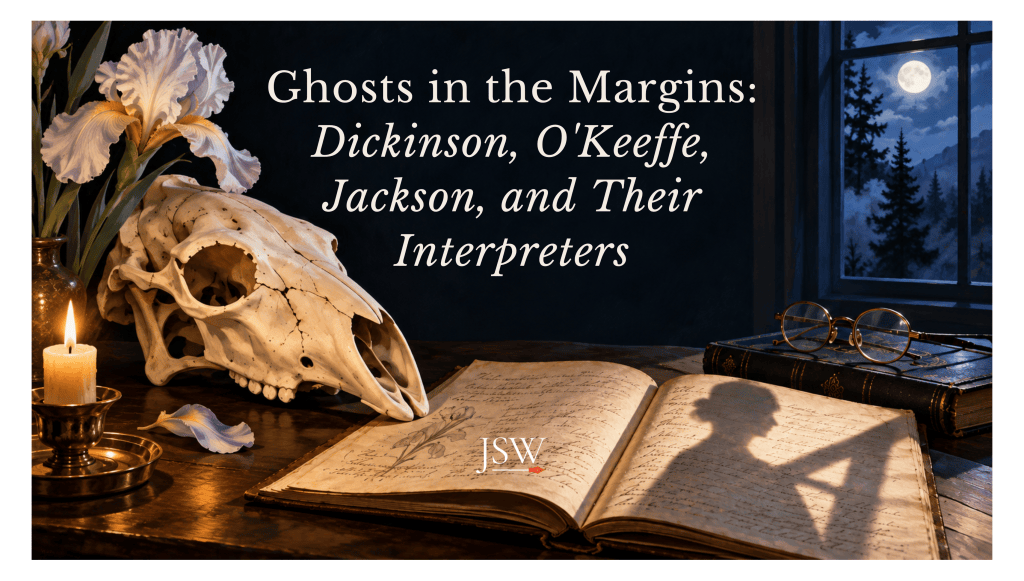
The stories told about Dickinson, O’Keeffe, and Jackson still haunt their work. Looking closely reveals how much those familiar portraits leave unseen.
By Jill Szoo Wilson
Writer | Theatre Artist | Educator
In 1949, John Farrar, Shirley Jackson’s publisher, received a pair of World Series tickets from a friend, along with an unusual request. Would he please ask Shirley to order, from her usual source of supply, a series of light sun-showers for Saturday? Farrar’s firm had spent the spring telling booksellers and reviewers that Jackson was a witch. Someone was finally asking her to do something about it. An early book jacket described her as “perhaps the only contemporary writer who is a practicing amateur witch,” though arranging the weather for a World Series game seems a considerable assignment for an amateur. An Associated Press profile ran under the headline “Shirley Jackson Is ‘Sure ’Nuff’ Witch,” but the reporter had to concede that her eyes behind her glasses looked entirely ordinary. He concluded that she resembled a witch in only one respect: she was hard to pin down. There was still no word on Saturday’s forecast.
Jackson helped create her reputation as a witch through her interest in witchcraft and her jokes about placing hexes on publishers, but she disliked seeing those stories become the focus of her publisher’s campaign. Readers were being encouraged to imagine the author of “The Lottery” as a sinister figure, even as she was writing affectionate, funny accounts of raising four children. Those accounts became Life Among the Savages, published in 1953, in which Jackson describes the daily disorder of family life with the same close attention to human behavior that gives her darker fiction its force. Readers familiar with her frightening stories could discover another part of her work in its pages, one that the witch publicity had largely left out. The witch and the mother lived in the same house and wrote at the same desk, but only one of them made a good headline.
Artists have always lived with captions: the descriptions supplied by reviewers, publishers, and biographers that tell an audience who an artist is and how to approach her work. Those descriptions can follow a book or painting for generations, shaping what people expect to find before they have read a sentence or entered a gallery. Halloween seems the right season to consider three women whose public reputations acquired lives of their own, surviving objections from the artists themselves and evidence in the work that complicated the familiar story. These are the ghosts haunting this essay: the versions of Dickinson, O’Keeffe, and Jackson that remain so recognizable they can keep us from looking closely at the women’s work.
For Emily Dickinson, the distance between the poet and her public image began with changes to the poems themselves. Fewer than a dozen of her nearly eighteen hundred poems appeared in print during her lifetime, though she shared her writing with people close to her. When she died in 1886, her sister Lavinia honored her request to destroy the letters she had received, leaving later readers with few of the voices that had answered hers. Dickinson’s own letters survived elsewhere, preserved by the people to whom she had written. They carried poems and intimate observations beyond the Amherst house, revealing how much of her life continued through correspondence even as she withdrew from visiting. While sorting her sister’s papers, Lavinia also discovered hundreds of poems for which Emily had left no instructions. Among them were small booklets she had sewn together by hand, preserving a body of work far larger than the few poems that had reached the public.
Lavinia resolved to bring that work into print, seeking help first from their sister-in-law, Susan Dickinson, one of Emily’s closest readers, and later from Mabel Loomis Todd, who enlisted Thomas Wentworth Higginson. Their 1890 collection introduced readers to a poet who had been tidied up for company. They regularized her punctuation and altered some of her words to make the rhymes or meanings more conventional, while titles supplied for untitled poems offered readers an explanation before Dickinson had spoken her first line. Even Todd doubted the wisdom of naming them and privately objected to many of Higginson’s choices. The poems had found their way out of the hand-sewn booklets, but the world was meeting Dickinson through decisions she had never been asked to make.
The Dickinson that readers met in 1890 was a real poet and an altered one. Her dashes, those small horizontal hesitations that make her lines feel as though they are listening for something, had been partly swept away. Her slant rhymes had been nudged toward respectability. For more than sixty years, the public knew a Dickinson arranged by others, and the arrangement shaped what her poems seemed to say. Only in 1955, when Thomas Johnson published an edition based closely on her manuscripts, did most readers encounter the poems substantially as she had written them. A woman who had written so often about death had, in a sense, become newly recognizable twice: once in 1890, wearing the clothes her editors had chosen, and again in 1955, in her own.
Her letters reached readers through another carefully arranged introduction. With Lavinia’s help, Todd gathered correspondence from friends and relatives for a two-volume edition published in 1894, but the selection was heavily edited and omitted letters to important people, including Susan Dickinson and Judge Otis Phillips Lord. Those omissions narrowed the relationships readers could see and the emotional life they could reconstruct. The woman who had written so personally to particular people became, in publication, a figure assembled from the letters others chose to share.
Dickinson’s editors altered work they admired; Edgar Allan Poe, the patron saint of literary Halloween, received his posthumous introduction from a rival. Two days after his death in 1849, Rufus Wilmot Griswold published an obituary under the name “Ludwig” observing that few would be grieved, then expanded it into a memoir that shaped Poe’s reputation for generations. His case belongs to a different genre, malice rather than marketing or misreading, and I have imagined him reading that obituary from beneath the rain in Edgar Allan Poe Receives the Morning Paper.
Georgia O’Keeffe had decades in which to object to the story others told about her, though being present to answer did little to settle the matter. Alfred Stieglitz, an influential photographer and gallery owner who championed her work, was then her lover and later became her husband. Over many years, their photographic collaboration produced an extended portrait of O’Keeffe through images of her face and hands, alongside clothed and nude studies. In 1921, Stieglitz exhibited a selection at the Anderson Galleries in New York, where the nudes caused a public sensation. O’Keeffe had participated actively in making the portraits, but she could hardly determine what viewers would make of them.
When she began exhibiting her large flower paintings, critics approached them with the photographs in mind and the Freudian vocabulary fashionable in New York at hand, treating the flowers as disclosures about her sexuality. O’Keeffe objected to having the associations viewers brought to her paintings presented as intentions she had put there. Their explanations told her what she meant, then accompanied the paintings into galleries where later viewers encountered those explanations before they had looked closely at the work. Generations of museumgoers have consequently stood before her flowers already knowing what they were supposed to see, which is one of the more efficient ways to avoid seeing a painting at all.
Her later paintings of desert bones gave viewers more to consider than the familiar story about the flowers could explain. She went to New Mexico and painted the bleached skulls and pelvis bones she found in the desert, holding them up against an enormous blue sky. Critics were puzzled, and even Stieglitz was unconvinced at first. She painted them anyway, for decades, explaining simply that she found them beautiful. The bones complicate the familiar account in a wonderfully spooky way: the painter everyone knew for flowers spent years arranging bones against the sky. They may be the most Halloween-ready still lifes in American art. Late in her life, looking over the photographs Stieglitz had taken of her more than sixty years earlier, she wrote that she wondered who that person was. The woman in the photographs had become a stranger to the woman looking at them.
O’Keeffe’s surprise at her own photographs exposes a difficulty running through all three histories: the familiar image can remain fixed while the person it represents grows increasingly difficult to fit inside it. Once Jackson became the witch behind “The Lottery,” her domestic comedies could seem an unexpected departure, although the household had been there all along. Viewers taught to read a confession in O’Keeffe’s flowers could carry that explanation into the gallery and experience its confirmation as a discovery of their own. Dickinson’s readers had still less opportunity to notice what stood between them and the poet, since the editorial decisions had entered the lines themselves. A missing dash leaves no visible vacancy on a printed page. The resulting portraits could therefore feel complete even to attentive readers, whose close acquaintance with the work began after someone else had decided how to introduce it.
Even an artist’s opportunity to answer could do little to loosen a familiar description. O’Keeffe could explain what she saw in her flowers, but her objections had to compete with an interpretation viewers already knew. Jackson faced the awkwardness of protesting a joke she sometimes enjoyed telling. Dickinson’s manuscripts remained available to challenge her editors’ decisions, though that challenge depended on someone returning to the papers and asking what had been changed. A reputation could circulate for years while the evidence that complicated it waited for readers.
The captions, for their part, have not gone anywhere. Readers who meet Dickinson through older anthologies can still find “The Chariot,” her editors’ title for “Because I could not stop for Death,” with its punctuation tidied and an entire stanza missing—an unsettling fate for a poem about riding toward the grave. Visitors still approach O’Keeffe’s flowers knowing what they are supposed to mean, and Jackson’s name turns up in Halloween lists beside the word witch. The captions linger in the margins, rattling a little, insisting on their version of events.
Yet the work remains in the room with them. In Johnson’s edition, Dickinson’s restored dashes interrupt the smooth progress her early editors arranged, asking readers to pause where they might otherwise have continued. O’Keeffe’s bones open onto expanses of sky that deserve attention before explanation, while Jackson’s domestic comedies stand beside her ghost stories, inviting readers to spend more time with the woman who wrote both.
Somewhere in a Vermont kitchen, Jackson is still outnumbered by her children and being asked to arrange the weather for Saturday. If she has also been reading what people say about her, we might do well to bring an umbrella.
Sources
Emily Dickinson Museum. (n.d.). Emily Dickinson’s letters.
https://www.emilydickinsonmuseum.org/emily-dickinson/poetry/emily-dickinsons-letters/
Emily Dickinson Museum. (n.d.). The posthumous discovery of Dickinson’s poems.
https://www.emilydickinsonmuseum.org/emily-dickinson/poetry/the-poet-at-work/the-posthumous-discovery-of-dickinsons-poems/
Franklin, R. (2016). Shirley Jackson: A rather haunted life. Liveright.
Georgia O’Keeffe Museum. (n.d.). Exhibiting O’Keeffe [PDF].
https://www.okeeffemuseum.org/wp-content/uploads/2023/01/exhibiting-okeeffe.pdf
Georgia O’Keeffe Museum. (n.d.). Stieglitz photography.
https://prints.okeeffemuseum.org/feature/stieglitz-photography
Griswold, R. W. [“Ludwig”]. (1849, October 9). Death of Edgar A. Poe. New-York Daily Tribune. Reprinted by the Edgar Allan Poe Society of Baltimore.
http://www.eapoe.org/papers/misc1827/nyt49100.htm
Johns Hopkins Sheridan Libraries. (n.d.). Obituaries. Enigmatic Edgar exhibition.
https://exhibits.library.jhu.edu/exhibits/show/enigmatic-edgar/life-after-death/obituaries
Johnson, T. H. (Ed.). (1955). The poems of Emily Dickinson. Belknap Press of Harvard University Press.
Franklin, R. (2016, September 28). Shirley Jackson wasn’t actually a witch. Literary Hub.
https://lithub.com/shirley-jackson-wasnt-actually-a-witch/
White Heat. (n.d.). January 8–14: The “Azarian School.” Dartmouth College.
https://journeys.dartmouth.edu/whiteheat/jan-8-14-poems/


Leave a Reply