
By Jill Szoo Wilson
Writer | Theatre Artist | Educator
Too Much Meaning
Meta-Absurdism is an artistic and theatrical framework that inherits the existential concerns of Absurdism while responding to the conditions of digital life. Absurdism asked how human beings live when the world gives us no answer. Meta-Absurdism asks how we live when the world gives us too many.
Digital culture produces explanations, interpretations, labels, performances, images, and narratives at extraordinary speed. Meaning has not disappeared. It has multiplied. The contemporary problem is how to distinguish what happened from the representations surrounding it, the meanings assigned to it, and the narratives that begin to form around it.
Meta-Absurdism examines that condition across theatre, art, and ordinary life. Information overload, algorithmic mediation, self-performance, competing realities, and the search for authenticity all become expressions of the same underlying problem: we live inside a culture that produces interpretations faster than we can sort them.
Absurdism: too little meaning.
Meta-Absurdism: too much meaning.
The Historical Lineage of Meta-Absurdism
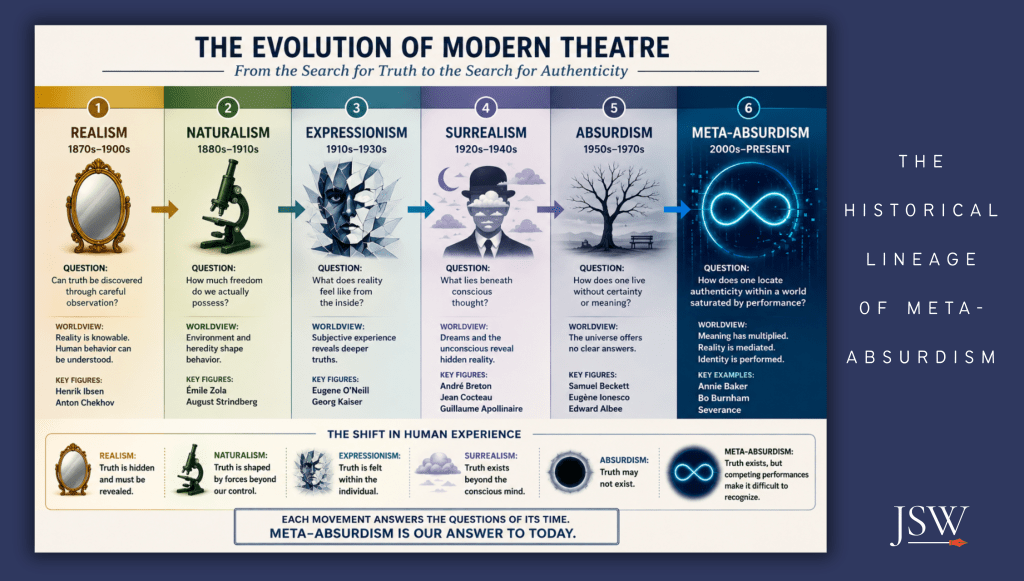
Meta-Absurdism did not emerge in isolation. Like every major artistic movement, it developed through a conversation with the forms that came before it. Modern theatre can be understood as a long investigation into the relationship between reality, meaning, identity, and human consciousness. Each movement inherited questions from its predecessor while introducing new anxieties of its own.
| Movement | Approximate Era | Central Question | Representative Artists | Dominant Worldview |
|---|---|---|---|---|
| Realism | 1870s–1900s | What happens when truth confronts social convention? | Henrik Ibsen, Anton Chekhov | Reality can be observed and understood through careful examination of ordinary life. |
| Naturalism | 1880s–1910s | How much control do human beings actually possess? | Émile Zola, August Strindberg | Human behavior is shaped by heredity, environment, and circumstance. |
| Expressionism | 1910s–1930s | What does the world feel like from the inside? | Eugene O’Neill, Georg Kaiser | Subjective experience reveals truths unavailable through objective observation. |
| Surrealism | 1920s–1940s | What lies beneath conscious thought? | André Breton, Jean Cocteau, Guillaume Apollinaire | Dreams, symbols, and the unconscious contain deeper truths than reason alone. |
| Absurdism | 1950s–1970s | How does one live in a universe without inherent meaning? | Samuel Beckett, Eugène Ionesco, Edward Albee | Meaning is unstable, certainty is elusive, and existence often appears irrational. |
| Meta-Absurdism | 2000s–Present | How do we know what something means when explanations and competing narratives multiply faster than we can evaluate them? | Annie Baker, Bo Burnham, Severance, emerging contemporary artists | Meaning has not disappeared. It has multiplied, fragmented, and become increasingly difficult to evaluate and trust. |
Viewed together, these movements reveal an evolving inquiry into the nature of truth and human experience. Realism sought truth through observation. Naturalism located human behavior within systems of heredity and environment. Expressionism turned inward toward subjective perception, while Surrealism explored the unconscious dimensions of experience. Absurdism confronted the collapse of certainty itself. Meta-Absurdism inherits this history while responding to a culture shaped by digital mediation, perpetual performance, and competing realities.
Where Beckett’s characters waited in silence, contemporary characters confront endless streams of information. Where Absurdism wrestled with absence, Meta-Absurdism wrestles with overload. The problem is no longer the disappearance of meaning but the proliferation of competing meanings, performances, narratives, and identities.
Examples of Meta-Absurdism in Contemporary Theatre and Culture
Samuel Beckett’s Waiting for Godot (1953)
Absurdist Foundation
Two men wait endlessly for a figure who never arrives. The play embodies the central concerns of Absurdism: uncertainty, repetition, silence, and the search for meaning within an indifferent universe. Beckett’s world is defined by absence. The characters continue speaking because silence offers no answers.
Key Question: What happens when the world gives us no answer?
Annie Baker’s The Flick (2013)
The Transition Toward Meta-Absurdism
Set inside a struggling movie theatre, The Flick explores loneliness, alienation, and the difficulty of genuine human connection in contemporary life. The characters spend much of the play sweeping floors, waiting, and exchanging fragmented conversations that often feel incomplete. Unlike Beckett’s characters, they are surrounded by culture, images, and stories. Yet connection remains elusive.
Baker preserves the stillness of Absurdism while relocating it to a world shaped by media, technology, and emotional distance.
Key Question: What happens when connection remains available but increasingly difficult to sustain?
Bo Burnham’s Inside (2021)
Meta-Absurdism and Self-Performance
Inside transforms digital life into theatrical form. Alone in a room, Burnham performs for cameras while simultaneously critiquing the culture of performance that produced him. The work folds inward repeatedly, creating layers of observation, commentary, self-awareness, and irony.
The result resembles Absurdism filtered through social media. Burnham understands the performance even as he remains trapped within it.
Key Question: What happens when the self becomes both performer and audience?
Severance (2022–Present)
Meta-Absurdism as Institutional Reality
Few contemporary works illustrate Meta-Absurdism more clearly than Severance. The series imagines a world in which identity can be divided into separate selves, one existing only at work and the other only outside it. The premise appears absurd, yet the emotional reality feels deeply familiar to contemporary audiences.
The sterile hallways, circular procedures, bureaucratic language, and endless rituals evoke Beckett and Ionesco. At the same time, the series addresses distinctly modern concerns involving corporate control, data systems, surveillance, compartmentalized identity, and technological mediation.
Key Question: What remains of the self when institutions shape consciousness itself?
The Defining Characteristics of Meta-Absurdism
Meta-Absurdist works begin from a world in which meaning is abundant rather than absent. Characters encounter events through layers of representation, interpretation, commentary, performance, and competing narratives. The difficulty lies in determining what deserves their trust and whether an authentic response remains possible beneath all that explanation.
Works associated with Meta-Absurdism often include:
• Information overload rather than existential silence
• Competing interpretations of the same event or reality
• Hyper-awareness of performance and self-presentation
• Characters who recognize they are participating in constructed systems
• Tension between authenticity and performance
• Fragmented identities and competing realities
• Technology as a mediator of perception and communication
• Irony paired with a genuine longing for sincerity
• Persistent searches for meaning amid an excess of possible meanings
If Absurdism asked how human beings survive a world without answers, Meta-Absurdism asks how human beings locate truth within a world overflowing with answers.
Taken together, these characteristics distinguish Meta-Absurdism from its twentieth-century predecessors. The movement retains the existential concerns of Absurdism while shifting attention toward performance, mediation, identity construction, and the search for authenticity within increasingly fragmented cultural environments.
About the Author
Jill Szoo Wilson is a writer, theatre artist, educator, and MFA-trained director whose work explores theatre, performance, identity, communication, and contemporary culture. Meta-Absurdism emerged from her research into modern theatre movements and the changing problem of meaning in digital life, where interpretation, performance, and competing narratives multiply faster than we can sort them.
Click here to read more Theatre essays by Jill.
Further reading on Meta-Absurdism:
- From Realism to Meta-Absurdism: The Evolution of the Modern Stage
- Can ChatGPT Interpret Your Text Messages? AI Relationship Advice and Meta-Absurdism
- Meta-Absurdism: What Happens Between an Event and the Story We Tell
- Peter Brook and the Empty Space in an Age of Meta-Absurdism
- The Ordinary Infinite: Annie Baker and the Meta-Absurdist Stage
- The Performing University: Assessment, Authenticity, and Meta-Absurdism in Higher Education
- The Meta-Absurdism Theatre Lab: Let’s Build It Together

