
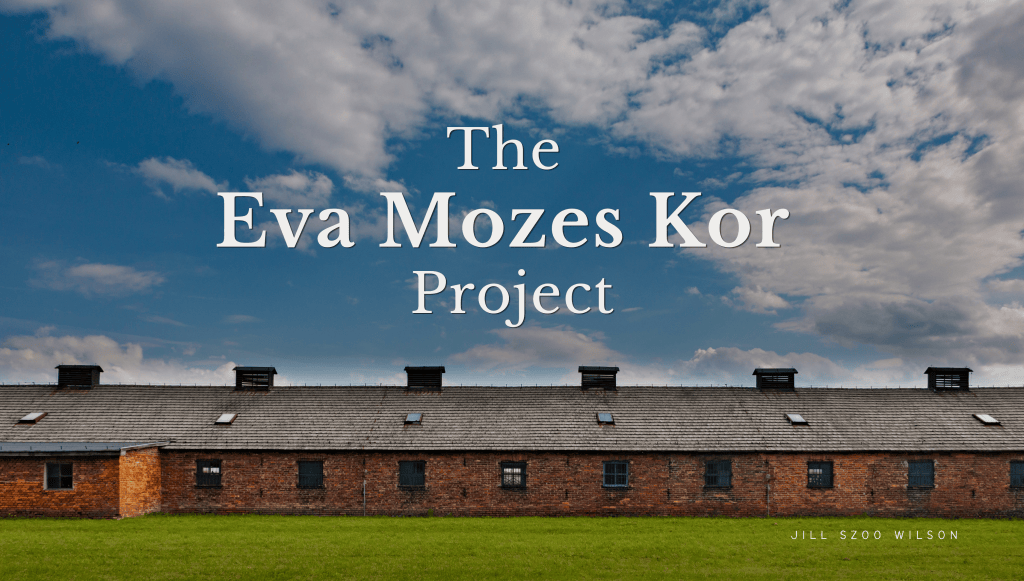
Exploring the life and legacy of Auschwitz survivor and forgiveness advocate Eva Mozes Kor, whose story asks difficult questions about suffering, justice, and the freedom she found in forgiveness.
By Jill Szoo Wilson
Writer | Theatre Artist | Educator
Eva Mozes Kor was ten years old when she and her twin sister, Miriam, were deported with their family to Auschwitz-Birkenau in May 1944. Their parents and older sisters were murdered. Eva and Miriam were selected for experiments conducted on twins under the direction of Nazi physician Josef Mengele.
Eva and Miriam survived Auschwitz and were liberated in January 1945.
For the rest of her life, Eva told the world what had happened to her family and to the other children subjected to medical experimentation at Auschwitz. She searched for surviving Mengele twins, founded CANDLES in 1984, and later opened the CANDLES Holocaust Museum and Education Center in Terre Haute, Indiana. Her work preserved testimony, confronted the abuse of human beings in the name of science, and insisted that young people could learn to recognize the consequences of prejudice.
Eva also became known for a decision that generated admiration, anger, and lasting debate. In 1995, she publicly forgave the Nazis. She described forgiveness as something she could choose for herself, an act that released her from the power of those who had harmed her. She did not claim the authority to forgive on behalf of other victims, and she did not believe forgiveness erased responsibility or made justice unnecessary.
I worked and traveled with Eva for four years, following the geography of her life through Romania, Hungary, Poland, and Auschwitz-Birkenau. I listened as she told her story to students, teachers, museum visitors, and fellow travelers. Our conversations, disagreements, and journeys became the foundation for my play, Throwing Stones: The Eva Mozes Kor Project, and for the continuing body of writing gathered here.
This project examines Eva’s life without reducing it to an uncomplicated lesson about forgiveness. Her story requires us to think about survival, memory, accountability, and the choices people make after terrible harm. It also asks what testimony requires from those who inherit it.
Begin Here
Jill Szoo Wilson on Eva Mozes Kor, Forgiveness, and the Seeds We Plant
Originally prepared as a reflection on peace for a group of creative colleagues, this essay introduces Eva’s survival, her decision to forgive, and the public advocacy that followed. Her image of goodness spreading like ripples from a pebble leads to a question each reader must answer: What are you already planting in the lives around you?
Survival, Auschwitz and the Work of Memory
Eva’s life cannot be understood apart from the world that the Nazis attempted to destroy, the machinery of Auschwitz and the medical experiments imposed upon children selected because they were twins. These essays examine specific places, experiences, and people within that history while keeping the lives of the victims at the center.
Block 10 in Auschwitz
Because I was traveling with Eva, I was among a small group permitted to enter Block 10, the building at Auschwitz I where prisoners were subjected to medical experiments and autopsies. This essay records what remained inside its largely untouched rooms and the spiritual reckoning that followed as I confronted the human cruelty enacted there and the question of God’s presence among the brokenhearted.
Eva Mozes Kor, the Scheisskommando, and the Cost of One More Day
Standing inside a latrine at Birkenau, Eva asked her listeners what they would do to survive. This essay examines the Scheisskommando, prisoners assigned to remove human waste, and the terrible paradox that one of Auschwitz’s most degrading jobs could also offer relative safety and a better chance of living one more day.
A Candle at Auschwitz: Lit by a Former Nazi
On January 28, 1995, Eva handed former Auschwitz doctor Hans Münch a candle inside the crematorium at Auschwitz I. He lit it in memory of the people he had watched die in the gas chambers. Told primarily in Eva’s voice, this essay considers the significance of a former Nazi publicly confirming the truth in the place where those crimes occurred, especially when so few people showed interest in hearing what he had come to say.
The Difficult Question of Forgiveness
Eva believed that forgiveness gave her power over a past she could not change. Other survivors strongly objected, fearing that forgiveness could diminish responsibility, obscure the demands of justice, or place another burden upon those who had already endured the unthinkable.
Those disagreements deserve to be taken seriously. The essays in this section explore what Eva meant by forgiveness, what she did not mean, and why no survivor’s response can become a command imposed upon another.
Forgiving a Nazi Doctor: Eva Mozes Kor’s Life-Changing Decision
While searching for a way to thank former Auschwitz doctor Hans Münch for confirming the operation of the gas chambers, Eva decided to write him a letter of forgiveness. That decision led her to forgive Josef Mengele and, on January 27, 1995, publicly read her declaration at Auschwitz. Told largely in Eva’s own voice, this essay explains why she understood forgiveness as a personal power that neither excused evil nor erased history.
Eva Mozes Kor and the Price of Forgiveness
Eva’s decision to forgive did not free her from conflict. Drawing partly on a private email she sent me, this essay follows the backlash surrounding her relationship with Hans Münch into her struggle to establish the CANDLES Holocaust Museum and the 2003 arson that destroyed it. Eva’s response to the ruins reveals the resolve beneath her message of peace: she chose to rebuild.
The Power of Forgiveness: Eva Mozes Kor’s Call for a New Human Right
In a 2008 commencement address at Saint Mary-of-the-Woods College, Eva proposed an addition to the Universal Declaration of Human Rights recognizing the right to live free from emotional pain and presenting forgiveness as one possible path toward that freedom. This essay traces how Eva carried her personal decision into public advocacy while insisting that each person must choose forgiveness in their own time and on their own terms.
Forgiveness After the Battle: Eva Mozes Kor’s Path to Reclaiming Peace
Eva rejected the idea that forgiveness should be demanded while someone is still fighting to survive. Drawing on what she called the “battlefield mentality,” this essay explains why she believed safety must come first and how forgiveness, when freely chosen after the danger has passed, can become a way of reclaiming peace.
When You Have to Forgive Between 1 and 1,000 Times
Forgiveness rarely happens only once. Using the image of floating above deep water, this personal reflection considers what happens when pain returns after we thought we had released it and describes forgiveness as a repeated surrender to God. It also introduces my conversations with Eva, including the places where we disagreed about what forgiveness means and how it becomes possible.
Mercy, Justice and Accountability
Forgiveness becomes most difficult when it is confused with excusing wrongdoing, abandoning justice, or restoring a relationship that is no longer safe. These essays place Eva’s philosophy in conversation with the questions people face when harm cannot be undone and fairness offers no adequate remedy.
The Question of Justice: Forgiveness vs. Accountability
Eva did not understand forgiveness as a substitute for truth or accountability. This essay follows the 1985 inquest she organized into the disputed evidence surrounding Josef Mengele’s reported death, as well as her efforts to secure compensation for survivors of his experiments. Her work demonstrates how personal forgiveness can exist alongside the continuing pursuit of justice.
When Fairness Fails: What Forgiveness Teaches Us About Mercy
Fairness can identify a wrong and enforce a rule, but it cannot always repair what harm has broken. Bringing psychological research into conversation with theatre and Scripture, this essay considers what forgiveness offers when justice cannot restore the life that existed before the injury. It presents Christian forgiveness as an act of mercy that releases the injured person from an endless accounting of what can never be made fully equal.
Encounters Beyond Auschwitz
Eva’s life did not stop at liberation, nor did her work remain confined to the history of the Holocaust. She traveled widely, entered difficult conversations, and continued testing her convictions in circumstances she could not always control.
Trapped in the West Bank: Eva Mozes Kor’s Harrowing Encounter
Based on a private email Eva sent me in 2015, this essay recounts in her voice an experience from a 2005 trip connected to the filming of Forgiving Dr. Mengele. What she expected to be a discussion with Palestinian educators became a frightening encounter that left her feeling trapped and powerless, strengthening her conviction that many Holocaust survivors living in Israel still experience life through what she called the “battlefield mentality.”
Memory and Christian Responsibility
Remembering Auschwitz carries a responsibility in the present. Eva’s question, “What has changed since Auschwitz?” asks Christians to recognize antisemitism as it takes shape and to consider what faithfulness requires when Jewish people are threatened.
Faithfulness in the Face of Antisemitism
Eva repeatedly asked, “What has changed since Auschwitz?” Beginning with that question, this essay examines the gradual process by which antisemitism becomes socially acceptable and politically enforced before confronting its renewed expression in the present. It calls Christians to understand standing with Jewish people not as an optional political position, but as faithfulness to Scripture and to the covenant-keeping God of Israel.
 Jill Szoo Wilson