One of the greatest joys of teaching is discovering that your students are asking better questions than the ones you planned to answer.
That’s what has happened over the past year as Meta-Absurdism has gradually begun to take shape.
What began as a theatre course gradually became a collaborative investigation into authenticity, performance, philosophy, psychology, and the changing cultural landscape young artists now inhabit. We read, argued, devised scenes, challenged assumptions, borrowed insights from other disciplines, and followed questions wherever they led. As recurring ideas surfaced, we refined our language, abandoned concepts that failed under scrutiny, and developed others that illuminated what we were observing together.
The framework did not exist before those conversations.
It emerged through them.
For years, I’ve been drawn to educational philosophies that treat learning as an active process rather than a passive one. Jean Piaget argued that “Knowledge is not a copy of reality. To know an object is to act upon it.” Vygotsky carried that insight further by observing that higher forms of thinking first emerge between people before becoming internal ways of understanding. Both thinkers remind us that genuine learning happens when people engage with ideas together rather than simply receiving information from an “expert.”
Our little classroom on the second floor of the communication building became an opportunity to put those ideas into practice.
Instead of presenting conclusions, we kept asking questions. Instead of defending positions, we tested them. Students challenged one another’s assumptions, connected ideas across disciplines, refined language together, and gradually developed a shared vocabulary for describing something none of us could fully articulate when the semester began.
The Socratic method helped shape that process. Good questions have a remarkable way of slowing a conversation just enough for everyone in the room to think more carefully. They expose assumptions, invite clarification, and encourage us to follow an idea further than we expected. More than once, a single student’s observation changed the direction of an entire class, sending all of us—including me—back to reconsider ideas we thought we understood. There were moments when the room fell silent because we realized an assumption no longer held. We groaned when an idea collapsed under closer examination and laughed when an unexpected connection opened an entirely new way of thinking. Every breakthrough belonged to the room.
Those moments changed the way we all thought about Meta-Absurdism.
Those moments changed the way we all thought about Meta-Absurdism. More importantly, they convinced me that meaningful artistic ideas can emerge from communities willing to think carefully together.
As our conversations continued, another realization slowly came into focus.
Theatre has always advanced this way.
When we look back at figures like Stanislavski, Meisner, Viola Spolin, Peter Brook, or Jerzy Grotowski, it’s easy to focus on the systems, exercises, and vocabulary they eventually became known for. History tends to remember the finished framework: the published books, the named movements, the exercises, and the vocabulary. It rarely preserves the years of uncertainty that came first, when artists were still observing, experimenting, revising, and searching for language equal to what they were discovering.
Stanislavski spent decades pursuing a simple question: Why do some performances feel deeply truthful while others do not? Meisner explored what it means to live truthfully in imaginary circumstances. Spolin investigated spontaneity through improvisation. Brook asked what is fundamentally required for theatre to exist at all. Grotowski continually stripped performance to its essentials in order to understand what theatre uniquely offers.
Although each pursued a different question, they shared an important conviction: theatre advances through collaborative inquiry. The rehearsal room is never the work of a solitary thinker. It is a community of artists testing ideas together: listening, responding, refining, discarding, discovering, and slowly giving language to insights that no one person could fully arrive at alone. Theatre has always been a profoundly communal art, and its greatest innovations have emerged from communities willing to investigate difficult questions together.
Each artist began with a question.
Each pursued that question with discipline.
Each allowed rehearsal, collaboration, and practice to refine understanding.
Only then did a recognizable framework emerge.
Watching that process unfold in theatre history gave me confidence to let Meta-Absurdism develop in the same way. Rather than rushing toward tidy definitions, we continued to ask questions, test ideas, and allow the language to become more precise over time. The framework continues to evolve because the conversation does.
Where the Conversation Is Leading
As our conversations continued, one observation kept resurfacing.
The Theatre of the Absurd emerged from a generation asking whether life possessed any meaning at all. Again and again, my students described a different experience. They felt an overabundance of meaning. Every event seemed to arrive already interpreted, commented upon, branded, analyzed, and absorbed into competing narratives before they had the opportunity to encounter it for themselves.
Somewhere during the semester, we realized we needed language for that condition. The name Meta-Absurdism gradually emerged from those conversations, not as a declaration that we had discovered a new movement, but as our best attempt to describe a cultural experience we all recognized but had not yet learned to articulate.
In all this meaning, what is true?
That question continues to shape every essay I’ve written and every conversation we’ve had since.
The Next Step
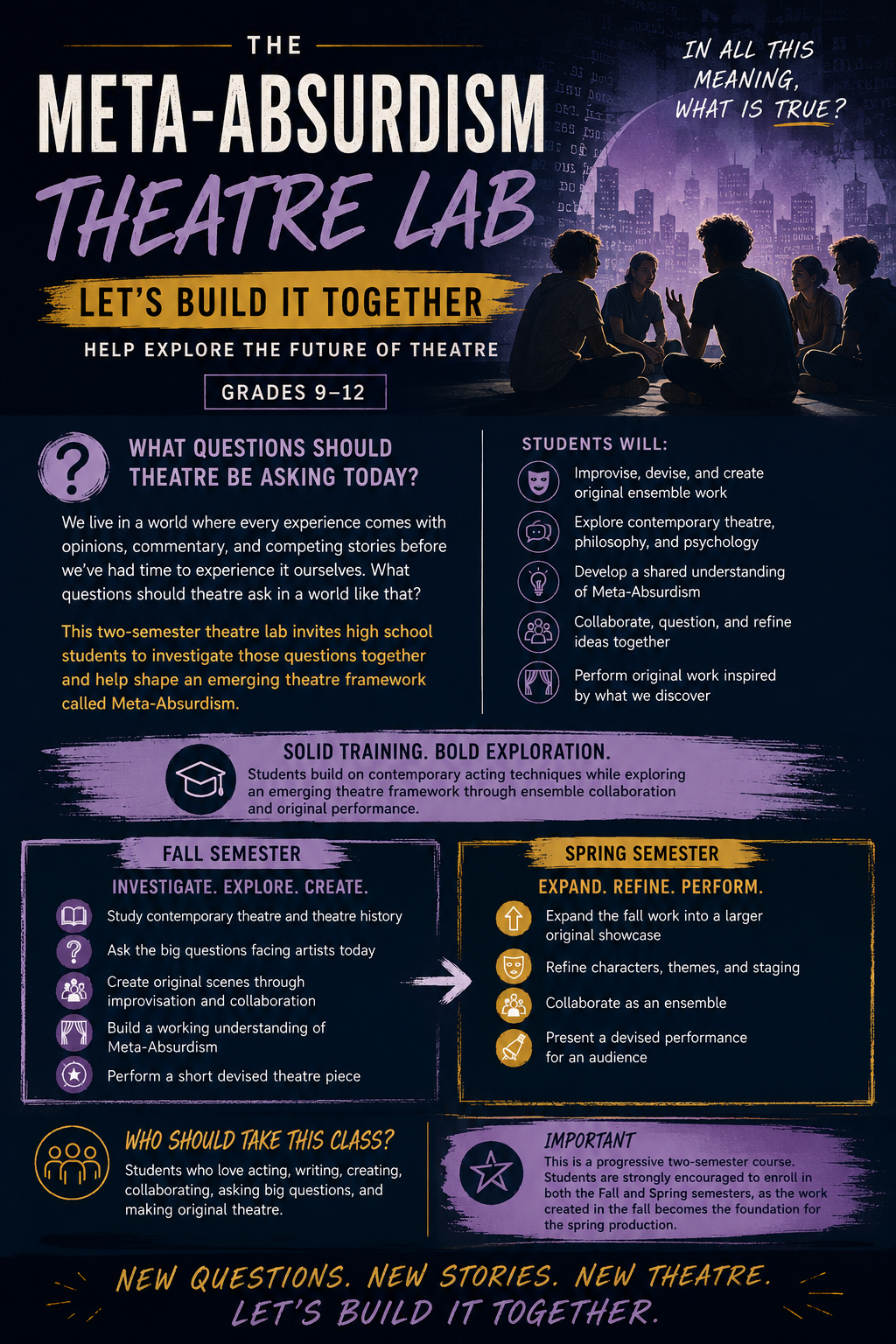
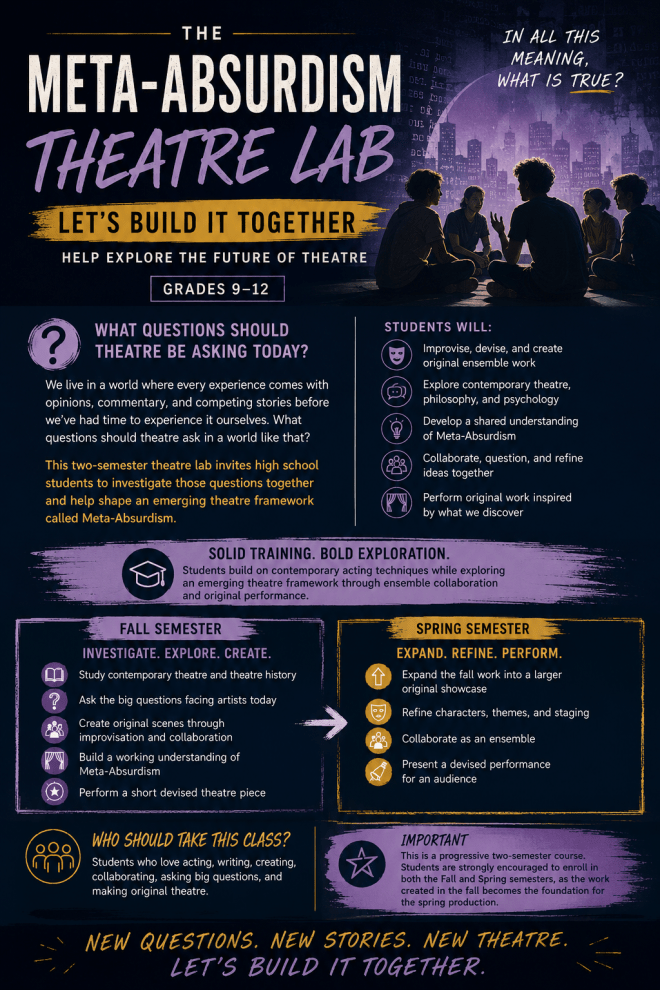
One of the most exciting outcomes of this project is that the conversations themselves have begun suggesting a new kind of theatre laboratory. Students would study the great practitioners who shaped modern theatre while exploring the questions that shaped their work. Stanislavski, Meisner, Spolin, Brook, Grotowski, and other influential artists would provide the historical and artistic foundation, inviting students to see how theatre continually grows through careful observation, disciplined experimentation, and thoughtful collaboration.
From that foundation, the class would explore the questions shaping today’s artists. Through improvisation, devising, ensemble work, contemporary theatre, and conversations that draw from philosophy and psychology, students would investigate the cultural conditions that gave rise to Meta-Absurdism. Together, we would continue refining the language, testing the ideas, and exploring the questions that first brought the framework into being.
Throughout the fall semester, the ensemble would create original scenes and collaborative performances inspired by those discoveries. In the spring, that work would deepen into a larger devised production, allowing the artistic and philosophical questions to continue developing through rehearsal, revision, and performance.
What excites me most is the opportunity to invite students into a process that few artists experience firsthand. Theatre students spend years studying the movements that shaped the past. This lab would allow them to witness how artistic frameworks gradually emerge through observation, collaboration, rehearsal, and thoughtful conversation. They would inherit the rich traditions of theatre while contributing their own questions to the ongoing story of the art form.
Whether Meta-Absurdism ultimately becomes part of that story remains to be seen. For now, the questions themselves have proven more than worthwhile, and I’m excited to see where they lead next.
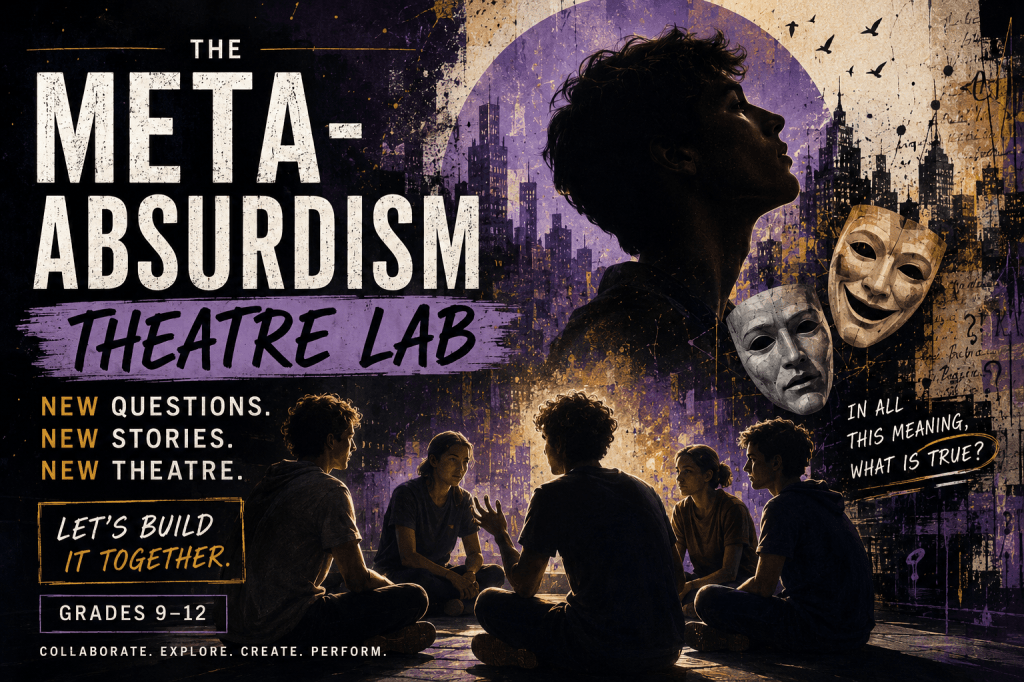
Below is the first concept flyer for the Meta-Absurdism Theatre Lab, a collaborative theatre program I’m developing for performing arts studios, colleges, and universities.
A few people have wondered whether teenagers are ready for questions like these. I suspect they’re already living them. My hope is simply to give them a place to explore those questions together through the collaborative art of theatre.
If you’d like to read more about the Meta-Absurdism movement, here are some essays for you:
What is Meta-Absurdism?
From Realism to Meta-Absurdism: The Evolution of the Modern Stage
Today’s Students Want to Be in the Room
The Ordinary Infinite: Annie Baker and the Meta-Absurdist Stage
 Jill Szoo Wilson