The Power of Forgiveness: Eva Mozes Kor’s Call for a New Human Right

In the fall of 2006, Eva Mozes Kor, Holocaust survivor and Mengele twin, received an unexpected invitation that would set her on a new path in her journey to advocate for forgiveness as a human right. Dr. Joan Lescinski, president of Saint Mary-of-the-Woods College in Terre Haute, Indiana, invited Eva to a private lunch. Eva, ever curious, arrived dressed in her favorite bright blue suit, eager to learn more. Little did she know, this would be the beginning of an incredible journey, one that would shape not only her legacy but also the conversation around emotional healing and forgiveness on a global scale.
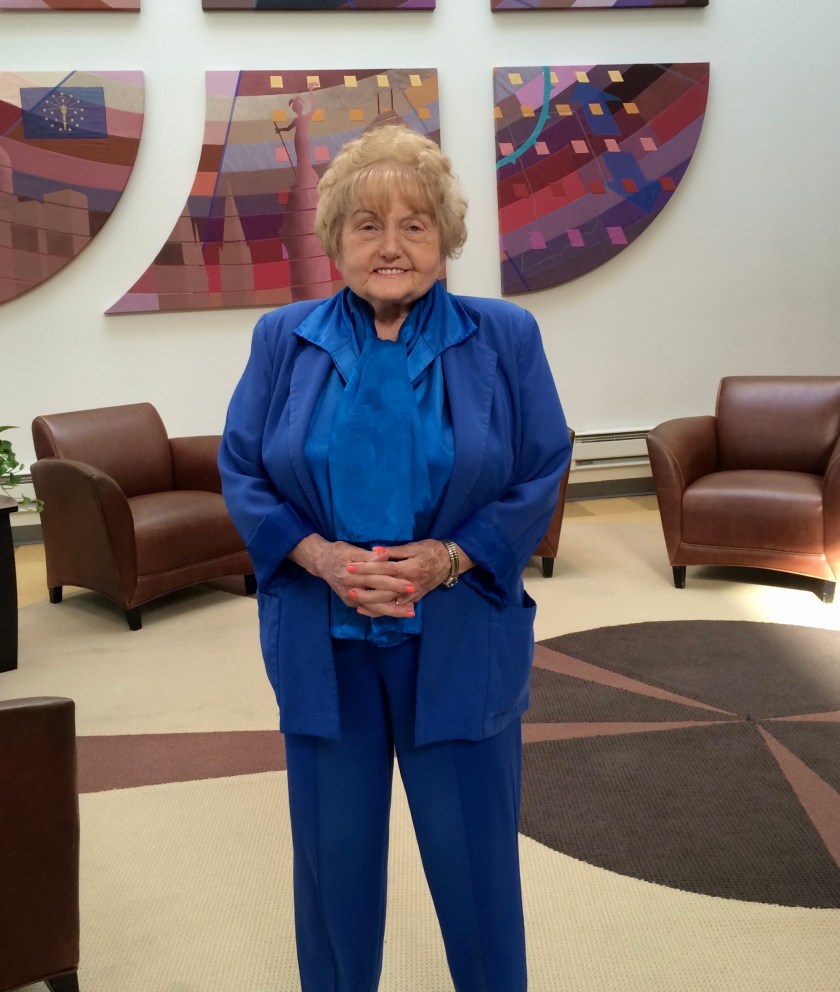
Eva Mozes Kor, photo taken by Jill Szoo Wilson
Eva Mozes Kor. Jill Szoo Wilson took this photo at an NBC studio in Indiana.

A Life-Changing Invitation

As Eva stepped onto the campus, the vibrant fall colors of the trees created a beautiful backdrop for the day ahead. Dr. Lescinski explained that the board of directors had voted to honor Eva with an honorary doctorate for her work in forgiveness and had chosen her to be the commencement speaker in May 2008. It was a rare and deeply meaningful recognition, one that both humbled and surprised Eva, knowing the weight of the responsibility that lay ahead of her.

But this honor would not come quickly. The process took almost a year and a half to prepare. During this time, Eva decided to dive deeper into the Universal Declaration of Human Rights (UDHR), especially since the declaration did not address the emotional pain inflicted on survivors and victims of atrocities.

The Idea of an Addendum

Eva, alongside Kiel Majewski, researched the UDHR and realized that while the declaration addressed the physical and civil rights of individuals, it failed to address the emotional trauma that people, especially victims of genocide, carry for most of their lives. This led Eva to propose an addendum to the UDHR, one that would acknowledge the human right to live free of emotional pain inflicted by others and by life itself.

A Legacy of Resilience: Saint Mother Theodore Guerin

As Eva prepared for her speech, she reflected on the perseverance and strength of those who built the foundation of the institution she was addressing. One such person was Saint Mother Theodore Guerin, the founder of Saint Mary-of-the-Woods College. Guerin’s own journey, filled with adversity and relentless determination, resonated deeply with Eva.

Saint Mother Theodore Guerin, a French nun, traveled across the Atlantic Ocean in 1840 to establish what would later become Saint Mary-of-the-Woods College in Terre Haute, Indiana. She was part of a group of Sisters of Providence sent by the Superior General of the Congregation of the Sisters of Providence in France to open a mission in the United States.

She and her fellow sisters arrived in the United States at a time when the country was still relatively young, and the area around Terre Haute was largely undeveloped. Despite facing numerous challenges, including language barriers, limited resources, and harsh conditions, Mother Theodore Guerin persevered and founded the college in 1840. Her vision and determination to provide education for women in the midwestern United States became a reality, and Saint Mary-of-the-Woods College was established.

Eva often reflected on how one person’s determination could spark lasting change. Guerin’s commitment to education, even in the face of hardship, was the very kind of perseverance Eva hoped to embody in her own work. As Guerin had never given up on her dream, Eva refused to give up on her vision for a world where emotional healing was recognized as a fundamental human right.

Eva’s Commencement Speech

In May 2008, Eva arrived at the commencement ceremony, accompanied by her son Dr. Alex Kor and her husband, Marius Kor (“Mickey”). The ceremony felt like another survival test, but Eva was resolute. She stood before the graduates, faculty, and board members, prepared to speak from her heart.

During her speech, Eva took a moment to reflect on her past, on the unimaginable horrors she endured as a ten-year-old girl in Auschwitz. Separated from her parents and two older sisters, Eva, along with her twin sister Miriam, was thrust into an environment of unspeakable cruelty. She shared the vivid memories of being shoved into filthy, overcrowded barracks, deprived of food, and subjected to the terrifying medical experiments led by Dr. Josef Mengele. But she also spoke of her defiance, the way she managed to survive after Mengele’s chilling prediction that she would be dead within two weeks following his lethal injection. Against all odds, Eva lived, and in the process, she learned the profound strength that kept her going (Kor, Surviving the Angel of Death).

Below is an excerpt from her speech:

You have come a long way, and so have I. Sixty four years ago at this time, I was a ten-year-old little girl, huddled with my twin sister, Miriam, in our filthy bunk beds crawling with lice and rats. We were starved for food, starved for human kindness, and starved for the love of the mothers and fathers we once had. We did know then that there was a United States of America. But I knew nothing about the state of Indiana, Terre Haute, Indiana, Saint-Mary-of-the-Woods-College, nor did I dream of receiving an honorary doctorate. In those days I dreamed of food and freedom, so all my energies focused on living one more day and surviving one more experiment [. . .] We arrived in Auschwitz in the Spring of 1944. Within 30 minutes we were ripped apart from my parents and two older sisters. Only my twin sister and I survived Auschwitz. I defied Mengele who said that I would be dead in two weeks after he injected me with a deadly germ, I defied Auschwitz, a factory of death, because I never gave up on myself nor on my dreams.

As she spoke to the graduates, she drew a powerful parallel between her survival and their own journeys. She reminded them that, like herself, they had persevered through challenges. The graduates had worked hard, faced their own struggles, and overcome personal obstacles to reach this moment of triumph. Eva’s words connected their achievements in the classroom to her own perseverance in the face of unspeakable violence. Both, she emphasized, were the result of relentless strength, the kind of resilience that endures and thrives even in the face of overwhelming adversity.

The Power of Forgiveness

Eva then shared a life lesson that she held dear: “Forgive your worst enemy, and forgive everybody who has hurt you. It will heal your soul and set you free.” Her journey to forgiveness, which began on January 27, 1995, was pivotal not only in her own healing but in her advocacy for others to release emotional pain through forgiveness (Kor, CANDLES Foundation).

As part of her speech, Eva called upon the students, faculty, and staff at Saint Mary-of-the-Woods College to sign an addendum to the UDHR, which would advocate for the right to emotional healing through forgiveness. This proposed addendum would be sent to the United Nations, the President of the United States, and the Helsinki Human Rights Commission. Eva felt confident that Saint Mother Theodore Guerin, the founder of the college, was smiling down in approval of this effort.

The Addendum to the Universal Declaration of Human Rights

Eva’s proposed addendum stated the following:

  • Right to Freedom from Emotional Pain: Every person has the human right to live free from the emotional pain and burden imposed by others, society, or life itself.
  • Forgiveness as a Path to Freedom: Forgiveness is a viable option for achieving that freedom and the human right to emotional well-being.
  • Personal and Universal: Forgiveness is a personal act of self-healing, a right that every person must claim for themselves. Each person has the right to forgive in their own time and on their own terms.
  • The Power of the Addendum: This addendum would serve as a beacon for anyone who has endured pain, offering them the right to transcend their suffering by choosing forgiveness.

Conclusion: A Call for Healing

As the panel of faculty and students signed the addendum, Eva felt a sense of hope. It was not just a symbolic gesture; it was a call to action for everyone who has suffered. Eva’s speech was not only about her own personal forgiveness but also about empowering others to take control of their emotional freedom.

“I did not want to carry the burden of hatred with me. I wanted to live and not just survive.” – Eva Mozes Kor

The event and the addendum were a culmination of Eva’s belief that emotional healing, through the act of forgiveness, was just as vital as any civil or political right. She challenged everyone to embrace forgiveness, not only to heal themselves but to contribute to a world that acknowledges the emotional scars we carry and the universal right to find peace.

  • Kiel Majewski worked as the Director of Research at the CANDLES Holocaust Museum and Education Center. His role involved conducting research related to the Holocaust, specifically focusing on the Mengele Twins and other aspects of the museum’s mission.

© Jill Szoo Wilson, 2025

Further Reading

  • Arendt, Hannah. The Human Condition. University of Chicago Press, 1958.
  • Guerin, Mother Theodore. Journals and Letters. Sisters of Providence of Saint Mary-of-the-Woods, 1996.
  • Kor, Eva Mozes, with Lisa Rojany Buccieri. Surviving the Angel of Death: The Story of a Mengele Twin in Auschwitz. Tanglewood, 2009.
  • Kor, Eva Mozes. Echoes from Auschwitz: Dr. Mengele’s Twins. CANDLES, 2000.
  • United Nations. Universal Declaration of Human Rights. United Nations, 1948.
Poem: Unzipped

Born into the beauty of Spring

Between a fog-covered morning and

Daffodils breezily performing

A ballet in minor keys

She was touched first by the sun

Tenderly

Warmly

Our greatest star floated down

Like a blanket,

Covering.


Her mother was gentle

Hands soft and graceful—

Rose petals against her fingers

Blushed in their inadequacy

To soothe pain

With placid refrains of

Touch

Sliding down from

Cheeks to chins

With whispers thin.


Her father worked the fields

Gathered to his chest

The yields he nurtured

From seeds into

Future nourishment

Carried

In straw-colored baskets

To a town where

Eyes lit with hellos and

Hands shook with goodbyes.


Buried deep inside

The beauty young

A grain of aberration was planted—

Roots grew long and

Slanted downward

Spreading wide

Like awns on Wheat

Piercing delicate organs

Changing the beat

Of her sunflower heart.


Melancholia filled the pasture

Of her mind

A harvest inward

Pulling

Watered by heredity

Drowned in mystery

Tears stagnant

Hidden

Breeding mosquitos

Draining from within.


Born into the beauty of Spring

She lived in the landscape of Winter

Bracing against snow-filled torrents

Of frozen joy—

A sculptor of ice into smiles

A painter of masks

Detailing profiles

Desperate to delight

Those she could not disappoint—

Ashamed to bare only flickering light.


Her mother named her Bliss

Her father called her Life

They held her hands

Through seasons passing

Interlocked their fingers

With her plans

Held her high for every eye

To marvel and admire

Proud of the child, the woman

They knew her to be.


Her outside

Belied

Silent cries—

A contrast of

Cheerful attainment to

Sorrowful containment

Wrenching from

The wish to please

To the reality of

Brokenness.


As Autumn sang

Its songs of change

She unzipped her disguise

Let her discrepancy fall

And her hopelessness rise—

A coffin soft

Burlap and heavy

She sunk into the shadow

Where finally she could hide

From sunshine and from lies.

© Jill Szoo Wilson, 2016

Beauty and Destruction in the Work of Sam Shepard: A Theatrical Collision

By Jill Szoo Wilson

Introduction

In the plays of Sam Shepard, beauty and destruction are not opposing forces so much as interdependent elements, continually coexisting, colliding, and reconstituting one another. His characters, often broken men in desolate landscapes or fraying domestic spaces, search for transcendence but are tethered to the ruins of family, memory, and myth. This essay explores Shepard’s use of beauty and destruction as thematic counterpoints and mutually generative forces in works such as Buried Child (1978), True West (1980), and Fool for Love (1983). In Buried Child, a child’s corpse buried in the backyard serves as a symbol of familial disintegration that resurfaces through surreal harvests. In True West, the kitchen becomes a battleground where toast and typewriters fly, and in Fool for Love, the rhythm of two doomed lovers is rendered audible through physical contact with a set built from drum skin. Each play demands intense physical and emotional presence, and together they form a trilogy of destruction drawn in poetry, silence, and sound. This essay considers the structural and performative demands these themes place on both text and actor.

In contrast to playwrights who treat destruction as a moral end or beauty as a redemptive balm, Shepard constructs a theatrical world in which the two often co-occur. In Shepard’s work, we see raw violence framed in lyricism and spiritual longing undercut by physical collapse. His stage directions read like prose poems. His dialogue pulses with the tension of characters reaching for something sublime while pulling the trigger on their own undoing. This paradox resonates deeply with the teachings of Sanford Meisner, who insisted that “acting is the ability to live truthfully under imaginary circumstances.” In Shepard’s imaginary worlds, the truth is frequently unbearable and, at the same time, luminous.

Destruction as Inheritance — Buried Child

In Buried Child, Shepard excavates the American family mythos, exposing its rotted core beneath the pastoral iconography of the Midwest. The play opens with Dodge, an alcoholic patriarch, coughing on a couch while rain lashes the windows of his decaying farmhouse. The setting is already decomposing; destruction is not merely happening, it has happened, and its aftermath persists like mold on the American Dream.

What makes this destruction poetic rather than gratuitous is Shepard’s language. Dodge’s sardonic wit and Tilden’s fractured monologues evoke a kind of haunted beauty. When Tilden carries in freshly harvested corn and carrots, impossibly, from land long presumed fallow, the vegetables function as both an eerie miracle and a symbol of buried truth. The farm yields again, but only as a sign that the past cannot stay buried.

This return of growth serves as a central metaphor in the play: the truth, once buried, has taken root. It now pushes upward in ways the characters cannot fully comprehend or control. The new growth is ambiguous—both miraculous and monstrous, both a sign of life and a symptom of rot. As the character Shelly remarks, “You can’t force a thing to grow.” Her observation, offered with both innocence and frustration, frames one of the play’s central tensions: the futility of control. What has been buried, especially when traumatic or unacknowledged, does not remain dormant. It germinates in silence, demanding recognition. The corn and carrots become emblems of this paradox in that the land produces life not in celebration, but in indictment. The soil remembers.

As acting theorist Uta Hagen writes in Respect for Acting, “the objective must always be rooted in the truth of the moment, however elusive that truth may be.” In Buried Child, the actor’s task is to embody emotional disorientation within a physical world that no longer obeys rational laws. The characters’ denial of the unspeakable crime (an incestuous child murdered and buried in the backyard) structures their entire relational dynamic, making truth both the threat and the only possible redemption. Destruction in this play is not explosive but ambient; it lingers, infects, and ultimately demands to be unearthed. When Dodge mutters, “He’s not dead. He’s lying out there in the rain,” or when Tilden brings in armfuls of crops and states flatly, “I picked it. I picked it all,” the audience begins to grasp the scale of denial wrapped in ritual and decay. The crime at the heart of the family has not simply been buried; it has become atmospheric, altering everything it touches.

Beauty on the Brink — True West

If Buried Child presents destruction as something buried within the familial structure, True West stages it as a volatile performance, immediate, escalating, and bound by an unstable intimacy. The play centers on two estranged brothers, Austin and Lee, whose identities slowly collapse into one another in a taut, absurdist spiral. Their interactions shift from passive aggression to full-blown physical chaos, culminating in a nearly feral regression.

What emerges, paradoxically, is a strange kind of beauty: a dark symmetry between the brothers, a primal dance of dominance and dependence. Their chaotic exchanges echo Meisner’s call for emotional truth: “Don’t do anything until something happens to make you do it.” Every gesture in True West is reactive, impulsive, and dangerously real. The play becomes a study in what happens when actors are fully present within characters who are fully unraveling.

In one of the play’s quieter yet more hauntingly resonant moments, Austin asks his mother if he can take some of her china with him into the desert. The request, almost absurd given the play’s building chaos, reflects a deeply human impulse: to carry something civil, refined, and domestic into a wild and untamed place. It is a moment of tragic tenderness. Austin, whose identity has begun to dissolve under the pressure of his brother’s presence and the unraveling of his life, tries to hold on to something emblematic of order. The china becomes an anchor, a symbolic plea for beauty in a world rapidly losing form. But the attempt to impose civility on chaos is ultimately futile.

This desire to preserve the daily rituals of safety, represented by dishes, meals, and domestic customs, is swallowed by the very wilderness he is stepping into. The destruction of the daily order becomes, paradoxically, an act of liberation: a refusal to replicate the emotional sterility and performative masculinity modeled by their father. Their unraveling, though chaotic, is also an act of anti-inheritance. It’s a way of rejecting the rigid, lifeless structures passed down to them. In destroying the structure, the brothers reach, however destructively, for something that might be more authentic.

Their final confrontation, circling each other with cords and toasters, lit in a harsh wash of kitchen light, culminates not in resolution but in a mutual snarl of recognition. As the lights go down, they are frozen, both caught in mirrored stances, each a grotesque reflection of the other. The beauty here is not in their harmony but in the stark exposure of their inherited chaos. It is the raw, unvarnished honesty of the moment—the shedding of illusion, the physical embodiment of the emotional lineage they have both tried to escape—that becomes beautiful. In seeing themselves reflected in each other’s ruin, they finally confront the truth that has been simmering beneath the surface all along. The symmetry is terrible, but it is real. In Shepard’s world, reality, no matter how brutal, carries its own strange and terrible grace.

Shepard writes the destruction of these men with startling elegance. Their violence is framed in precise stage directions and taut, almost musical dialogue. Beauty resides not in the content of their actions, but in the way the play choreographs collapse with clarity and control. The kitchen, once a place of order and domesticity, becomes the site of total disorder. Toast burns, typewriters smash, and identities merge. And yet, in this implosion, Shepard captures something elemental: the deep, even mythic pull toward self-annihilation in the search for meaning.

Desire on the Edge of Ruin — Fool for Love

In Fool for Love, Shepard explores the entanglement of beauty and destruction through the lens of obsessive love. The play unfolds in a Mojave motel room where May and Eddie, bound by shared history and irrevocable desire, attempt to extricate themselves from a relationship that has long since passed the point of salvation. Their love is violent, cyclical, and relentless: a collision of longing and despair.

Here, destruction takes the shape of repetition. Eddie leaves, returns, makes promises, and breaks them. May pulls away, only to be drawn back in. Their intimacy is a closed circuit, sparking and sparking but never resolving. The presence of Martin, a well-meaning outsider, introduces a strategic third element, used by May to reestablish her autonomy and disrupt the intensity between herself and Eddie.

Martin becomes a foil, not only to Eddie but to the rhythm of the couple’s collapse. He functions less as a romantic rival and more as a symbol of distance, a grasp at sanity, and an invitation to something less volatile. In Martin’s calm and steadiness, Eddie’s chaos becomes unmistakable, and for a moment, May can see it for what it is and see herself as someone who might choose differently.

In one unforgettable scene, Martin asks simple questions—about Eddie, about the past—but is met with silence or deflection. He becomes a quiet observer, watching the frayed edges of a relationship he cannot fully comprehend. When Eddie returns with rope and a motel bedpost in mind, Martin shifts from passive guest to unwitting witness, positioned just outside the emotional violence unfolding before him. His bafflement mirrors the audience’s own, offering a point of contrast: where Eddie and May are entangled in a closed circuit of obsession, Martin represents the rational world. He is detached, orderly, and unprepared for the depth of their volatility. In this way, Martin’s presence underscores the gulf between emotional entrapment and emotional clarity.

The language of the play is undeniably beautiful. Shepard allows lyricism to rise through the violence, crafting lines that vibrate with poetic realism. In the original production, that lyricism was made visceral through sound. The set design included walls made of stretched drum material, allowing the actors to fall against, roll against, and hit the surfaces. Their bodies created percussion with each physical interaction resonating audibly in the space. In one key moment, May launches herself against the wall in anguish, and the reverberation stuns both the audience and her scene partner, making the violence not just visible but visceral. The drum-like resonance blurs the line between action and underscoring, allowing the architecture itself to speak the unspeakable. The walls held their pain, amplified their pulses, and gave form to the emotional choreography that defined their bond. In this way, the set itself became an instrument, conducting the music of destruction.

Uta Hagen reminds us that “the best performances are those in which the actor ceases to act and begins to live.” Fool for Love demands exactly that. The actors must inhabit emotional extremes without ever veering into melodrama. They must make devastation look inevitable but never rehearsed. It is step by step that Eddie and May unravel. The characters are not caricatures of dysfunction; they are portraits of the human impulse to chase beauty (love) even when it leads to ruin.

Conclusion

In Shepard’s theatrical universe, beauty is never pristine, and destruction is rarely complete. The two are fused in an uneasy duet with one rising through the other, undoing and remaking what came before. His characters do not simply live in the aftermath of chaos; they create it, inherit it, resist it, and remake themselves through it. They destroy what they love in the same breath that they reach for transcendence. Truth, in this world, is not a final destination but something that emerges only through rupture and rebirth.

For actors, Shepard’s work is both an invitation and a crucible. It demands presence without pretense, risk without rehearsal, and emotional exposure without easy catharsis. As Sanford Meisner reminds us, the actor’s task is to live truthfully under imaginary circumstances, and in Shepard’s plays, those circumstances are often brutal. The performer must inhabit contradictions so fully that they cease to be contradictions and become character. For audiences, the reward is a visceral encounter with the kind of upheaval that often defines real life, rendered before them with clarity, immediacy, and form. Shepard’s plays are not about fixing what’s broken. They are about what is revealed when the breaking is allowed to speak.

If you’d like to keep reading more essays like this, you can also find me on Substack: https://substack.com/@jillszoowilson