
By Jill Szoo Wilson
Writer | Theatre Artist | Educator
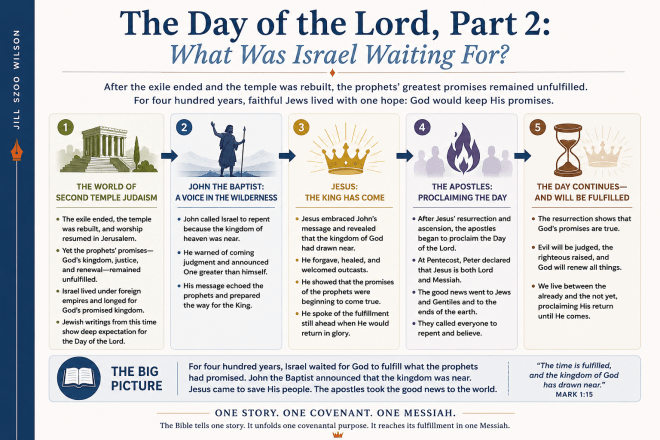
The World of Second Temple Judaism
The exile had ended, but Israel’s waiting had not. God’s people had returned to the land and rebuilt the temple, yet the prophets’ greatest promises still lay ahead.
Although the exile had ended, the return from Babylon might appear to fulfill the prophets’ promises. God’s people returned to the land, rebuilt the temple, resumed worship in Jerusalem, and once again celebrated the covenant festivals. Yet the prophets had envisioned far more than a geographical return from exile. Isaiah looked beyond the rebuilding of a city to the renewal of a people, the restoration of David’s kingdom, and the public reign of the Lord over all creation. Ezekiel anticipated a renewed covenant in which God would cleanse his people and give them new hearts. Zechariah declared that the Lord himself would become king over all the earth, and Malachi announced a messenger who would prepare the way for the Lord’s arrival. The return from Babylon demonstrated God’s covenant faithfulness, but it also revealed that Israel’s greatest hopes still lay ahead.
When the prophet Malachi finished writing, the voice of prophecy fell silent. For roughly four hundred years, no new prophetic books were added to Israel’s Scriptures. Those centuries are known as the Second Temple period because they began after the Jews returned from exile, rebuilt the temple, and resumed life in the land. They ended with the destruction of that same temple by the Romans in A.D. 70. The New Testament opens during this period, making it the historical bridge between the Old and New Testaments.
As those centuries unfolded, the political realities of Israel’s history only reinforced the conviction that the prophets’ greatest promises still awaited fulfillment. Israel lived under one foreign empire after another. The Persians gave way to the Greeks, and the Greeks eventually to Rome. No son of David returned to the throne, and the nations continued to dominate God’s people. Although the temple stood once again in Jerusalem, many faithful Jews believed they were still waiting for the restoration the prophets had described. They had returned from exile, yet the world looked very different from the one Isaiah, Ezekiel, Zechariah, and Malachi had envisioned.
That waiting shaped the theological world of first-century Judaism. Jewish teachers read the prophets carefully because they believed God’s decisive intervention still lay ahead. Different groups disagreed about many details, yet they shared a common conviction: the God of Israel had not abandoned his covenant. He would act. He would judge evil. He would vindicate his people. He would establish his kingdom. The Day of the Lord remained a future hope rather than a forgotten promise.
This expectation appears throughout Jewish literature written during the Second Temple period. Books such as 1 Enoch, the Psalms of Solomon, and portions of the Dead Sea Scrolls reflect communities wrestling with the prophets’ promises. These writings differ in important ways and should never be treated as Scripture. They do, however, provide a valuable window into the questions faithful Jews were asking. They continued to wait for the Lord to act, for the Messiah to appear, for the resurrection of the righteous, for the defeat of evil, and for the renewal of God’s people.
Understanding this world changes the way we read the opening pages of the New Testament. John the Baptist does not appear among people who have forgotten the prophets. He appears among people who have spent centuries waiting for them to be fulfilled. When he announces that the kingdom of heaven has drawn near, that the axe already lies at the root of the trees, and that one greater than himself is about to come with winnowing fork in hand, his audience already understands the language. The prophets have been teaching it for generations. The question is no longer whether the Lord will come. The question is whether Israel will recognize him when he does.
John the Baptist: Announcing the Arrival of the Day
After four centuries of prophetic silence, a voice suddenly cried out in the wilderness.
The Gospels introduce John the Baptist with remarkable simplicity because they assume their readers already understand why his arrival matters. Luke tells us that “the word of God came to John son of Zechariah in the wilderness” (Luke 3:2). Matthew identifies him with Isaiah’s prophecy: “A voice of one calling in the wilderness, ‘Prepare the way for the Lord’” (Matt. 3:3; Isa. 40:3). To modern readers, these verses often function as little more than historical introductions. To John’s first audience, they signaled that the prophetic silence had ended. God was speaking again.
John’s location also mattered. He preached in the wilderness, the very place where Israel had first become God’s covenant people after the Exodus from Egypt. The wilderness reminded Israel of both God’s faithfulness and her own failures. It was there that God provided manna, gave the Law at Sinai, and entered into covenant with his people. It was also there that Israel repeatedly grumbled, rebelled, and learned the consequences of unbelief. By calling the nation back into the wilderness, John symbolically called Israel back to the beginning of her covenant story. The nation needed more than political freedom from Rome. It needed spiritual renewal before the God who had redeemed it.
John’s message immediately confirms that this is his purpose. “Repent, for the kingdom of heaven has come near” (Matt. 3:2). Repentance, in the language of the prophets, means more than feeling sorry for sin. It means turning back to God with wholehearted covenant faithfulness. John is not asking Israel to begin a new religion. He is calling God’s covenant people to prepare for the arrival of the King they have been waiting for.
His warning becomes even more striking when crowds gather to hear him. “Who warned you to flee from the coming wrath?” he asks (Luke 3:7). To a reader unfamiliar with the prophets, the language seems severe. To someone shaped by Amos, Isaiah, Zephaniah, and Malachi, it sounds entirely familiar. The prophets had repeatedly described the Day of the Lord as a day when God would confront evil, expose hypocrisy, and judge covenant unfaithfulness. John announces that this long-awaited day is no longer a distant hope. It is approaching so quickly that Israel must prepare now.
The images John uses all come from that prophetic world. “The axe is already at the root of the trees,” he warns, “and every tree that does not produce good fruit will be cut down and thrown into the fire” (Luke 3:9). Later he describes the coming one holding “his winnowing fork…to gather the wheat into his barn, but he will burn up the chaff with unquenchable fire” (Luke 3:17). These are not random illustrations. The prophets had long described God’s coming as a refining fire that exposed genuine covenant faithfulness while consuming persistent rebellion. A farmer used a winnowing fork to toss harvested grain into the air. The valuable kernels fell back to the ground while the lighter chaff blew away. John’s audience immediately understood the picture. The coming of the Lord would reveal what was genuine and what was empty.
John’s practice of baptism belongs within this same context. Jewish people were already familiar with ritual washing. The Law required various forms of washing after certain kinds of ritual impurity, and many Jewish communities practiced regular immersion as an expression of ceremonial cleanliness. John’s baptism, however, carries a different emphasis. He calls people to a public baptism of repentance because the decisive moment the prophets had announced is now at hand. Baptism becomes an outward declaration that a person is turning back to God in preparation for his coming. John’s ministry is therefore thoroughly Jewish. He is calling Israel to renew her covenant faithfulness before the Lord acts in history.
Yet John never presents himself as the center of the story. “I baptize you with water,” he says, “but after me comes one who is more powerful than I” (Matt. 3:11). Everything John does points beyond himself. His preaching prepares the way. His baptism prepares the people. His warnings prepare Israel for judgment. Like the prophets before him, John understands that the story has always been moving toward the arrival of the Lord himself.
Here the Gospels make their astonishing claim. The one whose coming John announces is Jesus of Nazareth. The prophets had spent centuries teaching Israel to expect the Day when the Lord would come to judge evil, fulfill his covenant promises, and establish his kingdom. John announces that this long-awaited moment has arrived. The New Testament does not abandon the prophets’ expectation. It identifies the person through whom those promises begin to unfold.
Jesus immediately picks up John’s announcement: “The time is fulfilled, and the kingdom of God has come near.” His ministry demonstrates that the kingdom promised by the prophets has entered history. In Jesus, the coming of God’s kingdom is no longer only a future expectation. The reign the prophets anticipated has begun to break into history through the Messiah himself. His miracles, teaching, and authority all testify that God has begun fulfilling the promises Israel had long awaited. Yet Jesus also speaks repeatedly of a future day when the Son of Man will judge the nations and establish his kingdom in its fullness. The kingdom has drawn near, but the story is not yet complete.
The Apostles: Announcing the Fulfillment of Israel’s Hope
Jesus’ resurrection and ascension did not mark the end of Israel’s story. They explained why the apostles proclaimed Jesus with such confidence. Throughout Acts, their sermons return to the same conviction: the God who spoke through Moses and the prophets has acted decisively in raising and exalting Jesus. They do not announce a new religion or a new understanding of God’s purposes. They proclaim that Israel’s long-awaited Messiah now reigns and that the covenant story has entered its decisive stage.
Luke makes this continuity clear in the opening chapter of Acts. Standing once again on the Mount of Olives, the disciples ask the risen Jesus, “Lord, will you at this time restore the kingdom to Israel?” (Acts 1:6). Readers sometimes assume the disciples have misunderstood Jesus, as though they still expect an earthly kingdom while he intends something entirely different. Luke presents the conversation more carefully. Jesus does not tell them that the prophets were wrong or that Israel’s hope has been replaced. Instead, he tells them that the timing belongs to the Father. Their responsibility is different. They are to become witnesses “in Jerusalem, and in all Judea and Samaria, and to the ends of the earth” (Acts 1:8). The kingdom remains God’s promise. The apostles’ task is to announce the King.
That mission begins at Pentecost. When the Holy Spirit descends upon the gathered believers, Peter immediately explains what is happening by quoting the prophet Joel. Joel had promised that, before the great and glorious Day of the Lord, God would pour out his Spirit upon his people (Joel 2:28–32). Peter does not search for a new explanation. He reaches back into the prophets because they have already taught him how to understand the moment. The gift of the Spirit announces that God’s promised age has begun. Peter therefore concludes his sermon by proclaiming that God has made the crucified Jesus “both Lord and Messiah” (Acts 2:36). The resurrection has revealed the identity of the King whom the prophets anticipated.
As the gospel spreads beyond Jerusalem, the apostles discover that the prophets’ promises extend farther than they had imagined. In Acts 10, Peter enters the home of the Roman centurion Cornelius after receiving a vision that overturns his understanding of ritual purity. At first, Peter believes the vision concerns food. He soon realizes that God is teaching him something much greater. The covenant blessings promised through Abraham were always intended to reach the nations. When the Holy Spirit falls upon Cornelius and his household, Peter recognizes that God’s saving work now embraces Gentiles as well as Jews. Isaiah’s vision of the nations coming to the God of Israel has begun to unfold before his eyes.
Paul carries that same message into the Gentile world. His address before the philosophers of Athens provides a remarkable example of how the apostles proclaimed Israel’s hope to people who had never read Israel’s Scriptures. Paul begins with creation because that is common ground between himself and his audience. Yet his sermon arrives at the same destination as Peter’s. God now “commands all people everywhere to repent” because “he has fixed a day on which he will judge the world in righteousness by a man whom he has appointed” (Acts 17:30–31). Notice that Paul still speaks of a future day of judgment. The resurrection has not eliminated the prophets’ expectation. It has revealed the identity of the Judge. The Day toward which the prophets pointed still lies ahead, but the world now knows who will preside over it.
This perspective explains why the apostles constantly quote the Law, the Prophets, and the Psalms. They never present themselves as founders of a new religious movement. They believe they are witnesses to the fulfillment of Israel’s Scriptures. Their mission grows naturally out of the covenant God who first called Abraham, descended upon Sinai, spoke through the prophets, and finally revealed his Messiah. The story has not changed. It has reached its decisive turning point.
Conclusion
The expression “the Day of the Lord” first appears in the prophets, but the story behind that phrase begins much earlier. It begins at Sinai, where Israel first learned what it meant for the living God to descend among his people. From that moment forward, the biblical authors repeatedly returned to the same pattern. The God who established his covenant would one day come again. Amos taught that his coming would expose covenant unfaithfulness. Isaiah expanded that vision until it embraced every nation and the whole created order. The later prophets added still more detail, until the Day of the Lord became Israel’s great hope for the future.
By the first century, faithful Jews had spent generations waiting for the Day the prophets had proclaimed. They had returned from Babylon, rebuilt the temple, and resumed life in the land, yet they continued reading the Scriptures because they believed God’s greatest promises still lay ahead. John the Baptist entered that world announcing that the waiting was drawing to an end. Jesus proclaimed that the kingdom had drawn near, demonstrated its arrival through his ministry, and revealed himself as the Messiah through whom God’s promises were being fulfilled. The apostles announced his resurrection and exaltation because they believed God had publicly identified the King who would one day judge the world in righteousness.
From Sinai to Revelation, the story never changes. The covenant God who descended upon the mountain, spoke through the prophets, and sustained Israel’s hope throughout the Second Temple period is the same God who acted decisively in Jesus the Messiah. The New Testament, therefore, introduces no fundamentally new theological category. It proclaims that the story God began telling through the Torah, the Prophets, and the Writings has entered its climactic chapter. The Day of the Lord remains the fulfillment of Israel’s covenant hope, now revealed in the Messiah who has come, who reigns, and who will return to complete everything the prophets foretold. The Bible tells one story. It unfolds one covenantal purpose. It reaches its fulfillment in one Messiah.
One Story. One Covenant. One Messiah explores a simple but far-reaching conviction: the New Testament introduces no fundamentally new theological categories. Instead, it continually reaches back into the Torah, the Prophets, and the Writings with extraordinary density, depth, and intentionality. Rather than beginning a new theological story, the New Testament proclaims the ongoing covenantal and messianic fulfillment of Israel’s Scriptures.
If you’re new to the series, these essays provide a helpful foundation:
- The Son of Man in the Tanakh: Why Jesus Called Himself the Son of Man
- The New Testament Was Written by Second Temple Jews
- One Root. Many Branches. Paul’s Answer in Romans 11
- The Day of the Lord, Part 1: Why the Prophets Expected God to Come Again
Each essay traces another thread of Scripture, revealing how the New Testament builds upon the theological world of Israel rather than replacing it.
New here? Visit the About Jill Szoo Wilson page to learn more about my work, or continue exploring my theology series, theatre essays, Meta-Absurdism, communication, and vocation.






Leave a Reply