The Day of the Lord, Part 1: Why the Prophets Expected God to Come Again

By Jill Szoo Wilson

Have you ever wondered why the New Testament writers so often assume their readers already know what they’re talking about?

One Story. One Covenant. One Messiah is an ongoing series exploring how the Torah, the Prophets, and the Writings shape every page of the New Testament through the lens of Second Temple Judaism and first-century Jewish thought. Rather than treating the New Testament as the beginning of a new theological system, these essays trace the continuity of God’s covenant purposes from Sinai to the Messiah. Readers new to the series may wish to begin with The Son of Man in the Tanakh: Why Jesus Called Himself the Son of Man and The New Testament Was Written by Second Temple Jews, and One Root. Many Branches. Paul’s Answer in Romans 11, which introduces the central themes developed throughout the series.


The expression Yom YHWH, the Hebrew phrase translated “the Day of the Lord,” appears throughout the prophetic books of the Hebrew Bible and stands at the center of the preaching of John the Baptist, Jesus, the apostles, and the book of Revelation. Yet many Christians associate the phrase almost exclusively with the end of the world or the return of Christ. The story begins much earlier.

For the prophets, the Day of the Lord is not simply a future catastrophe or a final judgment. It is the moment when the God of Israel openly reveals himself in history to judge evil, rescue his people, establish justice, and make his kingship known over all creation. It is one of Scripture’s great unifying themes, weaving together Israel’s covenant story, the hope of the prophets, the expectations of Second Temple Judaism, and the proclamation of the New Testament.

To understand the Day of the Lord, however, we must begin long before the prophets first used the phrase. The language itself appears in the prophetic books, but the pattern that gives it meaning reaches back to Israel’s covenant at Mount Sinai. There, the Lord descended upon the mountain in cloud, fire, thunder, earthquake, and the sound of a trumpet as he established his covenant with the people he had redeemed from Egypt. For Israel, Sinai became the defining revelation of what it looked like when the living God came among his people. Centuries later, when the prophets proclaimed the Day of the Lord, they reached instinctively for the imagery of Sinai because it provided the pattern through which Israel understood God’s future coming.

As Israel’s history unfolded, the prophets looked back to Sinai while also looking beyond it. The God who had once descended upon one mountain to establish his covenant would one day reveal himself again, this time before all nations. His coming would confront human rebellion, judge evil, rescue his people, and establish his reign over the whole earth.

With each generation, the prophets expanded that vision. What began at Sinai as Israel’s experience of God’s covenant Lord coming among his people became the hope that he would one day come again to fulfill his covenant promises, judge evil, and establish his righteous kingdom. By the close of the prophetic era, the Day of the Lord had become one of Israel’s defining hopes.

That hope did not disappear when prophecy ceased. During the Second Temple period, faithful Jews continued reading the prophets, discussing their promises, and waiting for God to fulfill them. By the time the New Testament begins, generations of Israelites had been living in expectation of the Day the prophets had proclaimed. This first essay traces how that expectation developed from Sinai through the prophets. The next essay will explore how that prophetic hope shaped the world into which John the Baptist, Jesus, and the apostles began proclaiming the kingdom of God.

From Sinai to the Prophets

Although the expression Yom YHWH, “the Day of the Lord,” first appears in the prophetic books, the ideas that give the phrase its meaning begin much earlier. To understand why the prophets expected the Lord to come again, we must first understand what happened when he came the first time. That story begins at Mount Sinai.

Only a few weeks after Israel’s deliverance from Egypt, the Lord brought the newly redeemed nation to Mount Sinai to establish his covenant with them (Exod. 19). In the ancient world, a covenant was more than a promise. It established a binding relationship between a king and his people, defining both the king’s obligations and the people’s responsibilities. At Sinai, Israel did not simply receive a collection of religious laws. They entered into a covenant with the God who had rescued them from slavery. Before the Law was given, the Lord announced that he himself would descend upon the mountain in the sight of all the people. Israel was instructed to wash its garments, consecrate itself, and remain outside the boundaries surrounding the mountain because the nation was preparing to meet its holy King.

Exodus slows its narrative when that moment arrives. “On the morning of the third day there was thunder and lightning, with a thick cloud over the mountain, and a very loud trumpet blast. Everyone in the camp trembled” (Exod. 19:16). Smoke covered the mountain because “the Lord descended on it in fire” (19:18). The mountain shook violently, and the trumpet grew louder and louder until the Lord spoke from within the cloud. Moses does not describe these details simply to create drama. Each detail reveals something about the God who has come to meet his people.

Fire throughout Scripture regularly accompanies God’s holy presence. It both illuminates and consumes, revealing a God whose holiness cannot be approached casually. The thick cloud both reveals and conceals him. Israel knows the Lord has descended, yet his full glory remains hidden from human sight. The trumpet announces the arrival of the divine King, much as a royal procession in the ancient world was announced before the ruler appeared. Even the mountain trembles. Creation itself responds because its Creator has drawn near.

These details became enormously important because they shaped Israel’s understanding of what it meant for the Lord to come among his people. Every later generation learned this story. Parents told it to their children. Priests read it publicly. Prophets assumed their audiences knew it by heart. Whenever an Israelite heard of a cloud, fire, trumpet blast, earthquake, darkness, or the trembling of the earth, Sinai immediately came to mind. These were no longer merely descriptions of one historical event. They had become Israel’s language for describing the coming of the Lord.

This explains why the prophets repeatedly return to Sinai when they speak about the future. They do not invent an entirely new picture of God’s coming. They describe the future using the imagery Israel already knows. The God who once descended upon one mountain will one day reveal himself again before all nations. His future coming will be greater in scope, but it will reveal the same holy God acting with the same covenant faithfulness.

Moses himself points Israel in this direction before his death. In his final blessing, recorded in Deuteronomy 33, he recalls the Lord’s appearance at Sinai in language that already reaches beyond the wilderness generation: “The Lord came from Sinai and dawned over them from Seir; he shone forth from Mount Paran. He came with myriads of holy ones, with flaming fire at his right hand” (Deut. 33:2). Moses is remembering the covenant at Sinai, yet he describes the Lord as a victorious king advancing across the landscape surrounded by the armies of heaven. The historical event has become a pattern. The God who came once is also the God who will come again.

When the prophets begin speaking about the Day of the Lord, Israel already possesses the theological vocabulary necessary to understand them. They know what it looks like when the Lord appears. They know that his coming reveals holiness, demands covenant faithfulness, and causes creation itself to respond. The prophets are not introducing a new vision of God’s coming. They are calling Israel to remember the God who had already come at Sinai. Before they announce the Day of the Lord, Scripture has already taught Israel what it means for the Lord to come.

Amos: When the Day of the Lord Becomes a Warning

By the eighth century B.C.E., nearly seven hundred years had passed since Israel stood at Mount Sinai. The nation was now divided into two kingdoms. Amos ministered in the northern kingdom of Israel during the reign of Jeroboam II, a period of remarkable prosperity. Israel’s borders had expanded, trade flourished, and the economy was strong. The sanctuaries at Bethel and Gilgal remained busy with worshipers bringing sacrifices to the Lord. By every outward measure, Israel appeared to enjoy God’s blessing.

Under these circumstances, it is easy to understand why many Israelites longed for the Day of the Lord. If the Lord had once descended upon Sinai to establish his covenant, surely he would come again to defend his covenant people. They expected a day when God would defeat Israel’s enemies, vindicate his chosen nation, and establish his rule over the surrounding kingdoms. The Day of the Lord was the fulfillment of Israel’s hope.

Amos overturns that expectation with a single announcement.

“Woe to you who long for the day of the Lord!” he declares. “Why do you long for the day of the Lord? That day will be darkness, not light” (Amos 5:18).

The force of Amos’s words is easy to miss because many modern readers encounter the phrase “Day of the Lord” for the first time in his book. Israel did not. They already understood what it meant for the Lord to come among his people. Amos does not overturn the expectation that the Lord will come. He overturns the assumption that his coming will automatically favor Israel simply because she belongs to the covenant.

To explain this reversal, Amos paints a series of unforgettable pictures. A man escapes from a lion only to encounter a bear. Somehow he survives that attack, reaches the apparent safety of his own home, leans against the wall to catch his breath, and is bitten by a snake (Amos 5:19). Every place of refuge becomes another place of danger because the true problem is not outside the house. It lies within Israel herself. The nation has spent years assuming that military success, economic prosperity, and religious activity prove God’s approval. Amos insists that they prove no such thing.

The prophet then explains why. Speaking through Amos, the Lord declares, “I hate, I despise your festivals… Even though you bring me burnt offerings and grain offerings, I will not accept them” (Amos 5:21–22). To modern readers, these words can sound almost contradictory. After all, had not God himself commanded these sacrifices through Moses? He had. The problem was never the sacrificial system. The problem was that Israel continued to perform the rituals of the covenant while neglecting the covenant itself.

This distinction is essential. At Sinai, the Lord did not redeem Israel merely so they could offer sacrifices. He redeemed them so they could become a holy nation reflecting his character before the world (Exod. 19:5–6). Their worship, their justice, and their daily lives all belonged to the covenant. When Israel oppressed the poor while faithfully observing the religious calendar, they divided what God had joined together. Their sacrifices continued, but their covenant faithfulness had disappeared.

Now Amos reaches the heart of the matter with one of the best-known verses in the prophetic literature: “Let justice roll down like waters, and righteousness like an ever-flowing stream” (Amos 5:24). Justice and righteousness are not alternatives to worship. They are the evidence that worship has become genuine. Israel’s festivals, songs, and sacrifices were meant to express covenant faithfulness. When that faithfulness disappeared, the rituals themselves became empty.

Amos therefore transforms Israel’s understanding of the Day of the Lord. At Sinai, the Lord came to establish his covenant with a redeemed people. In Amos, the Lord comes to examine that covenant. The Day of the Lord becomes the moment when the covenant King evaluates whether his people have remained faithful to the covenant he established. It exposes the difference between outward religion and genuine covenant faithfulness. Membership in Israel alone offers no protection if Israel herself has abandoned the God who redeemed her.

Amos establishes one of the defining principles of the prophetic tradition. Before the Day of the Lord brings salvation, it brings judgment. Before it vindicates God’s people, it reveals who truly belongs to him. Every prophet who follows Amos builds upon this foundation, enlarging the vision until the Day of the Lord encompasses not only Israel but every nation and, ultimately, the whole creation.

Isaiah: The Day the Whole World Belongs to the Lord

If Amos corrects Israel’s understanding of the Day of the Lord, Isaiah enlarges it. Amos teaches that God’s coming begins with covenant accountability. Isaiah asks a different question: What happens when the God of Israel comes to reign over the whole world? His answer transforms the Day of the Lord from a warning directed primarily at Israel into the great hope toward which all history is moving.

Isaiah began his ministry in Jerusalem during the second half of the eighth century B.C.E., when the Assyrian Empire was rapidly becoming the dominant power of the ancient Near East. City after city fell before its armies. Smaller nations survived only by making political alliances or paying tribute to stronger kingdoms. In this world, military strength appeared to determine the future. Every empire credited its victories to its own gods, and every king sought security through armies, wealth, and diplomacy. Isaiah looked beyond these shifting political realities and announced a startling truth: history ultimately belonged neither to Assyria nor to Judah. It belonged to the Lord. The Day of the Lord would reveal that every human kingdom stood beneath the authority of Israel’s God.

Isaiah introduces this vision in chapter 2. “The Lord Almighty has a day in store for all the proud and lofty” (Isa. 2:12). As the chapter unfolds, Isaiah names everything people trust instead of God. He speaks of the cedars of Lebanon, famous throughout the ancient world for their height and strength. He mentions fortified walls, merchant ships, accumulated wealth, military power, and idols crafted by human hands. At first glance, these images seem unrelated, yet together they describe every place human beings seek security apart from their Creator. Some trust political power. Others trust economic prosperity. Still others trust military strength or religious idols. Isaiah gathers them all into one picture because the Day of the Lord exposes every false foundation on which humanity attempts to build its future.

The climax of the chapter explains why. “The arrogance of man will be brought low and human pride humbled; the Lord alone will be exalted in that day” (Isa. 2:17). Isaiah is no longer speaking only about Israel’s covenant faithfulness. He is speaking about the entire human race. The Day of the Lord reveals who truly governs history. Every rival authority eventually gives way before the kingship of the Lord.

Isaiah develops this theme further in chapter 13, where the language becomes strikingly cosmic. “The stars of heaven and their constellations will not show their light. The rising sun will be darkened and the moon will not give its light” (Isa. 13:10). Modern readers often wonder whether Isaiah is describing literal astronomical events. Before asking that question, however, it helps to understand how the prophets used this kind of language. Throughout the ancient Near East, the sun, moon, and stars represented stability, permanence, and authority. Nations associated heavenly bodies with the gods they worshiped, while kings often claimed that their rule reflected the order of the heavens. Isaiah announces that when the Lord comes, every competing claim to authority will fade before the Creator himself. The created order responds because the One who established it has entered history as its rightful King.

Yet judgment is only half of Isaiah’s vision. The Lord comes to remove evil because he intends to restore his creation. In chapter 11, Isaiah introduces a figure who stands at the center of that restoration: “A shoot will come up from the stump of Jesse” (Isa. 11:1). Jesse was the father of King David. By Isaiah’s day, David’s royal house appeared to have been cut down like a tree felled in the forest. Isaiah’s image is therefore deliberate. Although the Davidic kingdom appears dead, God will cause new life to emerge from what seems like a lifeless stump. The promised king will rule with perfect justice because “the Spirit of the Lord will rest on him” (11:2). Under his reign, the scattered people of Israel will be gathered, justice will replace oppression, and peace will characterize the created order itself. Isaiah’s famous picture of the wolf dwelling with the lamb expresses more than harmony among animals. It portrays a creation finally restored to the peace God intended from the beginning.

This restoration unfolds through another image that becomes increasingly important throughout the prophets: a Second Exodus. Israel’s first exodus brought God’s people out of slavery in Egypt and into covenant at Sinai. Isaiah now promises an even greater act of redemption. God will gather his dispersed people from the nations just as he once gathered them from Egypt. Rivers will once again divide before them. A highway will appear through the wilderness. The language deliberately echoes the book of Exodus because Isaiah wants his readers to understand that Israel’s first redemption pointed beyond itself. God was preparing his people to expect another act of deliverance that would surpass the first.

By the close of the prophetic era, the Day of the Lord had become one of Israel’s defining hopes. The prophets had expanded the pattern first revealed at Sinai into a sweeping vision of God’s future intervention in history. He would judge evil, vindicate his people, establish his kingdom, and renew creation. Yet when the prophetic voice fell silent, those promises remained unfulfilled. The story therefore did not end with Malachi. It entered a long period of waiting that shaped the world into which Jesus was born.

Part II will be posted soon!
The Son of Man in the Tanakh: Why Jesus Called Himself the Son of Man

By Jill Szoo Wilson

The Messiah Israel Expected

Among the central claims of the New Testament is the declaration that Jesus of Nazareth is the Messiah. Yet neither Jesus nor His earliest followers invented that category. The title emerged from centuries of Israel’s covenant history and carried with it a network of expectations shaped by the Tanakh, the Hebrew Scriptures later known to Christians as the Old Testament. When the apostles proclaimed Jesus as Messiah, they were identifying Him as the fulfillment of promises already embedded within Israel’s Scriptures.

The Hebrew word Mashiach, usually translated “Messiah,” means “anointed one.” Throughout Israel’s history, priests and kings were anointed with oil as a visible sign that God had appointed them for service among His covenant people. The act symbolized divine authorization, identifying a person as one whom God had appointed to serve a particular role within Israel’s covenant life. As Israel’s story unfolded, the Scriptures increasingly directed attention toward a future figure through whom God would restore His people, establish His kingdom, defeat evil, and bring His covenant promises to their appointed fulfillment.

Several prophetic streams contributed to this expectation. Moses promised that God would raise up a prophet like himself who would speak God’s words with unique authority and mediate between God and His people (Deuteronomy 18:15). Yet the Torah closes by observing that no prophet had arisen in Israel like Moses (Deuteronomy 34:10), leaving the promise awaiting fulfillment.

A second stream emerged through God’s covenant with David. The Lord promised that David’s throne would endure and that one of his descendants would establish an everlasting kingdom (2 Samuel 7:12–16). Later prophets returned repeatedly to this promise, envisioning a future ruler who would reign in righteousness, restore Israel, and bring justice to the nations (Isaiah 9:6–7; Jeremiah 23:5–6).

The Psalms deepened these royal expectations. Psalm 2 portrays the Lord’s anointed king receiving authority over the nations, while Psalm 110 depicts a ruler invited to sit at God’s right hand until all enemies are subdued. At the same time, Isaiah introduced another dimension to Israel’s hope through visions of a Spirit-anointed servant who would bring justice, healing, restoration, and redemption (Isaiah 42:1–7; 61:1–3). By the close of the Second Temple period, many Jews expected God to send a decisive deliverer who would fulfill these promises, defeat evil, restore His people, and establish His kingdom.

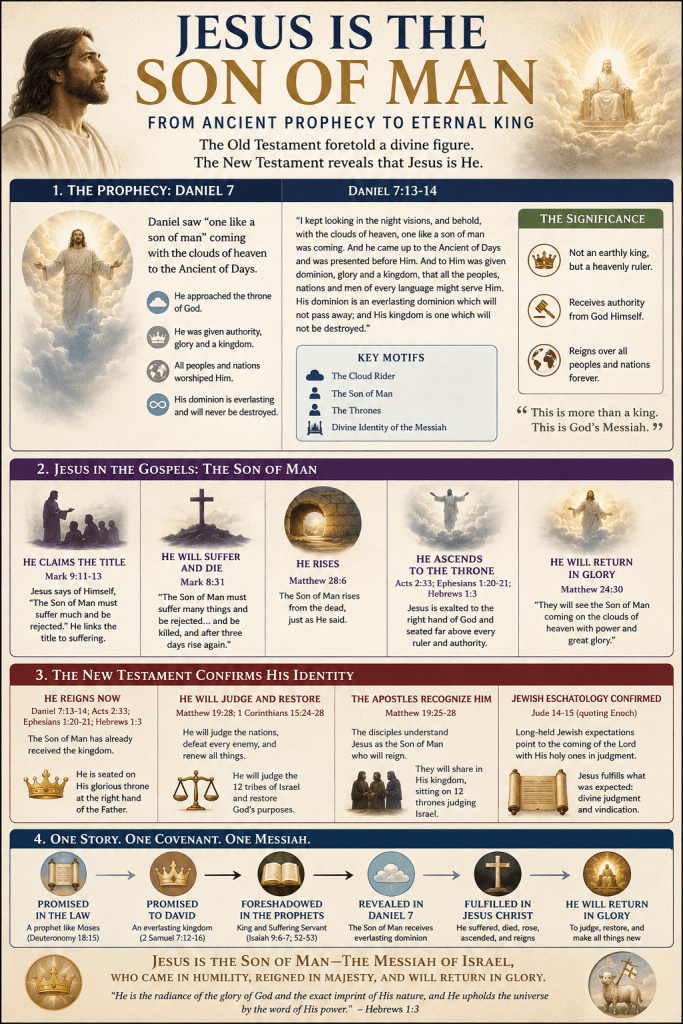
Alongside these familiar messianic expectations stood another figure whose significance grew steadily during the centuries leading up to the New Testament. In Daniel 7, the prophet describes “one like a son of man” approaching the Ancient of Days, a title that emphasizes God’s eternal rule over history. This figure receives authority, glory, and an everlasting kingdom so that all peoples and nations come under his dominion.

For many readers, Daniel’s vision raises immediate questions. Who is this ruler? Why does he receive authority directly from heaven rather than inheriting it through an earthly dynasty? And why does Daniel describe him using imagery that echoes passages elsewhere in Scripture associated with the presence and authority of God Himself?

These questions became increasingly important during the Second Temple period, the centuries leading up to the time of Jesus. As foreign empires continued to dominate the Jewish people, many looked to Daniel’s vision for hope. The Son of Man came to represent far more than another Davidic king. He became associated with God’s final victory over evil, the judgment of oppressive kingdoms, the restoration of God’s people, and the establishment of a kingdom that would never end.


Against this backdrop, one feature of Jesus’ ministry stands out. Although the Gospels identify Him as Messiah, Son of David, Rabbi, and Son of God, Jesus most often refers to Himself as the Son of Man. He uses the title when speaking about His authority, His suffering, His resurrection, His future return, and the coming kingdom of God. Understanding why Jesus chose this title opens a window into how He understood His own mission and how the New Testament understands the fulfillment of Israel’s story.

Daniel’s Vision of the Son of Man

The title Son of Man comes from one of the most important visions in the book of Daniel. Daniel receives this vision during the Babylonian exile, a period when God’s people lived under foreign rule, and many wondered how God’s promises to Israel would ultimately be fulfilled. Powerful empires controlled the world. Jerusalem had fallen. The temple had been destroyed. The question facing God’s people was straightforward: if the God of Israel truly ruled history, why did pagan kingdoms continue to dominate His people?

Daniel’s vision answers that question through a series of vivid images. He sees four great beasts rising from the sea. Later in the chapter, Daniel learns that these beasts represent kingdoms that exercise authority over the earth. The imagery is intentionally unsettling. Human governments appear as powerful animals rather than noble rulers. Daniel’s vision reveals that history unfolds simultaneously on earthly and heavenly stages. While empires rise, wage war, and exercise power on earth, the heavenly court remains in session above them. The vision emphasizes that political events never exist apart from God’s sovereign rule and judgment.

As the vision unfolds, Daniel’s attention shifts from earth to heaven. Thrones are placed in position, and the Ancient of Days takes His seat. The title emphasizes God’s eternal existence and sovereign authority. Human rulers govern for a season before passing from the stage of history. Empires rise and fall. Generations come and go. The God of Israel remains enthroned above them all.

Daniel then watches as a heavenly court convenes. Judgment begins. The beasts that appeared so powerful at the beginning of the vision suddenly stand accountable before a higher authority. The future of the nations rests in the hands of God.

At this point, a new figure enters the vision. Daniel sees “one like a son of man” coming with the clouds of heaven (Daniel 7:13). The description immediately creates a contrast with everything that has come before. The kingdoms of the world appeared as beasts. This ruler appears as a human being. The beasts seized power through violence. The Son of Man receives authority from God. The beasts devoured nations. The Son of Man receives a kingdom intended to endure forever. Throughout the vision, Daniel presents the Son of Man as the answer to the failed rule of the beasts.

Daniel then watches as the Son of Man approaches the Ancient of Days and receives authority, glory, and kingship. The result is extraordinary: all peoples, nations, and languages come under his rule. His kingdom will never be destroyed, and his dominion will never pass away.

One detail in the vision deserves special attention. Daniel does not simply describe the Son of Man receiving a kingdom. He describes him arriving “with the clouds of heaven.” To modern readers, that detail can appear incidental. To readers familiar with the rest of the Old Testament, it would have stood out immediately.

Throughout the Old Testament, cloud imagery is closely associated with the presence and authority of God. The Lord descends upon Mount Sinai in a cloud, leads Israel through the wilderness by a pillar of cloud, and fills both the tabernacle and the temple with His glory. Israel’s poets even celebrate the Lord as the one who rides upon the clouds of heaven. Daniel, therefore, presents more than a human ruler receiving a kingdom. The Son of Man participates in imagery traditionally associated with the God of Israel Himself.

The Son of Man in Second Temple Judaism

Daniel’s vision did not remain confined to the pages of Scripture. During these centuries, Daniel’s vision became a focal point for Jewish reflection on God’s future kingdom. Foreign powers continued to dominate the Jewish people. Although Israel had returned from exile and rebuilt the temple, the great promises of restoration described by the prophets still awaited fulfillment. Daniel’s vision offered hope that God remained sovereign over history and would one day establish His kingdom over every earthly power.

This period is commonly called Second Temple Judaism because it stretches from the rebuilding of the temple after the Babylonian exile until its destruction by Rome in A.D. 70. It includes the lifetime of Jesus, His disciples, and the earliest Christian movement. During these centuries, many Jews returned repeatedly to Daniel’s writings as they wrestled with questions about Israel’s future. They asked many of the same questions readers ask today. Who is the Son of Man? When will God’s kingdom arrive? How will evil finally be defeated? Daniel’s vision became one of the central texts through which many Jews understood God’s future intervention in history.

Among the most significant examples appears in the Book of Enoch, a collection of Jewish writings that circulated widely during the centuries before and during the time of Jesus. Several sections portray a heavenly Son of Man who receives authority from God, judges wicked rulers, vindicates the righteous, and presides over the final establishment of God’s kingdom. Enoch is not part of the biblical canon, yet it provides valuable insight into how many Jews understood Daniel’s vision during the first century. By the time Jesus began His public ministry, the Son of Man had become associated with God’s coming judgment, the defeat of evil, the vindication of God’s people, and the arrival of His everlasting kingdom.

This broader interpretive tradition helps explain why Daniel 7 occupied such an important place within Jewish expectation. The Son of Man was far more than a poetic description of humanity. He increasingly functioned as a figure associated with heavenly authority, divine judgment, covenant fulfillment, and God’s ultimate victory over the kingdoms of the world. Daniel’s vision had become part of Israel’s larger hope for the future.

The New Testament itself provides evidence of this interpretive environment. The Epistle of Jude cites a prophecy attributed to Enoch concerning the Lord’s coming judgment: “Behold, the Lord comes with ten thousands of his holy ones, to execute judgment on all” (Jude 14–15). Jude’s citation does not place Enoch on the same level as Scripture, but it demonstrates that Jewish believers remained familiar with traditions that developed around Daniel’s apocalyptic vision. Themes such as heavenly judgment, angelic hosts, the defeat of evil, and the coming kingdom formed part of the theological world inhabited by Jesus and His earliest followers.

By the first century, therefore, Daniel’s Son of Man carried far greater significance than the phrase might suggest to a modern reader. The title evoked expectations of heavenly enthronement, divine judgment, covenant fulfillment, and the arrival of God’s kingdom. When Jesus repeatedly identified Himself as the Son of Man, He was not selecting an obscure expression. He was placing Himself within one of the most powerful and recognizable prophetic visions in Israel’s Scriptures and within one of the most influential streams of Jewish expectation.

Jesus Claims Daniel’s Identity

Against this backdrop, Jesus’ repeated use of the title Son of Man takes on extraordinary significance. The phrase appears more than eighty times in the Gospels and serves as Jesus’ preferred description of Himself. While others call Him Messiah, Son of David, Rabbi, or Son of God, Jesus consistently returns to the title rooted in Daniel’s vision.

The most revealing example occurs during His trial before the high priest. Asked directly whether He is the Messiah, the Son of God, Jesus responds by combining two of the most significant messianic texts in Israel’s Scriptures. Drawing from Psalm 110 and Daniel 7, He declares, “From now on you will see the Son of Man seated at the right hand of Power and coming on the clouds of heaven” (Matthew 26:64).

The force of this statement becomes clear only when both passages are considered together. Psalm 110 portrays a royal figure invited to sit at God’s right hand until all enemies are placed beneath his feet. Daniel 7 depicts the Son of Man approaching the Ancient of Days, receiving everlasting dominion, and ruling over all nations. By combining these texts, Jesus identifies Himself as the ruler who shares in God’s authority, receives God’s kingdom, and exercises God’s judgment over the world.

Just as significant is the direction of the prophecy. Jesus does not merely claim that He will someday appear in glory. He tells the members of the Sanhedrin that they themselves will witness the vindication of the Son of Man. The judges seated before Him believe they possess authority over His fate. Jesus responds by declaring that history is moving toward a moment when their authority will be eclipsed by His own. The accused stands before the court, announcing that He is the figure Daniel saw receiving the kingdom.

The high priest immediately tears his garments and accuses Jesus of blasphemy. This reaction is often misunderstood. The controversy does not arise because Jesus claims to be human. Nor does it arise merely because He claims to be the Messiah. First-century Judaism knew of various messianic expectations, and other messianic claimants would appear during this period. The crisis emerges because Jesus places Himself within Daniel’s heavenly vision and applies to Himself the cloud-riding imagery associated throughout Israel’s Scriptures with the authority of God. The Son of Man receives everlasting dominion, exercises judgment over the nations, and participates in imagery traditionally reserved for the Lord Himself. Jesus does not merely claim a royal office. He claims Daniel’s identity.

The same pattern appears throughout the Gospels. When Jesus forgives sins, He declares that “the Son of Man has authority on earth to forgive sins” (Mark 2:10). When He speaks of the coming judgment, He describes the Son of Man seated upon a glorious throne with all nations gathered before Him (Matthew 25:31–32). When He predicts His return, He again draws directly from Daniel’s language, declaring that the Son of Man will come with power and great glory upon the clouds of heaven (Matthew 24:30). In each case, Jesus presents Himself as the figure Daniel saw approaching the heavenly throne.

This explains why the title Son of Man ultimately carries greater theological weight than many of the other messianic titles found in the New Testament. Son of David emphasizes royal descent. Prophet recalls Moses. Servant evokes Isaiah. Son of Man gathers all of these themes into a single figure while simultaneously placing that figure within Daniel’s vision of heavenly enthronement and everlasting dominion. No other title so comprehensively unites Israel’s prophetic, royal, covenantal, and apocalyptic expectations.

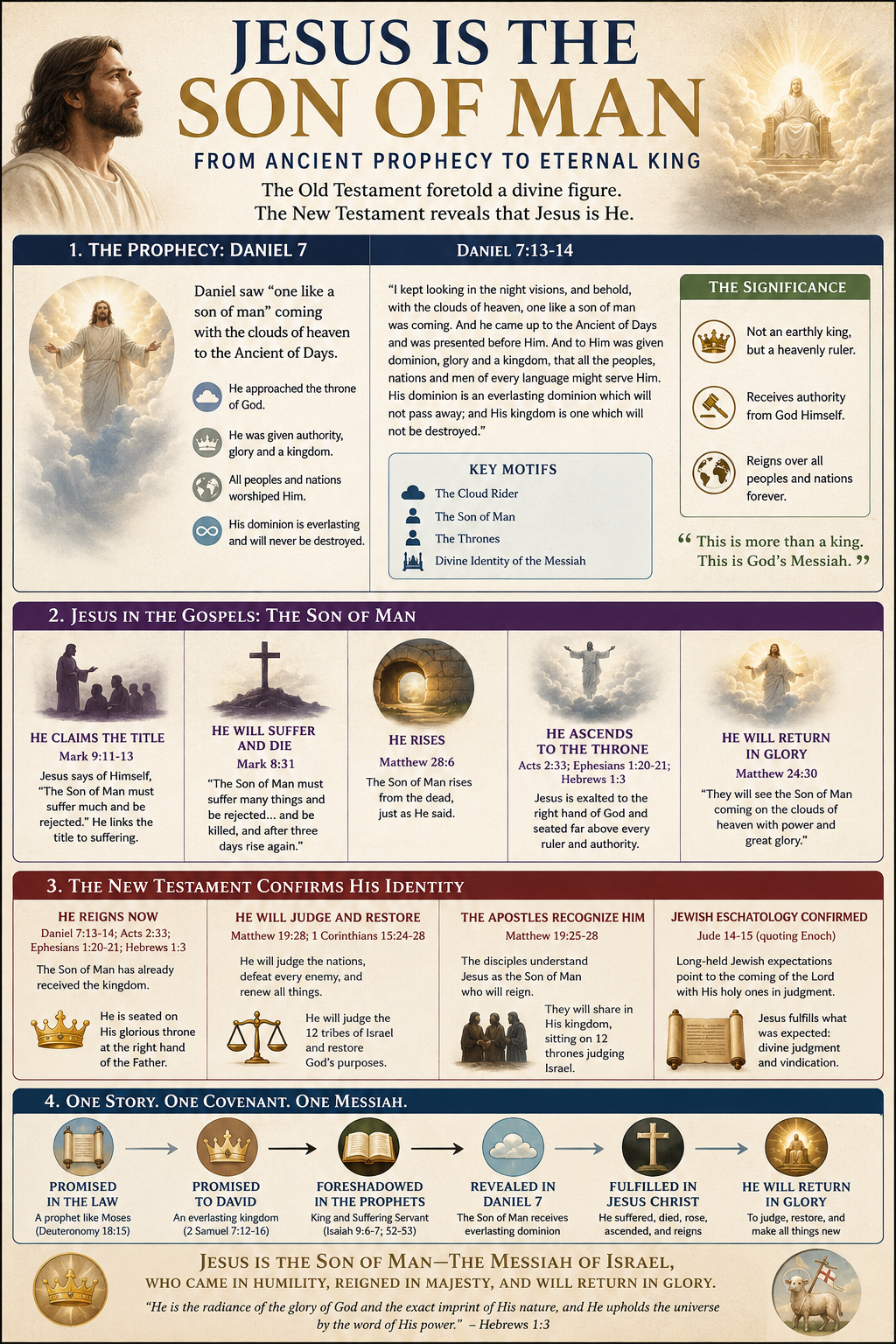
Before moving forward, it may be helpful to visualize how Daniel’s vision, Jewish expectation, and Jesus’ own claims fit together within a single messianic framework.

The Son of Man Must Suffer

By the time Jesus began His public ministry, many Jews associated the Son of Man with authority, judgment, victory, and the coming kingdom of God. Daniel’s vision describes a ruler who receives everlasting dominion from the Ancient of Days and reigns over all nations. For this reason, many expected the Messiah’s story to move toward triumph. The Son of Man would defeat God’s enemies, establish God’s kingdom, and bring history to its appointed conclusion.

The Gospels present a surprising development. Immediately after Peter identifies Jesus as the Messiah, Jesus begins teaching that “the Son of Man must suffer many things and be rejected by the elders and the chief priests and the scribes, and be killed, and after three days rise again” (Mark 8:31). Instead of speaking about victory, He speaks about rejection. Instead of describing conquest, He describes suffering. The Son of Man who receives the kingdom must first endure death.

Jesus returns to this theme repeatedly. While discussing Elijah and the restoration of all things, He asks a remarkable question: “How is it written of the Son of Man that he should suffer many things and be treated with contempt?” (Mark 9:12). The question itself reveals something important. Jesus assumes that the Scriptures already speak of the suffering of the Son of Man. Yet Daniel never describes the Son of Man being rejected, wounded, or killed. Jesus is therefore interpreting Daniel within the larger framework of Israel’s Scriptures.

The solution emerges through Isaiah’s Servant Songs, particularly Isaiah 52–53. Isaiah describes a servant who suffers rejection, bears the sins of others, and is ultimately vindicated by God. For centuries, Jewish interpreters wrestled with the identity of this figure. Jesus brings Isaiah and Daniel together. The servant who suffers is the Son of Man who receives the kingdom. The ruler who inherits everlasting dominion is also the one who bears rejection. The figure enthroned in Daniel and the servant wounded in Isaiah belong to a single messianic mission.

This synthesis represents one of the most significant theological developments in the New Testament. Jesus does not abandon Israel’s messianic expectations. He reveals how the various strands of Israel’s Scriptures fit together. The path to the throne runs through the cross. The kingdom arrives through suffering before it arrives in judgment. Glory follows sacrifice.

The Gospels repeatedly present the disciples struggling to understand this connection. They recognize Jesus as the Messiah but continue to expect immediate triumph. Jesus, however, insists that the Scriptures tell a larger story. Before the Son of Man receives the kingdom openly, He must first accomplish the work described by Isaiah’s suffering servant. The covenant promises given to Israel require more than the defeat of political enemies. They require the defeat of sin, death, and evil themselves.

By joining Daniel’s Son of Man and Isaiah’s Servant into a single figure, Jesus resolves a tension that had long existed within Israel’s prophetic hope. The Messiah will indeed receive everlasting dominion. He will indeed judge the nations and establish God’s kingdom. Yet before He reigns in glory, He will suffer on behalf of the people He came to redeem. The crown and the cross belong to the same story.

The Son of Man Receives the Kingdom

Once Jesus joins Daniel’s Son of Man and Isaiah’s suffering servant into a single messianic mission, another question naturally follows. When does Daniel’s vision actually occur?

Many readers associate Daniel 7 primarily with the end of history because the chapter culminates in everlasting dominion and universal kingship. Yet a careful reading reveals that the central movement of the vision is not downward from heaven to earth. It is upward toward the heavenly throne. Daniel sees the Son of Man approaching the Ancient of Days in order to receive authority from Him.

This detail proves crucial for understanding how the apostles interpreted Jesus’ resurrection and ascension. Following His resurrection, Jesus ascends into heaven and takes His seat at the Father’s right hand. Throughout the New Testament, the apostles repeatedly describe this event using the language of enthronement. Peter proclaims that the risen Christ has been exalted to God’s right hand (Acts 2:33). Paul declares that God seated Him above every rule, authority, power, and dominion (Ephesians 1:20–21). The author of Hebrews describes Him taking His place at the right hand of Majesty after accomplishing purification for sins (Hebrews 1:3).

These passages reflect the same theological reality. The ascension is not merely Christ’s departure from earth. It is His enthronement. The Son of Man approaches the Ancient of Days and receives the kingdom Daniel foresaw.

This understanding explains why the New Testament consistently speaks of Christ’s present reign. The kingdom has not yet reached its final consummation, yet the King already occupies the throne. Daniel’s vision has begun to unfold. The Son of Man has received authority, and His reign now extends throughout the nations through the proclamation of the gospel. The promises given to David find their fulfillment in the enthroned Messiah, and the dominion foreseen by Daniel enters history through the victory of the risen Christ.

At the same time, the New Testament insists that history is moving toward a future moment when the authority of the Son of Man will be revealed openly throughout creation. The kingdom has been inaugurated through His exaltation, but it has not yet reached its appointed completion.

Jesus repeatedly describes this future using the language of Daniel 7. In His Olivet Discourse, He declares that “they will see the Son of Man coming on the clouds of heaven with power and great glory” (Matthew 24:30). The imagery is unmistakable. The cloud-rider of Daniel’s vision will ultimately appear before all nations as the rightful ruler of the world.

This expectation extends beyond judgment alone. When Peter asks what awaits those who have followed Him, Jesus speaks of “the renewal of all things” when the Son of Man will sit upon His glorious throne and the twelve apostles will judge the twelve tribes of Israel (Matthew 19:28). The language reflects the restoration anticipated throughout the prophets. God’s purposes for creation, Israel, and the nations move toward fulfillment rather than abandonment. Evil will be overthrown. The righteous will be vindicated. Creation itself will experience renewal.

This future hope appears throughout the New Testament. Paul describes the final defeat of every enemy beneath Christ’s feet (1 Corinthians 15:24–28). The book of Revelation portrays the consummation of God’s kingdom and the renewal of heaven and earth. The story consistently moves toward the same destination. The reign inaugurated through the exaltation of the Son of Man will one day become visible throughout all creation.

The New Testament therefore presents a unified vision of the Messiah’s work. The Son of Man receives the kingdom through His resurrection and ascension, exercises authority in the present age, and ultimately returns to bring His reign to completion. Daniel’s vision stretches from Christ’s exaltation to the renewal of all things, binding together the present and future dimensions of God’s kingdom in a single covenantal story.

One Story. One Covenant. One Messiah.

The title Son of Man reveals why the New Testament cannot be separated from the Scriptures that precede it. Jesus does not adopt a new theological category. He identifies Himself with a figure already standing at the center of Israel’s prophetic and apocalyptic imagination. Daniel saw the Son of Man approach the Ancient of Days and receive everlasting dominion. Israel’s prophets anticipated a coming ruler who would establish God’s kingdom, restore His people, judge evil, and fulfill the covenant promises given to Abraham, Moses, and David. Second Temple Judaism continued to reflect upon these expectations as it awaited God’s decisive intervention in history. The New Testament declares that this long-anticipated figure has appeared in Jesus of Nazareth.

Yet the Gospels also reveal something Daniel’s vision did not fully disclose. The Son of Man who receives the kingdom is also the suffering servant who bears the sins of His people. The ruler who inherits everlasting dominion first walks the path of rejection, death, and resurrection. Jesus therefore brings together prophetic streams that had previously stood side by side within Israel’s Scriptures and reveals their fulfillment within a single messianic mission.

For this reason, the title Son of Man occupies a central place in the New Testament. It gathers the promises made to Israel, the visions of the prophets, the hopes of Second Temple Judaism, and the covenant purposes of God into a single figure. Jesus is the prophet greater than Moses, the Son promised to David, the servant proclaimed by Isaiah, the priest-king envisioned in the Psalms, and the heavenly ruler seen by Daniel. The New Testament’s repeated use of the title is therefore an act of identification rather than innovation. The Messiah anticipated throughout the Tanakh has arrived. The kingdom promised throughout God’s covenants has begun in Him. The Son of Man has received the kingdom, and through Him the story of Israel moves toward its appointed fulfillment. One Story. One Covenant. One Messiah.


To read previous essays in this series, click any of the titles below:

One Story. One Covenant. One Messiah.
Shavuot and Pentecost: One Feast, One Story
Abraham, Isaac, and Jacob: Why the Abrahamic Covenant Still Stands
One Root. Many Branches. Paul’s Answer in Romans 11
From Sinai to Messiah: The Prophet Like Moses in Deuteronomy and the New Testament
The New Testament Was Written by Second Temple Jews

The New Testament Was Written by Second Temple Jews

How Israel’s Scriptures Shaped Every Page of the New Testament

By Jill Szoo Wilson

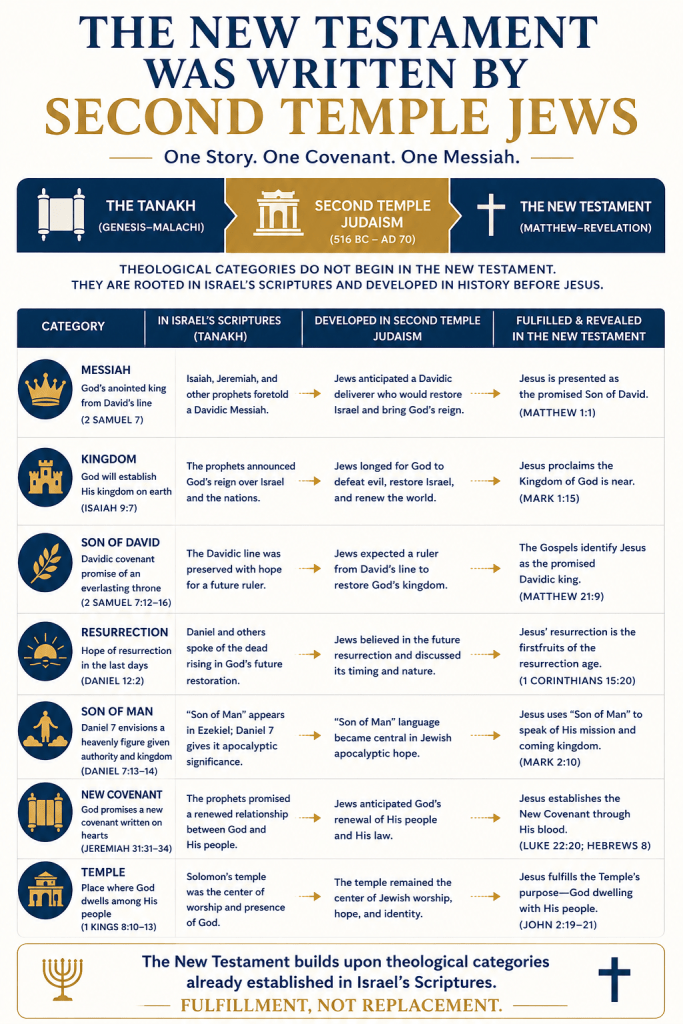
The New Testament presents Jesus as the Messiah, the Son of David, the Son of Man, the mediator of a New Covenant, and the inaugurator of God’s kingdom. None of these titles or concepts receive extensive explanation from the biblical authors themselves. Matthew does not pause to explain why readers should care about the Son of David. Jesus does not stop to define the kingdom of God every time he mentions it. Paul assumes his audiences understand covenant, resurrection, temple, sacrifice, and redemption. The New Testament writers proceed as though they are entering a conversation that has already been underway for centuries.

They are.

Understanding that conversation requires understanding what historians call Second Temple Judaism.

Historians use the phrase Second Temple Judaism to describe the period between two defining events in Israel’s history: the rebuilding of the Jerusalem Temple after the Babylonian exile and the destruction of that same temple by Rome in AD 70. The era begins when Jewish exiles return from Babylon under Persian rule and rebuild the temple described in Ezra and Nehemiah. It ends nearly six centuries later when Roman armies level Jerusalem during the Jewish revolt. These centuries form the world of the New Testament. Jesus taught within this world. Paul wrote within this world. The earliest churches emerged within this world.

Understanding Second Temple Judaism therefore provides more than historical background. It introduces the theological environment that shaped the questions, expectations, and assumptions carried by the first followers of Christ.

To understand why questions of Messiah, kingdom, restoration, and covenant renewal dominated Jewish thought during the Second Temple period, we must begin with the Babylonian exile. When Babylon conquered Judah in the sixth century BC, the devastation reached every visible sign of Israel’s national and religious life. Jerusalem fell, the temple was destroyed, and the Davidic monarchy collapsed. Israel’s prophets interpreted these events as covenant judgment for the nation’s persistent rebellion against the God who had delivered Israel from Egypt and entered into covenant with his people at Sinai. Yet the prophets who announced judgment also proclaimed restoration.

Isaiah prophesied renewal for Zion and the nations (Isaiah 2:1-4; 11:1-10; 60:1-22). Jeremiah promised a New Covenant in which God would write his law upon the hearts of his people (Jeremiah 31:31-34). Ezekiel described the return of God’s presence, the gathering of scattered Israel, and the restoration of life where death had seemed final (Ezekiel 36:22-28; 37:1-14; 43:1-5).

“I will put my law within them, and I will write it on their hearts. And I will be their God, and they shall be my people.”
Jeremiah 31:33

When Jewish exiles eventually returned to the land and rebuilt the temple, many of the prophets’ promises appeared to be moving toward fulfillment. Jerusalem once again became the center of Jewish worship, and life resumed in the land God had promised to Israel. Yet the restoration foretold by Isaiah, Jeremiah, and Ezekiel extended far beyond a return from Babylon. The prophets spoke of renewed kingship, covenant renewal, the gathering of God’s people, the defeat of Israel’s enemies, and the visible reign of God. The temple stood once again, but the larger story remained unfinished in several obvious ways. Foreign powers continued to rule the land. The promised son of David had not appeared. The nations had not streamed to Zion, and the universal peace prophesied by the prophets remained unrealized. The centuries that followed were therefore shaped by a single urgent question: when would God complete the restoration he had promised?

When would God complete the restoration he had promised?

The centuries following the exile produced an extraordinary engagement with Israel’s Scriptures because Jewish communities believed the prophets themselves contained the answer. The Torah, the Prophets, and the Writings became the lens through which Israel interpreted its past, understood its present condition, and anticipated its future restoration. As Jewish communities wrestled with these questions, themes such as Messiah, kingdom, resurrection, judgment, covenant renewal, and restoration moved to the center of Jewish thought. These ideas did not arise during the Second Temple period. Rather, centuries of study, worship, and reflection brought renewed attention to themes already woven throughout the Scriptures of Israel.

The expectation of a coming Messiah provides a clear example of how Second Temple Jews searched Israel’s Scriptures for answers to the unresolved promises of restoration. The Hebrew word mashiach means “anointed one,” a title originally associated with individuals whom God had set apart for a particular role, including kings, priests, and occasionally prophets. Over time, however, the term became increasingly connected to Israel’s royal hopes because of God’s covenant with David. In 2 Samuel 7, God established a covenant with David, promising that his royal line would continue and that his throne would remain central to Israel’s future hope. As later generations reflected upon that promise in the aftermath of exile, the prophets began to describe a future ruler who would restore justice, gather God’s people, and extend God’s reign beyond Israel to the nations. By the first century, hopes for restoration and hopes for a Davidic king had become inseparable. When the New Testament identifies Jesus as the Son of David, it places him within those expectations and presents him as the promised heir to God’s covenant with David, the ruler through whom Israel’s story would reach its fulfillment.

The same pattern appears in Jewish expectations concerning resurrection. The New Testament proclamation of Jesus’ resurrection rests upon a hope already present in Israel’s Scriptures and developed through centuries of reflection upon God’s promises. Daniel 12 gives this hope one of its clearest expressions, describing a future resurrection in which God would vindicate the righteous and judge evil. For many Jews living during the Second Temple period, resurrection expressed confidence that God’s covenant promises would ultimately prevail over suffering, injustice, and death itself. Martha’s response to the death of Lazarus reveals how deeply this expectation had taken root. When she tells Jesus that Lazarus “will rise again in the resurrection on the last day,” she speaks from a hope already rooted in Israel’s Scriptures. The apostles later proclaimed that Jesus had been raised from the dead, interpreting that event through a category that already occupied a central place within Jewish thought.

The title “Son of Man” demonstrates the same pattern. Daniel 7 portrays a figure “like a son of man” receiving authority, dominion, and an everlasting kingdom from the Ancient of Days. The vision became deeply influential during the Second Temple period because it addressed questions of kingship, judgment, and God’s rule over the nations. When Jesus repeatedly identifies himself as the Son of Man, he draws upon a category already embedded within Israel’s Scriptures and familiar to the theological world of first-century Judaism. The expression appears throughout the Tanakh, particularly in Ezekiel, and reaches a climactic expression in Daniel 7 before becoming one of Jesus’ most frequent self-designations (Ezekiel 2:1; Daniel 7:13-14; Matthew 8:20; Mark 2:10; Luke 19:10; John 5:27).

The kingdom of God likewise stands at the center of Jesus’ preaching because it already stood at the center of Israel’s prophetic hope. Isaiah envisioned a day when the nations would stream to Zion. Daniel described God’s everlasting kingdom overcoming every earthly empire. Zechariah declared that the Lord would become king over all the earth. Consequently, when John the Baptist announced that the kingdom of heaven was near and Jesus proclaimed the arrival of God’s kingdom, they were speaking into a conversation that had been underway long before either of them appeared on the banks of the Jordan River.

Christians therefore believe that Jesus is the promised Messiah anticipated by Israel’s Scriptures. He was crucified, buried, and raised from the dead in fulfillment of God’s promises. Following his resurrection, he appeared to his disciples and to hundreds of eyewitnesses, including more than five hundred people at one time according to the testimony preserved in 1 Corinthians 15. He ascended to the right hand of God, where he now reigns as King and High Priest. Yet the biblical story has not reached its final chapter. The prophets spoke not only of the coming Messiah, but also of the restoration of all things, the renewal of creation, the judgment of evil, and the visible reign of God upon the earth. Christians therefore continue to await the fulfillment of those promises. Christ’s work on the cross secured victory over sin and death, but it also points forward to the day when he will return, establish his kingdom in its fullness, and bring the story of redemption to its appointed conclusion.

Recognizing this reality changes the way the New Testament is read. Many Christians approach the New Testament as though it introduces an entirely new theological world. The first followers of Jesus understood themselves very differently. They believed they were living within the fulfillment of a story that had already been unfolding for centuries. The categories through which they understood Jesus did not originate in the first century. Messiah, Son of Man, kingdom, resurrection, covenant, temple, and restoration were already deeply rooted in Israel’s Scriptures and had become central themes within Second Temple Judaism.

This continuity extends beyond individual doctrines and into the structure of the New Testament itself. Jesus, Paul, Peter, John, Matthew, and the earliest followers of Christ did not treat Israel’s Scriptures as historical background material. They treated them as the authoritative framework through which God’s purposes were being revealed. Matthew repeatedly presents Jesus as the fulfillment of Israel’s story. Peter explains Pentecost through the prophet Joel. Paul grounds his arguments in Genesis, Exodus, Deuteronomy, Isaiah, Habakkuk, and the Psalms. The Epistle to the Hebrews assumes familiarity with temple worship, sacrifice, priesthood, covenant mediation, and ritual holiness. The Book of Revelation draws heavily upon Daniel, Ezekiel, Isaiah, Zechariah, and Exodus. The New Testament writers do not merely quote the Tanakh. They think through it, argue from it, and interpret the life of Jesus through its categories.

The significance of the New Testament, therefore, lies not in the introduction of new theological categories but in the claim that those categories find their fulfillment in Jesus of Nazareth. The apostles present Jesus as the promised Son of David, the Son of Man envisioned by Daniel, the mediator of Jeremiah’s New Covenant, and the king anticipated by the prophets. Their message rests upon the conviction that God’s promises to Israel had been decisively inaugurated in the Messiah and would reach their fullness through his return and reign.

The apostles drew upon the Torah, the Prophets, and the Writings because those Scriptures provided the categories through which they understood Jesus and his mission. Son of David, Son of Man, New Covenant, kingdom, resurrection, and restoration belonged to a story already in motion long before the first century. The New Testament therefore presents itself as the continuation of that story, carrying forward the promises given to Abraham, developed through Moses, entrusted to David, proclaimed by the prophets, and inaugurated in Christ. The same story that begins in Genesis continues through the Gospels, the Epistles, and Revelation, moving toward the day when every promise of God reaches its complete fulfillment under the reign of Israel’s Messiah.

Second Temple Judaism forms the bridge between the world of the Tanakh and the world of the New Testament. The apostles proclaimed that Jesus, Israel’s Messiah, had decisively inaugurated all that the Scriptures had been pointing toward, and they explained that reality through the language, expectations, and theological framework of Israel’s Scriptures. The New Testament therefore stands as the continuation of Israel’s covenant story, revealing promises first given to Abraham, developed through Moses, entrusted to David, and proclaimed by the prophets. The story that begins in Genesis continues through the New Testament and moves toward the day when Christ returns to establish his kingdom in its fullness, and every promise of God reaches its complete fulfillment.


Author’s Note:

I write as a Gentile Christian whose faith is rooted in the conviction that Jesus of Nazareth is Israel’s Messiah and the Savior of the world. The more deeply I study the Scriptures, the more convinced I become that Christianity cannot be understood apart from the story of Israel.

I do not hold to replacement theology, the belief that the Church has replaced Israel in God’s redemptive purposes. Rather, I believe Gentile believers are graciously grafted into Israel’s covenant story through faith in Christ (Romans 11:17-24). The New Testament’s authors were Jews who understood themselves to be proclaiming the fulfillment of God’s promises, not the abandonment of them.

As one who has been grafted into that story by grace, I approach these essays with gratitude for the Jewish foundations of the Christian faith and with confidence that Jesus, Israel’s Messiah, will one day return to rule and reign from Jerusalem as King.

Shavuot and Pentecost: One Feast, One Story

By Jill Szoo Wilson

Jerusalem is already full. Pilgrims crowd the streets. Homes are filled with conversation and prayer. Merchants, families, travelers, and worshippers move through the city, gathering for one of Israel’s sacred festivals. Then, without warning, a sound like a violent rushing wind fills the place where the disciples are gathered. Fire appears. The disciples begin speaking in other languages as the Holy Spirit enables them. Men and women who have traveled from every corner of the Jewish diaspora stop, listen, and suddenly hear the works of God proclaimed in the languages of their birth.

Luke describes one of the most astonishing moments in all of Scripture. Yet the men and women filling Jerusalem that day had not traveled there because the Holy Spirit was about to fall. They had come because it was Pentecost, the Greek name for an ancient feast Israel had been observing for centuries, rooted in the Torah and woven deeply into Israel’s covenantal life.

That feast is Shavuot.

In the Hebrew Scriptures, Shavuot, often translated the Feast of Weeks, first appears in passages such as Leviticus 23, Numbers 28, and Deuteronomy 16. The instructions for observing this feast are precise. Beginning with Passover, Israel is commanded to count seven full weeks, forty-nine days in all, and on the fiftieth day to appear before the Lord with the first produce of the harvest, acknowledging that the grain, the land, and the provision itself have come from God. Farmers bring the earliest portion of what the fields have produced. Households journey to Jerusalem with offerings of gratitude. Priests present loaves of newly baked bread before the Lord as a visible sign that the harvest belongs first to him. What begins as a harvest pilgrimage rooted in gratitude for God’s provision gradually becomes one of Israel’s sacred festivals, one of the divinely appointed seasons God established for worship, remembrance, and covenant life.

The Greek-speaking Jewish world knew this same feast by another name.

Pentēkostē.

The fiftieth day.

Pentecost.

By the first century, therefore, when Luke writes, “When the day of Pentecost had fully come,” he is locating his readers within a feast Israel had already been observing for centuries. He writes with the assumption that they understand Israel’s sacred calendar, the annual gathering in Jerusalem, and the covenantal significance of the feast itself. In Luke’s world, Pentecost already carried the memory of harvest, worship, Scripture, and the God who had formed Israel as his covenant people.

By the time Luke opens the second chapter of Acts, Jerusalem is already full. Jewish pilgrims have arrived from across the diaspora, gathering for Shavuot exactly as Israel had been commanded for centuries. Luke’s geographical precision is striking. Parthians, Medes, Elamites, residents of Mesopotamia, Judea, Cappadocia, Pontus, Asia, Egypt, Libya, visitors from Rome, Cretans, and Arabians fill the city. The list is neither accidental nor ornamental. It establishes covenant geography before the Holy Spirit ever falls. Israel is gathered. The nations are present. Jerusalem remains at the center.

Only then does the evidence of the Holy Spirit’s presence begin: A sound like a mighty rushing wind. Tongues as of fire. Speech heard across linguistic boundaries.

Through the power of the Holy Spirit, Jewish pilgrims from across the diaspora hear the works of God proclaimed in the languages of their birth as they gather in Jerusalem for Shavuot.

Within the theological world of Second Temple Judaism, Shavuot carried more than the memory of harvest. By the time Luke writes the book of Acts, this feast also carried the memory of another defining moment in Israel’s history: the giving of Torah at Mount Sinai through Moses. There, after Israel’s deliverance from Egypt, God descended upon the mountain in fire, spoke with power, and entered into a covenant with his people. Luke’s imagery in Acts 2 invites his readers to remember that moment. The fire that once marked God’s descent upon Sinai now appears in Jerusalem. The wind that accompanied the covenant now fills the temple complex where the disciples are gathered. The divine speech that once formed Israel through Torah now moves outward through human language to Jewish pilgrims gathered from across the diaspora. The signs that once accompanied the giving of Torah now accompany the outpouring of the Holy Spirit in Jerusalem.

The connection deepens as Peter the Apostle begins to explain what the crowd is witnessing. He turns to Joel, a prophet who had spoken centuries earlier of a day when God would pour out his Spirit upon his people:

“In the last days, God says, I will pour out my Spirit on all flesh.”

For Peter, this is not a random verse pulled from memory. He is telling the crowd that what they are seeing in Jerusalem has already been spoken of in Israel’s Scriptures. The rushing wind, the fire, the languages, and the outpouring of the Holy Spirit are not disconnected signs. They belong to a story God had already been telling.

Peter then turns to the Psalms, quoting the words of David, Israel’s greatest king, to show that the promised Messiah would not remain in the grave but would rise again. In just a few verses, Peter moves from the prophets to the kings of Israel, from the giving of the covenant to the promise of resurrection, from Sinai to the Messiah. The language never changes because the story never changes. Covenant. Spirit. Kingdom. Jerusalem. Nations. Peter speaks the language of Israel’s Scriptures because the events unfolding in Acts remain deeply rooted in Israel’s story, now moving forward through Israel’s Messiah.

Luke presents Pentecost as far more than a dramatic moment in the life of the early church. He presents it as Shavuot remembered, interpreted, and carried forward through Israel’s Messiah. The New Testament once again reaches back into the Tanakh, not to replace what came before, but to reveal its ongoing covenantal and messianic fulfillment.

And once again, Scripture reveals one God, one covenantal story, one unfolding kingdom, and one Messiah bringing that story toward its appointed fulfillment.

One Story. One Covenant. One Messiah.

How the Tanakh shapes every page of the New Testament

By Jill Szoo Wilson

For the past two years, I’ve been studying God’s covenant with Abraham, Isaac, and Jacob. That journey has brought me to the following summary. Over the next several months, I’ll be writing more about what I’ve learned.


The faith of Jesus of Nazareth and his earliest followers was never intended to create a new religion separated from Israel, but to reveal the long-awaited fulfillment of the story God had already been telling through the Torah, the Prophets, and the Writings, collectively referred to as the Tanakh*. This conviction is rooted in Second Temple Judaism** and in the apocalyptic imagination of the first-century Jewish world, where the writings of the New Testament introduce no fundamentally new theological categories, but instead reach back into the Tanakh with extraordinary density, depth, and intentionality. Nearly every covenant, feast, sacrifice, kingdom motif, wilderness narrative, prophetic vision, temple image, priestly act, messianic promise, and apocalyptic expectation in the Hebrew Scriptures finds its echo, expansion, or unveiling in the New Testament. Scripture is one unified, divinely authored story in which the later writings constantly hyperlink back to what came before, not to replace it, but to reveal its fullness.

There is no theological dividing wall between Judaism and Christianity, nor has the Church replaced Israel. Through Israel’s Messiah, the nations are grafted into Israel’s covenantal promises, sharing in the rich root of the olive tree described by Paul the Apostle in Romans. The promises remain Israel’s promises. The covenants remain Israel’s covenants. The Messiah remains Israel’s Messiah, now extending mercy to the nations.

Jesus of Nazareth is the Jewish Messiah promised in the Tanakh. The New Testament does not replace Israel’s story; it reveals its ongoing messianic fulfillment. Gentile believers are grafted into Israel’s covenantal promises through Israel’s Messiah. And that story reaches its climactic fulfillment on the Day of the Lord, when Jesus returns to reign from Jerusalem exactly as the prophets anticipated.

From beginning to end, Scripture reveals one God, one covenantal story, one unfolding kingdom, and one Messiah bringing that story to its appointed fulfillment.


*For readers unfamiliar with the acronym Tanakh:

T = Torah (the law): Genesis, Exodus, Leviticus, Numbers, Deuteronomy

N = Nevi’im (the Prophets): Joshua, Judges, Samuel, Kings, Isaiah, Jeremiah, Ezekiel, and the Twelve Minor Prophets

K = Ketuvim (The Writings): Psalms, Proverbs, Job, Song of Songs, Ruth, Lamentations, Ecclesiastes, Esther, Daniel, Ezra–Nehemiah, Chronicles

**Second Temple Judaism refers to the period of Jewish history between the rebuilding of the Temple in Jerusalem after the Babylonian exile (c. 516 BC) and its destruction by Rome in AD 70. This was the theological, cultural, and apocalyptic world of Jesus of Nazareth, his disciples, and the earliest believers. To read the New Testament through the lens of Second Temple Judaism is to read it as a thoroughly Jewish document emerging from Israel’s already existing covenantal, messianic, and prophetic worldview.