
Responsible AI use begins with disciplined human judgment, especially in the places where people learn and teach.
By Jill Szoo Wilson
Writer | Theatre Artist | Educator
The students appeared to be learning.
In a large field experiment involving nearly 1,000 high-school mathematics students, researchers gave some students access to a standard GPT-4 interface while they worked through practice problems. Their performance improved by 48 percent. Then the researchers took the technology away. On a later assessment without AI, those students performed 17 percent worse than classmates who had never received the tool. A second group used an AI tutor specifically designed to guide students without readily supplying answers. The safeguards largely prevented the decline. The study, led by Hamsa Bastani and published in the Proceedings of the National Academy of Sciences, reached a conclusion educators can no longer afford to ignore: generative AI can improve a student’s work while weakening the learning that work is supposed to represent.
In that reversal lies the central problem AI creates for education. A student can perform better without becoming more capable. Until recently, a completed essay, a solved equation, or a lucid explanation served as imperfect evidence that intellectual work had taken place. Generative AI can now produce much of that evidence before the learner has developed the knowledge it appears to demonstrate.
Educational psychologists Robert and Elizabeth Bjork have spent decades studying the uneasy relationship between performance and learning. Their research describes certain forms of effort as “desirable difficulties.” Retrieving information from memory, generating an answer before seeing one, and returning to material after some forgetting can make learning feel slower. Those difficulties strengthen retention and make knowledge more transferable. Ease can create familiarity, and familiarity is easily mistaken for understanding.
Students themselves do not always recognize this distinction. In a 2019 study of undergraduate physics courses, Louis Deslauriers and his colleagues found that students in active-learning classrooms learned more while feeling as though they had learned less. The mental effort that improved their learning made the experience seem less effective. A smooth lecture felt more instructive, even when it produced weaker results.
Generative AI often creates the opposite experience. It makes difficult intellectual work feel fluent. It can explain a stubborn concept, identify an error, or offer a well-timed question that helps a student move forward. It can also remove the struggle in which understanding would have formed. The same technology can become a tutor or an escape route, depending on its design and the judgment of the person using it.
Jonathan Haidt’s campaign for phone-free schools offers a warning from the recent past. Haidt has argued that schools spent years treating smartphones as personal accessories while teachers experienced them as an environmental force, changing the conditions under which students could pay attention and belong to one another. His case for removing phones from the school day places responsibility on the institution as well as the individual student.
The comparison has limits. Smartphones compete for attention; generative AI can participate in the work that attention was supposed to accomplish. The institutional lesson still matters. Schools and universities should decide what purposes a powerful technology will serve before convenience hardens into culture.
That decision is already overdue. In a 2026 survey of 1,054 full-time undergraduates in the United Kingdom, 95 percent reported using AI in some capacity, and 94 percent had used generative AI to help with assessed work. Only 48 percent believed their instructors were helping them develop the AI skills they would need professionally. The survey describes one country, though its central tension reaches well beyond it: students have adopted the technology faster than many of the adults responsible for teaching them have learned to guide its use.
The central question for the 2026–2027 school year is therefore larger than whether AI should be permitted. Students need to know when its assistance enlarges their abilities and when it quietly replaces them. Teachers need to identify which forms of effort belong to the learning itself. Everyone working with these systems must learn to verify their claims, protect private information, recognize their biases, and preserve human responsibility for the consequences.
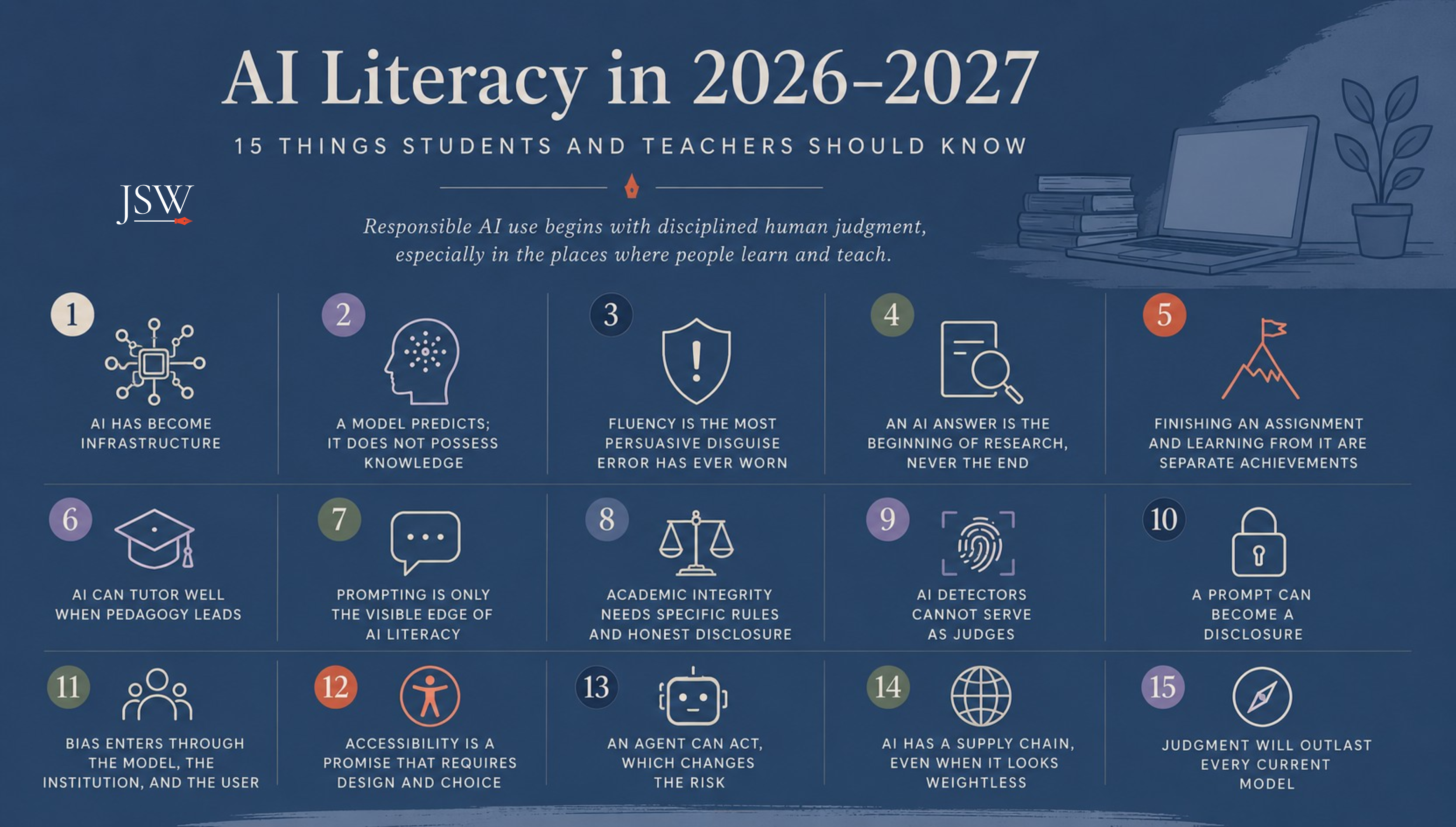
AI literacy depends on the disciplined use of human judgment. The following fifteen ideas offer a place to begin.
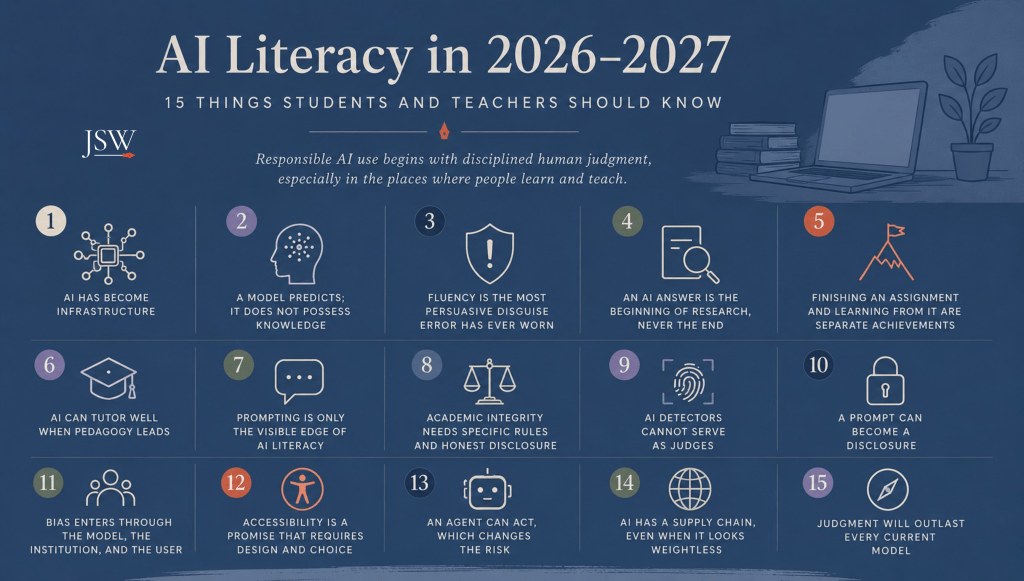
1. AI has become infrastructure
At first, generative AI was a destination: a separate website, a conspicuous box, a machine whose presence was impossible to miss. By fall 2026, it will increasingly function as infrastructure, operating inside search engines, learning-management systems, office software, library tools, tutoring platforms, and accessibility services. The boundary between using AI and using software has grown porous.
This makes broad course rules such as “No AI” difficult to interpret. Does the rule include automated captions, grammar correction, translation, search summaries, coding suggestions, or a study tool that converts notes into practice questions? Students deserve definitions precise enough to follow. Instructors need approved examples for each assignment. Campus leaders should inventory which systems already contain AI, what data those systems receive, and who remains responsible when an automated feature makes a consequential mistake.
AI literacy therefore belongs in student orientation, faculty development, and institutional planning. UNESCO’s AI Competency Framework for Teachers treats the subject as a combination of technical understanding, ethics, pedagogy, and human agency. The European Union has gone further: Article 4 of its AI Act already requires many organizations that deploy AI to take measures supporting staff literacy, with enforcement rules beginning in August 2026. The European Commission’s guidance reflects a useful principle for universities everywhere. Access to a tool does not amount to preparation for its use.
2. A language model predicts; it does not possess knowledge in the human sense
The most important technical lesson can be stated without mathematics. A large language model learns patterns from enormous collections of data and generates a response by predicting what should come next in context. Newer systems can search the web, inspect files, analyze images, run code, and use external tools. These additions expand what the system can accomplish.
That distinction explains much of AI’s peculiar behavior. A model can describe grief without grieving, construct an argument without holding a conviction, and produce a polished explanation without having experienced the slow human process of understanding. Even the word “reasoning,” now common in product descriptions, should be treated operationally. It tells us that a system can perform certain multi-step tasks. It does not establish consciousness, wisdom, intention, or moral responsibility.
Students who understand this will ask better questions of the technology. Teachers who understand it will avoid assigning human authority to a synthetic voice. Leaders who understand it will keep accountability attached to people, especially when AI enters advising, grading, admissions, financial aid, disability accommodations, or disciplinary processes.
3. Fluency is the most persuasive disguise error has ever worn
Earlier technologies failed loudly: broken links, error codes, blank screens. Generative AI can fail in complete, elegant paragraphs. It may invent a quotation, misstate a court decision, produce a plausible chemical procedure with a dangerous flaw, or create a citation to an article that never existed. The response can arrive with flawless punctuation and the bedside manner of a favorite professor.
The National Institute of Standards and Technology calls these errors “confabulations” and warns that people may defer too readily to systems whose increasing fluency makes them appear more reliable than they are. Its Generative AI Risk Management Profile places confabulation alongside privacy, bias, information integrity, security, and environmental risks.
Verification must become a routine academic habit. Open every cited source. Confirm that the author, title, date, and page exist. Recalculate important numbers outside the model. Compare legal, medical, scientific, and historical claims with authoritative materials. Ask the system where uncertainty lies, then remember that its account of its own uncertainty can also be wrong. A confident tone is a feature of the interface, not a measure of truth.
4. An AI answer is the beginning of research, never the end
AI can be extraordinarily useful during the early stages of inquiry. It can suggest vocabulary for an unfamiliar subject, identify competing interpretations, generate search terms, explain why a database query failed, and help a student recognize the shape of a field before entering it. These are valuable forms of orientation.
Research begins when the student leaves the synthetic summary and encounters the evidence. A linked article must be read. A dataset must be inspected. A quotation must be placed back into its paragraph. A study’s method, sample, limitations, and funding source deserve attention. An AI research tool that attaches citations may reduce fabrication, though a citation badge cannot guarantee that the source supports the sentence beside it.
Libraries become more important in this environment because abundance has increased the value of selection. Librarians teach the difference between discovery and evidence, between a source that mentions a claim and one capable of supporting it. Faculty members should design research assignments that make this process visible through annotated bibliographies, source notes, search logs, or short explanations of why particular evidence earned a place in the final work.
5. Finishing an assignment and learning from it are separate achievements
Generative AI is exceptionally good at removing friction. Education depends on recognizing which friction carries intellectual value. The blank page, the stubborn equation, the failed first attempt, and the uncomfortable moment when two sources refuse to agree can each perform work inside the learner. They force retrieval, comparison, judgment, and revision.
When AI removes those moments too early, a student may submit a better-looking product while developing a weaker command of the subject. A 2026 study of 299 STEM students across five North American universities found that students who reported trusting and routinely using generative AI also reported lower levels of reflection, critical thinking, and desire for understanding. The research relied on survey data and cannot settle every causal question, though its idea of “cognitive debt” deserves attention. Repeatedly borrowing thought from a machine may leave the learner with less capacity to repay the loan.
A practical rule follows: attempt before assistance. Solve part of the problem, draft the claim, sketch the structure, or explain the concept from memory before asking AI to intervene. Then use it to challenge the attempt, locate gaps, produce counterexamples, or ask questions that make the student do the next piece of thinking. Students should leave an AI session able to perform more independently than when they entered it.
6. AI can tutor well when pedagogy leads
The warning about cognitive offloading can coexist with genuine educational promise. In a randomized controlled trial published in 2025, students in a Harvard undergraduate physics course used a carefully designed AI tutor or attended an in-person active-learning lesson covering the same material. The students using the AI tutor achieved more than twice the median learning gain in less time, while also reporting greater engagement and motivation.
The word “carefully” carries most of that result. The tutor used established answers, structured the lesson in sequence, managed cognitive load, encouraged active participation, and delivered targeted feedback. The researchers explicitly distinguished this design from an ordinary chatbot built to provide a helpful answer as quickly as possible. A system optimized for completion will often rob the learner of the very struggle a tutor should manage.
Students can reproduce some of the better design in their own use. Ask the model to withhold the solution, diagnose the first mistaken step, present one question at a time, or create practice that becomes harder as understanding improves. Instructors should evaluate AI tutoring products according to learning science, subject accuracy, accessibility, data protection, and evidence of effectiveness. The presence of a conversational interface proves very little about the quality of the teaching inside it.
7. Prompting is only the visible edge of AI literacy
For several years, “prompt engineering” stood in for the larger skill of working with AI. Clear instructions still matter. A useful prompt establishes the task, context, audience, constraints, desired format, and criteria for success. It may include examples or source material. It also leaves room for the user to test and revise the result.
The greater skill lies in task judgment. Should AI participate in this work at all? Which part can be delegated safely? What expertise must the user possess to evaluate the answer? What evidence would reveal failure? How much authority does the output deserve? A beautifully engineered prompt cannot rescue a task that requires confidential information, firsthand human testimony, professional licensure, or a moral decision the user has no right to outsource.
UNESCO’s student and teacher frameworks place human agency and ethics beside technical competence for good reason. AI literacy includes knowing how a system works, recognizing its social effects, protecting the people represented in its data, and declining its help when assistance would violate the purpose of the work.
8. Academic integrity needs specific rules and honest disclosure
Students cannot follow a policy that changes meaning from one classroom to the next while using the same vague vocabulary. “AI-assisted,” “AI-generated,” and “AI-edited” can describe radically different activities. A student who asks for five practice questions has made a different academic choice from one who submits a generated essay. A scientist using code completion faces different obligations from a social-work student entering details from a client case.
Every substantial assignment should state which uses are permitted, which require disclosure, and which would defeat the learning objective. A simple scale can help: AI prohibited; AI allowed for defined support; AI expected and evaluated. The rule belongs beside the assignment, where students will see it at the moment of decision.
Disclosure should become ordinary rather than confessional. A brief AI-use statement can name the tool and version, describe the task it performed, note the date of use, and explain how the student verified or changed the output. Instructors who use AI to draft feedback, create course materials, or summarize student comments should practice the same transparency. Integrity becomes credible when it travels in both directions.
9. AI detectors cannot serve as judges
Text detectors estimate whether language resembles patterns associated with machine-generated writing. They do not recover a hidden record of authorship. A student can receive a false accusation, while heavily edited AI prose can pass unnoticed. The systems also change as models and human writing practices evolve.
The fairness problem is especially serious for multilingual writers. A Stanford-led study found that several widely used detectors frequently misclassified essays written by non-native English speakers. Even Turnitin tells instructors that its AI score should never become the sole basis for adverse action.
A detector may prompt a conversation. It cannot establish misconduct by itself. Fair process requires the assignment instructions, drafts, document history, notes, sources, prior work, and the student’s explanation of the process. Faculty members should ask students to discuss their choices before reaching a conclusion. Institutions should give accused students a clear path to review and appeal. The burden of preserving academic integrity cannot justify a system that treats statistical suspicion as proof.
10. A prompt can become a disclosure
Students and employees often write to an AI system with the intimacy of a private notebook. The interface encourages this. It remembers context, responds conversationally, and appears to be speaking with one person at a time. The underlying service may log prompts, retain uploaded files, route information through third parties, or use content according to settings and contracts the user has never read.
No one should paste identifiable student information, unpublished research, protected health or legal records, confidential personnel matters, or proprietary code into an unapproved consumer tool. Replacing names may still leave enough context to identify a person. Faculty members carry particular obligations because students did not consent to have their work or personal information submitted to a vendor.
Institutional accounts can provide stronger contractual protections than personal accounts, though “enterprise” and “education” labels should never substitute for review. Universities need clear data classifications, approved-tool lists, retention rules, and procurement questions about training, storage, subprocessors, deletion, and breach response. The U.S. Department of Education’s student privacy resources remain a starting point for FERPA obligations, while NIST’s framework treats data privacy as a central generative-AI risk. The safest prompt is sometimes the one never sent.
11. Bias enters through the model, the institution, and the user
AI systems learn from human-made data and inherit patterns of attention, exclusion, stereotype, and historical inequality. A model may associate leadership with certain names, produce weaker information about communities underrepresented online, flatten dialect into standardized prose, or perform unevenly across skin tones and accents. Fine-tuning and safety work can reduce particular harms without creating neutrality.
Bias also enters when a university chooses the wrong tool for a consequential task. A generic model used to assess “professionalism,” predict persistence, screen applications, or flag risk may turn institutional habits into automated judgment. The output can appear objective because the interface hides the assumptions that shaped it.
Good practice begins with a narrower question: How does this system perform for the people who will bear the consequences? Universities should test tools across relevant populations, document failure patterns, invite affected students and staff into evaluation, and preserve meaningful human review. Students should examine whose knowledge appears in an answer, whose language gets corrected, and whose experience has been treated as an exception.
12. Accessibility is a promise that requires design and choice
AI can expand access in remarkable ways. It can generate captions, describe images, simplify dense prose, support dictation, translate language, reorganize notes, and give a student unlimited time to ask a question without embarrassment. For students with disabilities, multilingual students, and learners entering college with uneven preparation, these uses may open doors that traditional instruction left unnecessarily heavy.
The same technology can create barriers. Captions can mishear technical language. Image descriptions can omit the detail an assignment requires. A voice interface may fail with a particular speech pattern. An instructor may ban a tool that a student has quietly used as an accessibility aid, while a university may require an AI product that works poorly with a screen reader or demands hardware some students cannot afford.
Accessibility therefore requires alternatives, testing, and human support. The U.S. Department of Education’s guidance on designing AI for education places digital accessibility within institutions’ existing disability obligations. Campus leaders should involve disability-services professionals and disabled students before adoption. Instructors should distinguish assistance that provides access from assistance that replaces the skill being assessed. Equal treatment may require different paths toward the same intellectual goal.
13. An agent can act, which changes the risk
A chatbot produces language. An AI agent can combine language generation with tools that read email, browse websites, edit files, run code, make purchases, or update records. This difference resembles the distance between an adviser who suggests a route and an assistant who takes the keys.
The convenience is obvious. An agent could coordinate a student organization’s meeting, search a literature database, prepare a lab workflow, or reconcile a department’s calendar. Its mistakes can also travel beyond the chat window. A malicious instruction hidden inside a webpage, document, or email can attempt to redirect an agent through an attack called prompt injection. Overly broad permissions can turn a small error into a deleted folder, an exposed record, or a message sent to the wrong audience.
The security principle for 2026 is least privilege. Give an agent access only to the information and actions required for the immediate task. Require human confirmation before sending, publishing, purchasing, deleting, grading, or changing a record. Keep logs. Separate experimentation from live institutional systems. NIST’s emerging cybersecurity guidance recommends distinct permissions and authorization policies for AI agents, and OWASP’s agent security guidance identifies prompt injection, tool abuse, privilege escalation, and data leakage among the central risks.
14. AI has a supply chain, even when the interface appears weightless
Every AI response rests on material and human inputs that the chat window makes easy to forget. Models are trained on vast collections of text, images, audio, and code assembled through choices that remain legally and ethically contested. They run in data centers that require chips, electricity, cooling, construction, and local infrastructure. Human workers help label data, evaluate outputs, moderate disturbing content, and maintain the systems.
This supply chain also carries legal questions about authorship and ownership. The U.S. Copyright Office concluded in its 2025 report on AI-generated material that copyright protects human-authored expression, including qualifying human contributions to AI-assisted work, while purely machine-generated material does not receive the same protection. Questions about training on copyrighted works remain active in courts and policy debates. Students and faculty should preserve drafts, document creative decisions, respect licenses, and avoid assuming that an available output is free of intellectual-property concerns.
Synthetic media adds another problem: provenance. A realistic image, audio clip, or video should be evaluated through its source and history rather than appearance alone. The C2PA standard known as Content Credentials can attach tamper-evident information about how a digital asset was created and changed. It cannot prove that every claim inside the media is true, though it offers useful evidence about origin and editing.
The environmental cost also belongs in the conversation. The International Energy Agency’s 2026 analysis projects that global data-center electricity consumption will roughly double from 2025 to 2030, with AI-focused facilities driving much of the increase. Individual users rarely receive a meaningful meter for a prompt, so precise personal accounting remains difficult. Universities can still ask vendors about energy, water, hardware life cycles, model size, and whether a smaller system can perform the task. Convenience does not make computation immaterial.
15. Judgment will outlast every current model
Students entering the workforce will meet employers who expect some ability to work with AI. The World Economic Forum’s Future of Jobs Report 2025 places AI and big data among the fastest-growing skill areas while continuing to emphasize analytical thinking, creative thinking, leadership, collaboration, and lifelong learning. Entry-level work is already shifting as software takes on portions of research, drafting, analysis, coding, and administration.
The least durable career strategy is to compete with AI at producing generic first drafts. The stronger strategy combines subject knowledge with the ability to define a problem, notice what the system missed, test an answer against reality, communicate with another person, and accept responsibility for the result. Expertise becomes more valuable when it allows someone to recognize a polished mistake before that mistake enters a bridge, a budget, a classroom, a clinical note, or a public policy.
Universities should resist the temptation to build entire curricula around the products currently winning the market. Product names will change. Interfaces will consolidate. Some companies will disappear. Students need transferable habits: framing questions, tracing evidence, protecting data, documenting process, working across differences, and knowing when a human being must remain present.
The work ahead
The university has always been a place where tools meet purposes. Calculators changed mathematics instruction. Search engines changed research. Word processors changed revision. None arrived with a settled philosophy of use, and each eventually became ordinary enough for educators to see its proper limits more clearly.
AI compresses that adjustment into a much shorter period because it reaches into nearly every form of intellectual work at once. It can write, explain, imitate, translate, classify, recommend, and act. Its range makes a single campus policy inadequate. Universities need shared principles accompanied by rules precise enough for a nursing simulation, an acting studio, an engineering lab, and a first-year composition course.
Before the 2026–27 school year begins, students should know when AI is allowed and how to disclose it. Teachers should decide which parts of an assignment represent the learning itself and protect those parts accordingly. Leaders should provide secure tools, meaningful training, equitable access, and fair procedures when concerns arise. Every campus should preserve places where people think together without optimization, because education involves more than producing acceptable answers.
The arrival of a machine that can speak in the language of knowledge has made one human responsibility newly visible. A university must teach people how to tell the difference between an answer that sounds finished and a mind that is still becoming capable of understanding it.
If you’re new here and would like to know more about my work and writing, you can read my About page.
Further Reading
- Student Generative Artificial Intelligence Survey 2026, Higher Education Policy Institute
- AI Competency Framework for Teachers, UNESCO
- Artificial Intelligence Risk Management Framework: Generative Artificial Intelligence Profile, NIST
- AI Tutoring Outperforms In-Class Active Learning, Scientific Reports
- Thinking Less, Trusting More: GenAI’s Impacts on Students’ Cognitive Habits
- Using the AI Writing Report, Turnitin
- Copyright and Artificial Intelligence, U.S. Copyright Office
- Key Questions on Energy and AI, International Energy Agency
- Content Credentials, Coalition for Content Provenance and Authenticity
- Future of Jobs Report 2025, World Economic Forum



Leave a Reply