
A twenty-year university career ended in upheaval, opening a chapter of our lives we never could have imagined.
By Jill Szoo Wilson
Writer | Theatre Artist | Educator
There are moments when your feelings are absolutely certain and absolutely wrong.
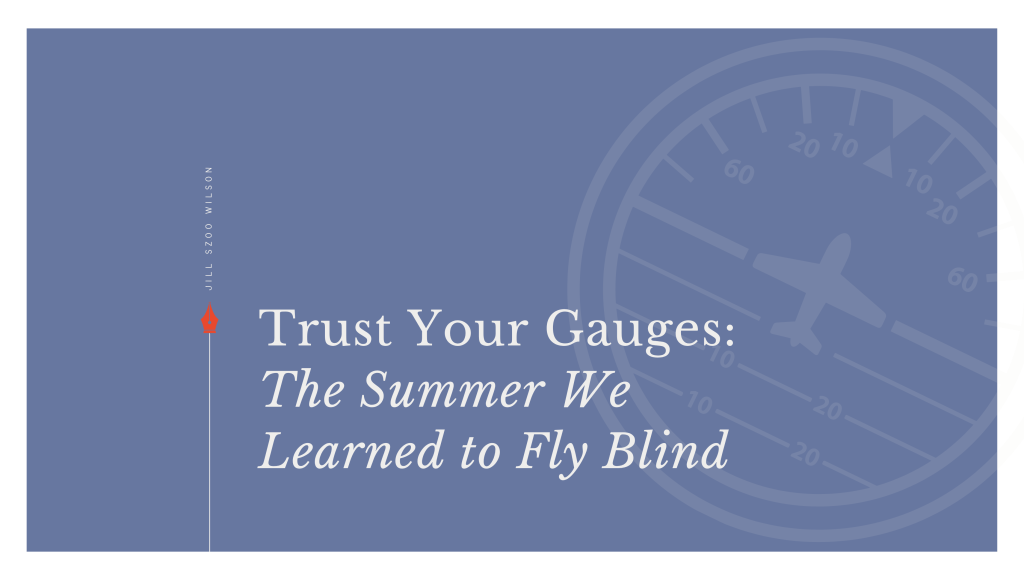
Pilots know something about this. Spatial disorientation can occur when a pilot loses a clear visual horizon, and the body begins sending information that conflicts with what the airplane is actually doing. A pilot may feel as though the aircraft is banking when it is flying level, or feel level while the plane is turning. In heavy cloud cover or darkness, the sensations can become convincing enough that correcting what feels wrong can put the aircraft in real danger.
That’s why pilots are trained to trust their instruments. The horizon may disappear, and the body may insist on one thing, but the gauges continue reporting what the airplane is actually doing.
Life obscures the horizon too. Sometimes a job you counted on is suddenly gone, a person you trusted betrays you, or a doctor gives you news you never expected to hear. Sometimes a plan you spent years building simply stops being possible, and you find yourself trying to make decisions inside a life that looks nothing like the one you thought you were living.
Those are dangerous moments for decision-making. When you can’t see the future clearly, your feelings can start issuing instructions. Fear tells you to do something now, before you have time to think. Anger starts composing the speech, the email, or the confrontation that will finally make someone answer for what happened. Grief convinces you that the way life feels today is the way it will always feel, while embarrassment suggests disappearing until everyone has mercifully forgotten your name. And anxiety is especially industrious. Give it twenty quiet minutes, and it can build an entire alternate future before breakfast.
Feelings matter because they tell us something about what we are experiencing. Fear may alert us to danger, anger can reveal that something valuable has been violated, and grief tells us that we have lost something we loved. We should listen to what those feelings are telling us, then check them against what we know to be true before deciding what to do next. Your feelings belong in the cockpit. They just don’t belong at the controls.
What Are Your Gauges?
When everything feels disorienting, you need something outside the feeling itself to help you determine where you are.
For me, the first gauge is God and His Word. Circumstances can change with astonishing speed, but what I know about the character of God when life is quiet remains true when life becomes frightening. Isaiah 50:10 speaks directly to that kind of season: “Let him who walks in darkness and has no light trust in the name of the Lord and rely on his God.” There have been seasons when my circumstances offered very little reassurance, and I had to rely on what I already knew about Him.
Another gauge is the counsel of people who have earned your trust over time. These are the people whose judgment has survived years of ordinary life, disagreement, mistakes, and hard conversations. Sometimes the person you most need is the one willing to say, “I understand why you feel that way, but I don’t think that is what is actually happening.” A friend who can sit beside you in the fog without pretending to see something that isn’t there is worth keeping close.
Facts are another reliable gauge. When emotions are high, separate what you actually know from what you are assuming, and what has happened from what you are afraid might happen next. Those distinctions can sound almost insultingly simple when life is calm. Inside a crisis, they can become surprisingly difficult to make.
Experience belongs on the instrument panel too. You have survived circumstances you once had no idea how to survive. You have learned which problems look different after a night of sleep, which people reveal themselves if given enough time, and how often urgency loses some of its authority when you allow yourself enough time to think. You know things now that an earlier version of you had to learn the difficult way, and those memories become instruments too.
When We Lost the Horizon
I know how important those gauges can become because one of the most disorienting seasons of our lives began in a place that had always felt remarkably steady.
When 2020 began, my husband had spent twenty years building his career at one university, beginning as an assistant professor of theatre and eventually serving as chair of the School of Visual and Performing Arts and head of the Department of Theatre and Dance. Over those two decades, his work had become woven into the rhythms of our family, our friendships, and our community. We had built a life there, and we had every reason to believe it would continue.
Then came the summer of 2020. As protests spread across the country, alumni began pressing the department to issue an official statement about Black Lives Matter. The requests quickly carried another expectation as well: people wanted the department to make clear where it stood and to demonstrate publicly that it was “on board.” Because my husband was chair, the decision about what the department would say on its official and university-adjacent social media ultimately rested with him.
The difficulty was that almost no one seemed certain what the right response should be. Faculty members disagreed. His dean changed his advice several times as events unfolded. The president of the university had told faculty that he alone would speak for the institution on political matters and had cautioned them against making political statements on university-affiliated or university-adjacent pages. Meanwhile, alumni from around the country were posting increasingly critical comments and demanding a response. Everyone seemed to understand that whatever the department did next could provoke an even larger reaction.
My husband was trying to move carefully through all of it. He cared deeply about his students and wanted them to know that he would listen to them, support them, and take seriously what they were experiencing. He also understood that, as chair, anything published through the department carried institutional weight. He wanted time to think about what the department could say honestly, what belonged within his authority to say, and how to respond without turning a complicated moment into a public declaration simply because pressure was building.
The pressure did not allow much time for discernment. When he did not act as quickly or as decisively as some faculty members and alumni wanted, frustration inside the department intensified. Faculty members began asking where his black square was and then pressing him to post one on his personal account as an individual show of support. He declined, believing that a public gesture should represent an actual conviction rather than compliance with a demand.
By then, the disagreement had become much larger than a social-media image. It involved what a university department should say publicly, who had the authority to say it, how a chair should respond to students and alumni during a volatile national moment, and whether hesitation itself would be treated as evidence of the wrong beliefs. Within hours of the pressure becoming personal, members of his faculty organized a vote of no confidence in his leadership.
That escalation carried another layer of history. One faculty member, who we later learned helped lead the effort, and my husband had experienced a longstanding professional conflict dating back to the chair-selection process, and his dean was familiar with that history. As the situation accelerated, the dean told my husband that he understood what was happening but did not believe there was anything he could safely do to stop it. For my husband, the question was no longer simply whether to post an image. He was watching a disagreement over a personal act of expression become a challenge to a twenty-year career, while people above him acknowledged the dynamics at work and still felt unable to intervene.
This was the choice I watched him make. He could try to relieve the pressure by giving people the public gesture they were demanding, or he could accept that remaining faithful to his own conscience might cost him something substantial. He chose the latter. Watching him hold his ground while the consequences gathered around him remains one of the most courageous things I have ever witnessed.
Eventually, the university put those consequences in concrete terms. My husband could give up his chair position, spend the following year completing required racial sensitivity training alongside his faculty, and then apply again for the position he had already held, with no guarantee that it would be returned to him. Or he could leave. After twenty years of building a career, a department and a life in that community, those were the choices in front of him.
For several weeks, our house filled with meetings, phone calls, documents and conversations that began with, “You are not going to believe this.” People we trusted dropped everything to come sit with us. They prayed with us, laughed with us when we needed to laugh, cried with us when there was nothing else to do, and helped us make sense of what was happening.
At some point, we stopped reacting to each new development long enough to return deliberately to the gauges. We prayed and returned to what we knew about God and His character. We listened to the people who had earned our trust over years of friendship and who had been close enough to see the situation clearly. We looked at the facts as they stood, including the choices the university had placed in front of my husband. And we drew on what our own lives had already taught us about integrity, institutions, endings and the danger of making frightened decisions simply to preserve what feels familiar.
Somewhere in that process, my husband and I reached the same conclusion at almost exactly the same time. It was time to go. I cannot point to one conversation or one piece of information that made the decision for us. By then, we had examined the situation from every direction we knew how, and the answer simply became clear to both of us.
The remarkable part was the peace. The circumstances around us were still chaotic, and we had no idea what would come next. We did not know where my husband would work, where we would eventually live, or what our lives would look like once we stepped away from the place that had shaped them for twenty years. None of that had become clear. But the decision in front of us had.
We could not see the future. We could see the next faithful step.
The Gauges May Tell You Something You Don’t Want to Know
This is the part of the metaphor I understand better now.
We tend to think of clarity as comforting. We imagine that once we have gathered enough facts, prayed enough, talked to wise people, and allowed our emotions to settle, the answer will somehow make us feel better. Sometimes it does. Sometimes the gauges confirm that the turbulence will pass and the course you are already flying remains sound.
Sometimes they tell you something you would rather never have known.
The relationship really has changed. The opportunity really has closed. Someone you trusted really did betray you. The institution really is making a decision you cannot reverse. The future you spent years imagining really will require revision.
Orientation and reassurance are different gifts. Reassurance tells you that everything will turn out the way you hoped. Orientation tells you where you are, which is far more useful when you have to decide where to go next.
That distinction challenged the way I understand security. In a disorienting season, almost everything can begin to feel equally uncertain, but it isn’t. Circumstances change. Institutions change. Relationships change. Plans that once seemed settled can disappear in a matter of days. Those things may have occupied enormous space in our lives, but none of them were sturdy enough to tell us who God was, who we were, or what faithfulness required of us.
God was. His character had not changed because our circumstances had. His Word had not become less trustworthy because following it was suddenly expensive. The people who loved us were still telling us the truth. The facts remained the facts, even when we wished they pointed somewhere else. And our own experience had taught us that preserving a familiar life at the expense of conscience would leave us with something far more difficult to recover than a job or a title.
That was the difficult gift of the gauges. The gauges offered no promise that God would restore the life we had built or eventually lead us back to the future we had planned. What became clear instead was something we did not want to hear: it was time to let that future go.
Faith became very concrete at that point. We had to decide whether we trusted God only when His direction seemed likely to preserve the things we loved, or whether we trusted Him enough to follow when obedience appeared to lead directly into loss. The peace we felt did not make the loss smaller. It came from recognizing that the most important thing in the room had never moved. We could release what was changing because we knew whom we were trusting while it changed.
What We Couldn’t See Yet
In 2020, we could see what we were losing with remarkable clarity. We could name the positions, the relationships, the routines and the community that had shaped our family for twenty years. What we could not see was how much life could still be built beyond them.
Six years later, both of us have work we genuinely love. We live closer to family, belong to a church that has become deeply important to us, and have built a life that fits us in ways the old one eventually stopped fitting. Some of the changes we once regarded with fear have become things for which I am profoundly grateful.
Something else happened along the way. The experience gave us a language for sitting with people whose own lives have suddenly come apart. When a friend loses a job, faces an institutional fight, discovers that people she trusted have turned against her, or has to choose between preserving a position and preserving her conscience, we understand something about the strange terrain she has entered. We know how frightening it is when the landmarks disappear, how tempting it is to believe that the life behind you was the only good one available, and how much courage it can take to move before you can see where the new road leads.
That may be one of the hardest things to remember when you are inside your own fog. You can usually see the loss long before you can see what might grow in the space it leaves behind. The instruments can tell you where you are and help you choose the next faithful course, but they cannot show you every landscape you will eventually fly over.
Some landscapes become visible only as you continue forward.
Who Do You Want to Be When the Sky Clears?
Once you know where you are, another question becomes possible: Who do you want to be when this is over?
Every crisis changes more than circumstances. It places pressure on character. Fear can make cruelty feel justified, humiliation can tempt us toward recklessness, and another person’s behavior can begin setting the standard for our own unless we decide in advance that their choices will have no authority over ours.
Eventually, the weather changes. When it does, you still have to live with the person who made your decisions inside the storm, so make decisions you will recognize later. Give the future version of yourself a history she can carry without having to spend years explaining why panic was allowed to take command.
That kind of steadiness can require considerable action. You may need to gather information, make an uncomfortable phone call, set a firm boundary, leave a place that has become unhealthy, tell the truth when silence would be easier, or make a decision that costs far more than you hoped to pay. Courage frequently looks less like charging into battle than remaining aligned with what you know is true while pressure builds around you.
That was what I watched my husband do in 2020. His courage never guaranteed the outcome he wanted. It allowed him to leave the storm with his conscience intact, and in the years since, I have come to understand how much that matters.
When You Cannot See the Horizon
Another storm will come because life has been remarkably consistent on this point. There will be days when your circumstances bear very little resemblance to what you expected, and the sensation of falling becomes so convincing that some dramatic correction begins to feel urgent.
That is the moment to check the gauges. Return to what you know about God, look carefully at the facts actually in front of you, listen to the people who have earned the right to tell you the truth, and remember what previous storms have already taught you. Then look honestly at the airplane you are flying now and choose a course that the person you hope to become will understand.
Fear can come with you. Anger can occupy another seat, and grief may remain aboard for a very long flight. Their presence says something important about where you have been and what you have lost, while the instruments help you decide where you are going.
Some days the gauges will reassure you. Other days they will ask you to accept a course you never imagined taking. Either way, they give you something your feelings alone cannot provide when the horizon disappears: enough orientation to make the next faithful decision.
Keep your hands on the controls, keep your eyes on what is true, and fly the airplane you are actually in.
Trust your gauges.



Leave a Reply