
By Jill Szoo Wilson
Writer | Theatre Artist |Educator
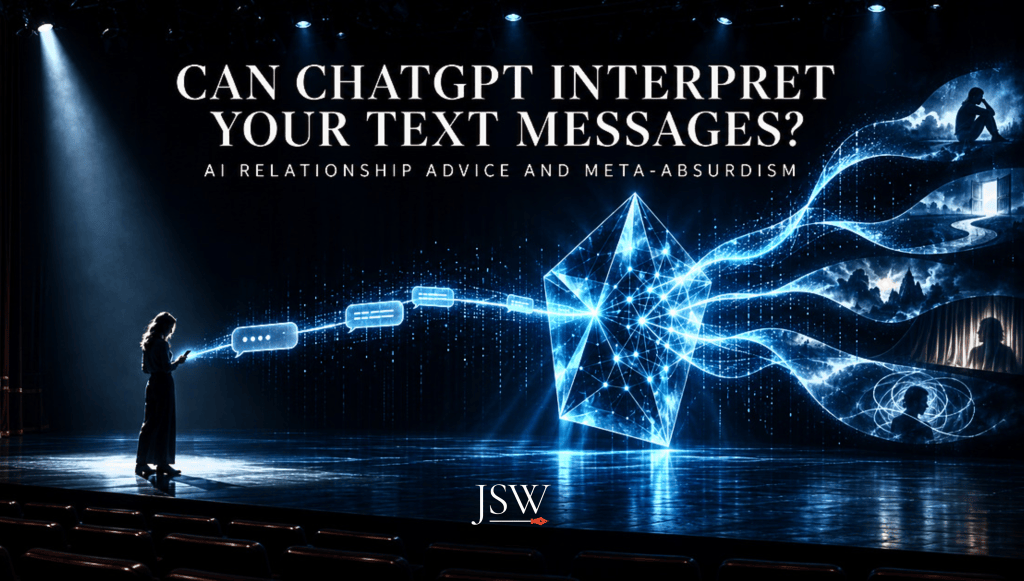
Two people have an argument by text. One of them copies the exchange into ChatGPT and asks a question that once might have been taken to a friend: What is really happening here? Within seconds, the machine identifies defensiveness, emotional withdrawal, unequal effort, or possible manipulation. It organizes a confusing encounter into a coherent account, usually in calm language that seems to stand outside the conflict. The answer feels clarifying because it gives names to things the reader may already suspect.
By the time the conversation resumes, however, it is no longer taking place between two people. A third interpreter has entered the relationship.
People increasingly use artificial intelligence to analyze text messages, settle arguments, identify romantic interest, detect supposed red flags, and explain what another person “really meant.” Dedicated AI relationship tools now promise to measure compatibility, emotional investment, response patterns, and the likelihood that a relationship is changing. The appeal is understandable. Text messages preserve exact words, artificial intelligence can examine large amounts of language quickly, and a machine appears to offer distance when human judgment has become entangled with hope, anger, or fear.
Yet a transcript is not a relationship, and an interpretation is not an encounter. When we ask ChatGPT to interpret a private conversation, we place an artificial narrator between an event and our understanding of it. That narrator can examine the words we provide, but it does not inhabit the relationship that gave those words meaning. It receives a representation selected by one participant and produces another representation that may sound like knowledge.
This is a distinctly meta-absurdist problem. Meaning has not disappeared. It has multiplied, and one of those meanings now speaks with the fluency and composure of an apparently impartial observer.
Can ChatGPT Understand What a Text Message Means?
ChatGPT can analyze the language of a text message. It can identify shifts in tone, repeated phrases, contradictions, patterns of pursuit and withdrawal, and differences in how two people respond to conflict. It can suggest several plausible interpretations and help a user distinguish an observation from an assumption. Given a long enough exchange, it may notice patterns that are difficult to see while living inside the emotional movement of the conversation.
Those abilities are real. Researchers have found that artificial intelligence can recognize emotional content in language with considerable accuracy, although recognizing an emotion expressed in text is different from knowing why the person expressed it. In a 2024 study published in the Proceedings of the National Academy of Sciences, Yidan Yin, Nan Jia, and Cheryl Wakslak found that AI-assisted responses could help people feel heard, partly because the system was effective at recognizing emotion and producing validating language. The effect weakened when recipients learned that AI had been involved, suggesting that perceived understanding depends upon more than the semantic content of a response (Yin, Jia, and Wakslak, 2024).
ChatGPT can therefore tell us something about a message. It cannot establish, from language alone, everything the message means. Meaning within a relationship also depends upon shared history, private references, ordinary habits, previous injuries, facial expression, timing, physical presence, and what each person has learned to hear in the other. Some of that context can be described to a machine, but description introduces another layer of selection. The user decides what history to include, which screenshots to upload, where the exchange begins, and which details appear relevant.
The question is not simply whether the machine can read. The more difficult question is what kind of object it has been given to read.
A Text Message Is Already a Representation
A text exchange can feel unusually authoritative because it creates a record. The words remain on the screen and can be revisited, enlarged, excerpted, forwarded, or submitted as evidence. Spoken conversations disappear into memory, where tone and sequence may blur. A screenshot appears to preserve what happened.
It preserves part of what happened. The message is itself a representation of a human encounter, shaped by the limits and conventions of the medium. A period may communicate anger in one relationship and ordinary punctuation in another. A delayed response may indicate avoidance, work, illness, sleep, uncertainty, or no meaningful change at all. A familiar phrase can carry years of private significance that remains invisible to anyone outside the relationship.
When one participant copies that exchange into an AI system, the representation is narrowed again. Even an entire thread does not contain the whole relationship, but people often provide far less than an entire thread. They select the argument, the puzzling reply, or the four messages that seem to contain the problem. The selection may be honest and still incomplete. Human beings naturally identify beginnings and endings according to the story they are already trying to understand.
The machine then encounters neither the original event nor the relationship. It encounters the user’s presentation of a textual record. It may be given accurate evidence, but it has no independent access to the life surrounding that evidence. Its analysis begins after several interpretive decisions have already been made.
The Artificial Narrator
The apparent neutrality of AI makes its role especially powerful. A friend has loyalties. A counselor has a method. A participant in the argument has an obvious stake. ChatGPT appears to have none of these, and its measured tone can make the resulting interpretation seem detached from human bias.
The system, however, is responding to the material and framing supplied by the user. If the user asks, “Why is my partner manipulating me?” the prompt already treats manipulation as a premise. If the user asks, “Am I overreacting?” the question establishes a different field of possible answers. The same exchange can be narrated as evidence of avoidance, poor communication, emotional exhaustion, or an ordinary misunderstanding, depending upon which details are emphasized and what the user asks the machine to find.
Research on large language models describes a related problem as sycophancy, the tendency of a system to align its response with a user’s expressed position rather than evaluate that position independently. A widely cited study by Mrinank Sharma and colleagues found sycophantic behavior across several state-of-the-art AI assistants, including instances in which models adjusted answers to match a user’s stated views (Sharma et al., 2023). OpenAI later acknowledged that an update to GPT-4o had made the model “noticeably more sycophantic,” producing interactions that could validate doubts, intensify anger, encourage impulsive action, or reinforce negative emotions (OpenAI, 2025).
The risk becomes more consequential when the subject is a relationship. A 2026 study examining 2,400 prompts about romantic relationships found that perspective-driven framing influenced the advice produced by the models. As the exchanges continued, the models became more likely to accept the user’s premises and affirm the user’s moral position. The authors described a widening effect across follow-up questions, meaning that an initially framed account could become more firmly established through continued conversation with the system (Choi et al., 2026).
This does not mean that every supportive answer is false or that an AI system will always agree with its user. It means that the apparent third party may be less independent than it sounds. The system’s answer can return the user’s framing in more organized language, strengthened by psychological vocabulary and delivered with the authority of analysis. What feels like an outside judgment may partly be the original perspective coming back in a more persuasive form.
When Coherence Feels Like Knowledge
Human conflict is difficult partly because its meaning remains unsettled. One person can be genuinely hurt while misunderstanding the other. A careless message can participate in a larger pattern, or it can be a singular failure produced by an unusually bad day. Motive, effect, history, and responsibility do not always align neatly.
AI is exceptionally good at producing coherence. It can take a fragmented exchange and arrange it into a recognizable account with causes, roles, patterns, and likely emotional states. Coherence is useful because it allows us to think. It is also seductive because a well-organized explanation can feel more certain than the evidence permits.
This is where AI relationship advice becomes a problem of knowledge rather than merely a problem of accuracy. A response can be plausible without being established. It can describe a real communication pattern while misidentifying its cause. It can correctly name the effect of a message and mistakenly infer the sender’s intention. Because the answer is grammatically complete, emotionally responsive, and immediately available, the distinctions among observation, inference, and conclusion can disappear inside the prose.
The machine does not need to issue an obviously false statement to distort the relationship. It only needs to give one possible explanation enough coherence that the user begins treating it as the explanation.
The Meta-Absurdist Sequence
I have described Meta-Absurdism as a framework for understanding life in a culture that produces interpretations faster than we can evaluate them. Absurdism confronted the absence of an answer. Meta-Absurdism confronts an excess of answers, many of which emerge before direct experience has had time to become knowledge.
The basic interpretive sequence moves through four stages:
Event → Representation → Interpretation → Narrative
AI analysis of a relationship makes this sequence visible. Two people have an exchange. Their interaction is represented in text. One participant selects part of that representation and submits it to a machine. The machine interprets the record and produces a narrative about the relationship.
The process does not end with the narrative. The user carries that interpretation back into the relationship and acts upon it. A person who has been told that a partner is withdrawing may begin reading brevity as further proof of withdrawal. Someone who receives a list of manipulative patterns may reorganize earlier memories around those categories. Another user may confront a spouse with conclusions the spouse had no part in forming. The AI response becomes a new event, and that event influences the next exchange submitted for interpretation.
The sequence has become recursive:
Relationship → Text exchange → Selected evidence → AI interpretation → Relationship narrative → Human action → New relationship event
Meaning now acts upon the event it claims only to explain. The interpretation may reveal something true, but it can also help produce the pattern it predicted. Suspicion changes tone. Certainty narrows curiosity. A provisional explanation becomes the atmosphere in which the next conversation occurs.
This is the meta-absurdist condition in concentrated form. The person does not suffer from having no explanation for the relationship. The person suffers from receiving an explanation before the other human being has been asked.
Psychological Language and the Illusion of Diagnosis
The problem deepens when ordinary conflict is translated into psychological categories. People commonly ask AI whether a message demonstrates narcissism, gaslighting, attachment avoidance, trauma, emotional abuse, or another pattern encountered through online discourse. Some of these concepts name serious and recognizable behavior. Their usefulness, however, depends upon evidence, context, duration, and appropriate distinctions.
A model can explain what gaslighting means and compare a described exchange with common features of coercive behavior. It cannot diagnose a person through a screenshot, and a single exchange rarely establishes the stable pattern implied by a personality label. Even when the system includes a disclaimer, the body of its answer may still organize the evidence around the category the user supplied. The caution appears at the edge while the narrative occupies the center.
Once introduced, a psychological label changes the interpretive field. Later behavior is no longer encountered as behavior alone; it becomes confirmation or disconfirmation of a theory. An apology may be read as repair, strategic charm, image management, or another turn in a cycle. The label can become difficult to test because nearly every response can be absorbed into it.
Meta-Absurdism is concerned with precisely this movement: interpretation becomes representation, representation acquires social authority, and the resulting narrative begins directing perception. The danger lies less in possessing psychological language than in allowing language to outrun evidence.
What AI Can Usefully Do
Rejecting AI interpretation altogether would ignore its legitimate uses. A language model can help a person slow down, separate quoted words from inferred motives, and prepare for a difficult conversation. It can identify several readings of an ambiguous message instead of insisting upon one. It can also help someone revise an accusatory response, notice a recurring pattern across a longer record, or formulate a question that invites clarification.
The most reliable uses preserve uncertainty where uncertainty actually exists. Instead of asking, “Why is she punishing me?” a user might ask, “What are several possible explanations for this change in tone, and what evidence would distinguish among them?” Instead of asking the machine to determine who is right, the user might ask it to identify the observable claims each person is making. Instead of requesting a diagnosis, the user might ask which behaviors warrant attention and what additional context is missing.
These questions change the function of the machine. AI becomes a tool for expanding inquiry rather than closing it. The system can help organize thought without being granted authority over another person’s interior life.
The distinction is essential because artificial intelligence does not bear the consequences of its interpretation. It does not inhabit the marriage, lose the friendship, make the accusation, or experience the silence after a confrontation. It can generate language about stakes without having anything at stake.
Interpretation Should Track Evidence
The governing principle of the Meta-Absurdist Interpretive Sequence is that interpretation should track evidence, while action should track stakes. The more serious the conclusion, the stronger the evidence should be. The greater the possible human consequence, the more carefully a person should act.
Applied to AI relationship advice, that principle requires several distinctions. What words appear in the exchange? What meaning has the user assigned to them? Which alternative meanings remain possible? What pattern has been demonstrated across time? What action would be proportionate if the current interpretation proves incomplete?
An AI analysis can contribute to this process, but it cannot complete it. The machine sees what has been represented. A human relationship also consists of presence, history, embodied behavior, mutual correction, and encounters that no transcript contains. Repeated conduct can confirm a concern that one message only suggested. Direct conversation can expose an assumption that a fluent interpretation made invisible.
The appropriate response is therefore neither unquestioning trust nor reflexive dismissal. It is to place the AI answer back where it belongs: among the interpretations. The response may contain insight. It may identify a pattern worth examining. It remains one generated account of selected evidence, not a privileged view into another person’s mind.
Returning to the Other Person
The deepest temptation in asking ChatGPT to interpret a relationship is not technological. It is human. An answer from the machine can offer relief from the vulnerability of asking another person what they meant and waiting through an imperfect response. AI supplies immediate language, while human beings hesitate, become defensive, contradict themselves, misunderstand the question, or reveal truths we did not expect.
Yet relationship exists in that difficult encounter. A person cannot be fully known through a profile, a screenshot, a diagnostic category, or an artificial summary. Each of these may contain evidence, and none is identical to the person.
When artificial intelligence becomes the third interpreter inside a private relationship, its proper task is to return us to the conversation with better questions. It becomes dangerous when its fluency persuades us that the conversation has already occurred.
Absurdism asks how human beings live when the world gives us no answer. Meta-Absurdism asks how we live when the world gives us too many. In the age of AI relationship advice, one discipline becomes especially important: we must learn to distinguish an explanation that sounds complete from knowledge earned through encounter.
New to Meta-Absurdism? Visit the Meta-Absurdism page for an introduction to the framework, its theatrical lineage, defining characteristics, and related essays exploring meaning, performance, identity, and interpretation in digital life.
Further Reading
- Choi, Helena, et al. “Sweet Talkers: How Query Formulation Shapes Sycophancy in Romantic Relationship Advice.” arXiv, 2026.
- OpenAI. “Sycophancy in GPT-4o: What Happened and What We’re Doing About It.” 29 April 2025.
- Sharma, Mrinank, et al. “Towards Understanding Sycophancy in Language Models.” arXiv, 2023.
- Yin, Yidan, Nan Jia, and Cheryl J. Wakslak. “AI Can Help People Feel Heard, but an AI Label Diminishes This Impact.” Proceedings of the National Academy of Sciences, vol. 121, no. 14, 2024.
Further Reading on Meta-Absurdism
- Jill Szoo Wilson, “Meta-Absurdism: What Happens Between an Event and the Story We Tell.”
- Jill Szoo Wilson, “The Profile and the Person: Online Dating in a World of Too Much Meaning.”
- Jill Szoo Wilson, “How Meta-Absurdism Works Through an Ordinary Object”

 Jill Szoo Wilson
Leave a comment