
Miriam Mozes Zeiger survived Auschwitz beside her sister Eva. The question of what had been done to her body set Eva on the path to forgiveness.
By Jill Szoo Wilson
Writer | Theatre Artist | Educator
There is a piece of Soviet film, shot in the weeks following the liberation of Auschwitz in January 1945, in which a column of children walks toward the camera between strands of barbed wire. They are wearing striped prisoner jackets far too large for them. Near the front, two small girls in knitted caps hold hands. They are Eva and Miriam, ten-year-old twins.
Eva Mozes Kor once told me that when she first saw a still from that day, years later, she recognized Miriam immediately. It took her a moment longer to understand that the other girl, the one holding her sister’s hand, was herself. There had been no mirrors in the camp. She had spent most of a year looking at Miriam’s face instead of her own, and it had become the face she knew best.
The world remembers Eva Mozes Kor as the Auschwitz survivor who forgave the Nazis. Fewer people know that her forgiveness began as a search on her sister’s behalf: for a name, a chemical, a file, anything that might explain what Josef Mengele had done to Miriam’s body. Eva never found that answer. Instead, she found something that changed the rest of her life.
Two Girls from Portz
Miriam and Eva were born on January 31, 1934, in Portz, a farming village in northwestern Romania with no running water and no electricity. Their parents ran a working farm. There were two older sisters, Edit and Aliz. The family was devout and, according to the USC Shoah Foundation’s biography of Miriam, the only Jewish family in town.
The twins started school in 1940, just as Hungary took control of the region and the hostility around them hardened into something official. Classmates called them dirty Jews, spat on them, pushed them. A teacher showed the class a film about how to catch and kill Jews. The family tried once to flee, but they were caught at the edge of their own land and sent back home.
In the spring of 1944, the Mozes family was taken to a ghetto in Şimleu Silvaniei, where their father was tortured by men who believed he was hiding gold. After about two and a half months, everyone in the ghetto was loaded onto cattle cars. When the doors opened at Auschwitz, a guard moving down the platform was calling for twins. The girls’ mother answered him. Within minutes, Eva and Miriam were pulled away, and the last Eva saw of her mother was an arm stretched out toward the two of them before she vanished into the crowd. Their parents and both older sisters were murdered that day.
The twins survived because Mengele wanted them. Twins were the raw material of his research, and two genetically matched children could serve as an experiment and a control.
Two Weeks
The experiments came in a weekly rhythm. Some days, the children were measured and studied for hours. On others, blood was drawn from one arm while unknown substances were injected into the other. After one injection, Eva grew violently ill, her limbs swelling and her body burning with fever. Mengele looked at her chart, laughed, and said that she had two weeks to live.
What Eva didn’t know at the time was what was happening on the other side of the camp. For two weeks, the sisters were kept apart, and Miriam was held under close watch. The twins learned later why. If Eva had died, Miriam would have been killed immediately so that their bodies could be autopsied and compared. Each sister’s survival was literally the condition of the other’s. Eva, delirious, refused to die. She told herself she would get back to Miriam, and she did.
Miriam paid in her own way. During their months in the camp, she contracted dysentery and a kidney infection, which she attributed to the injections. Neither girl knew what had been put into her. Neither ever would.
After
When the Germans emptied the camp ahead of the Soviet advance, they sent most prisoners away on death marches. Those who remained on January 27, 1945, were mostly the sick, the old, and the children. The twins recovered for a time in a convent in Katowice, then made their way back to Romania with Mrs. Csengeri, a fellow prisoner who had known their mother and was herself the mother of twins. They went to live with an aunt.
In 1950, at sixteen, the sisters emigrated to Israel. They lived on a kibbutz and attended an agricultural school. Miriam trained as a nurse. She married Yekutiel Zeiger, whom she called Kuti, and they raised three daughters, Yaffa, Ariella, and Ayala. Eventually there were ten grandchildren.
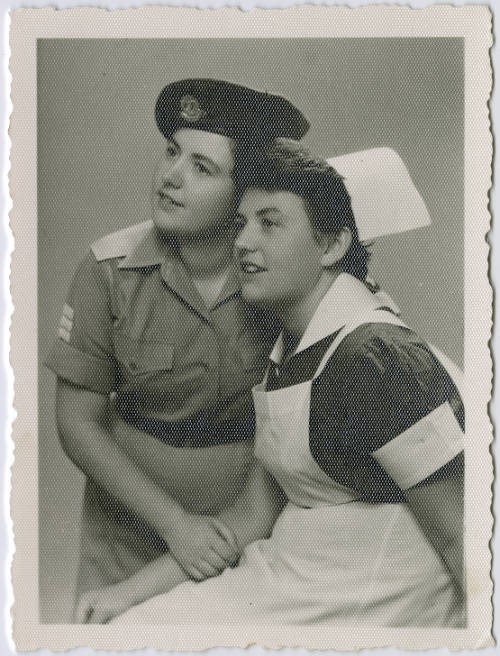
It is worth pausing on that. By every outward measure, Miriam’s life after Auschwitz was full: a profession that cared for the sick, a husband, three girls, a houseful of grandchildren. The Nazis had tried to erase her family entirely, and she built a new one in its place. But she carried the camp with her in a way no one could see.
The Size of a Child
Eva described it simply: “Miriam’s kidneys stopped growing.” They had remained the size of a child’s, frozen at roughly the age when the injections began, and as Miriam’s body grew around them, they struggled to do an adult’s work. She lived with kidney disease her whole life. After her last pregnancy, her kidneys began to fail.
In 1987, Eva gave her sister one of her own.
Something about that act feels almost unbearably fitting. In the camp, each twin’s life had depended on the other’s. Four decades later, one twin’s body sustained the other’s again, this time by choice and out of love, not at the order of a doctor who regarded them as specimens.
The transplant bought time. It could not undo what had been done. Miriam’s doctors wanted to know what she had been injected with as a child, because it might explain her illness and guide her care. No one could tell them. Any records of Mengele’s work, if they ever existed in a useful form, were gone. Mengele himself had escaped to South America and died there in 1979 without ever facing trial.
The Search
Eva’s search for answers had begun years earlier. In 1978, after watching the American television miniseries Holocaust, she began to wonder what had become of the other children who had been in Mengele’s twin barracks. She started looking for them. Miriam, still in Israel, helped. In 1984, Eva founded an organization with a name that was also a lament: CANDLES, for Children of Auschwitz Nazi Deadly Lab Experiments Survivors. She named Miriam its vice president for survivors living in Israel.
The twins they found carried similar stories in their bodies: illnesses no one could explain, conditions doctors couldn’t trace. Many of them wanted the same thing Miriam’s doctors wanted: a record of what had been done to them. Eva went looking for files and found almost nothing. The people who knew were dead, in hiding, or silent.
Miriam developed cancer. She died in Israel on June 6, 1993.
Eva was left with the same unanswered question, now sharpened by grief. Her sister was gone, and she still didn’t know what had been done to them.
A Doctor in Germany
A year before Miriam’s death, the twins had served together as consultants on a 1992 documentary made by the German broadcaster ZDF about Mengele’s twins. Among the people the filmmakers interviewed was Hans Münch, a former SS physician who had served at Auschwitz. He had known Mengele, though he hadn’t worked on the twin experiments.
In July 1993, a month after Miriam died, Eva received an invitation from Boston College to speak at a conference on Nazi medicine. The organizer asked whether she might bring a Nazi doctor with her. It was an extraordinary request, and Eva, characteristically, took it seriously. She remembered Münch from the documentary, got his contact information through ZDF, and, with a friend’s help, reached him. In August 1993, she traveled to Germany to meet him at his home.
She went hoping he might know something about the injections, something that could finally explain what had happened to Miriam. He didn’t. Mengele had shared his work with no one, Münch said. There were no files. But the meeting did not go the way Eva expected. Münch treated her, as she later put it, “with the utmost respect.” They sat outside, and at one point he went into the house and came back with a pillow to make her more comfortable, then again, and again, five times in all. She found herself telling him she liked him, and was startled to mean it.
When she asked how the Nazi staff had coped with what they did at Auschwitz, he told her that most of them got drunk every night. When she asked about the gas chambers, he answered: “This is the nightmare I live with.” He described how they worked, and he told her he had signed the death certificates.
Eva asked whether he would come to Auschwitz in January 1995, for the fiftieth anniversary of the liberation, and sign a statement confirming what he had seen, before witnesses, so that no one could ever deny it. He agreed.
She went home and spent months trying to think how to thank a Nazi doctor for telling the truth. When the answer came, it surprised her: she could write him a letter of forgiveness. As she wrote it, she discovered something that would shape the rest of her life. She realized, as she put it, that she “had the power to forgive,” a power that no one could give her and no one could take away.
On January 27, 1995, at Auschwitz-Birkenau, Münch signed a statement confirming the existence and use of the gas chambers. Eva then read and signed her own declaration, granting amnesty to the Nazis “in my name only.” Afterward, she said she was “finally free.”
What She Found Instead
I have heard people describe Eva’s forgiveness as if it came out of nowhere, a grand gesture by a woman who simply decided to rise above. That isn’t how it happened. It began with a sick sister, a pair of kidneys the size of a child’s, a doctor’s reasonable question, and a twin who would not stop looking for the answer.
She never found it. To the end of her life, Eva did not know exactly what had been injected into Miriam, or into her. The question that sent her to Germany went unanswered. But the search put her outside a house in Germany, sitting across from a man who had stood inside the machinery that killed her family, and he turned out to be a person: frightened, haunted, willing to tell the truth. Something in her shifted there, and kept shifting, until she understood that the people who had taken her family no longer had to own the rest of her life.
Miriam did not live to see that. She died a month before Eva was asked to bring a Nazi doctor to Boston, about a year before Eva wrote her letter of forgiveness, and a year and a half before Eva stood at Birkenau and read her declaration aloud. Every step of the journey that would make Eva known throughout the world for forgiving the Nazis happened after Miriam was gone.
And yet she was present at every step. Eva went to Germany for Miriam. She asked Münch about the injections for Miriam. They had spent years searching for the surviving twins together, but Eva made this final journey alone. When people called Eva the twin who forgave, they were naming only half of a pair.
In that liberation footage, the two girls still walk forward, hand in hand, toward a life neither could imagine. Eva would spend decades telling the world what happened to them. Miriam spent hers raising three daughters, carrying the camp quietly in her body, and helping her sister search.
Eva spent the rest of her life teaching what she discovered on that journey. One of her simplest lessons required only a single coin: read The Penny in Front of Your Eye.
Sources
CANDLES Holocaust Museum and Education Center. (2001). Eva Kor 2001 speech on healing and forgiveness. https://candlesholocaustmuseum.org/educational-resources/evas-2001-speech-on-healing.html
Indiana Historical Society. (n.d.). Eva Mozes Kor collection, ca. 1930s–2019 [Collection guide]. https://indianahistory.org/blog/seeing-double-twins-in-the-digital-collection
The Forgiveness Project. (n.d.). Eva Kor. https://www.theforgivenessproject.com/stories-library/eva-kor/
USC Shoah Foundation. (n.d.). Miriam Mozes Zeiger [Child survivor biography]. https://sfi.usc.edu/sites/default/files/a70_childsurvivor_bios/Miriam%20Mozes%20Zeiger.pdf
My Jewish Learning. (n.d.). The Nazi victim who forgave her perpetrators. https://www.myjewishlearning.com/article/the-nazi-victim-who-forgave-her-perpetrators
Kor, E. M., & Rojany Buccieri, L. (2009). Surviving the angel of death: The story of a Mengele twin in Auschwitz. Tanglewood.



Leave a Reply