
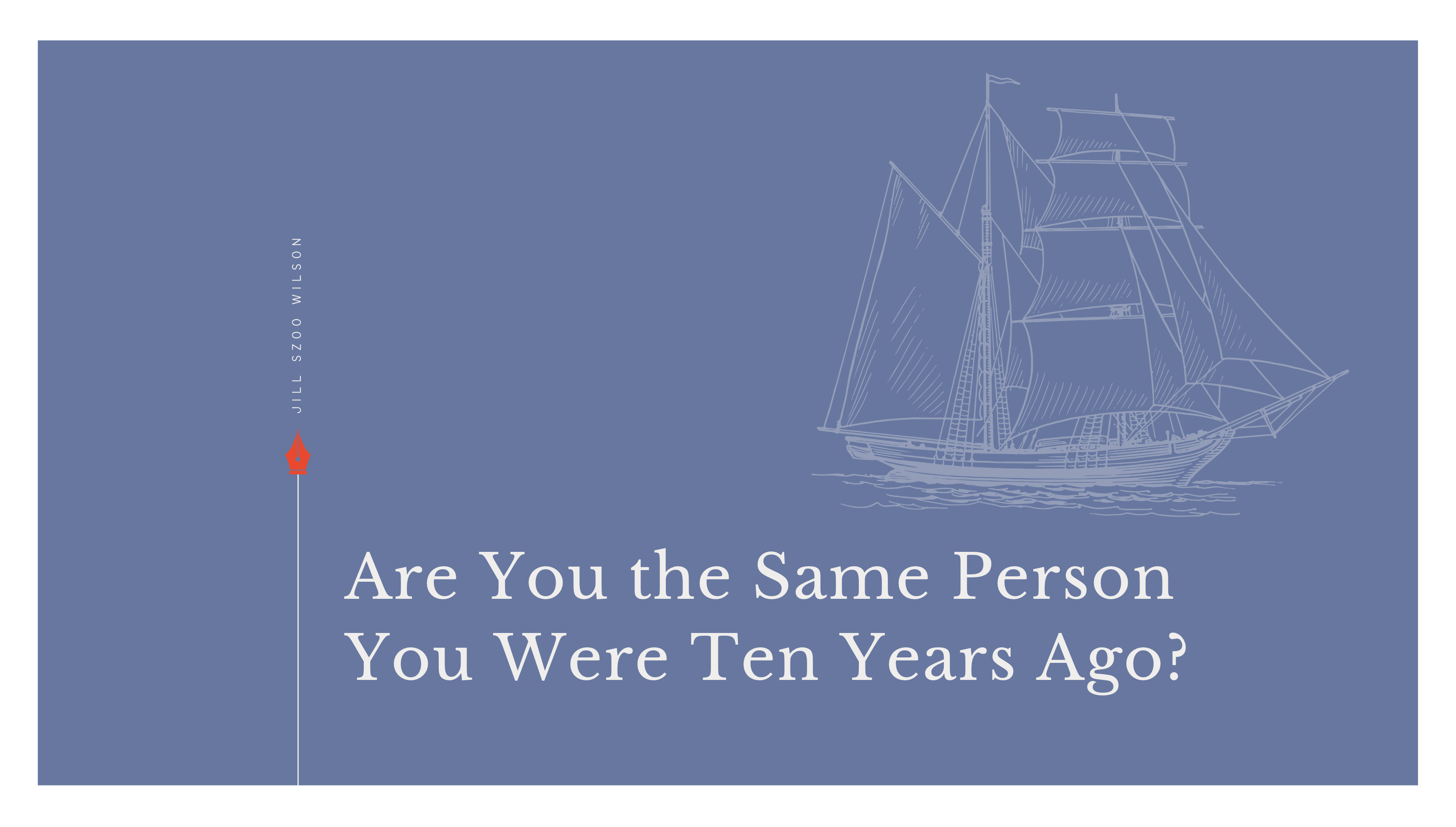
Who are you, where did you come from, and who are you becoming?
By Jill Szoo Wilson
Writer | Theatre Artist | Educator
In Brief: For more than two thousand years, philosophers have asked whether a thing can replace all of its parts and still be the same thing. The puzzle is called the Ship of Theseus, and it applies to you. This essay walks through three philosophical answers, then the Bible’s answer: you remain the same person because God made you, knows you, and will raise you. Finally, Sam Shepard’s play Buried Child shows how much of who you are was in place before you were born, including parts of your family’s story you may never have heard.
In Sam Shepard’s Buried Child, a young man named Vince walks into his grandparents’ Illinois farmhouse after six years away. He’s brought his girlfriend, Shelly, to meet the family. Upon their arrival, his grandfather, Dodge, looks up from the couch and the flashing, blinking glare of the TV he stares at throughout the play. He does not recognize Vince. Soon after, his father, Tilden, comes in from the yard with an armful of carrots and doesn’t recognize him either.
Vince tries everything. He does the tricks he used to do as a boy, like bending his thumb back and drumming his fingernails on his teeth, hoping something will register. Nothing does. Tilden tells Shelly that Vince looks familiar, as if there is a face somewhere inside his face, but still can’t say who Vince is.
Most of us will never walk into a room where none of our family members recognize us. Most of us have, however, looked at an old photo, read an old journal, or heard our younger voice on a recording and barely recognized ourselves. Is that person me? If so, what still connects us, when so much has changed?
The Ship of Theseus
This question has a name. In Greek legend, Theseus was the hero who sailed to Crete, killed the Minotaur in its labyrinth, and sailed home to Athens. Around AD 100, the Greek writer Plutarch told his story in the Life of Theseus, part of a collection of biographies called Parallel Lives. Plutarch writes that the Athenians kept Theseus’s ship for generations, as late as the 300s BC. As each plank rotted, they replaced it with new timber. Philosophers began to use the ship as an example of a puzzle about things that change: once every plank had been replaced, was it still the ship of Theseus?
The English philosopher Thomas Hobbes made the puzzle harder. Suppose someone saved every old plank as it came off and later built a second ship from them. Now there are two ships. One has the original wood. The other has the original history of sailing, docking, and repair. Which one is the ship of Theseus?
You and I are like this ship. You may have heard that your body replaces every one of its cells every seven years. That isn’t quite true. Different parts of you renew at different speeds. The outer layer of your skin replaces itself every few weeks. Red blood cells last about four months. Fat cells last about ten years. Some cells, including most of the neurons in your brain’s cortex and the cells in the lens of your eye, stay with you for life. Even so, the point still stands. The body you have now is not, piece for piece, the body you had at ten. Your opinions, tastes, fears, and hopes have changed too, some of them more than once.
So what makes you the same person through all of it?
Four Ways to Answer the Question
Here are four ways to answer the question. The first three come from philosophers, and each of those gets something right and leaves something out. The fourth comes from the Bible.
Answer One: The Body
The simplest answer says you are the same person because you are the same living body. Your body has a continuous history. It was never swapped out all at once, only plank by plank, the way the Athenians kept their ship.
This answer explains why you can recognize an old friend at a reunion. It struggles with one question, though. If your memories, personality, and values were erased tomorrow, would the person living in your body still be you? Most people hesitate.
Answer Two: Memory
John Locke was an English philosopher whose ideas about natural rights helped shape the American Declaration of Independence. In 1689, he published An Essay Concerning Human Understanding, which argued that the mind begins as a blank slate and is filled by experience. In the second edition, published in 1694, he added a chapter on identity.
Locke argued that personal identity rests on consciousness, especially memory. You’re the same person as the child in that old photo because you can remember being that child, from the inside.
To make his point, Locke imagined a prince who wakes up in the body of a cobbler, a shoemaker, with all of the prince’s memories intact. Who is he now? Locke said he is the prince. The body belongs to the cobbler, but the person is the one who remembers being the prince.
Thomas Reid was a Scottish philosopher who taught at the University of Glasgow. Reid trusted common sense and distrusted arguments that led to strange conclusions. In 1785, in his Essays on the Intellectual Powers of Man, he challenged Locke with a story about a brave officer.
As a boy, the officer was flogged for stealing apples from an orchard. As a young soldier, he captured an enemy flag, and he still remembered the flogging. As an old general, he remembered capturing the flag but had forgotten the flogging.
Here is the problem. By Locke’s rule, the general is the same person as the soldier, because he remembers being the soldier. The soldier is the same person as the boy, because he remembered being the boy. By the same rule, though, the general is not the same person as the boy, because he has forgotten being the boy. That cannot all be true. Identity works like a chain of equal signs: if the general is the soldier, and the soldier is the boy, the general has to be the boy. Reid’s point was that memory alone cannot be what makes you the same person, because memory has gaps.
Answer Three: Psychological Continuity
A third answer builds on Locke and repairs the gap Reid found. You don’t need to remember every day of your life. You need overlapping connections among your memories, beliefs, intentions, values, and character, each one linked to the next like strands in a rope. The general does not remember the flogging, yet he remembers the soldier, and the soldier remembered the boy. The rope holds.
Derek Parfit was a British philosopher who spent most of his career at the University of Oxford. In his 1984 book Reasons and Persons, he took this view further. Think about the person you were last year. You probably had many of the same friends, the same worries, and the same plans you have now. Now think about yourself at seven. You had different fears, loved different things, and could not have imagined the life you live today. Parfit would say you are strongly connected to last year’s you and only weakly connected to the seven-year-old. He argued that these connections may count for more than the question of whether you are literally the same person.
Parfit tested the idea with a thought experiment. Imagine a machine that scans every cell of your body, destroys it, and builds an exact copy on Mars. The person who steps out on Mars has your face, your memories, and your plans for tomorrow. Is that person you?
Many people would say no, because your original body was destroyed. Parfit asked a different question: what would you actually lose? The person on Mars has all of your memories. That person loves the people you love and will finish the work you started. Parfit argued that nothing you care about has been lost. In his view, calling the person on Mars “you” or “a copy” does not change any of that.
Parfit wrote that this view changed how he lived. He had felt sealed inside his own life, as if moving through a glass tunnel. Once he accepted the view, the walls seemed to open, and he cared less about the rest of his own life and more about the lives of others.
A Challenge to All Three
David Hume was a Scottish philosopher of the Enlightenment and one of the thinkers Reid argued against most often. He published A Treatise of Human Nature in 1739, while he was still in his twenties. In it, Hume questioned whether there is a single, enduring self to preserve in the first place.
Hume tried an experiment you can try yourself. He looked inward for his self. Every time, he found a particular thought or feeling: warmth or cold, light or shadow, love or hatred. He never found a self apart from those experiences. He concluded that a person is a bundle of perceptions that follow one another quickly, always moving and changing. Philosophers call this the bundle theory of the self.
If Hume is right, the question changes. We have been asking what makes you the same person underneath all the change. Hume suggests there may be nothing underneath, only the changing thoughts and feelings themselves. In terms of the ship, there are only the planks.
Answer Four: Body and Soul
If Hume found only planks, the Bible points to the one who built the ship.
For most of history, most people would have given a simpler answer to our question: you are the same person because you have the same soul. In the Bible, though, the soul is not a ghost around riding inside a body. Genesis describes the first human this way: “then the LORD God formed the man of dust from the ground and breathed into his nostrils the breath of life, and the man became a living creature” (Genesis 2:7).
The Hebrew words for “living creature” are nefesh chayah. The word nefesh is the one often translated “soul.” The man did not receive a soul as a separate part. He became one. In the Hebrew Scriptures, a person does not have a nefesh; a person is a nefesh, a whole, living self of body and breath together.
The Bible does not set the body aside. It treats the whole person, body and soul, as God’s work, held together by God. David writes, “For you formed my inward parts; you knitted me together in my mother’s womb” (Psalm 139:13). A few lines later he adds, “Your eyes saw my unformed substance; in your book were written, every one of them, the days that were formed for me, when as yet there was none of them” (Psalm 139:16). God told the prophet Jeremiah, “Before I formed you in the womb I knew you” (Jeremiah 1:5).
On this view, you remain the same person because God knows you and holds you, through every replaced plank and every forgotten day. Your memory has gaps. God’s does not.
The Bible also describes a change so deep it sounds like a new ship. Paul writes, “Therefore, if anyone is in Christ, he is a new creation. The old has passed away; behold, the new has come” (2 Corinthians 5:17). Yet the man who wrote those words still called himself Paul, still remembered persecuting the church, and still carried his history with him (1 Corinthians 15:9). The new creation is the same person, made new.
Paul goes further when he describes the resurrection of the dead. He says it will happen when Jesus returns: “Christ the firstfruits, then at his coming those who belong to Christ” (1 Corinthians 15:23). He compares the body to a seed: “And what you sow is not the body that is to be, but a bare kernel, perhaps of wheat or of some other grain” (1 Corinthians 15:37). The plant looks nothing like the seed, yet it grew from that seed and no other. In the same way, the body God raises at Jesus’ return will be changed, yet it will still be your body.
Jesus himself shows what this looks like. When he rose from the dead, his body still bore the marks of the nails. He told Thomas, “Put your finger here, and see my hands; and put out your hand, and place it in my side” (John 20:27). The risen body was the same body, made new. The Bible’s hope for every believer is the same: not escape from the body, but the resurrection of the body, with the same person, body and soul, raised to life.
The Ship of Theseus asks whether a thing can change every part and still be itself. The Bible’s answer is yes. You remain the same person through every change, and even through death, because God made you, knows you by name, and will raise you.
Seeing the Question Onstage
Each of these four answers asks what keeps you the same person as you change. The Bible’s answer reaches further than the others, back before your birth and forward past your death. Sam Shepard was not writing about God, but his play reaches back before birth too. He asks a related question: what made you the person you are in the first place? His play points to your family and everything it carried. Some of your planks were laid down before you were born.
Shepard was born in 1943 in Fort Sheridan, Illinois, and grew up partly on an avocado ranch in Southern California. His father, a pilot in World War II, drank heavily, and fathers and sons struggle with each other throughout Shepard’s work. At nineteen, Shepard moved to New York and began writing plays for small off-off-Broadway theaters. He went on to write more than fifty plays, including some of the most unsettling portraits of American family life in modern theatre.
Buried Child premiered in 1978 at the Magic Theatre in San Francisco and won the 1979 Pulitzer Prize for Drama. It takes place in a run-down farmhouse in Illinois, where a family has spent years refusing to talk about what happened there.
Dodge, still unaware of who Vince is, sends him out for a bottle of whiskey. Vince leaves Shelly at the farmhouse and drives off into the rain. He means to keep driving and never come back. Somewhere on the road, he catches his reflection in the windshield and studies his own face as if it belonged to another man. Then he watches it turn into his father’s face, then his grandfather’s, and on back through generations of faces he never knew. The bones, the eyes, the nose, even the breath had come from someone else. What he sees changes his mind about leaving, and he turns the car around.
Vince came home hoping his family would see who he was. They looked at him and saw a stranger. Alone on the road, he looked at himself and saw them.
When he comes back the next morning, he’s drunk, throwing bottles and cutting his way through the porch screen. He tells Shelly what he saw in the windshield. This time, his grandparents recognize him. Dodge leaves him the house, and when Shelly asks whether Vince is coming with her, he replies, “I just inherited a house. I’ve finally been recognized. Didn’t you hear?” By the end of the play, Vince has taken his place in the family he tried to leave.
The way Shepard has worked out the Ship of Theseus in his own imagination is unsettling. The young man who arrived sober and hopeful at the beginning of the play couldn’t get his family to recognize him. The man who came back was behaving in ways they knew. He was built partly of inherited timber: his father’s way of leaving home and coming back, his grandfather’s drinking, the family’s habit of looking past each other. Some of what had changed in Vince was not new at all. It was old wood coming to the surface.
The play offers a second image. Throughout the story, Tilden carries in vegetables from a backyard where nothing has been planted in decades, first corn, then carrots. The family insists nothing can grow out there. The rain keeps falling, and the field keeps producing anyway.
The vegetables are not the only thing the ground gives up. Years earlier, Halie gave birth to a child, apparently fathered by her own son, Tilden. Dodge drowned the baby and buried it in the backyard. The family has lived with that secret ever since. In the final moments of the play, Tilden comes in from the field carrying the child’s remains.
That raises a question memory alone cannot answer: can something be part of who you are if you have no memory of it? Vince does not need to remember the buried child for its death to have shaped his life. It shaped the family that shaped him.
Which Parts of You Are Yours?
Put the four answers and the play together, and a fuller picture appears. You may be the same person you were ten years ago, but that doesn’t mean everything about you has stayed the same. Your body carries a continuous history. Your memory connects many of your days, with gaps. Your character has kept some planks and replaced others. Through all of it, the God who knit you together in your mother’s womb still knows you by name.
Some of your planks you chose. You picked a career, practiced a skill, kept a promise, or let go of a habit. Others came to you without asking: a temper, a laugh, a way of standing at the kitchen sink that belongs to your mother. Part of growing up is learning to tell the difference, so you can keep what is worth keeping and repair what is not. You don’t have to do that repair alone. The same God who made you promises to make you new (2 Corinthians 5:17).
Here are a few questions to sit with:
- What is one thing about you that has not changed in ten years?
- What is one thing you believed ten years ago that you no longer believe?
- Which of your habits did you choose, and which did you inherit?
- If someone who knew you ten years ago walked into the room, what would they recognize first?
- What did you inherit from someone you never met?
- What old wood in your life would you like God to make new?
In the last moments of Buried Child, the voice of the matriarch of the family, Halie, drifts down from upstairs. She is talking about the rain and the crops it has brought up from the ground. “You can’t force a thing to grow,” she says. At the same moment, Tilden climbs the stairs toward her, carrying the remains of the buried child.
The ground has given up something the family thought it had put away for good.
You can’t become someone new by deciding to on a Tuesday, and you can’t stop being someone old by deciding to forget. The next time you look at an old photograph, notice something besides how much you have changed. The tilt of your head may belong to your father. The way you hold your hands may belong to your mother. Some things in that photograph you have spent years trying to change, and some you are only now learning to recognize.
Sources and Further Reading
Hobbes, T. (1655). De Corpore (Elements of Philosophy Concerning Body), Part II, Chapter 11, “Of Identity and Difference.”
Hume, D. (1739). A Treatise of Human Nature, Book I, Part IV, Section 6, “Of Personal Identity.”
Locke, J. (1689; 2nd ed. 1694). An Essay Concerning Human Understanding. The chapter on identity, Book II, Chapter 27, “Of Identity and Diversity,” was added in the second edition.
Parfit, D. (1984). Reasons and Persons. Oxford University Press.
Plutarch. Life of Theseus, 23.1. In Parallel Lives.
Reid, T. (1785). Essays on the Intellectual Powers of Man, Essay III, Chapter 6.
Shepard, S. (1979). Buried Child. First produced in 1978 at the Magic Theatre, San Francisco; winner of the 1979 Pulitzer Prize for Drama.
Shepard, S. (1996). Buried Child (revised ed.). Dramatists Play Service.
Spalding, K. L., Bhardwaj, R. D., Buchholz, B. A., Druid, H., & Frisén, J. (2005). “Retrospective Birth Dating of Cells in Humans.” Cell, 122(1), 133–143.
Spalding, K. L., Arner, E., Westermark, P. O., Bernard, S., Buchholz, B. A., Bergmann, O., Blomqvist, L., Hoffstedt, J., Näslund, E., Britton, T., Concha, H., Hassan, M., Rydén, M., Frisén, J., & Arner, P. (2008). “Dynamics of Fat Cell Turnover in Humans.” Nature, 453, 783–787.
Scripture quotations are from the ESV® Bible (The Holy Bible, English Standard Version®), © 2001 by Crossway, a publishing ministry of Good News Publishers. Used by permission. All rights reserved.
Leave a Reply