
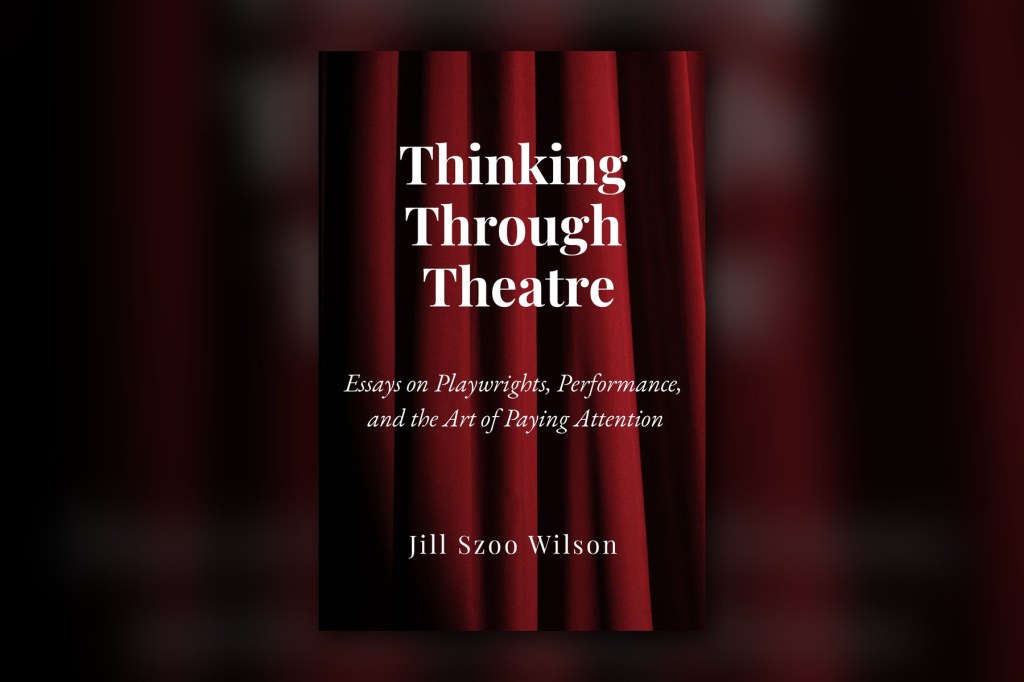
Essays on Playwrights, Performance, and the Art of Paying Attention
by Jill Szoo Wilson
Buy the paperback on Amazon | Buy the Kindle edition
Theatre is one of the few places left where people agree to sit together in the dark, put their phones away, and pay attention to other human beings. In twenty-five essays, Jill Szoo Wilson asks what that attention can teach us about plays, about acting, and about one another.
Drawing on Sanford Meisner and Uta Hagen and on nearly twenty years in rehearsal rooms and classrooms, these essays read playwrights the way an actor or director must: by asking what each person wants, what stands in the way, and what changes when someone speaks. The book moves from theatre’s purpose and the actor’s craft to close readings of Shakespeare, Chekhov, Ibsen, Lorraine Hansberry, August Wilson, Tom Stoppard, Timberlake Wertenbaker, and Annie Baker, then returns to the classroom.
Each essay ends with ten discussion questions, some about the argument, some about specific scenes, and some to try on your feet in a rehearsal room or classroom. Along the way, the book introduces Meta-Absurdism, a framework developed with college theatre students to explore performance and attention in an age when everyone is shouting their answers at once.
Who this book is for
- Actors and directors preparing a role or a production of Shakespeare, Chekhov, Williams, Miller, Hansberry, August Wilson, Mamet, or Annie Baker.
- Theatre teachers and professors looking for essays and ready-made discussion questions for acting, script analysis, and dramatic literature courses.
- Students learning to read a play from the inside.
- Book clubs and playgoers who want to talk about what happened on stage.
Contents
Introduction
Part I: The Stage Itself
- Three Visions of the Stage: Plato, Socrates, and Aristotle on Theatre
- From Realism to Meta-Absurdism: The Evolution of the Modern Stage
- Peter Brook and the Empty Space in an Age of Meta-Absurdism
Part II: The Actor’s Attention
- The Courage to Imagine: Acting, Attention, and the Recovery of Interior Life
- The Meisner Technique and the Art of Paying Attention
- The Mind-Body-Emotion Circuit: Learning How to Respond on Purpose
Part III: The Playwrights
- Shakespeare and the Psychology of the Speaking Mind
- Passion Needs a Partner: Love, Anger, and Justice in Romeo and Juliet, King Lear, and The Merchant of Venice
- No True Valor: What Courage Is For in Macbeth, Hamlet, and Much Ado About Nothing
- Henrik Ibsen, Moral Architecture, and the Performance of Social Identity
- Chekhov and the Psychology of What We Leave Unsaid
- The Uses of Tomorrow: What Hope Asks of People in Chekhov
- The Rooms Where Truth Presses In: On Tennessee Williams and the Work of Being Seen
- Blanche’s Last Witness
- The Cost of Becoming: Willy Loman and the Collapse of the Performed Self
- The Rooms That Fight Back: Space, Aspiration, and Performance in Lorraine Hansberry
- Tom Stoppard and the Pleasure of Thinking
- Conversation as Negotiation: The Theatre of Lanford Wilson
- Need as Dramatic Force in the Plays of David Mamet
- Who Gets to Tell It: Experience and Authority in August Wilson’s Fences, The Piano Lesson, and Ma Rainey’s Black Bottom
- The Conditions of Speech: Voice, Power, and Authorship in the Plays of Timberlake Wertenbaker
- The Ordinary Infinite: Annie Baker and the Meta-Absurdist Stage
Part IV: Theatre and the Classroom
- Living With Questions: The Socratic Method in Classroom and Culture
- Thinking in Community: Constructivism and the Socratic Tradition in Higher Education
- The Performing University: Assessment, Authenticity, and Meta-Absurdism in Higher Education
A Note on Meta-Absurdism
Questions readers ask
What is Thinking Through Theatre about?
Thinking Through Theatre is a collection of twenty-five essays by Jill Szoo Wilson on playwrights, acting, and the practice of paying attention. It reads plays the way an actor or director must, by asking what each person wants, what stands in the way, and what changes when someone speaks.
What is Meta-Absurdism?
Meta-Absurdism is a theatrical framework that Jill Szoo Wilson developed with her theatre students at St. Louis Community College–Meramec in 2025. Where Absurdism explored the tension between the human search for meaning and a world that offers no clear answer, Meta-Absurdism describes a world crowded with competing answers, until their very abundance makes meaning harder to discern.
Can teachers use this book in a class?
Yes. Every essay ends with ten questions for discussion, including questions about particular scenes and exercises to try on your feet, so the book works for acting, script analysis, dramatic literature, and theatre history courses.
Which playwrights does the book discuss?
The book discusses Shakespeare, Anton Chekhov, Henrik Ibsen, Tennessee Williams, Arthur Miller, Lorraine Hansberry, Tom Stoppard, Lanford Wilson, David Mamet, August Wilson, Timberlake Wertenbaker, and Annie Baker. It also draws on the philosophy and theatre practice of Plato, Aristotle, Peter Brook, Sanford Meisner, and Uta Hagen.
About the author
Jill Szoo Wilson is a writer, theatre artist, and educator based in St. Louis. She taught theatre and communication for nearly twenty years, directing productions and coaching actors. Thinking Through Theatre is her first book of essays.
Paperback: 256 pages, 6 × 9 in. ISBN 9798166334176. Also available as a Kindle eBook.

