The New Testament Was Written by Second Temple Jews

How Israel’s Scriptures Shaped Every Page of the New Testament

By Jill Szoo Wilson

The New Testament presents Jesus as the Messiah, the Son of David, the Son of Man, the mediator of a New Covenant, and the inaugurator of God’s kingdom. None of these titles or concepts receive extensive explanation from the biblical authors themselves. Matthew does not pause to explain why readers should care about the Son of David. Jesus does not stop to define the kingdom of God every time he mentions it. Paul assumes his audiences understand covenant, resurrection, temple, sacrifice, and redemption. The New Testament writers proceed as though they are entering a conversation that has already been underway for centuries.

They are.

Understanding that conversation requires understanding what historians call Second Temple Judaism.
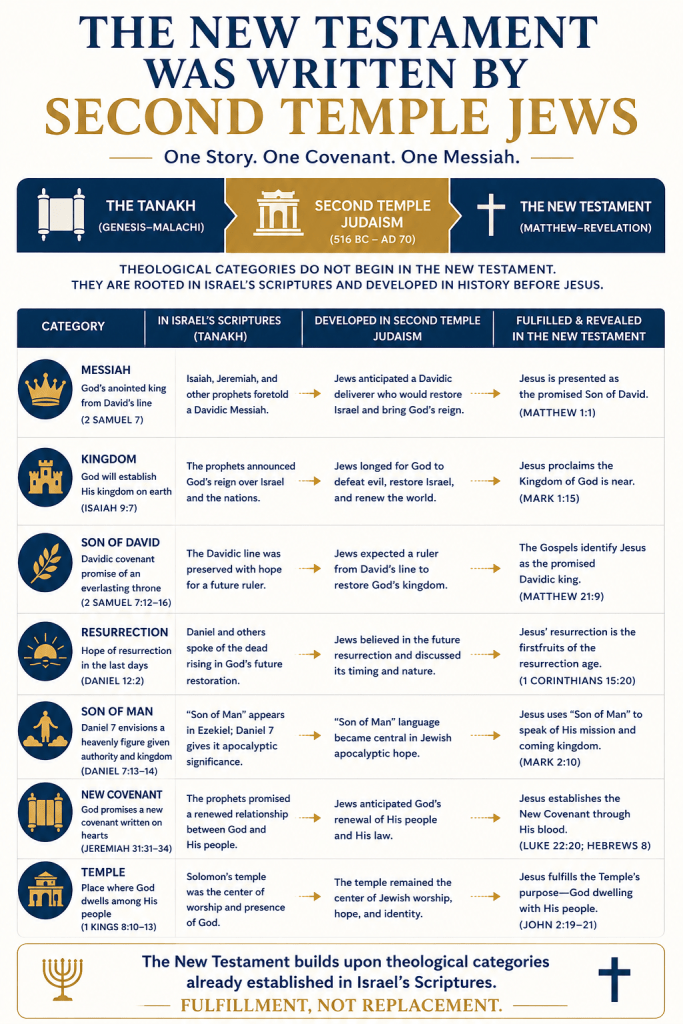
Historians use the phrase Second Temple Judaism to describe the period between two defining events in Israel’s history: the rebuilding of the Jerusalem Temple after the Babylonian exile and the destruction of that same temple by Rome in AD 70. The era begins when Jewish exiles return from Babylon under Persian rule and rebuild the temple described in Ezra and Nehemiah. It ends nearly six centuries later when Roman armies level Jerusalem during the Jewish revolt. These centuries form the world of the New Testament. Jesus taught within this world. Paul wrote within this world. The earliest churches emerged within this world.

Understanding Second Temple Judaism therefore provides more than historical background. It introduces the theological environment that shaped the questions, expectations, and assumptions carried by the first followers of Christ.

To understand why questions of Messiah, kingdom, restoration, and covenant renewal dominated Jewish thought during the Second Temple period, we must begin with the Babylonian exile. When Babylon conquered Judah in the sixth century BC, the devastation reached every visible sign of Israel’s national and religious life. Jerusalem fell, the temple was destroyed, and the Davidic monarchy collapsed. Israel’s prophets interpreted these events as covenant judgment for the nation’s persistent rebellion against the God who had delivered Israel from Egypt and entered into covenant with his people at Sinai. Yet the prophets who announced judgment also proclaimed restoration.

Isaiah prophesied renewal for Zion and the nations (Isaiah 2:1-4; 11:1-10; 60:1-22). Jeremiah promised a New Covenant in which God would write his law upon the hearts of his people (Jeremiah 31:31-34). Ezekiel described the return of God’s presence, the gathering of scattered Israel, and the restoration of life where death had seemed final (Ezekiel 36:22-28; 37:1-14; 43:1-5).

“I will put my law within them, and I will write it on their hearts. And I will be their God, and they shall be my people.”
Jeremiah 31:33

When Jewish exiles eventually returned to the land and rebuilt the temple, many of the prophets’ promises appeared to be moving toward fulfillment. Jerusalem once again became the center of Jewish worship, and life resumed in the land God had promised to Israel. Yet the restoration foretold by Isaiah, Jeremiah, and Ezekiel extended far beyond a return from Babylon. The prophets spoke of renewed kingship, covenant renewal, the gathering of God’s people, the defeat of Israel’s enemies, and the visible reign of God. The temple stood once again, but the larger story remained unfinished in several obvious ways. Foreign powers continued to rule the land. The promised son of David had not appeared. The nations had not streamed to Zion, and the universal peace prophesied by the prophets remained unrealized. The centuries that followed were therefore shaped by a single urgent question: when would God complete the restoration he had promised?

When would God complete the restoration he had promised?

The centuries following the exile produced an extraordinary engagement with Israel’s Scriptures because Jewish communities believed the prophets themselves contained the answer. The Torah, the Prophets, and the Writings became the lens through which Israel interpreted its past, understood its present condition, and anticipated its future restoration. As Jewish communities wrestled with these questions, themes such as Messiah, kingdom, resurrection, judgment, covenant renewal, and restoration moved to the center of Jewish thought. These ideas did not arise during the Second Temple period. Rather, centuries of study, worship, and reflection brought renewed attention to themes already woven throughout the Scriptures of Israel.

The expectation of a coming Messiah provides a clear example of how Second Temple Jews searched Israel’s Scriptures for answers to the unresolved promises of restoration. The Hebrew word mashiach means “anointed one,” a title originally associated with individuals whom God had set apart for a particular role, including kings, priests, and occasionally prophets. Over time, however, the term became increasingly connected to Israel’s royal hopes because of God’s covenant with David. In 2 Samuel 7, God established a covenant with David, promising that his royal line would continue and that his throne would remain central to Israel’s future hope. As later generations reflected upon that promise in the aftermath of exile, the prophets began to describe a future ruler who would restore justice, gather God’s people, and extend God’s reign beyond Israel to the nations. By the first century, hopes for restoration and hopes for a Davidic king had become inseparable. When the New Testament identifies Jesus as the Son of David, it places him within those expectations and presents him as the promised heir to God’s covenant with David, the ruler through whom Israel’s story would reach its fulfillment.

The same pattern appears in Jewish expectations concerning resurrection. The New Testament proclamation of Jesus’ resurrection rests upon a hope already present in Israel’s Scriptures and developed through centuries of reflection upon God’s promises. Daniel 12 gives this hope one of its clearest expressions, describing a future resurrection in which God would vindicate the righteous and judge evil. For many Jews living during the Second Temple period, resurrection expressed confidence that God’s covenant promises would ultimately prevail over suffering, injustice, and death itself. Martha’s response to the death of Lazarus reveals how deeply this expectation had taken root. When she tells Jesus that Lazarus “will rise again in the resurrection on the last day,” she speaks from a hope already rooted in Israel’s Scriptures. The apostles later proclaimed that Jesus had been raised from the dead, interpreting that event through a category that already occupied a central place within Jewish thought.

The title “Son of Man” demonstrates the same pattern. Daniel 7 portrays a figure “like a son of man” receiving authority, dominion, and an everlasting kingdom from the Ancient of Days. The vision became deeply influential during the Second Temple period because it addressed questions of kingship, judgment, and God’s rule over the nations. When Jesus repeatedly identifies himself as the Son of Man, he draws upon a category already embedded within Israel’s Scriptures and familiar to the theological world of first-century Judaism. The expression appears throughout the Tanakh, particularly in Ezekiel, and reaches a climactic expression in Daniel 7 before becoming one of Jesus’ most frequent self-designations (Ezekiel 2:1; Daniel 7:13-14; Matthew 8:20; Mark 2:10; Luke 19:10; John 5:27).

The kingdom of God likewise stands at the center of Jesus’ preaching because it already stood at the center of Israel’s prophetic hope. Isaiah envisioned a day when the nations would stream to Zion. Daniel described God’s everlasting kingdom overcoming every earthly empire. Zechariah declared that the Lord would become king over all the earth. Consequently, when John the Baptist announced that the kingdom of heaven was near and Jesus proclaimed the arrival of God’s kingdom, they were speaking into a conversation that had been underway long before either of them appeared on the banks of the Jordan River.

Christians therefore believe that Jesus is the promised Messiah anticipated by Israel’s Scriptures. He was crucified, buried, and raised from the dead in fulfillment of God’s promises. Following his resurrection, he appeared to his disciples and to hundreds of eyewitnesses, including more than five hundred people at one time according to the testimony preserved in 1 Corinthians 15. He ascended to the right hand of God, where he now reigns as King and High Priest. Yet the biblical story has not reached its final chapter. The prophets spoke not only of the coming Messiah, but also of the restoration of all things, the renewal of creation, the judgment of evil, and the visible reign of God upon the earth. Christians therefore continue to await the fulfillment of those promises. Christ’s work on the cross secured victory over sin and death, but it also points forward to the day when he will return, establish his kingdom in its fullness, and bring the story of redemption to its appointed conclusion.

Recognizing this reality changes the way the New Testament is read. Many Christians approach the New Testament as though it introduces an entirely new theological world. The first followers of Jesus understood themselves very differently. They believed they were living within the fulfillment of a story that had already been unfolding for centuries. The categories through which they understood Jesus did not originate in the first century. Messiah, Son of Man, kingdom, resurrection, covenant, temple, and restoration were already deeply rooted in Israel’s Scriptures and had become central themes within Second Temple Judaism.

This continuity extends beyond individual doctrines and into the structure of the New Testament itself. Jesus, Paul, Peter, John, Matthew, and the earliest followers of Christ did not treat Israel’s Scriptures as historical background material. They treated them as the authoritative framework through which God’s purposes were being revealed. Matthew repeatedly presents Jesus as the fulfillment of Israel’s story. Peter explains Pentecost through the prophet Joel. Paul grounds his arguments in Genesis, Exodus, Deuteronomy, Isaiah, Habakkuk, and the Psalms. The Epistle to the Hebrews assumes familiarity with temple worship, sacrifice, priesthood, covenant mediation, and ritual holiness. The Book of Revelation draws heavily upon Daniel, Ezekiel, Isaiah, Zechariah, and Exodus. The New Testament writers do not merely quote the Tanakh. They think through it, argue from it, and interpret the life of Jesus through its categories.

The significance of the New Testament, therefore, lies not in the introduction of new theological categories but in the claim that those categories find their fulfillment in Jesus of Nazareth. The apostles present Jesus as the promised Son of David, the Son of Man envisioned by Daniel, the mediator of Jeremiah’s New Covenant, and the king anticipated by the prophets. Their message rests upon the conviction that God’s promises to Israel had been decisively inaugurated in the Messiah and would reach their fullness through his return and reign.

The apostles drew upon the Torah, the Prophets, and the Writings because those Scriptures provided the categories through which they understood Jesus and his mission. Son of David, Son of Man, New Covenant, kingdom, resurrection, and restoration belonged to a story already in motion long before the first century. The New Testament therefore presents itself as the continuation of that story, carrying forward the promises given to Abraham, developed through Moses, entrusted to David, proclaimed by the prophets, and inaugurated in Christ. The same story that begins in Genesis continues through the Gospels, the Epistles, and Revelation, moving toward the day when every promise of God reaches its complete fulfillment under the reign of Israel’s Messiah.

Second Temple Judaism forms the bridge between the world of the Tanakh and the world of the New Testament. The apostles proclaimed that Jesus, Israel’s Messiah, had decisively inaugurated all that the Scriptures had been pointing toward, and they explained that reality through the language, expectations, and theological framework of Israel’s Scriptures. The New Testament therefore stands as the continuation of Israel’s covenant story, revealing promises first given to Abraham, developed through Moses, entrusted to David, and proclaimed by the prophets. The story that begins in Genesis continues through the New Testament and moves toward the day when Christ returns to establish his kingdom in its fullness, and every promise of God reaches its complete fulfillment.


Author’s Note:

I write as a Gentile Christian whose faith is rooted in the conviction that Jesus of Nazareth is Israel’s Messiah and the Savior of the world. The more deeply I study the Scriptures, the more convinced I become that Christianity cannot be understood apart from the story of Israel.

I do not hold to replacement theology, the belief that the Church has replaced Israel in God’s redemptive purposes. Rather, I believe Gentile believers are graciously grafted into Israel’s covenant story through faith in Christ (Romans 11:17-24). The New Testament’s authors were Jews who understood themselves to be proclaiming the fulfillment of God’s promises, not the abandonment of them.

As one who has been grafted into that story by grace, I approach these essays with gratitude for the Jewish foundations of the Christian faith and with confidence that Jesus, Israel’s Messiah, will one day return to rule and reign from Jerusalem as King.
One Root. Many Branches. Paul’s Answer in Romans 11

By Jill Szoo Wilson

“I ask, then, has God rejected his people? By no means” (Romans 11:1).

When Paul the Apostle writes those words, the covenant God first established with Abraham remains fully alive in the life of Israel. The temple in Jerusalem still stands. Torah is still read in the synagogues. Pilgrims still travel to the appointed feasts. Families still preserve the memory of tribes, ancestors, promises, exile, and return. Yet something historically unprecedented is unfolding. The message that Jesus of Nazareth is Israel’s Messiah is now moving beyond Judea into the nations, and Gentile believers are entering a covenantal story that began long before Rome, long before Caesar, and long before the first page of the New Testament was ever written. Within that moment, one question rises with unavoidable force: Has God rejected his people?

The force of Paul’s question depends upon the meaning of the phrase his people. In the language of the Tanakh, the phrase refers to the people of Israel, the descendants of Abraham, Isaac, and Jacob who were brought out of Egypt, gathered before God at Sinai, instructed through Torah, and preserved through centuries of war, exile, return, and covenantal remembrance. The covenant shaped worship, law, ancestry, land, calendar, and the hope of Israel’s future restoration. When Paul asks whether God has rejected “his people,” he is speaking about Israel in the fullest historical and covenantal sense. The people who received the promises in Genesis remain fully in view.

Paul rejects the conclusion immediately. The Greek phrase is mē genoito, an expression he uses throughout his letters when rejecting a conclusion he considers fundamentally incompatible with the character and faithfulness of God. English translations render the phrase “By no means,” “Certainly not,” or “God forbid,” though each only approximates the sharpness of Paul’s response. The question itself carries enormous theological weight. If God has rejected Israel, then the covenant promises given to Abraham, reaffirmed through Isaac and Jacob, and carried through the history of Israel, would stand broken. Paul rejects that conclusion immediately because the faithfulness of God to his covenant remains at stake.

Paul then offers himself as evidence:

“For I myself am an Israelite, a descendant of Abraham, a member of the tribe of Benjamin” (Romans 11:1).

This is more than autobiography. Paul grounds his argument in covenant identity. In the first century, tribal ancestry still carried historical and theological meaning within Jewish life. By identifying himself as a descendant of Abraham and a member of the tribe of Benjamin, Paul places himself firmly within the covenant people of Israel. His faith in Israel’s Messiah does not remove him from that identity. It confirms that the covenant promises given in Genesis remain alive within the apostolic age itself. Paul presents himself as evidence that the story continues. The risen Christ has not erased Israel’s story. That story is continuing, but now, Gentiles are given the opportunity to step directly into it.

Paul then points to the days of Elijah, when the prophet believed he alone remained faithful in Israel. Yet God answered:

“I have kept for myself seven thousand men who have not bowed the knee to Baal” (Romans 11:4).

The reference comes from 1 Kings 19, where Elijah looks across Israel and believes he alone remains faithful to the God of Israel. Large portions of the nation have turned toward the worship of Baal, and covenant loyalty appears to be collapsing. Yet God reveals that thousands within Israel still remain faithful. Paul uses that moment to explain his own generation. Even when large portions of Israel appear spiritually divided or uncertain, God continues to preserve a remnant within his covenant people. The promises first given to Abraham remain alive because the faithfulness of God has not failed.

By the middle of Romans 11, Paul the Apostle turns from remnant to imagery. Israel becomes an olive tree. In the agricultural world of the Mediterranean, olive trees often survived for centuries and became part of a family’s inheritance across generations. Their deep root systems allowed them to endure drought, war, political upheaval, and changing empires while continuing to produce fruit. Paul chooses this image with extraordinary care because it communicates continuity, ancestry, nourishment, and permanence all at once. Some branches have been broken off. Wild branches from the nations have been grafted in. Yet the tree itself remains the same.

Paul describes Gentile believers as “a wild olive shoot” grafted into “the nourishing root of the olive tree” (Romans 11:17). The image carries theological weight far beyond agriculture. Gentile believers are not planted into a second tree with a different root system. They are grafted into an already living covenantal story shaped by the promises given to Abraham, carried through Israel’s history, preserved through exile and return, and now proclaimed through Israel’s Messiah. The nourishment sustaining the branches comes from a covenantal root that existed long before Gentile believers entered the story. Paul’s imagery depends upon continuity. The tree remains alive because the covenant promises of God remain alive.

Paul’s warning to Gentile believers follows immediately:

“Do not be arrogant toward the branches” (Romans 11:18).

The warning only makes sense if Israel remains central to the covenantal story Paul is telling. Gentile believers are entering promises that existed long before their arrival. The patriarchs, the covenants, Torah, the prophets, the worship of the temple, and the hope of the Messiah all emerge from the history of Israel. Paul’s concern is not merely interpersonal humility. He is protecting the memory of the covenant itself. Arrogance becomes possible when later branches begin to imagine that the root no longer matters, or that the story began with them instead of with Abraham and the people of Israel. Paul refuses that conclusion entirely. The nations are being welcomed into an already existing covenantal story shaped through centuries of promise, exile, preservation, and hope. The root sustains the branches, not the branches the root.

Paul’s warning becomes even sharper as the passage continues. Some branches were broken off because of unbelief, while Gentile believers stand within the tree through faith rather than superiority. The covenantal root does not exist to affirm arrogance or triumphalism. Paul warns Gentile believers to remember both “the kindness and the severity of God” (Romans 11:22), because the covenantal story still unfolds under divine judgment, mercy, and faithfulness. Even the branches that were broken off remain capable of being grafted in again, “for God has the power to graft them in again” (Romans 11:23). The image remains one tree, one root, and one continuing covenantal story governed by the same faithful God.

Paul’s argument reaches its climax near the end of the chapter:

“For the gifts and the calling of God are irrevocable” (Romans 11:29).

The Greek word is ametamelēta, meaning unregretted, unrevoked, incapable of being withdrawn. Paul chooses the term carefully. The covenant promises first spoken to Abraham and carried forward through Israel’s history, including Egypt, Sinai, exile, return, and the prophetic hope surrounding the coming Messiah, still remain under the care of the same faithful God who first spoke in Genesis. Paul’s point is clear. God has not abandoned the promises he made to Israel. The covenant continues because the faithfulness of God continues.

Throughout Romans 11, Paul describes Gentile believers as entering an already existing covenantal story rooted in the promises given to Israel. The olive tree remains rooted in the covenant promises first spoken to Abraham and carried forward through the history of Israel. Gentile believers now share in that nourishment through Israel’s Messiah, yet the root itself remains unchanged. The God who called Abraham continues to preserve his people, fulfill his promises, judge with holiness, and extend mercy to the nations within the same unfolding story. The New Testament repeatedly builds its theology from the Scriptures of Israel because the covenantal world of Abraham, Isaac, Jacob, Moses, the prophets, exile, restoration, and Messiah still remains fully in view. Scripture reveals one God, one unfolding covenantal story, one kingdom, and one Messiah through whom the promises given to Israel continue to stand.

Abraham, Isaac, and Jacob: Why the Abrahamic Covenant Still Stands

By Jill Szoo Wilson

The story of Israel begins with a covenant.

In the Hebrew Scriptures, the word for covenant is berit, a term that refers to a binding relationship established by oath, promise, and obligation. In the world of Abraham, covenants joined kings to their people, families to one another, and tribes to shared responsibilities. They were sealed with spoken promises, witnessed in public, and often marked by physical signs, written agreements, shared meals, or sacrificial rituals that bound those promises to future generations. When the God of Israel enters into a covenant, Scripture takes this familiar human framework and fills it with extraordinary weight. Covenant becomes the chosen means through which God binds his name, his promises, and his redemptive purposes to human history.

The first covenant that shapes the identity of Israel appears in the book of Genesis with a man named Abram, who is living among the people of Mesopotamia. He has livestock, servants, extended family, and an established life when the God of heaven speaks with startling clarity in Genesis 12:

“Go from your country and your kindred and your father’s house to the land that I will show you.”

With those words, the covenantal story that shapes Abraham, Isaac, Jacob, Israel, the prophets, the exile, Second Temple Judaism, and the theological world of Jesus of Nazareth begins.

God’s promises to Abram unfold in three movements that will shape every chapter that follows.

First, God promises land. The Hebrew word is eretz, a word that can refer to land, territory, or earth depending on context. Here, it refers to a specific inheritance that will eventually become central to Israel’s national identity.
Second, God promises descendants, even though Abram’s wife, Sarah, remains barren and no child has yet come.
Third, God promises blessing, declaring that through Abram, “all the families of the earth shall be blessed.” From its earliest articulation, the covenant carries Israel and the nations within the same promise.

The covenant deepens in Genesis 15 through a ritual Abram would have recognized immediately. Animals are divided, and their bodies are placed opposite one another, creating a path between the pieces. In covenant ceremonies of Abram’s world, both parties would walk that path together, publicly declaring that the fate of the animals would become the fate of anyone who breaks the covenant. The Genesis account then unfolds with extraordinary precision. Abram falls into a deep sleep. Darkness settles over the scene. A smoking fire pot and a flaming torch, visible signs of God’s presence, pass alone between the divided sacrifices. Abram never walks the path. God walks it alone. From the beginning, the covenant rests upon the faithfulness of God, who binds himself to promises that will shape generations still to come.

In Genesis 17, the covenant receives a permanent sign in the flesh. God changes Abram’s name to Abraham, meaning “father of many,” and changes Sarai’s name to Sarah. He then establishes circumcision as the physical sign of the covenant, a mark every male descendant will carry in his own body as a visible reminder that he belongs to the family God has set apart. The covenant now shapes identity, inheritance, family, worship, and the future of every generation that follows.

When Abraham dies, the covenant remains alive. In Genesis 26, God speaks the same promises to Isaac. In Genesis 28, God speaks the same promises again to Jacob as he sleeps beneath the open sky near Bethel. God repeats the same promises: Land. Descendants. Blessing. Nations. By the end of Genesis, these covenantal promises have passed through three generations and become inseparable from the identity of the people who will eventually be called Israel.

By the first century, nearly two thousand years have passed since God first spoke to Abram in Genesis. Israel has become a nation. Slavery in Egypt, deliverance through Moses, the giving of Torah at Sinai, life in the promised land, the rise of kings, the voices of the prophets, the destruction of Jerusalem, and the trauma of exile have all become part of Israel’s collective memory. The temple in Jerusalem has been rebuilt, and Jewish life once again gathers around worship, sacrifice, pilgrimage, and the reading of Scripture. Historians refer to this period, from the rebuilding of the temple after the Babylonian exile until its destruction by Rome in AD 70, as Second Temple Judaism. It is the theological, cultural, and covenantal world into which Jesus of Nazareth is born.

Through every generation, the covenant first spoken to Abraham, Isaac, and Jacob continues to shape who belongs to the people of Israel, how families preserve their ancestry, why the land of Israel remains sacred, how worship is ordered in Jerusalem, how exile is understood, and why many still wait for the promised Messiah. When first-century Jews speak of “the God of Abraham, Isaac, and Jacob,” they are invoking a covenant that still governs Israel’s past, present, and future.

This same covenant stands at the center of the New Testament. When Mary sings in the opening chapter of Luke, she anchors the coming of Israel’s Messiah in promises first spoken to Abraham:

“He has helped his servant Israel, in remembrance of his mercy, as he spoke to our fathers, to Abraham and to his offspring forever” (Luke 1:54–55).

When Peter the Apostle stands in Jerusalem after the outpouring of the Holy Spirit, he speaks to the people of Israel with the same covenant firmly in view:

“You are the sons of the prophets and of the covenant that God made with your fathers, saying to Abraham, ‘And in your offspring shall all the families of the earth be blessed’” (Acts 3:25).

The covenant God established with Abraham, Isaac, and Jacob continues beyond the boundaries of ethnic Israel and into the nations through Israel’s Messiah.

When Paul the Apostle writes to Gentile believers in Romans 11, he uses the image of an olive tree to describe the nations being grafted into Israel’s covenantal life, sharing in promises that had already been alive for centuries. The image is deliberate. Gentile believers do not replace the natural branches. They are brought into an already living covenant, nourished by promises first spoken to Abraham and carried forward through Isaac, Jacob, Israel, the prophets, and the apostolic witness*.

The covenantal vocabulary remains consistent because the covenant itself remains active. Paul the Apostle never presents Gentile believers as a new people detached from Israel’s story, nor does he present Israel as a covenant that has somehow expired. The God who called Abraham continues to govern the promises he first established in Genesis. Through Israel’s Messiah, the nations now participate in a covenantal story already in motion, joining a people, a history, and a kingdom that began long before the writings of the New Testament.

The New Testament reaches back into the Tanakh with extraordinary precision, grounding the identity of Jesus of Nazareth, the mission of the apostles, and the inclusion of the nations within promises first spoken in Genesis. From Abraham’s call in Mesopotamia to Peter’s preaching in Jerusalem, from circumcision in the flesh to the outpouring of the Holy Spirit, from the land of promise to the hope of resurrection, Scripture reveals one God, one covenantal story, one unfolding kingdom, and one Messiah through whom that covenant still stands.


*The term apostolic refers to the apostles, the foundational witnesses commissioned by Jesus Christ and recognized in the earliest Christian communities as authoritative witnesses to his resurrection and teaching. Their preaching, teaching, and written testimony form the foundation of the earliest Christian witness preserved in the New Testament.

One Story. One Covenant. One Messiah.

How the Tanakh shapes every page of the New Testament

By Jill Szoo Wilson

For the past two years, I’ve been studying God’s covenant with Abraham, Isaac, and Jacob. That journey has brought me to the following summary. Over the next several months, I’ll be writing more about what I’ve learned.


The faith of Jesus of Nazareth and his earliest followers was never intended to create a new religion separated from Israel, but to reveal the long-awaited fulfillment of the story God had already been telling through the Torah, the Prophets, and the Writings, collectively referred to as the Tanakh*. This conviction is rooted in Second Temple Judaism** and in the apocalyptic imagination of the first-century Jewish world, where the writings of the New Testament introduce no fundamentally new theological categories, but instead reach back into the Tanakh with extraordinary density, depth, and intentionality. Nearly every covenant, feast, sacrifice, kingdom motif, wilderness narrative, prophetic vision, temple image, priestly act, messianic promise, and apocalyptic expectation in the Hebrew Scriptures finds its echo, expansion, or unveiling in the New Testament. Scripture is one unified, divinely authored story in which the later writings constantly hyperlink back to what came before, not to replace it, but to reveal its fullness.

There is no theological dividing wall between Judaism and Christianity, nor has the Church replaced Israel. Through Israel’s Messiah, the nations are grafted into Israel’s covenantal promises, sharing in the rich root of the olive tree described by Paul the Apostle in Romans. The promises remain Israel’s promises. The covenants remain Israel’s covenants. The Messiah remains Israel’s Messiah, now extending mercy to the nations.

Jesus of Nazareth is the Jewish Messiah promised in the Tanakh. The New Testament does not replace Israel’s story; it reveals its ongoing messianic fulfillment. Gentile believers are grafted into Israel’s covenantal promises through Israel’s Messiah. And that story reaches its climactic fulfillment on the Day of the Lord, when Jesus returns to reign from Jerusalem exactly as the prophets anticipated.

From beginning to end, Scripture reveals one God, one covenantal story, one unfolding kingdom, and one Messiah bringing that story to its appointed fulfillment.


*For readers unfamiliar with the acronym Tanakh:

T = Torah (the law): Genesis, Exodus, Leviticus, Numbers, Deuteronomy

N = Nevi’im (the Prophets): Joshua, Judges, Samuel, Kings, Isaiah, Jeremiah, Ezekiel, and the Twelve Minor Prophets

K = Ketuvim (The Writings): Psalms, Proverbs, Job, Song of Songs, Ruth, Lamentations, Ecclesiastes, Esther, Daniel, Ezra–Nehemiah, Chronicles

**Second Temple Judaism refers to the period of Jewish history between the rebuilding of the Temple in Jerusalem after the Babylonian exile (c. 516 BC) and its destruction by Rome in AD 70. This was the theological, cultural, and apocalyptic world of Jesus of Nazareth, his disciples, and the earliest believers. To read the New Testament through the lens of Second Temple Judaism is to read it as a thoroughly Jewish document emerging from Israel’s already existing covenantal, messianic, and prophetic worldview.