
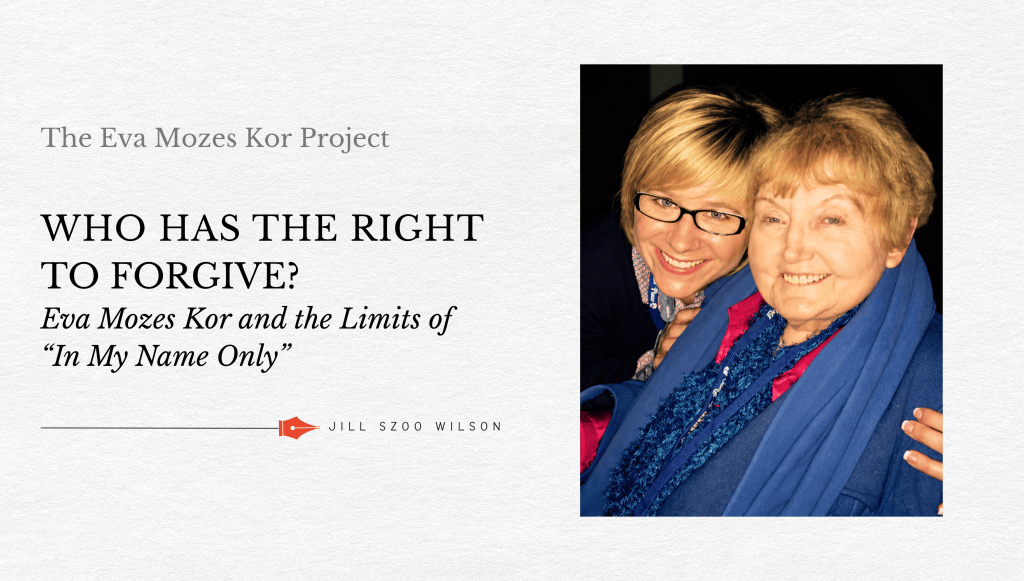
In 1995, Auschwitz survivor Eva Mozes Kor forgave the Nazis “in my name only.” Other survivors asked whether forgiveness that public could ever belong to just one person.
By Jill Szoo Wilson
Writer | Theatre Artist | Educator
On January 27, 1995, fifty years after the liberation of Auschwitz, a real estate agent from Terre Haute, Indiana, stood on the selection platform at Auschwitz-Birkenau and read aloud a document she had written herself. Beside her stood Hans Münch, a former SS doctor at the camp, who had come to sign a document of his own: a statement confirming that the gas chambers had existed.
His document was about the past. Hers was about what to do with it. It filled a single typed page, under the title “Declaration of Amnesty: Auschwitz 50 Years Later,” and it opened plainly:
“I, Eva Mozes Kor, a twin who as a child survived Josef Mengele’s experiments at Auschwitz fifty years ago, hereby give amnesty to all Nazis who participated directly or indirectly in the murder of my family and millions of others.”
The amnesty went on to cover “all governments who protected Nazi criminals for fifty years, then covered up their acts, and covered up their cover up.” Only in the third paragraph did Eva add the phrase that would follow her for the rest of her life:
“Fifty years after liberation from Auschwitz, I Eva Mozes Kor, in my name only, give this amnesty because it is time to go on; it is time to heal our souls; it is time to forgive, but never forget; …”
Most people who heard about that day remembered the word amnesty. A few remembered forgive, but never forget. The phrase Eva cared about most sat in the middle of that sentence, tucked between her name and her reasons, where it was easy to miss: in my name only.
A Fence Around a Sentence
Amnesty was an odd word for a realtor to choose. Amnesty is what governments grant. It requires courts, laws, and someone with the authority to set punishment aside. Eva had none of these. She could not release a single Nazi from a single day in prison, and she knew it.
She could only decide what the past would be allowed to do to her. That is the qualifier’s job. In my name only works like a fence built around the rest of the sentence. Everything inside it belongs to Eva. Everything outside it, including her parents, her older sisters, Edit and Aliz, her twin, Miriam, and the millions she named, is left untouched.
Read closely, and you’ll find a tension her critics would spot almost immediately. She forgave those who took part “in the murder of my family and millions of others.” Those were crimes against other people. How can anyone forgive, in her own name, a murder in which she was not the one murdered?
Eva’s answer, given in lecture halls and interviews for the next twenty-four years, was that she wasn’t forgiving the murder on behalf of the dead. She was forgiving what the murder had done to her: the ten-year-old who lost her family on a selection platform, and the woman who had carried that loss for half a century. The dead had their own claims. She did not presume to settle them.
But the declaration did not stay entirely inside its fence. It demanded that classified files be opened so that “every Mengele Guinea Pig” could learn “what germs and chemicals were injected into my body fifty years ago.” And in its fourth paragraph, the woman who forgave in her name only wrote this:
“I, the only living member of a very large family, in their name and mine appeal to the U.S. Congress, to the Israeli Knesset, the German legislators, and others who have the power, to pass laws dismantling all Nazi-related investigative units, such as the U.S. Justice Department Office of Special Investigations, and open up all Nazi files to survivors and the public.”
“I am healed inside,” the next paragraph continued, “therefore it gives me no joy to see any Nazi criminal in jail.”
In that passage, Eva was not forgiving on her family’s behalf. She was speaking as their only survivor. She was asking governments to open the files that might finally explain what had been done to her and the other surviving twins. But she was also asking them to end the investigations of Nazi criminals. She carefully drew the fence around her forgiveness. What she asked the world to do with that forgiveness reached well beyond it.
“I Hate You for That Forgiveness”
The objection arrived quickly, and some of it came wrapped in affection. Michael Berenbaum, a Holocaust scholar who directed the research institute at the U.S. Holocaust Memorial Museum, greeted Eva at the museum with a hug and a kiss. Then he told her: “I hate you for that forgiveness.” He explained that Jewish tradition holds that the perpetrator must repent and ask for forgiveness before it can be given.
That tradition is old and precise. The Mishnah, compiled around 200 C.E., draws a line between two kinds of wrongdoing. Sins against God can be atoned for on Yom Kippur. But “sins between one man and his friend, Yom Kippur does not atone for until one appeases his friend.” In this view, forgiveness is not a feeling. It is the end of a transaction, and the transaction begins with the person who did the harm. He has to come, admit what he did, and ask. The Nazis Eva forgave had, for the most part, done none of these things.
A second objection lay beneath the first: a survivor who forgives publicly cannot help speaking for others, whatever she writes in her opening clause. Twenty years after Birkenau, Eva traveled to Lüneburg, Germany, to testify at the trial of Oskar Gröning, a former SS man known as the “bookkeeper of Auschwitz.” When she took his hand and he kissed her cheek, the photograph circulated worldwide. Her fellow co-plaintiffs, forty-nine of them, issued a statement in reply: “We cannot forgive Mr Gröning for his participation in the murder of our relatives.” They accused her of staging a “one-woman rehabilitation” show.
Eva had anticipated this. In a letter to Gröning, she wrote that she was “probably the only survivor who has forgiven all the Nazis, including you, in my name alone.” She added: “My forgiveness does not absolve the perpetrators from taking responsibility for their actions.” She knew a photograph has no qualifying clause.
The co-plaintiffs’ anger was about more than a photograph. Around the same time, on the German talk show Günther Jauch, Eva argued that the case should not have come to court; the co-plaintiffs’ lawyers quoted her as saying, “These prosecutions must stop.” Eva later told NPR that her remarks had been mistranslated. “There have been rumors that I have asked to stop prosecution of all Nazis,” she said, “and that is 100 percent incorrect.” Her 1995 declaration, after all, had said it gave her “no joy to see any Nazi criminal in jail.” Whatever she meant in 2015, her fellow survivors heard a woman who had forgiven in her own name appearing to weigh in on justice owed to theirs.
The objection lived in her own home, too. Her husband, Mickey Kor, was also a Holocaust survivor. “You can’t put into words what we went through — what I went through,” he told an interviewer from PBS in 2007, and he did not think he could ever forgive the Nazis who had tormented him. Their marriage held both answers under one roof. Eva could forgive in her name, but Mickey’s suffering belonged to Mickey, and so did the decision about forgiving it.
The Man Who Said Nothing
The most famous argument about who may forgive whom was written by a man who chose not to answer.
In 1943, Simon Wiesenthal was a prisoner in the Lemberg concentration camp, in what is now Lviv, Ukraine. One day his work detail was sent to a hospital for German soldiers. A nurse pulled him aside and led him to the bed of a dying SS man named Karl. Karl wanted to confess to a Jew, any Jew. He told Wiesenthal how his unit had forced about three hundred Jews into a house, set it on fire, and shot the people who jumped from the windows. Then he asked to be forgiven.
Wiesenthal listened for hours. Then he walked out of the room without a word. Karl died the next day.
Wiesenthal never stopped wondering whether his silence had been right. In The Sunflower, his account of that afternoon, he turned the question over to his readers: what would you have done? Later editions printed fifty-three answers from theologians, survivors, writers, and statesmen. The Dalai Lama and Archbishop Desmond Tutu leaned toward forgiveness. Primo Levi, Cynthia Ozick, and the theologian Abraham Joshua Heschel did not. Ozick quoted the rabbis: “whoever is merciful to the cruel will end by being indifferent to the innocent.”
Heschel answered with a story. A rabbi from Brisk was traveling by train when a group of card players, irritated that he would not join them, threw him out of the compartment. At the station, one of them learned who the old man was and begged his pardon. The rabbi refused. The man, he explained, had not insulted the rabbi of Brisk. He had insulted an ordinary person, and it was an ordinary person he needed to ask. Heschel’s conclusion was blunt: no one can forgive crimes committed against other people.
Here is the thing about Karl’s request. He did not ask Simon Wiesenthal to forgive him for something done to Simon Wiesenthal. He asked a stranger to stand in for three hundred people who could no longer speak. Wiesenthal’s silence was a refusal to accept that role.
Fifty-two years later, Eva Mozes Kor wrote four words that refused the same thing.
Two Traditions
The debate over Eva’s declaration was, in part, a collision between two religious traditions that use the same word in different ways. Both traditions are broad, and a Hasidic rabbi and a Reform rabbi, or a Catholic priest and a Baptist pastor, might put things differently. But the mainstream teachings of each are clear enough to show where the disagreement lies.
In Judaism, forgiveness is bound up with teshuvah, a Hebrew word that means “return.” The wrongdoer begins the process. According to Maimonides, the twelfth-century authority whose Laws of Repentance remains a standard text, he must recognize the wrong, regret it, confess it aloud, resolve never to repeat it, and repair what he can. Because Yom Kippur does not atone for wrongs against another person until that person is appeased, the right to forgive belongs to the one who was hurt. Many Jews observe a custom before Yom Kippur of going to friends and family to ask, in effect, “If I have wronged you this year, will you forgive me?”
The victim has obligations too. “It is forbidden for a person to be cruel and refuse to be appeased,” Maimonides wrote. A wrongdoer who is turned away should return with three friends and ask again, a second time and a third. If he is refused all three times, the fault shifts to the one refusing. But the system depends on a living victim. A person who has been murdered cannot be appeased, and no one else can accept the apology on her behalf. This is the logic behind Heschel’s rabbi on the train, behind Wiesenthal’s silence, and behind the anger of Eva’s critics.
Much Christian teaching places the emphasis elsewhere: on grace, a forgiveness from God that no one earns. Christians forgive one another because they believe they have been forgiven. “Forgive us our trespasses,” the Lord’s Prayer says, “as we forgive those who trespass against us.” When Peter asks whether he must forgive seven times, Jesus answers, “seventy times seven.” The tradition’s defining image is Jesus on the cross saying, “Father, forgive them, for they know not what they do,” before anyone has repented of anything. Christians have long debated whether forgiveness requires repentance; the Gospel of Luke also says, “if he repents, forgive him,” and the German pastor Dietrich Bonhoeffer, executed by the Nazis in 1945, warned that “cheap grace is the preaching of forgiveness without requiring repentance.” But the ideal of forgiving an enemy who has never asked runs deep. So does the belief that every sin is ultimately a sin against God, who can forgive anything.
It would be easy, and wrong, to reduce this to the old caricature of Christian love against Jewish law. The Hebrew Bible is full of a God who is “slow to anger and abounding in steadfast love.” The real difference is structural. It concerns who holds the right to forgive, and whether forgiveness waits to be asked.
Eva fit neither tradition neatly, which may be why her declaration unsettled so many people. Like the Christian ideal, she forgave people who never asked. Like the Jewish tradition, she insisted that she could not forgive for anyone else. And she rejected the religious frame altogether.
Two Kinds of Forgiveness
Eva’s critics and Eva were often not arguing about the same thing. Much of the time, they were using one word for two different acts.
The forgiveness Berenbaum described, and Heschel, and the Mishnah, is a moral exchange between two parties. It belongs to the wronged person, it waits for the wrongdoer, and it settles a debt. By that definition, Eva’s critics were right. She could not forgive on behalf of her mother. Nobody could.
Eva was describing something else. Forgiveness, she said, “has nothing to do with the perpetrator, has nothing to do with any religion.” It was “my act of self-healing, self-liberation and self-empowerment.” It settled no debts and canceled no sentences: “I am not condoning it, nor am I excusing it.” She even allowed that her forgiveness “may be different from other people’s forgiveness.” What it did was end the Nazis’ power over the one life she had standing to speak for, her own.
Seen this way, in my name only is not a loophole. It is a confession of limits. Eva claimed the smallest possible jurisdiction: one woman, one body, one memory. Inside that small territory, she claimed total authority. She did not need Mengele’s repentance to stop being his victim, any more than she needed his permission to be born.
It also explains how she could urge audiences to forgive their own worst enemies while insisting she spoke for no one but herself. The invitation was never to forgive with her, or for anyone else. It was to forgive in your own name.
Still, the distinction does not settle everything. An act of forgiveness can be made in one person’s name, but it rarely stays private. At a trial in which forty-nine other co-plaintiffs, survivors and relatives of the murdered, were seeking justice, her public embrace could not help but be read as a statement about them, too. Eva’s fence was real. But a fence drawn in words is invisible in a photograph, and the survivors who objected were not wrong to say so.
In many conversations I witnessed, someone eventually challenged Eva about her forgiveness.
In January 2015, I was at Birkenau for the seventieth anniversary of the liberation. It was freezing, and snow covered the ground. The ceremony took place inside a tent, and those of us who were not inside stood in the cold near some of the barracks still standing, watching the program on a large screen. It helped me understand the bone-chilling, devastating cold that could take over that ground. Outside the tent that evening, a group of survivors stood together mourning the families they had lost there. Eva had always returned to the camp as a victor. She had survived, and she wanted the place to know it. She told some of the survivors that they could free themselves, too, if they turned from mourning to celebrating that they were alive. They had spent decades mourning, she said. Now they should live.
One woman answered that she would never forgive, and that Eva was dishonoring the memory of her family, who had died there.
I understood both sides of that conversation. Eva was offering what had saved her. The woman was keeping faith with the people she had lost. Eva’s declaration said in my name only, and she meant it. But outside that tent, her invitation reached into another survivor’s grief, and that grief was not Eva’s to settle.
The Smallest Jurisdiction
Eva died in Kraków in July 2019, on one of the trips she led to Auschwitz every summer. In the twenty-four years since Birkenau, her commitment to forgiving in her own name never wavered.
Her critics were right that she could not forgive on behalf of the dead. She never claimed she could, though she did, once, appeal to the world in their name. Her views on justice were always more complicated than her views on forgiveness. What she claimed was smaller: that a person who has had nearly everything taken still owns one thing no one else can take, or give away for her. Whether a claim that small can be made in public without speaking for others is a question her fellow survivors had every right to ask. Eva answered it one way. Many of them answered it another.
She stood at Birkenau and said so, in her name only.
Sources
- “The Nazi Victim Who Forgave Her Perpetrators.” My Jewish Learning.
- Kor, E. M. (1995, January 27). Declaration of amnesty: Auschwitz 50 years later [Signed declaration]. CANDLES Holocaust Museum and Education Center. https://candlesholocaustmuseum.org/visit/exhibits/candles-history-online-exhibit.html
- “The Auschwitz Declaration.” Jewish Virtual Library.
- “Holocaust Forgiveness Advocate Eva Kor.” Religion & Ethics NewsWeekly, PBS, July 13, 2007.
- NPR interview with Eva Mozes Kor, transcript. NPR, 2015.
- “At Trial of Former Nazi, a Tough Embrace.” Tablet, April 28, 2015.
- “Auschwitz Survivors Row Over Forgiveness.” The Irish Times, April 27, 2015.
- Mishnah Yoma 8:9, trans. in Prero, Yehudah. “Yom Kippur.” Torah.org.
- Wiesenthal, S. (1998). The sunflower: On the possibilities and limits of forgiveness (Rev. & expanded paperback ed.). Schocken Books.
- Maimonides (Moses ben Maimon). Mishneh Torah, Hilchot Teshuvah (Laws of Repentance) 2:2, 2:9–10. English translation: Laws of Repentance, chapter 2.
- Bonhoeffer, Dietrich. The Cost of Discipleship. 1937. Trans. R. H. Fuller. New York: Touchstone, 1995.
- Matthew 6:12, 18:21–22; Luke 17:3, 23:34; Exodus 34:6 (King James and English Standard versions).
- “Auschwitz Survivor Says SS Officer Prosecutions Should Stop.” Mail & Guardian, April 28, 2015.



Leave a Reply