
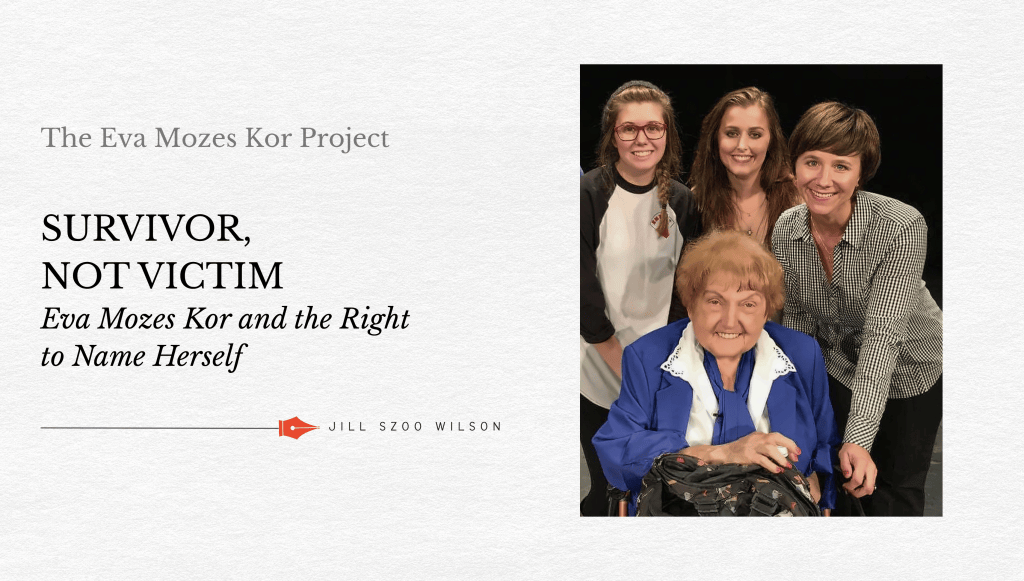
Eva Mozes Kor survived Mengele’s experiments at Auschwitz, but she refused to call herself a victim. Some survivors were inspired by that. Others were wounded.
By Jill Szoo Wilson
Writer | Theatre Artist | Educator
In April 2015, Eva Mozes Kor sat in a courtroom in Lüneburg, Germany, as a co-plaintiff in the trial of Oskar Gröning, a former SS man who had worked at Auschwitz. She was eighty-one. Seventy-one years earlier, her parents and two older sisters had been murdered there, and she and her twin, Miriam, had been handed over to Josef Mengele.
By almost any definition, she was a victim of the crimes being tried in that room. She refused the word.
“I’m a survivor, not a victim,” she said that week, in remarks reported by The Irish Times. Then she went further: “Fostering victimhood doesn’t help victims and society shouldn’t encourage it.”
It was a startling thing to say at a trial whose entire purpose was to honor the victims of Auschwitz. Some of the people who heard it were moved. Others were wounded. Both reactions make sense, and the distance between them is the subject of this essay. Eva believed that the word a person chose for herself could shape the rest of her life. To understand why, it helps to know where the word survivor came from, and what Eva meant when she claimed it.
A Name of Their Own
The people who walked out of the camps in 1945 were not called survivors, at least not at first. They were called many things. In Hebrew, they were she’erit ha-peletah, “the surviving remnant.” In Yiddish, they were lebn-geblibene, “those who remained alive.” In English, they were refugees, persecutees, victims, and, in the bureaucratic language of the Allied relief agencies, displaced persons.
None of these names was neutral. As the historian Jenna Weissman Joselit has written, the label “DP” was imposed from outside and functioned as a stigma. The scholar Benjamin Harshav, recalling those years, put it bluntly: “DP. We hated that word.”
Survivor won out slowly. In the United States, historians generally date its normalization to the 1970s, though the timing differed from one community to another. The Eichmann trial in 1961 brought survivor testimony to an unprecedented public audience. By the late 1970s, books and gatherings had turned the word into something more than a description. It became a source of moral authority, a claim to be heard. Unlike the names assigned by relief agencies, Joselit writes, “survivor” was “all theirs.”
Eva arrived in the United States in 1960 and spent much of the next two decades raising a family in Terre Haute, Indiana. The word she would later claim so fiercely was taking shape around her in those same years. When she said “survivor, not victim,” she was drawing on that history, the long work of people who had been defined by what was done to them insisting on a name that described what they had done next.
Growth After Trauma
Eva’s conviction that a person could reclaim something of herself after catastrophe was not hers alone. In the same years she was becoming known for forgiveness, psychologists were trying to measure that very idea.
In 1996, Richard Tedeschi and Lawrence Calhoun introduced what they called posttraumatic growth: positive change people report after struggling with terrible events, in their relationships, their sense of their own strength, their spiritual lives, and their appreciation of being alive. They were careful not to oversell it. Nearly everyone they studied reported harm, and only about 60 percent also reported benefits. The good and the bad, they wrote, “probably coexist in the same person.”
Later researchers pushed back. In 2009, a team led by the psychologist Patricia Frazier measured people before and after difficult events and found that what they said about their own growth often did not match the changes the researchers could observe. That does not mean growth is imaginary. It means that the story a person tells about her suffering and the change she actually undergoes are not always the same thing.
That finding cuts in two directions for Eva. A skeptic could say her insistence on being a survivor was exactly that kind of story. But it also clarifies what she was doing. Eva did not claim that Auschwitz had made her better. She claimed that she had decided what Auschwitz would not be allowed to make her.
What Happens Inside You
In the decades since, the way many clinicians talk about trauma has moved closer to Eva’s language.
The Canadian physician Gabor Maté, whose book The Myth of Normal appeared in 2022, draws a line between an event and its wound. “Trauma is not what happens to you,” he has said. “Trauma is what happens inside you as a result of what happened to you.” The distinction matters because of what follows from it. The event cannot be undone. But the wound, Maté argues, “can heal at any time.”
The most striking parallel to Eva comes from another of Mengele’s prisoners. Edith Eva Eger was sixteen when her family was deported to Auschwitz from Hungary in 1944. On the day her mother was sent to the gas chamber, Mengele ordered Edith to dance for him. She survived, emigrated to the United States, and became a clinical psychologist. Her 2017 memoir, The Choice, makes an argument Eva would have recognized immediately.
Eger separates two things that are easy to confuse: victimization, which comes from outside, and victimhood, which does not. “Victimhood comes from the inside,” she has said. “We become victims not because of what happens to us, but when we choose to hold on to our victimization.” Her shortest version of it is also her most quoted: “Suffering is universal. Victimhood is optional.” And her own relationship to the camp sounds very much like Eva’s: “I will not forget my time in Auschwitz, but I don’t live there.”
The language of choice can be heard as blame, as though people who are still suffering simply chose wrong. Maté’s distinction helps separate the two. What happened at Auschwitz was not a choice. What two of Mengele’s former prisoners claimed, decades later, was the right to tend the wound it left in their own way.
The Drowned and the Saved
Not every survivor wanted to be told how to carry Auschwitz, and some of the most serious objections to Eva’s view came from people who had been there.
Primo Levi, the Italian chemist who survived Auschwitz and spent the rest of his life writing about it, approached the word survivor with something close to suspicion. In The Drowned and the Saved, published in 1986, he wrote that the people best able to describe the camps were the ones who had not come back. “I must repeat,” he wrote, “we, the survivors, are not the true witnesses.”
Levi was haunted by a question many survivors recognized: why them, and not someone else? He described a shame that came not from anything he had done, but from the fact of his own survival: the nagging suspicion that he was alive in someone else’s place, and that each survivor had, in some sense, taken a place that belonged to another.
Levi never wrote about Eva, and his words are not a verdict on her. But for someone who feels that way, survivor is not a triumphant word. It is a debt. Mourning is not a failure to move on. It is a way of keeping faith with the people who did not survive, of refusing to let their absence be smoothed over by anyone else’s happy ending.
I saw that difference up close. At the seventieth anniversary of the liberation, in January 2015, I watched Eva urge a group of survivors mourning outside the ceremony at Birkenau to turn from mourning to celebrating that they were alive. One woman answered that she would never forgive, and that Eva was dishonoring the memory of her family. Both women were survivors. They did not mean the same thing by the word.
That conversation was one of many like it. Eva was always arguing with other survivors, though arguing is not quite the right word. She was never mean, and she was not looking for a fight. She was passionate, and she tried to reason with them. She, of all people, could see their pain and sit with it, and then she would try to throw them a lifeline. Sometimes there came a point when she grew frustrated. I don’t think it was because their refusal said anything about her. It was because she knew she was walking away from someone who would go on feeling the way they felt. She remembered that feeling. She couldn’t bear the thought of anyone staying in it.
Hopeless, Helpless, Powerless
Eva never denied that she had been victimized. She described Mengele’s injections, her murdered family, and the two weeks she spent near death in the camp hospital in plain, unsparing detail for decades. What she rejected was something narrower: the idea that what had been done to her should define what she was.
She was precise about what she meant by victim. It was not a description of the past. It was a description of a state of mind. A person who has been hurt, she said, can “become a victim, and all victims feel hopeless, helpless, and powerless.” Those three words were her diagnosis, and every part of her life after 1995 was an argument against them.
The turning point, in her telling, was a letter. When she sat down to thank the former SS doctor Hans Münch for agreeing to confirm what he had seen at Auschwitz, she found herself writing that she forgave him. “Writing that letter I discovered I had power,” she said. “I had the power to forgive.” After that, she said, “I was no longer a victim of Auschwitz.”
For Eva, then, survivor was not a word about luck, or about being one of the people who happened to walk out of the gate. It was a word about agency. A victim, in her vocabulary, was someone things were done to. A survivor was someone who did something next.
She lived that distinction physically. Eva returned to Auschwitz again and again over the course of her life, leading groups through the camp, and she always came back as a victor.
Before my first trip there with her, I read book after book about how the Nazis built the camps and what happened inside them. Eva stopped me. “Okay, that’s enough,” she told me. “You’ve read enough books. Don’t keep reading all that. Just put it down now, and when we get there, you listen to what I have to say. Reading all that will get you depressed. But when you go with me, you will be going with someone who is victorious. I defeated Auschwitz! That’s how we return.”
She was not asking me to forget what the books said. She had lived it. She was asking me to see the place the way she had chosen to see it.
That was the stance that met the mourners outside the tent in 2015. To Eva, celebrating was a form of defiance. To the woman who answered her, it sounded like a betrayal of the dead.
Two Ways to Keep Faith
It would be easy to turn this into a lesson with a winner. Eva chose life, the story would go, and the mourners stayed stuck. That story is too simple. Eva’s argument was about despair, and about the power she had found, for herself, to leave it. But she did not keep that argument to herself. She pressed it on people who were not ready to hear it, and however lovingly she meant it, it could land as a judgment on how they grieved. That was part of who she was, and it does not need to be softened.
The research does not settle the question either. Growth after trauma is real for many people, and hard to measure in anyone. Levi’s shame and Eva’s defiance were both honest responses to the same place. One kept faith with the dead by refusing to let them be forgotten. The other kept faith by refusing to let their murderers win.
What Eva insisted on was the right to choose which of those she would live. Her family had been given no choices at Auschwitz. Neither had she, at ten. Calling herself a survivor was how she took one back.
She kept making that choice until the last week of her life. Eva died in Kraków on July 4, 2019, on one of the trips she led back to Auschwitz. She was eighty-five, and she had gone back again.
© Jill Szoo Wilson, 2026
Sources
- “Auschwitz Survivors Row Over Forgiveness.” The Irish Times, April 27, 2015.
- Charles, Steve. “Eva Kor and the Work of Witness and Forgiveness.” Wabash Magazine, November 16, 2016.
- Joselit, Jenna Weissman. “The Rise of the Survivors.” Tablet, April 26, 2024.
- Tedeschi, Richard G., and Lawrence G. Calhoun. “The Posttraumatic Growth Inventory: Measuring the Positive Legacy of Trauma.” Journal of Traumatic Stress 9, no. 3 (1996): 455–471.
- Frazier, Patricia, et al. “Does Self-Reported Posttraumatic Growth Reflect Genuine Positive Change?” Psychological Science 20, no. 7 (2009): 912–919.
- Levi, Primo. The Drowned and the Saved. 1986. Trans. Raymond Rosenthal. New York: Summit Books, 1988.
- Maté, Gabor, with Daniel Maté. The Myth of Normal: Trauma, Illness, and Healing in a Toxic Culture. New York: Avery, 2022. Quotations from “Are We Mislabeling Our Trauma?” CBC, The Next Chapter, 2022.
- Eger, Edith Eva. The Choice: Embrace the Possible. New York: Scribner, 2017. Quotations from Shelley Levitt, “Choosing Hope: The Life of Edith Eva Eger.” Live Happy, April 19, 2018.


Leave a Reply