
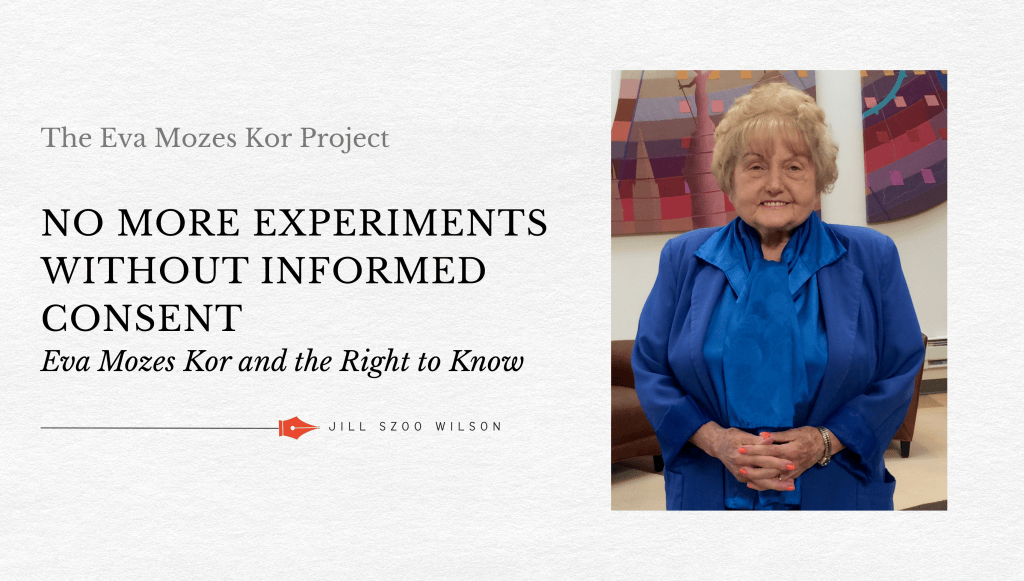
As a ten-year-old at Auschwitz, Eva Mozes Kor was experimented on by a doctor who never asked her anything. Fifty years later, she demanded informed consent for everyone else.
By Jill Szoo Wilson
Writer | Theatre Artist | Educator
Near the bottom of the declaration Eva Mozes Kor signed at Auschwitz-Birkenau on January 27, 1995, after the amnesty and the appeals to governments, there is a line set entirely in capital letters:
“NO MORE WARS, NO MORE EXPERIMENTS WITHOUT INFORMED CONSENT, NO MORE GAS CHAMBERS, NO MORE BOMBS, NO MORE HATRED, NO MORE KILLING, NO MORE AUSCHWITZES.”
Most of that list reads like the end of a peace rally. One item does not. Informed consent is the language of hospital clipboards and research protocols, of forms initialed at the bottom of every page. It’s not a phrase people chant. Eva put it second, between wars and gas chambers.
She knew exactly what she was asking for. As a ten-year-old at Auschwitz, she had been a research subject in the most literal sense: measured, sampled, injected, and recorded by a doctor who never asked her anything. Fifty years later, the phrase she chose was the closest thing medicine had built to an answer for what had been done to her. It took a long time to build, and even longer to take hold.
The Children Who Could Not Say No
The experiments had the outward form of science. That was part of their horror.
The twins in Josef Mengele’s barracks lived on a schedule. Three days a week, they were made to sit naked for hours while each child’s body was measured and compared with that of their twin. On other days, both arms were tied to restrict the blood flow, a large amount of blood was taken from the left arm, and at least five injections of unknown substances went into the right. Everything was observed. Everything was written down. Twins were valuable to Mengele because one could serve as an experiment and the other as a control.
None of it required anyone’s agreement. The subjects were children, prisoners, and Jews, in a camp where the alternative to being useful was the gas chamber. Their parents, who might have objected on their behalf, had been murdered on arrival. The question of consent did not arise, because in that world it could not. Decades later, Eva put it plainly. The staff, she wrote, “could do to our bodies whatever they wanted and we had no control over what they put into us, what they removed, or how they treated us.”
After one injection, Eva developed a raging fever. Mengele looked at her chart, laughed, and said she had two weeks to live. She later learned that if she had died, her twin, Miriam, would have been killed with a lethal injection so the two bodies could be dissected and compared. The children were not only subjects. They were matched specimens, kept alive for as long as they were useful as a pair.
Eva did not speak much about the experiments themselves. She had her limits. But once, she told me about twins whose eyes were propped open with steel rods while foreign liquids were dropped into them. No one ever told them what the liquids were. Of her own injections, Eva wrote, “We didn’t know the contents then and we don’t know today.”
Ten Points at Nuremberg
Mengele never stood trial. He escaped to South America and died there in 1979. But twenty-three other Nazi doctors and officials did.
The Doctors’ Trial opened in Nuremberg on December 9, 1946, the first of twelve trials held by American military tribunals after the war. Twenty of the defendants were physicians. The chief prosecutor, Telford Taylor, told the court it was “no mere murder trial.” Most of the accused were educated men who had committed atrocities using the methods and vocabulary of medicine. In August 1947, sixteen were convicted. Seven were sentenced to hang. Seven were acquitted.
To judge them, the American judges had to state what the defendants should have done instead. The result was a ten-point statement on the limits of human experimentation, now known as the Nuremberg Code. Its first principle is its longest, and its opening sentence carries the rest:
“The voluntary consent of the human subject is absolutely essential.”
The principle goes on to require that the person have the legal capacity to consent, be free from force or deceit, and understand the nature, purpose, methods, and hazards of what is being done. It also places the duty on the researcher personally. Responsibility could not be passed up a chain of command or down to an assistant. The children in Mengele’s barracks had none of these protections. The Code was, in effect, a description of everything that had been taken from them, written as a rule for everyone else.
Somebody Else’s Rule
The Code had a weakness built into its origin. It had been written to judge Nazis, which made it easy for doctors elsewhere to assume it was about Nazis. As the bioethicist Evelyne Shuster noted on the Code’s fiftieth anniversary, it has never been adopted in its entirety as law by any nation, or as ethics by any major medical association.
In 1964, the World Medical Association issued its own guidance, the Declaration of Helsinki, written by physicians for physicians. Two years later, Henry Beecher, an anesthesiologist at Harvard, published an article in The New England Journal of Medicine that broke the comfortable assumption that abusive research belonged to another country and another era. “Ethics and Clinical Research” described twenty-two studies, carried out at leading American medical schools, hospitals, and government institutions, in which subjects had been put at risk without their knowledge or meaningful agreement. Beecher left out the researchers’ names. Unethical practices, he warned, were “almost, one fears, universal.”
The most notorious case was still underway. Beginning in 1932, the U.S. Public Health Service followed about six hundred Black men in Macon County, Alabama, roughly four hundred of whom had syphilis, to observe the course of the disease. The men were never told what the study was for. They were offered free meals, rides, and burial in exchange for their participation. When penicillin became the standard cure, they were denied it. The study continued for forty years, until July 25, 1972, when the Associated Press reporter Jean Heller, working from documents provided by a whistleblower named Peter Buxtun, made it public.
This time, the country could not tell itself the problem was somewhere else. Within two years, Congress passed the National Research Act, signed on July 12, 1974. It created a national commission to identify the basic ethical principles for research on human subjects. The commission’s answer, the Belmont Report, was released on April 18, 1979. It named three principles: respect for persons, beneficence, and justice. It defined informed consent through three elements: information, comprehension, and voluntariness. It cited the Nuremberg Code by name, as the prototype for the codes that followed, and Tuskegee as a warning.
That is the system most researchers in the United States work within today. Every review board that approves a study and every consent form signed before a clinical trial descends from it. It took thirty-two years to get from a courtroom in Nuremberg to a federal report in Washington. In between, people were harmed in exactly the ways the Code had been written to prevent.
What Consent Cannot Fix
Informed consent protects people before an experiment begins. It has much less to say about the people who were never asked.
When Miriam’s kidneys began to fail after her last pregnancy, her doctors wanted to know what she had been injected with as a child. The answer might have explained her illness and guided her care. No one could give it to them. Eva gave her sister a kidney in 1987, but Miriam died in 1993, and the question died unanswered with her. The surviving twins Eva found through CANDLES, the organization she founded in 1984, carried similar mysteries in their bodies.
That is why Eva’s declaration did not stop at consent. Earlier in the document, she wrote:
“I, as a Citizen of the Free World, declare here in Auschwitz, that I have the human right to locate my Auschwitz files so I know what germs and chemicals were injected into my body fifty years ago.”
The Nuremberg Code says a person must know what will be done to her before it happens. Eva was claiming something the Code never addressed: the right to find out afterward. For the twins, consent had come fifty years too late to matter. The truth had not. It could still explain what their bodies carried.
Eva did not wait for the answers to come to her. In February 1999, she sued Bayer, the German pharmaceutical company that had been part of the IG Farben conglomerate during the war. Her lawsuit alleged that Bayer had been involved in Mengele’s experiments and had paid to use Auschwitz prisoners for its own research. Eva told me she believed Bayer had helped fund what was happening at Auschwitz. A Bayer spokesman declined to comment on the allegations, noting that the Nuremberg tribunals had rejected similar charges against IG Farben.
She also believed, she told me, that scientists at the Kaiser Wilhelm Institute knew what Mengele had injected into Miriam. There was a documented basis for that suspicion. Mengele had worked with scientists at the Kaiser Wilhelm Institute of Anthropology, Human Heredity and Eugenics in Berlin, sending them blood samples and preparations taken from murdered prisoners. In 2001, the Max Planck Society, the institute’s successor, held a symposium in Berlin to present what independent historians had found about its predecessor’s role. Eva gave the opening address on June 7, 2001. She called the Kaiser Wilhelm Institute “the institute that was in charge of our experiments.” The society’s president, Hubert Markl, apologized to her and to other surviving victims. “The sincerest form of apology,” he said, “is the disclosure of guilt.”
Eva spoke directly to the physicians and scientists in the room. “Human rights in medical experimentation is an issue that needs to be addressed,” she told them. She urged them to “make a moral commitment that you will never, ever violate anyone’s human rights.” For a room full of researchers, she was the research subject herself: someone who had lived through what happens when no one is there to say no.
The Second Item on the List
Eva died in Kraków on July 4, 2019, on one of the CANDLES trips she led to Auschwitz. Most of the demands in her capitalized line are still waiting. There are still wars. There are still bombs. Hatred and killing have not gone anywhere.
The second item is different, at least on paper. It has offices, staff, federal regulations, and a form for every study. Of everything on her list, it is the one that has been written into the rules institutions run on. It is also the one most people never think about, which is what a working protection looks like: it becomes routine.
Eva herself never stopped being afraid of doctors. She told me she had been frightened of doctors and dentists all her life. She also told me that when I went to one, I should try to remember that they were trying to help me, not harm me. Those two sentences hold the whole history. Trust in medicine is not automatic. The rules that make it reasonable to trust a doctor were written because doctors had once given people every reason not to.
But the history behind it is a reminder that routine is not the same as permanent. The Nuremberg Code was written with the evidence of Auschwitz in front of it and was still treated, for decades, as somebody else’s rule. Its protections held only when people chose to apply them to themselves.
Eva could not give or refuse consent at ten. At sixty, standing on the platform where she had last seen her mother, she demanded it for everyone else.
Sources
- Kor, Eva Mozes. “Declaration of Amnesty: Auschwitz 50 Years Later.” Signed declaration, Auschwitz-Birkenau, January 27, 1995. The History of CANDLES Online Exhibit, CANDLES Holocaust Museum and Education Center.
- Kor, Eva Mozes, and Lisa Rojany Buccieri. Surviving the Angel of Death: The Story of a Mengele Twin in Auschwitz. Terre Haute, IN: Tanglewood, 2009.
- Shuster, Evelyne. “Fifty Years Later: The Significance of the Nuremberg Code.” The New England Journal of Medicine 337, no. 20 (November 13, 1997).
- “Nuremberg Code.” Encyclopaedia Britannica.
- Beecher, Henry K. “Ethics and Clinical Research.” The New England Journal of Medicine 274 (1966): 1354–1360. See “Public Health Classics,” Bulletin of the World Health Organization 79, no. 4 (2001).
- “AP Exposes the Tuskegee Syphilis Study: The 50th Anniversary.” Associated Press, July 24, 2022.
- National Commission for the Protection of Human Subjects of Biomedical and Behavioral Research. The Belmont Report. April 18, 1979. U.S. Department of Health and Human Services.
- Kor, Eva Mozes. “Eva Kor 2001 Speech on Healing and Forgiveness.” Opening address, symposium “Biomedical Sciences and Human Experimentation at Kaiser Wilhelm Institutes: The Auschwitz Connection,” Berlin, June 7, 2001. CANDLES Holocaust Museum and Education Center.
- “‘Forgive Your Worst Enemy’: Obituary for Eva Mozes Kor.” Max Planck Society, 2019.
- “Bayer Accused of Involvement in Nazi Medical Experiments on Jews.” The Irish Times, February 19, 1999.
- Kor, Eva. “What It Was Like to Be Experimented on During the Holocaust.” TIME, December 16, 2014 (originally published on Quora).


Leave a Reply