
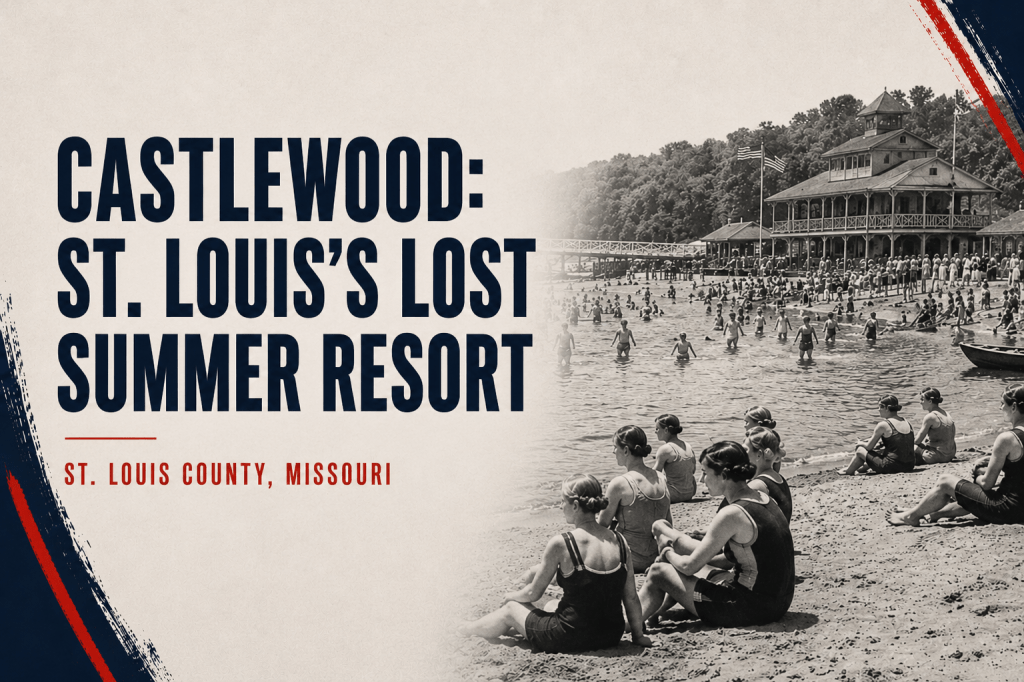
Before the hiking trails and mountain bikes, thousands of St. Louisans came here by train to swim, dance, and spend the weekend along the Meramec.
By Jill Szoo Wilson
Writer | Theatre Artist | Educator
Walk into Castlewood State Park on a Saturday morning, and the place seems entirely at home in its present life. Mountain bikes disappear into the trees while families settle near the picnic grounds, and hikers begin the climb toward the bluffs, where the Meramec curves through the valley below. The forest feels settled and self-contained, old enough to make every human interruption seem temporary.
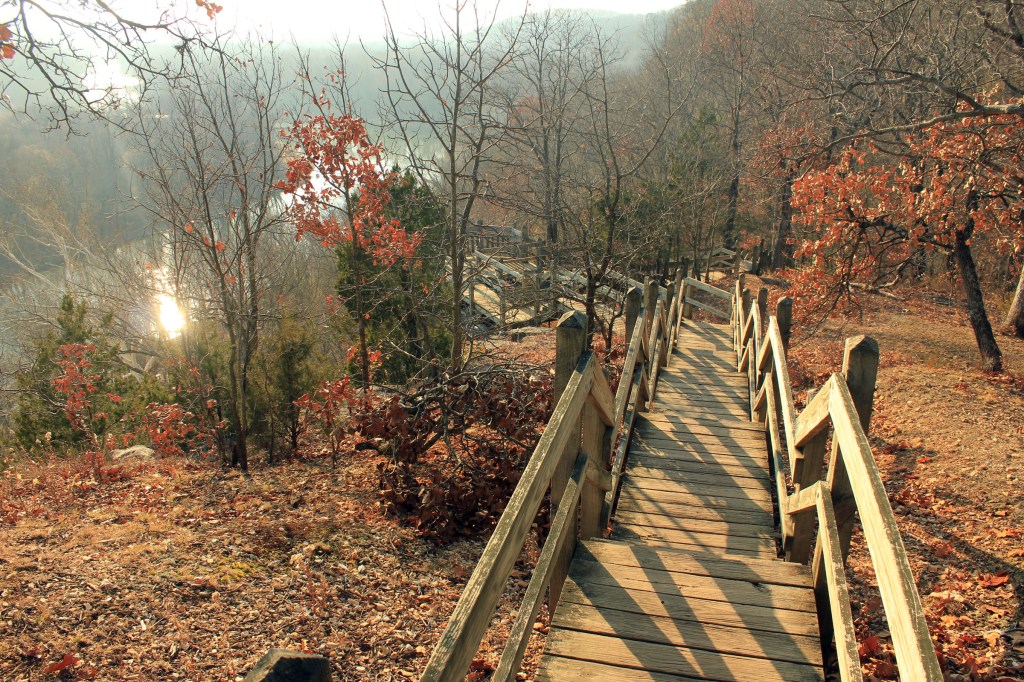
Then a broad concrete staircase rises along the River Scene Trail.
The steps have the scale and formality of an entrance, though the building they once approached has disappeared. They climb through the woods toward the bluff, carrying hikers past trees that have grown into spaces once occupied by hotel guests and summer residents. Their size makes sense only after you imagine the crowd they were built to receive.
A century ago, Castlewood ranked among the busiest summer destinations in the St. Louis region. On a popular weekend, more than 10,000 visitors arrived to swim in the Meramec, spend the night in a cabin, dance beneath electric lights and enjoy a few hours beyond the heat and routines of the city. Passenger trains stopped beside a resort district that spread from the river bottom into the hills, while ferries carried swimmers across the Meramec to Lincoln Beach.
The state park grew from the remains of a vacation town.
The Weekend Began on the Train
During the early twentieth century, summer pressed heavily against St. Louis. Most homes offered little relief from the heat, and automobile travel remained expensive enough to place a weekend journey beyond the reach of many working families. Castlewood succeeded because the railroad placed a river resort within easy distance of the city.
Missouri Pacific trains followed the Meramec Valley westward, carrying passengers toward several summer communities in western St. Louis County. Castlewood became one of the largest. By the time a train reached the depot near the river, its cars were often filled with singing passengers who had already begun treating the journey as part of the holiday.
Other travelers came as far as Meramec Highlands by streetcar and walked the remaining distance beside the tracks. Early motorists faced their own version of the trip, sometimes stopping along the way to patch another punctured tire before continuing toward the river. The inconvenience seems to have strengthened the sense of arrival. Castlewood lay within reach of a weekend excursion, and the effort of getting there made arrival feel earned.
By 1915, the Meramec Realty Company was promoting Castlewood as a full resort development. Buildings spread across the valley and hillside, supplying visitors with meals, lodging and places to gather after dark. The clubs carried names such as Happy Hollow, Wigwam, Gin Creek and Nuthatch, names that sound as though someone proposed them during a cheerful evening and painted them above the door the following morning.
Some clubs belonged to families or groups of friends who returned every summer. Others served working women from St. Louis, including the Wagner Electric Girls Club and the Catholic Corona Club. On Sunday mornings, hundreds of visitors gathered for Mass before returning to the river, where the rest of the day could unfold with fewer obligations.
Castlewood possessed the peculiar completeness of a community designed around leisure. A visitor could buy ice cream, rent a canoe, have his hair cut and find a drink before the evening dances began. Electric lights strung among the trees extended the day, and the final train carried the crowd home after Castlewood had given them as much Saturday as possible.
The Staircase in the Woods
The grand staircase began near the depot and climbed toward the hillside buildings above. Passengers arriving with weekend bags used it to reach a large hotel, nearby cabins, and the private clubs scattered along the bluff. Its broad steps turned the climb from the river bottom into a formal entrance, allowing the resort to reveal itself gradually as visitors rose above the tracks.
Today, hikers climb the same staircase with water bottles and trekking poles. The hotel has vanished, and the trees have absorbed the spaces around it, but the staircase still preserves the proportions of the vanished resort. Someone expected a great many people to pass this way. The concrete carries the ambition of a place designed to receive the city.
Other remnants survive nearby. A pedestrian tunnel completed in 1930 still leads beneath the active railroad tracks, and old pipes remain buried beneath the park. Some branches end below wooded ground where buildings once stood, tracing rooms and corridors that have disappeared from the surface.
Castlewood’s water system required an especially ambitious piece of engineering. Water rose from a well near the river to a cistern on higher ground, then traveled downhill through pipes toward the resort buildings. The cistern remains among trees that grew after the structures it supplied had fallen away.
Beneath the forest, the old plumbing still traces the resort’s vanished arrangement.
Lincoln Beach
The resort’s most famous attraction waited across the Meramec. Ferries carried visitors from the Castlewood side of the river toward Lincoln Beach, a wide sandbar created or enlarged through earlier gravel-dredging operations. The sand offered enough room for the crowds that arrived during the warmest months, and historic photographs show bathers standing shoulder to shoulder along the water.
Those photographs can surprise anyone familiar with the Meramec today. Canoes crowd the shoreline while umbrellas rise above groups of swimmers, creating a scene that resembles a coastal holiday resort transplanted into western St. Louis County. The river appears surrounded by people, its banks claimed for one afternoon by nearly everyone who had escaped the city.
The day continued beyond the beach. Visitors played games near the clubs and moved between the river and the hillside until music drew them toward the evening dances. Lights glowed among the trees while the Meramec passed below, and the resort offered a temporary freedom shaped by the knowledge that Monday would eventually reclaim everyone.
Prohibition pushed the drinking into private clubs and gave it a weekly schedule. Members began the beer on Sunday, bottled it during the middle of the week and placed it on ice before the trains arrived again. Castlewood had transformed illegal drinking into something resembling household preparation for company.
The resort allowed ordinary rules to loosen without disappearing altogether. Visitors knew the timetable home, which made the hours before departure feel more generous. For one weekend, the river valley held a version of life organized around music, water and the next train rather than the next workday.
A Landscape Built for Escape
Castlewood’s appeal began with the shape of the land. The Meramec curves through a broad valley below limestone bluffs that rise roughly 250 feet above the floodplain. From the overlook, St. Louis feels farther away than the map suggests. Down near the river, the hills enclose the valley and give the impression that the weekend has entered a world of its own.
The river also governed everything people built beside it. Floodwater shifted sediment across the bottomland, while changing shorelines and damp Missouri seasons wore steadily against wood and stone. Castlewood offered pleasure inside a landscape that continued revising itself.
For several decades, the resort held its ground through constant activity. Trains replenished the crowds, ferries crossed the river, pipes carried water, and each summer supplied enough visitors to reopen the cabins and clubs. The work of maintaining the place remained worthwhile because St. Louis kept arriving.
After World War II, the habits that supported Castlewood began to change. More families owned cars and could travel beyond the nearby river resorts. Air conditioning made summer in the city less punishing, while newer destinations competed for the attention of people who once depended on the railroad for recreation.
Passenger traffic dwindled, and the resort buildings entered a slower stage of decline. Clubs closed or changed hands as cabins aged beside the river, and vegetation returned to the clearings around them. The transformation took long enough for local children to grow up inside the remains.
The Children Who Inherited the Resort
In the late 1940s, Alice Young Mertz’s parents moved their family from St. Louis into a one-room former clubhouse near the Meramec. The grand resort years had begun to fade, though many of the buildings still stood. Alice later remembered that she and her siblings arrived as “city mice” and quickly began running loose through the woods.
Their Castlewood held the remains of someone else’s vacation. Old inns and clubs gave the children places to explore, while the gaps between them created room for imagination. The resort’s earlier life remained close enough to be felt in the buildings and in the adults who still understood what each place had once been.
One club remained firmly beyond the children’s reach. The Lone Wolf still carried enough status that Alice and her siblings were forbidden to enter its parking lot. Her brother Pete remembered a stone building with pillars and gates, the “classiest-looking joint in Castlewood,” grand enough to suggest that a private gathering might still be underway beyond the door.
Their father also carried a connection to the resort’s more secretive culture. Alice and Pete said he had worked as a bootlegger before later owning taverns in St. Louis. His children therefore grew up among adults who remembered where liquor had been hidden and which doors required membership. The old resort persisted through those habits and stories even as the formal world around them weakened.
Buildings designed for summer recreation gradually became year-round homes. Former club rooms acquired kitchens, beds, and the daily disorder of family life. Children slept in structures where weekend visitors had once danced or played cards, while old pipes continued carrying water toward buildings whose original purpose had already begun to blur.
Castlewood passed from resort to neighborhood by a series of small adaptations. People occupied what remained until weather and time finally claimed the structures themselves.
How Castlewood Became a Park
By the 1970s, suburban development had begun spreading rapidly through western St. Louis County, increasing the value of open land along the Meramec. The Open Space Council for the St. Louis Region helped preserve the Castlewood property, which Missouri received as a gift in 1974. The acquisition established Castlewood as the state park system’s first park created to serve as an urban open-space preserve.
The timing preserved a landscape already surrounded by metropolitan growth. A later effort might have found the bluffs divided among private developments, with the river bottom reshaped and the surviving traces of the resort scattered across separate properties.
Instead, Castlewood returned to public recreation.
Its new life grew naturally from the one that came before. Visitors arrived for the river and the wooded hills, even as hiking and mountain biking replaced many of the resort-era activities. Picnic tables appeared where clubhouses had once gathered people, while the old railroad corridor continued carrying trains through the valley.
The means of arrival changed gradually, along with the amount of time visitors expected to stay. Castlewood still offered St. Louis the same essential experience: a landscape close enough for an afternoon and spacious enough to make the city recede.
The Resort Beneath the Park
Once you know what stood here, the park begins to fill again. Passengers climb from the depot with weekend bags, their voices carrying through the tunnel beneath the tracks, while somewhere under the woods an old pipe still turns toward a vanished hotel. Across the Meramec, Lincoln Beach returns beneath thousands of bare feet.
Castlewood contains relatively few recognizable ruins because the resort relied heavily on wooden structures built beside a river. Floods covered foundations, and vegetation closed over the spaces left behind. The buildings surrendered piece by piece until the layout of the land carried more history than any single wall.
The trains still pass through the valley. The staircase climbs from the river bottom, and the cistern remains above the places it once supplied. The Meramec follows the bend where ferries carried swimmers toward Lincoln Beach.
On summer Saturdays, the parking lots fill early. People unload bicycles, coolers, and children, then head toward the same river that once drew trainloads of swimmers from St. Louis. The luggage has changed. The impulse has not.
Castlewood has spent more than a century teaching the city how to leave itself behind.
Sources and Further Reading
This essay draws on historical information from Missouri State Parks, the Missouri Department of Natural Resources, St. Louis Public Radio, the Missouri History Museum collections, and community research preserved by CastlewoodMO.com. Details about the surviving staircase, cistern, pedestrian tunnel, and buried water system come from Missouri State Parks and interviews with park staff.
If you enjoy uncovering hidden Missouri history, you might enjoy these articles:







Leave a Reply