
Absurdism asked how we live when the world gives us no answer. Meta-Absurdism asks how we live when the world gives us too many.
By Jill Szoo Wilson
Writer | Theatre Artist | Educator
Human beings have always made stories from what happens to us.
A friend grows quiet during an argument, and the silence begins to acquire a motive. A doctor gives us an unfamiliar diagnosis, and by the time we reach the parking lot our minds are already moving toward outcomes. Meaning gathers around an event while the event is still unfolding.
In “Life as Narrative,” psychologist Jerome Bruner argues that narrative participates in the construction of experience itself. The stories available within a culture shape memory and help determine which futures its members can imagine (Bruner 1987). Story gives experience a form we can remember and share. It also selects which details move forward. Soon we are living inside an account of what happened.
Digital life gives this ancient habit remarkable speed. A headline tells us what a public event means before we have read the article. Search results surround a symptom with possible diagnoses before a physician has evaluated it. Photographs appear with captions, and films arrive with scores and controversies already attached. Herbert Simon understood the basic economy of this condition in 1971 when he observed that “a wealth of information creates a poverty of attention” (Simon 1971, 40–41). That poverty becomes easy to feel when the phone keeps supplying explanations while we are still trying to understand what we saw.
Meta-Absurdism is a framework I am developing to describe this condition: the struggle to locate an authentic response in a world crowded with representations and competing meanings. Its practical value begins in the small interval between what happens and the story we tell about it. Meta-Absurdism asks us to preserve that interval long enough to see what is actually there. It becomes a discipline of interpretive sequence, keeping meaning answerable to experience and matching the speed of interpretation to the strength of the evidence and the urgency of the moment.
Why the Absurd Remains
Albert Camus locates the absurd in the confrontation between the human desire for intelligibility and the world’s unreasonable silence (Camus 1955). We want existence to yield a stable answer, while existence resists the demand. Twentieth-century Absurdism placed that confrontation onstage through repetition, suspended action, fractured language, and failed communication (Esslin 2004).
Absurdism confronts a shortage of meaning. Meta-Absurdism confronts an excess of it. The contemporary problem is no longer simply that the world refuses to explain itself. It is that explanations surround us before we have had time to encounter the thing being explained.
The old confrontation can be pictured as a person calling into a silent room and waiting for an answer. Digital culture fills the room with voices. A thirty-second clip of a public confrontation may acquire hundreds of explanations within an hour, each carrying its own vocabulary and its own account of who deserves trust. One account calls the encounter an abuse of power; another calls it a justified response. Others interpret the same faces and gestures through politics or psychology. Each can sound persuasive inside its own frame.
Their volume changes the experience while leaving the original uncertainty in place. Camus’s silence survives beneath the commentary because the world itself still resists a final interpretation. The explanations pile up, and the mind continues searching for a coherent relation to reality. Meta-Absurdism names what happens to that search in a meaning-flooded culture, where every account competes for our allegiance, and one explanation continually displaces another.
The prefix meta- names a second layer of awareness created by this environment. At a concert, we hear the song while watching ourselves record the song. During an argument, we feel hurt while choosing the language through which the hurt may later be explained. We experience ourselves as participants and potential narrators at the same time. Meta-Absurdism examines the pressure created by that double position.
Absurdism: The world will not give us an answer.
Meta-Absurdism: The world gives us too many answers.
The problem: Those answers attach themselves to events so quickly that we can lose sight of what actually happened.
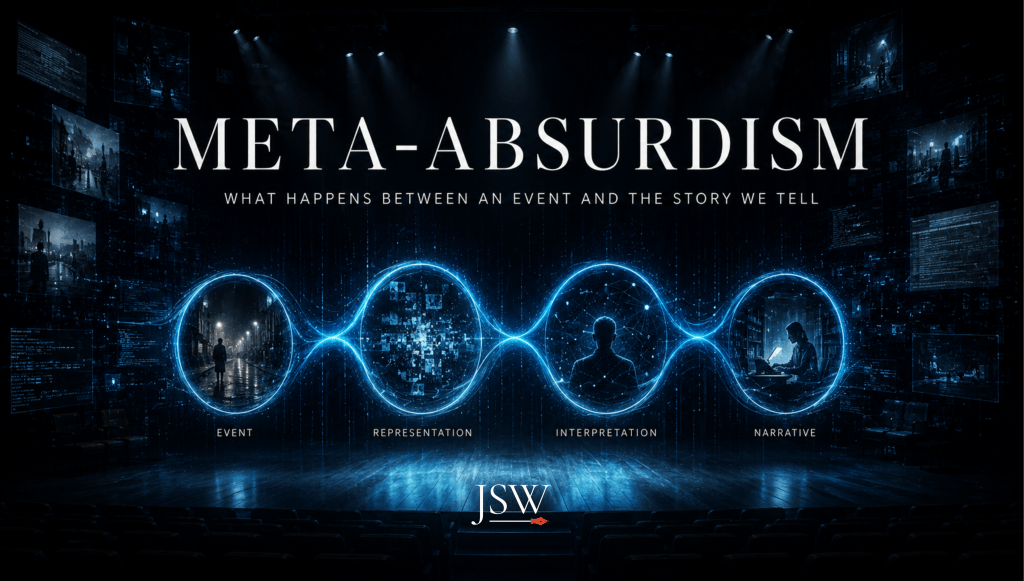
The response: Separate event, representation, interpretation, and narrative long enough to judge each appropriately.
Meta-Absurdism and Metamodernism
The closest neighboring framework is metamodernism, developed by Timotheus Vermeulen and Robin van den Akker. Their 2010 essay describes a cultural sensibility that oscillates between modern commitment and postmodern detachment (Vermeulen and van den Akker 2010). Metamodern works frequently move between sincerity and irony or hope and doubt. A film may reach for a deeply sincere emotional resolution and then undercut the moment with an ironic joke.
I use Meta-Absurdism to address a more specific problem. It asks what happens when event, representation, interpretation, and narrative are pressed so close together that they begin to feel simultaneous. An event becomes a selected version of the event. We assign that version a meaning, and the meaning enters a larger story about the world or the self. Digital media can complete the movement before we become conscious of making it.
Theatre gives Meta-Absurdism its starting point because theatre makes self-conscious performance visible in real time. An actor acts under the gaze of an audience, and the audience’s attention becomes part of the event. Metamodernism offers a broad account of cultural mood across architecture, visual art, politics, and other fields. Meta-Absurdism follows interpretive compression and mediated self-performance into the rehearsal room and everyday life.
A work may participate in both frameworks. A metamodern work can oscillate between sincerity and irony while using Meta-Absurdist forms to show a person caught among rival accounts of reality. Meta-Absurdism stays close to lived experience: How can we hear the song, receive the diagnosis, watch the film, or face the person in front of us before a ready-made story decides the experience for us?
The Interpretive Sequence
I have spent years in rehearsal rooms asking actors one deceptively simple question: What actually happened? An actor may tell me that another character humiliated her. I ask her to return to what could be seen and heard: the exact line, the laugh that followed it, the step backward, and the pause before the next response. Once those actions are clear, she can test whether humiliation is the strongest reading of the scene.
That rehearsal question reveals a sequence that operates throughout ordinary life. Something happens. We retain a selected version and assign it meaning. That meaning soon takes its place inside a larger story. The movement often takes seconds. Naming its four stages gives us a way to slow it when accuracy requires more care.
- Event: What occurred?
- Representation: Which part reached me, and through what medium?
- Interpretation: What meaning am I assigning to it?
- Narrative: What larger story is beginning to take shape?
Each stage contributes to understanding. Difficulty arises when the sequence collapses so completely that the story begins governing our perception of the event that produced it. Four ordinary situations show how this happens and how the rehearsal question can restore experience to the center of interpretation.
The Concert and the Future Audience
A woman has waited months to hear her favorite musician in concert. When the opening notes of a beloved song begin, she raises her phone and spends the next minute watching the stage through a six-inch screen. She adjusts the angle, checks whether the singer is centered, worries that her own voice will overwhelm the recording, and imagines the clip appearing online the next morning. Part of her attention has already moved into the future, toward people who may eventually watch the moment she is living now.
Research on photography shows how much depends upon the direction of that attention. Linda Henkel’s 2014 museum study found that participants remembered fewer objects and fewer details when they photographed whole objects than when they observed them directly. The camera appeared to carry part of the work of memory for them (Henkel 2014). Kristin Diehl, Gal Zauberman, and Alixandra Barasch later found across field and laboratory studies that deliberate photo-taking could increase enjoyment when choosing an image drew a person more deeply into the experience (Diehl, Zauberman, and Barasch 2016). Photography can deepen attention or redirect it.
The Meta-Absurdist concern begins when the anticipated audience enters the experience. A clip might preserve a memory, prove attendance, join an online conversation, or shape the concertgoer’s public image. Each purpose changes what she is attending to while the song plays. The event in the room and the version being prepared for circulation begin competing for the same minute.
The Interpretive Sequence offers a simple practice. Before the concert, she might choose one song and decide to record thirty seconds of it. When the clip ends, the phone goes back into her bag, and her attention returns to the bass beneath her shoes, the heat of the room, the crowd singing beside her, and the singer’s breath between lines. She leaves with a clip to share and with a memory formed through direct attention.
The Diagnosis and the Search Results
A family receives difficult medical news. During the appointment, they hear an unfamiliar diagnosis and a preliminary plan. By the time they reach the parking lot, one person has opened a search engine. Within minutes, the screen offers survival statistics, patient testimonies, sponsored treatments, and accounts of catastrophic outcomes. The family’s particular situation has entered a vast archive of other people’s experiences before the physician’s exact words have fully registered.
Online medical information can help patients understand a condition and prepare questions for the next appointment. The screen also changes the apparent scale of risk. A rare complication and a common symptom may occupy rectangles of the same size. Their position in a ranked list can make clinical probability difficult to feel.
Ryen White and Eric Horvitz studied this process through search logs and a survey of 515 people. They found that searches for common symptoms could escalate toward pages about serious and rare conditions, with anxiety sometimes continuing after the search session ended (White and Horvitz 2009). Their research describes a problem of sequence as well as accuracy. General information arrives before the individual case has acquired clear boundaries.
The family can restore those boundaries in the first five minutes after the appointment. Before searching, they might write down the physician’s exact words and the questions that remain open. Those notes give later information a specific case to answer to. Population statistics describe groups, and patient stories describe individual possibilities. This person has particular test results and a particular medical history. Search results become useful when they help the family prepare a better question for the physician who knows those details.
The Film and Its Cultural Verdict
A viewer plans to see a new film. By opening night, she has watched a trailer, seen an aggregate score, encountered a controversy, and scrolled past several scenes clipped for social media. She has heard that the film is courageous or offensive, and she may already know which opinion carries approval within her community. When the lights dim, those voices enter the theatre with her.
Literary theorist Gérard Genette used the term paratext for the materials that surround a text and shape its reception (Genette 1997). Jonathan Gray extends the concept to film and television in Show Sold Separately, showing how trailers, promotional materials, reviews, and audience discourse prepare viewers to understand a work before they encounter it directly (Gray 2010). Digital culture places that surrounding material in our pockets and updates it throughout the day.
Susan Sontag anticipated part of this difficulty in “Against Interpretation.” She argued that a dense apparatus of interpretation could dull the sensuous encounter with art, and she called for renewed attention to form and sensory perception (Sontag 1966). Meta-Absurdism carries her concern into a culture where interpretation is participatory and distributed by algorithms. The viewer may arrive prepared to verify a verdict that has already formed around the film.
During the first viewing, she can return to the rehearsal question and attend to the film’s own evidence: the length of a silence, the composition of a frame, the rhythm of an edit, and the emotional effect of a performance. After the credits, she might write down one scene that remains vivid and one question the film has opened. Reviews then enter as conversation partners in an experience she can already describe.
That order gives disagreement something concrete to examine. The viewer can trace her response to a choice on the screen, while another person can direct her attention toward a detail she missed. A review can help her see more because she has already seen enough to answer it.
The Argument and the Available Diagnosis
A husband becomes quiet during an argument and leaves the room. His wife feels hurt and types, “Why does my husband shut down during conflict?” The results offer stonewalling, avoidant attachment, narcissistic withdrawal, and nervous-system dysregulation. Each term carries expert language and a large body of popular commentary. Each also begins assigning the husband a role before he returns to the room.
Psychological vocabulary can give people language for patterns that once felt impossible to explain. Its usefulness depends upon precision. Psychologist Nick Haslam describes “concept creep” as the gradual expansion of harm-related concepts into new kinds of experience and milder instances of familiar experience (Haslam 2016). As specialized terms enter ordinary conversation, a single label can gather behaviors with very different causes and consequences.
During the first minutes after the argument, the wife has two clear pieces of information. He stopped speaking and left the room. She also knows the effect of his action: she felt abandoned. The possible meaning develops through the history around that event. He may use silence to punish her, fear saying something cruel, need time to regulate an intense physical response, or repeat a habit learned in earlier conflicts.
The Interpretive Sequence gives her a concrete way to approach the next conversation. She can say, “When you left while I was speaking, I felt abandoned. What was happening for you?” His answer and the history of the relationship supply further evidence. Careful sequence also strengthens the recognition of harmful behavior. A record of exact words, repeated departures, the conditions under which he returns, and his later explanations can reveal a pattern with far greater clarity than a label applied during one frightened search.
Once a category organizes perception, later behavior can begin to look like confirmation. The framework becomes a script, and each person enters a role within it. Meta-Absurdism asks us to keep the event and its possible explanation side by side until the evidence connects them. A serious category then retains its precision, and the particular person remains visible within it.
When Speed Protects
A tornado warning appears on a woman’s phone while she sits beneath a pale, quiet sky. Her eyes see calm weather, while the alert carries radar data beyond the reach of her senses. She goes to the basement. In this case, the movement from representation to action may take only seconds, and that speed may save her life.
The tornado warning establishes an important limit for the Interpretive Sequence. The interval changes length according to the reliability of the evidence and the stakes of the event. A warning from an established system reports a specific form of immediate danger. Action can come first, with further interpretation taking place from shelter.
The concert and the film carry modest immediate stakes. A diagnosis and a marriage conflict carry greater personal stakes, while their evidence also develops through medical testing or repeated interaction. Rapid certainty can close these cases before their relevant facts have emerged. The governing principle is proportion: interpret as quickly as the evidence warrants and act as quickly as the situation requires.
A Practice of Attention
The four situations place different pressures on attention. The concert asks how much of the present will be given to a future audience. The diagnosis asks which general information belongs to this particular body. The film asks whether the work can speak before its cultural verdict takes over. The argument asks how quickly an action should become a judgment about character.
Each situation returns us to the rehearsal question: What actually happened? From there, we can ask which part of the event reached us and which medium selected it. A camera angle, a search ranking, an edited clip, or a psychological label may already have narrowed the field. Two further questions calibrate the response: How reliable is the evidence? How urgent is the action?
Sometimes this interval lasts thirty seconds. In other cases, it may remain open through another medical appointment or until two people can speak again. It can feel uncomfortable to say, “I know what I saw, and I am still learning what it means.” That sentence leaves room for the next test result, the other person’s answer, a detail we missed, or the full scene surrounding a clipped moment.
This practice keeps a photograph in the category of a selected view and a statistic at the level of a group. It lets a review enter as another person’s reading and asks a psychological category to earn its authority through a repeated pattern. These distinctions make judgment more exact because each kind of evidence carries the weight it can responsibly bear.
Theatre has always trained this kind of patience. A line changes when an actor discovers what precedes it or when another actor answers differently. Meaning develops through close attention and revision. Meta-Absurdism carries that rehearsal discipline into daily life, where we continually move between lived experience and the stories gathering around it.
Conclusion
Meta-Absurdism begins with a reversal of the old absurdist problem. We are no longer only asking how to live when the world gives us no answer. We are also asking how to live when explanations, labels, images, and narratives reach us faster than we can sort them. The Interpretive Sequence offers a way to respond: begin with the event, notice how it has been represented, test the meaning we assign to it, and remain aware of the larger story beginning to form. The speed of that movement should follow the strength of the evidence and the urgency of the moment.
In practice, this discipline gives the concertgoer part of the evening back and gives a family a way to distinguish search results from the medical facts of one person’s case. It allows a film to become an experience before it becomes a position in a cultural argument. It also gives people language for describing harmful behavior with enough precision to recognize a real pattern. When a tornado warning arrives, the same discipline recognizes that reliable evidence and immediate danger call for immediate action.
I began developing Meta-Absurdism to describe an artistic sensibility shaped by digital life. As the framework has taken shape, I have come to see its usefulness in the ordinary act of paying attention. Beneath the captions, rankings, clips, and ready-made categories, there is still a song being sung in a room, a person receiving news about her own body, a work of art unfolding one image at a time, and another human being standing on the far side of a difficult conversation.
Human beings will continue to make stories because stories help us remember and live together. Digital culture asks us to make them at extraordinary speed. Each day still contains a brief interval before the story arrives, and within that interval we can meet the world closely enough to let meaning grow from what we have actually seen.
Further reading on Meta-Absurdism:
- What is Meta-Absurdism?
- From Realism to Meta-Absurdism: The Evolution of the Modern Stage
- Peter Brook and the Empty Space in an Age of Meta-Absurdism
- The Ordinary Infinite: Annie Baker and the Meta-Absurdist Stage
- The Performing University: Assessment, Authenticity, and Meta-Absurdism in Higher Education
- The Meta-Absurdism Theatre Lab: Let’s Build It Together
Works Cited
Bruner, Jerome. “Life as Narrative.” Social Research 54, no. 1 (1987): 11–32. https://www.jstor.org/stable/40970444.
Camus, Albert. The Myth of Sisyphus and Other Essays. Translated by Justin O’Brien. Alfred A. Knopf, 1955.
Diehl, Kristin, Gal Zauberman, and Alixandra Barasch. “How Taking Photos Increases Enjoyment of Experiences.” Journal of Personality and Social Psychology 111, no. 2 (2016): 119–140. https://doi.org/10.1037/pspa0000055.
Esslin, Martin. The Theatre of the Absurd. 3rd ed. Vintage Books, 2004.
Genette, Gérard. Paratexts: Thresholds of Interpretation. Translated by Jane E. Lewin. Cambridge University Press, 1997. https://doi.org/10.1017/CBO9780511549373.
Gray, Jonathan. Show Sold Separately: Promos, Spoilers, and Other Media Paratexts. New York University Press, 2010. https://www.jstor.org/stable/j.ctt155jkjw.
Haslam, Nick. “Concept Creep: Psychology’s Expanding Concepts of Harm and Pathology.” Psychological Inquiry 27, no. 1 (2016): 1–17. https://doi.org/10.1080/1047840X.2016.1082418.
Henkel, Linda A. “Point-and-Shoot Memories: The Influence of Taking Photos on Memory for a Museum Tour.” Psychological Science 25, no. 2 (2014): 396–402. https://doi.org/10.1177/0956797613504438.
Simon, Herbert A. “Designing Organizations for an Information-Rich World.” In Computers, Communications, and the Public Interest, edited by Martin Greenberger, 38–72. Johns Hopkins Press, 1971.
Sontag, Susan. “Against Interpretation.” In Against Interpretation and Other Essays, 3–14. Farrar, Straus and Giroux, 1966.
Vermeulen, Timotheus, and Robin van den Akker. “Notes on Metamodernism.” Journal of Aesthetics & Culture 2, no. 1 (2010): 5677. https://doi.org/10.3402/jac.v2i0.5677.
White, Ryen W., and Eric Horvitz. “Cyberchondria: Studies of the Escalation of Medical Concerns in Web Search.” ACM Transactions on Information Systems 27, no. 4 (2009): Article 23. https://doi.org/10.1145/1629096.1629101.



Leave a Reply