

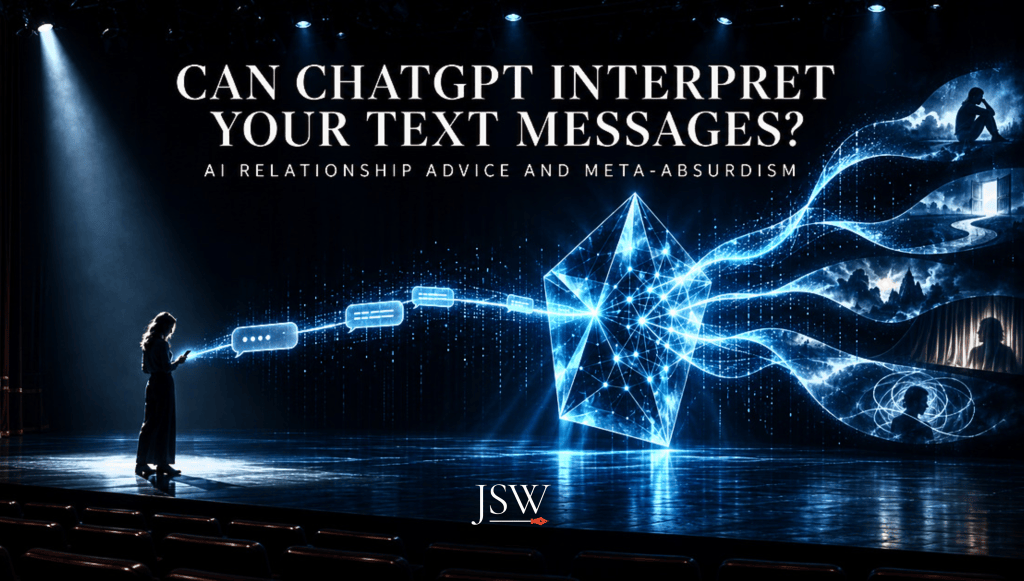
A Meta-Absurdist examination of online dating, where interpretation can begin shaping our understanding of another person long before acquaintance has had time to develop.
By Jill Szoo Wilson
Writer | Theatre Artist | Educator
Before the first date begins, she already knows quite a bit about him. She knows he has a dog and likes hiking. She has heard his opinions about coffee and seen a remarkably good photograph of him standing on the edge of something that looks like the Grand Canyon. She knows which television show he rewatches when he is sick. She knows that he uses a period at the end of most text messages, answers quickly during the day, and becomes harder to reach after nine. She has seen the photograph he chose to lead with and the four others he decided were necessary to complete the picture.
She may know considerably more. A last name can produce a LinkedIn page, while an Instagram account can reveal years of ordinary life and some of the people who have occupied it. A friend may already have examined his profile and announced that one photograph is a green flag while another is “interesting,” a judgment whose meaning depends almost entirely upon tone. By the time he walks through the restaurant door, she may possess dozens of facts and impressions about someone whose manner of moving through a room and listening to another person remain almost completely unknown.
This is one of the stranger conditions created by online dating. Two people can acquire substantial amounts of information about one another before they have accumulated very much interpersonal knowledge at all. Information can be collected without contact; acquaintance cannot. A profile can tell us where someone works, what he believes, and how he spends some of his time while leaving untouched many of the qualities that become visible only through interaction. Digital dating therefore creates a concentrated version of a broader contemporary problem: too much meaning attached to too little encounter.
Meta-Absurdism is a framework I am developing to describe that broader problem. Absurdism confronted a world in which human beings searched for meaning and encountered silence. Meta-Absurdism begins from a different condition. Contemporary life surrounds us with interpretations and explanations, often before we have had enough time or evidence to decide what deserves our trust. Absurdism asks how we live when the world gives us no answer. Meta-Absurdism asks how we live when the world gives us too many.
One practical part of the framework is the Interpretive Sequence: Event → Representation → Interpretation → Narrative. Something happens. We encounter some version of what happened, sometimes directly and sometimes through a medium that has already shaped what we see. We assign meaning to that representation, and those meanings gradually become part of a larger story about what happened and what it signifies. Digital culture often presses these stages together and repeats them rapidly, making it easy for interpretation to acquire the authority of fact before the evidence beneath it has become equally strong.
Online dating makes that process unusually visible because the object of interpretation is another human being. A photograph suggests character, while a delayed reply begins to suggest intention. Long before direct acquaintance can answer the questions Who is this person? and What might this relationship become?, the material supplied through the app can begin answering them for us. By the time two people finally sit across from one another, an interpretive structure may already surround each of them.
The Editable Front Stage
Erving Goffman’s The Presentation of Self in Everyday Life describes social interaction in theatrical terms. People perform versions of themselves before audiences, managing impressions while adjusting their behavior to the social setting in which the encounter occurs (Goffman 1959). The person presented during a job interview differs from the person presented at breakfast on Sunday morning. Neither presentation must therefore be fraudulent. Social life continually requires people to decide which aspects of themselves are relevant to a particular setting and which remain outside the frame.
Dating profiles make that ordinary process unusually visible because they separate self-presentation from immediate social response. Almost anything on a profile can be reconsidered before another person sees it. The person creating the profile therefore has time to think about an audience that is not yet present, and the eventual viewer encounters the performance only after the process of selection has taken place.
Goffman’s distinction between front stage and back stage remains useful here, although digital life changes the conditions under which the front stage operates. The profile is not merely a rehearsal for the later performance of the date. It is already a social performance, except that it can be revised before the audience encounters it and unfolds without the immediate feedback available when performer and audience occupy the same room. The person presenting the self can compose without watching the other person react, while the viewer later receives the resulting presentation without access to the decisions that produced it.
This helps explain why describing dating profiles simply as “fake” misses much of what makes them interesting. Nicole Ellison, Rebecca Heino and Jennifer Gibbs found that online daters often negotiated between presenting an accurate self and presenting an aspirational version of the self, someone they hoped to become or already understood themselves as becoming (Ellison, Heino, and Gibbs 2006). The profile can therefore function as a self-portrait rather than a neutral inventory. Like any portrait, it reflects choices about what deserves to be seen. The interpretive problem begins when those choices become invisible to the viewer.
What We Do With the Missing Parts
Catalina Toma, Jeffrey Hancock and Nicole Ellison examined the extent to which online dating profiles differed from measurable facts about the people who created them. Their findings are useful partly because the deceptions they documented were generally modest rather than spectacular. Men tended to report slightly greater height, women tended to report slightly lower weight, and participants rated their photographs as less accurate than several other kinds of profile information (Toma, Hancock, and Ellison 2008). The disappointing first date, then, cannot always be explained by the discovery that someone deliberately invented an entirely fictional self.
A more subtle process takes place between the profile and the meeting. Human beings infer what the available information does not actually establish. A photograph showing someone beside a dog may produce an impression of tenderness. A clever answer to a prompt may become evidence of intelligence. Six hours without a reply can acquire an explanation that has very little to do with what actually occupied those six hours. The amount of information may be small, but the amount of meaning generated from it can become remarkably large.
Digital culture intensifies this process because it supplies an increasingly elaborate vocabulary for interpreting limited evidence. A strange comment can become a red flag, while early intensity or later distance can quickly be understood through familiar psychological concepts. Even an awkward first meeting may begin acquiring a diagnosis or theory before either person has had much opportunity to establish a pattern of behavior.
Some of these interpretations will eventually prove accurate, and some concepts can help people identify patterns that might otherwise remain confusing. The Meta-Absurdist problem lies in the relationship between the amount of evidence available and the amount of interpretation attached to it. Contemporary culture gives us powerful explanatory systems, but the availability of a framework does not establish that the framework correctly describes the particular person in front of us. Interpretive sophistication can exceed evidentiary depth.
When Interpretation Outruns Acquaintance
Research on the transition from online communication to face-to-face meetings suggests that the interval before meeting can shape what people expect to find when they finally encounter one another. Artemio Ramirez and his colleagues studied online daters who eventually met in person and found that timing mattered. Moving from online communication to an in-person meeting relatively early could strengthen relational impressions, while longer periods of online-only communication sometimes allowed idealized impressions to develop that the eventual meeting had difficulty sustaining (Ramirez et al. 2015).
Kathryn Coduto’s more recent work helps explain why such idealization can develop. Studying people communicating online before meeting, Coduto found that participants formed imagined interactions with the people they had encountered through text. More specific imagined interactions were associated with greater idealization over time (Coduto 2024). The significance of that finding extends beyond online dating. Human beings do not merely tolerate gaps in what they know about one another. We often fill those gaps imaginatively, producing expectations that can begin to feel like knowledge.
This capacity is hardly new. A letter from someone we love can sustain hours of speculation, and literature is full of people who construct elaborate hopes from a glance across a room. Digital dating changes the amount of material available for that imaginative work and the number of occasions on which interpretation can occur. A profile becomes a match and then a conversation, which can continue generating new material for interpretation long before the two people meet. Each new fragment creates another opportunity to decide what the whole person means.
By the time two people meet, then, the problem is not simply that they possess incomplete pictures of one another. Incompleteness is unavoidable in every new relationship. The more distinctive problem is that incomplete information may already have been organized into a surprisingly coherent narrative. Each person can arrive carrying an interpretation of someone the other has never actually been.
The Interpretive Sequence on a First Date
The Interpretive Sequence I have proposed as part of Meta-Absurdism separates four stages that digital culture often presses together: Event → Representation → Interpretation → Narrative. Online dating reveals something particularly interesting about this sequence because it does not simply reverse the order. It proliferates the number of interpretive sequences occurring before direct acquaintance has had much time to develop.
A profile photograph is already a representation produced from an earlier moment, but encountering that photograph becomes a new event for the viewer. The viewer interprets what the image suggests and begins incorporating that interpretation into a larger narrative about the person. A message then becomes another event. Small features of the message can become evidence from which the recipient infers what the sender meant or how interested the sender seems. The interpretation modifies the emerging narrative, and the next message begins another cycle.
The stages therefore become recursive. Representation can become the event of a subsequent sequence, while a narrative constructed from earlier interactions can influence the interpretation of later ones. A four-hour delay in answering a message may mean little at the beginning of a conversation but acquire considerable significance once the recipient has already begun forming expectations about the other person. The sequence continues to operate, but each new cycle occurs under the influence of meanings produced by the cycles that preceded it.
By the time the first date occurs, hundreds of these small interpretive movements may already have taken place. The in-person meeting becomes valuable because it introduces forms of evidence that profiles and messages cannot provide. Conversation begins revealing qualities that become visible only in interaction: how someone listens, how attention shifts, and what happens when the exchange moves beyond material that can be prepared in advance. Such observations remain open to interpretation, but they broaden the evidentiary field.
The discipline of the Interpretive Sequence is therefore one of distinction rather than denial. “He interrupted me three times while I was answering” describes an observable event. “He is a selfish person” interprets that event as evidence of character. “He would never listen to me in a relationship” has begun constructing a narrative about future behavior from the interpretation. The interpretation may eventually prove correct, and the narrative may become well supported over time, but the evidentiary status of those statements is not identical. Meta-Absurdism asks us to remain aware of the distance between them.
The Problem With Knowing the Vocabulary
Contemporary psychological language has given people useful ways to describe relationship patterns that previous generations often struggled to name. Some of these concepts can help someone recognize recurring behavior that once seemed merely bewildering. The existence of a useful vocabulary, however, also changes what observers are prepared to notice.
Once a concept becomes familiar, the mind begins scanning experience for examples of it. Someone who has spent an evening watching videos about attachment styles may interpret a delayed text as evidence of avoidance. Someone familiar with the language of manipulation may see early enthusiasm and wonder whether it constitutes love bombing. Another person may read the same behavior as emotional openness. In each case, the concept offers a possible explanation before sufficient evidence exists to determine whether the explanation fits.
The problem is not that labels distort reality by definition. Some labels name real and consequential patterns. The problem arises when the label begins to precede the pattern it is supposed to describe. A concept that should summarize repeated evidence can instead become a lens through which ambiguous evidence is interpreted from the beginning.
This is precisely why sequence matters. The relevant questions remain deceptively simple: What happened? How did I encounter it? What meaning am I assigning to it? What larger story am I beginning to construct from that meaning? Keeping these questions distinct becomes especially valuable when an available explanation feels satisfying, because explanation reduces uncertainty even when the explanation itself remains untested.
Digital culture can provide that reduction in uncertainty almost instantly. Search the right phrase and somebody, somewhere, has already constructed a theory explaining what another person is doing and why. The danger lies in confusing the availability of an explanation with the strength of the evidence supporting it. A persuasive interpretation may eventually become an accurate one, but the two achievements should not be treated as synonymous.
Attraction Has Its Own Missing Data
Dating platforms inevitably turn people into information because information is what a platform can display. Some qualities fit easily into fields or selectable categories, while photographs provide another set of material to evaluate. The interface necessarily renders a person through discrete pieces of information that can be displayed, filtered, and compared.
This does not make such information trivial. Some stated preferences concern matters that will genuinely determine whether two people should meet at all. The difficulty is that the platform presents information about each person separately, while much of compatibility emerges only through interaction between them.
Eli Finkel and his colleagues made a related point in their extensive review of online dating research. Dating services can expand access to potential partners and facilitate communication, but claims that matching systems can reliably identify compatibility from profiles and algorithms exceed what psychological science has established. Compatibility depends heavily upon how two particular people behave together, something that cannot be predicted reliably from two separate collections of traits (Finkel et al. 2012).
This creates an important distinction between profile compatibility and relational compatibility. Two people may satisfy one another’s stated criteria and still produce an interaction that neither enjoys. Conversely, qualities that seem unremarkable in a profile may become significant in the presence of another person. Much of what makes an interaction compelling exists between the people involved and cannot be reduced to stable data points contained in either profile.
Liesel Sharabi’s research suggests that the information supplied before a meeting can also influence the encounter itself. In an experiment examining online dating profiles and subsequent first-date interactions, Sharabi found that seeing a profile beforehand could shape the eventual interaction rather than merely preview it. She described this as an amplification effect, demonstrating how information obtained before meeting can affect the way the meeting itself unfolds (Sharabi 2021).
The profile therefore becomes more than an introduction to the person. It enters the room with the person because each participant is already carrying expectations formed from what came before. Representation does not merely precede direct encounter. It can help structure the encounter through which later evidence is gathered.
When the Stakes Change
Interpretive patience has limits, particularly when safety is involved. Suppose something happens during a first date that produces a strong sense of alarm or makes one person want to leave. The Interpretive Sequence does not require continued exposure until enough evidence has accumulated to establish a complete theory of the other person’s character.
Safety decisions operate under different evidentiary conditions because the consequences of waiting can be different. Feeling unsafe does not establish, as a matter of fact, that another person is dangerous. It does establish something immediately relevant to the decision at hand: remaining in the situation no longer feels acceptable. That can be sufficient reason to end the date without determining what the other person’s behavior reveals about his or her enduring character.
This distinction preserves an important feature of the Interpretive Sequence. The amount of evidence required for a belief is not always identical to the amount required for an action. A person may reasonably leave a situation while withholding judgment about what the incident ultimately means. The cost of ending an ordinary but awkward dinner early is relatively small, while the possible cost of dismissing a serious safety concern can be much larger. Evidence should shape what we conclude about another person, but the stakes of a situation also help determine how much certainty we require before acting.
Meta-Absurdism therefore does not prescribe slowness for its own sake. It asks that the speed of interpretation remain proportionate to the evidence and that the speed of action remain proportionate to the stakes.
The Person Gets a Turn
By the end of an evening, parts of the original profile may look different. The photograph with the dog may genuinely have suggested something about tenderness, while a carefully crafted joke may turn out to matter much less than something spontaneous that happens during dinner. Other details that seemed significant beforehand may lose their importance entirely.
Direct acquaintance continually rearranges the evidence in this way. The profile remains part of the person’s story because it was something the person deliberately chose to present, and the messages remain part of the evidence because those conversations genuinely occurred. Neither, however, deserves permanent authority over everything that follows. Later evidence may support an early interpretation or change it substantially. It may also reveal how much of the original understanding came from the observer rather than the person being observed.
This is where online dating exposes one of the central problems of Meta-Absurdism particularly clearly. Digital life does not necessarily deprive us of information. It can give us so much information that we mistake informational abundance for epistemic depth. Greater access to another person’s digital presence can create a powerful impression of knowledge even though the fundamental human task of learning who someone is still depends upon behavior unfolding across time.
A better discipline, then, is not interpretive emptiness but proportion. A profile can remain a profile, and an unanswered message can remain an unanswered message until further evidence gives either one a larger meaning. Patterns deserve to become patterns because they recur, while conclusions about character become more trustworthy as behavior has time to establish them.
The Meta-Absurdist problem is therefore not simply that stories form too quickly. It is that contemporary systems give us increasingly sophisticated ways to construct those stories before the evidence beneath them has acquired comparable depth. Online dating makes the imbalance unusually visible because the object of interpretation is another human being, someone whose profile may be studied before his voice has been heard in the room.
When the person across the table does something the existing story did not predict, the story should be allowed to change. In a culture overflowing with interpretations, acquaintance still develops through the slower work of allowing another human being to become more complicated than the representation that came first.
Further reading on Meta-Absurdism:
- What is Meta-Absurdism?
- From Realism to Meta-Absurdism: The Evolution of the Modern Stage
- Meta-Absurdism: What Happens Between an Event and the Story We Tell
- Peter Brook and the Empty Space in an Age of Meta-Absurdism
- The Ordinary Infinite: Annie Baker and the Meta-Absurdist Stage
- The Performing University: Assessment, Authenticity, and Meta-Absurdism in Higher Education
- The Meta-Absurdism Theatre Lab: Let’s Build It Together
Works Cited
Coduto, Kathryn D. “The Development of Imagined Interactions in Online Text-Based Initial Interactions.” Communication Research Reports 41, no. 1 (2024): 49–59.
Ellison, Nicole, Rebecca Heino, and Jennifer Gibbs. “Managing Impressions Online: Self-Presentation Processes in the Online Dating Environment.” Journal of Computer-Mediated Communication 11, no. 2 (2006): 415–441.
Finkel, Eli J., Paul W. Eastwick, Benjamin R. Karney, Harry T. Reis, and Susan Sprecher. “Online Dating: A Critical Analysis From the Perspective of Psychological Science.” Psychological Science in the Public Interest 13, no. 1 (2012): 3–66.
Goffman, Erving. The Presentation of Self in Everyday Life. New York: Anchor Books, 1959.
Ramirez, Artemio, Erin M. Sumner, Christina Fleuriet, and Megan Cole. “When Online Dating Partners Meet Offline: The Effect of Modality Switching on Relational Communication Between Online Daters.” Journal of Computer-Mediated Communication 20, no. 1 (2015): 99–114.
Sharabi, Liesel L. “Online Dating Profiles, First-Date Interactions, and the Enhancement of Communication Satisfaction and Desires for Future Interaction.” Communication Monographs 88, no. 2 (2021): 131–153.
Toma, Catalina L., Jeffrey T. Hancock, and Nicole B. Ellison. “Separating Fact From Fiction: An Examination of Deceptive Self-Presentation in Online Dating Profiles.” Personality and Social Psychology Bulletin 34, no. 8 (2008): 1023–1036.




Leave a comment