
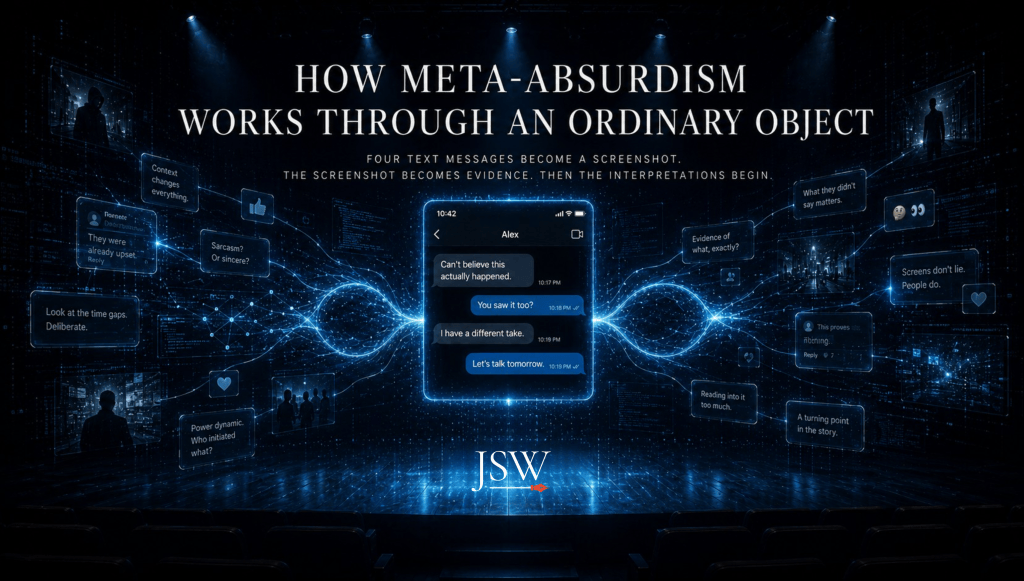
Four text messages become a screenshot. The screenshot becomes evidence. Then the interpretations begin.
By Jill Szoo Wilson
Writer | Theatre Artist | Educator
A friend sends you a screenshot from a text conversation. Above it she has written, Look what he said. The image contains four messages. You can see the sender’s name at the top of the screen and the time beside the final one. The sentence that matters appears exactly as he wrote it, giving the screenshot an authority a summary would never have. The wording requires no reconstruction from memory. You can read it yourself.
You read the sentence, and meaning begins gathering around it almost immediately. Perhaps it sounds cruel. Another reader hears defensiveness. Someone who already distrusts the sender sees confirmation of a pattern, while someone who knows him differently offers an explanation. A friend asks what came before the screenshot. Someone else focuses on the decision to share it. If the image moves farther, the range of interpretation expands with its audience. A stranger may attach psychological language to the exchange. Another may discover an earlier post that seems to clarify the situation and instead opens another line of interpretation. The screenshot remains four messages inside a rectangle while the world surrounding it becomes increasingly elaborate.
This is one of the conditions Meta-Absurdism is meant to describe. Absurdism confronted a scarcity of meaning, placing human beings before a world whose silence frustrated the desire for explanation. Meta-Absurdism begins in a culture saturated with explanations. Digital life produces interpretations at extraordinary speed, attaching them to images and events while audiences continue deciding which meanings deserve their trust. Meaning has multiplied, and the contemporary difficulty lies partly in sorting what has been produced.
The screenshot makes that difficulty unusually visible because it offers a finite representation and invites interpretive possibilities that can expand almost indefinitely. A few captured sentences may become the center of a story far larger than the conversation from which they came. The image travels, and each new setting supplies another opportunity to decide what it means.
The practical method I have proposed within Meta-Absurdism is the Interpretive Sequence: Event → Representation → Interpretation → Narrative. An event occurs. We encounter some representation of it, whether through direct observation or through a form already shaped by mediation. We assign meaning to what we encounter, and those meanings begin contributing to a larger narrative. Digital culture frequently compresses these stages until interpretation begins carrying the authority of the event itself. A screenshot presses the stages particularly close together because it looks so much like evidence.
The Authority of the Captured Screen
Screenshots have acquired a peculiar documentary force. A written summary clearly announces the presence of an interpreter. A screenshot appears to remove that person from the process. The words are visible in their original digital environment, complete with familiar interface features that tell the viewer where the language appeared.
Jan Švelch traces this authority through the history of screen capture, showing how screenshots developed through practices associated with accurate visual recording. That lineage helped establish an expectation of fidelity: the screenshot appears to preserve what existed on the screen with very little human intervention (Švelch 2021). The expectation has practical value. Screenshots can preserve evidence of what someone wrote and record a post that later disappears. They can also document an exchange that would otherwise exist only in memory. The strength of that evidence also creates the more interesting Meta-Absurdist problem, because confidence about what appears inside the image can spread into conclusions the image has yet to establish.
Suppose the screenshot contains the sentence, I never want to hear from you again. Assuming the image is authentic, the words themselves are available for inspection. The screenshot may tell us very little about the hours preceding the sentence, the condition of the relationship, or the events that followed. The image still feels unusually complete because visual specificity produces a powerful sense of access. We can point to the sentence. We can enlarge it. The words remain fixed every time we return to them. A narrow field of evidence can therefore generate an extraordinary amount of interpretation.
This suggests a useful concept for Meta-Absurdism: interpretive surplus, the amount of meaning produced around an event beyond what the available evidence can presently sustain. Interpretive surplus includes plausible explanations as well as mistaken ones. The surplus emerges when interpretation begins outrunning what the representation can presently establish.
Screenshots create favorable conditions for that surplus because they combine a strong appearance of documentary fidelity with a small field of evidence. Researchers Olivia Inwood and Michele Zappavigna have examined the way screenshots function as visual evidence in misinformation and disinformation, finding that the captured screen can lend legitimacy to the surrounding claim through its apparent technological authority. The viewer encounters something that looks like direct evidence, and the credibility of the visible artifact can strengthen the interpretation attached to it (Inwood and Zappavigna 2026).
The same mechanism appears in ordinary life on a smaller scale. A screenshot provides certainty about one part of an exchange, and that certainty begins lending weight to judgments about motive or character. Digital evidence can increase confidence faster than it increases knowledge.
Meaning Travels With an Audience
The screenshot becomes more distinctly Meta-Absurdist once it begins to move. Emily Cramer, Bryan Jenkins, and Yoonmo Sang studied the everyday use of screenshots and found that people use them to preserve information for themselves as well as to communicate information to others. Their research describes screenshotting as a practice through which information can be disclosed or reframed for another audience (Cramer, Jenkins, and Sang 2023).
Reframing begins before anyone alters the image. The sentence Look what he said already places the screenshot inside an interpretation. A different introduction could prepare the recipient to read the same messages differently. Can you tell me what you make of this? creates a different interpretive setting. So does Here is the message I was telling you about. The captured words remain stable while the conditions of reception change.
Alice Marwick and danah boyd’s work on context collapse helps explain part of this movement. Social media brings together audiences that would ordinarily occupy separate social settings, placing communication before people who possess different assumptions and different relationships to the speaker (Marwick and boyd 2011). A screenshot can make that movement especially deliberate because one participant can take language produced inside one relationship and place it before another audience entirely.
A conversation between two friends can become material in a workplace. A message written within a community that shares years of history can reach strangers who encounter only the captured sentences. As the audience grows, direct knowledge of the original event becomes progressively thinner.
Each audience also brings its own interpretive vocabulary. A group familiar with attachment theory may read the screenshot through one set of concepts. A political community may place it inside a larger ideological conflict. People who know the participants personally possess another body of information. Strangers may interpret the image through cultural scripts supplied by similar stories they have encountered elsewhere.
One representation can therefore support several coherent realities around itself. The people involved may share the same screenshot while disagreeing about what kind of event it represents, why it occurred, and what it reveals about the people inside it. Meta-Absurdism describes this as a problem of competing realities. The difficulty extends beyond the distinction between accurate and inaccurate information. Human beings can possess the same authentic fragment and construct substantially different narratives around it because interpretation always exceeds the visible facts.
Interpretation Becomes Performance
Digital interpretation occurs before an audience, which gives the act of interpretation another function. A person commenting publicly on a screenshot communicates a judgment about the image while simultaneously presenting something about himself. A declaration of outrage may express a sincere moral response and also establish where the speaker stands within a community. A psychologically sophisticated explanation can display familiarity with a particular way of understanding human behavior. The interpretation explains the screenshot while also participating in the interpreter’s self-presentation.
Meta-Absurdism is especially concerned with this dual role: contemporary people are frequently both interpreters and performers inside the systems they are trying to understand. The person commenting on a controversy knows that other people can see the comment. Judgment unfolds inside a social field where approval and belonging remain visible.
Research on moral discourse online offers a useful account of that environment. William Brady and his colleagues examined more than half a million social-media messages about contentious political and moral issues and found that moral-emotional language was associated with increased diffusion, particularly within ideological networks (Brady et al. 2017). Later research by Brady, Killian McLoughlin, Tuan Doan and Molly Crockett found that social feedback and perceived network norms could influence later expressions of moral outrage (Brady et al. 2021). These studies address political discourse rather than screenshot culture specifically, yet they illuminate the social environment in which interpretation now circulates. Reactions become visible to other people, and the response of the audience can shape future expression.
The meaning surrounding the screenshot consequently develops through more than private cognition. People watch one another making meaning. They encounter the image alongside other people’s reactions and begin interpreting those reactions as part of the event. By then, the screenshot has begun producing material that exceeds its original subject.
The Recursive Sequence
The Interpretive Sequence becomes especially useful once the screenshot starts generating new events. The original text conversation functions as the first event. Someone captures part of it, creating a representation. A recipient interprets the image, and that interpretation contributes to a narrative about the people involved. The act of sending the screenshot then becomes another event.
The recipient replies. A second person sees the image together with the first person’s interpretation. The conversation around the screenshot develops its own language and conclusions. If someone captures that discussion, the interpretation from one sequence becomes part of the representation in another. The sequence is now recursive.
This recursion developed as an important extension of the Interpretive Sequence in my examination of online dating. There, an early narrative about another person can influence the interpretation of later behavior. A delayed message acquires meaning partly through expectations created by previous exchanges. Screenshot culture carries the same process into collective judgment. An interpretation produced by one viewer can become part of the representational environment encountered by every viewer who follows.
A screenshot posted publicly may soon sit beneath a caption and above hundreds of comments. Someone extracts one comment and posts it elsewhere. Another person creates a video explaining the controversy. A later viewer enters the story through that video and encounters the original screenshot only after hearing what it supposedly demonstrates. By this stage, the interpretive structure has acquired a history of its own.
This recursion helps explain why contemporary controversies can become so difficult to reconstruct. Each generation of representation contains traces of the earlier ones while adding new meaning. The argument about the event becomes another event requiring interpretation, and that interpretation can circulate with the original evidence. The process can continue long after the people involved have stopped speaking.
Competing Realities Around the Same Image
The result is a curious form of epistemic abundance. People may possess more information than previous generations could have imagined while sharing less agreement about what the information means.
Consider a screenshot that circulates through two communities. The first encounters it through a caption describing the sender as dishonest. The second sees a repost arguing that the screenshot has been taken out of context. Both groups possess the same image. Their first encounter with the image has already placed it inside a different narrative.
The sequence matters because interpretation changes perception. Once a viewer begins from a story of dishonesty, later details are likely to be examined for their relationship to that story. Once another viewer begins from a story of selective framing, those same details enter a different structure of meaning. Each community can then continue gathering evidence, and the abundance of evidence may deepen the divergence because additional fragments become material for interpretation inside the narrative already established.
An older message can confirm a pattern for one audience while confirming selective framing for another. A public statement from one of the participants becomes another representation whose meaning depends partly upon which story the viewer is already inhabiting. Competing narratives can therefore become increasingly sophisticated as evidence accumulates.
The experience differs markedly from the absurdist world of silence. Contemporary subjects often stand before an event surrounded by people explaining it. The anxiety arises through excess. Several accounts may possess internal coherence. Each may contain pieces of genuine evidence. The person trying to decide what happened must evaluate a field already crowded with meaning.
Psychological Language and Interpretive Acceleration
The acceleration becomes especially visible when a screenshot concerns another human being because contemporary culture gives ordinary people access to an extensive vocabulary for describing relationship patterns and psychological behavior. Many of these concepts have genuine explanatory value. They can help people recognize patterns that once remained confusing for years. Their availability also changes the speed with which an event acquires interpretation.
A screenshot from an argument can be described as manipulation. A romantic exchange may become evidence of an attachment style. Once a concept has become culturally familiar, very little time separates the visible behavior from the label used to explain it.
The relationship between evidence and interpretation becomes crucial at precisely this point. A concept developed to describe a pattern gains its strongest explanatory force once enough behavior has accumulated to establish that pattern. Digital culture makes the vocabulary available at the beginning of the process as well as the end. A single screenshot can therefore enter a sophisticated theory before the person inside it has entered sustained acquaintance with the viewer.
Interpretive surplus also arises from the gap between available explanation and available evidence. The culture possesses more explanatory resources than the evidence currently requires, and those resources remain available for immediate use. A person can know very little about the sender while knowing several theories capable of explaining him.
The Interpretive Sequence offers a way to preserve the difference. The captured exchange belongs to representation. A conclusion about what the message means belongs to interpretation. A claim about the sender’s enduring character has already moved toward narrative. Each stage may eventually become strongly supported. Their evidentiary status changes as the sequence develops. Meta-Absurdism asks us to remain conscious of that movement because digital life encourages us to experience the stages as simultaneous.
The Search for an Authentic Response
Authenticity occupies an important place within Meta-Absurdism because a culture saturated with interpretation makes it difficult to know which responses actually belong to us. An authentic response to a screenshot begins with attention to the interpretive environment already present. The caption has influenced the encounter. The identity of the person who sent it matters. Previous beliefs about the people involved may already be shaping the reading. Familiar concepts may be waiting to organize the evidence before the viewer has fully examined it.
Awareness of those influences creates room for judgment, and the Interpretive Sequence functions here as a discipline of proportion. The viewer can ask what the image establishes, then allow further meaning to develop at the pace of the evidence. Some situations provide enough evidence for a strong conclusion very quickly. Others require a wider pattern before the interpretation acquires comparable weight.
Action follows a related principle while responding to a different variable. The refinement that emerged through this series can be stated simply: the speed of interpretation should remain proportionate to the evidence; the speed of action should remain proportionate to the stakes.
A threatening screenshot may justify immediate protective action. The seriousness of the situation can support a decision to block contact or seek help while larger questions about motive and character remain open. The evidence can still be preserved as interpretation continues developing according to what is known.
This form of attention requires intellectual patience in an environment organized around acceleration. Digital platforms invite immediate reaction because every representation can become the beginning of another communicative event. The screenshot appears, and the architecture already offers places to comment, forward, and repost. Meta-Absurdism asks what happens in the interval before those actions become a story.
The Story Around the Rectangle
Return to the screenshot from the beginning. The four messages may eventually support every conclusion your friend drew from them. They may become the first visible fragment of a pattern that grows clearer with additional evidence. The screenshot may remain important precisely because it preserved something real. Its Meta-Absurdist significance lies in what happens once that representation enters a culture capable of producing meaning around it almost instantly.
A caption begins the process before the recipient has examined the evidence. The recipient brings previous knowledge and cultural vocabulary to the screen. Sharing creates another audience. Public circulation introduces performance and group response. Each interpretation can become material inside the next person’s encounter with the image.
The rectangle stays small while the story around it expands.
That imbalance captures something essential about contemporary life. Digital culture gives representations extraordinary mobility, and mobility gives meaning repeated opportunities to accumulate. Even after an event ends, its interpretations can continue generating new events across audiences that possess very different relationships to the original moment.
The screenshot therefore offers more than a lesson about context. It reveals a world in which meaning has become abundant enough to develop an independent social life. Absurdism confronted the human desire for an answer in the face of silence. Meta-Absurdism confronts the human task of judgment in a world crowded with answers, where explanations can multiply faster than evidence, and each interpretation can become part of the reality encountered by someone else.
The screenshot sits inside that world as a small, stable representation surrounded by an expanding field of meaning. An authentic response begins by recognizing both. The image deserves the weight its evidence can carry, while the interpretations around it remain visible as interpretations.
The difficult contemporary question begins there: how much of what we believe we have seen belongs to the rectangle, and how much has accumulated around it?
For further reading on Meta-Absurdism:
- What is Meta-Absurdism?
- From Realism to Meta-Absurdism: The Evolution of the Modern Stage
- The Profile and the Person: Online Dating in a World of Too Much Meaning
- Meta-Absurdism: What Happens Between an Event and the Story We Tell
- The Ordinary Infinite: Annie Baker and the Meta-Absurdist Stage
- Peter Brook and the Empty Space in an Age of Meta-Absurdism
- The Performing University: Assessment, Authenticity, and Meta-Absurdism in Higher Education
- The Meta-Absurdism Theatre Lab: Let’s Build It Together
Works Cited
Brady, William J., Killian McLoughlin, Tuan N. Doan, and Molly J. Crockett. “How Social Learning Amplifies Moral Outrage Expression in Online Social Networks.” Science Advances 7, no. 33 (2021): eabe5641.
Brady, William J., Julian A. Wills, John T. Jost, Joshua A. Tucker, and Jay J. Van Bavel. “Emotion Shapes the Diffusion of Moralized Content in Social Networks.” Proceedings of the National Academy of Sciences 114, no. 28 (2017): 7313–7318.
Cramer, Emily M., Bryan M. Jenkins, and Yoonmo Sang. “What’s Behind That Screenshot? Digital Windows and Capturing Data on Screen.” Convergence: The International Journal of Research into New Media Technologies 29, no. 2 (2023): 467–480.
Inwood, Olivia, and Michele Zappavigna. “The Legitimation of Screenshots as Visual Evidence in Social Media: YouTube Videos Spreading Misinformation and Disinformation.” Visual Communication 25, no. 2 (2026): 446–472.
Marwick, Alice E., and danah boyd. “I Tweet Honestly, I Tweet Passionately: Twitter Users, Context Collapse, and the Imagined Audience.” New Media & Society 13, no. 1 (2011): 114–133.
Švelch, Jan. “Redefining Screenshots: Toward Critical Literacy of Screen Capture Practices.” Convergence: The International Journal of Research into New Media Technologies 27, no. 2 (2021): 554–569.



Leave a Reply