

In the summer of 1944, an SS officer at Auschwitz filled an album with parties, songs, and a joke about blueberries. Eighty-two years later, it’s on Broadway.
By Jill Szoo Wilson
Writer | Theatre Artist | Educator
On July 22, 1944, a group of young women gathered at Solahütte, an SS retreat in the wooded hills near Auschwitz, and posed for a series of photographs. They sat together along a wooden railing, holding bowls that had apparently contained blueberries. Karl Höcker, the SS officer whose album would preserve these pictures, came along on the trip. In one photograph he stands in the middle of the line of women, leaning against the fence. In another, a woman pretends to cry because her bowl is empty, while the others smile at the joke. Someone has written a caption beneath the pictures: Hier gibt es Blaubeeren. Here there are blueberries.
View the photograph at the United States Holocaust Memorial Museum
The women were SS-Helferinnen, female auxiliaries who worked for the SS as communications specialists at Auschwitz. Between May and July, trains from Hungary had brought hundreds of thousands of Jews to Auschwitz, and most of them were murdered on arrival. By late July, the mass deportations of Hungarian Jews to Auschwitz had largely ceased, following one of the most intensive periods of killing in the camp’s history. The women in the photograph were enjoying an afternoon away from work, and someone thought to bring a camera.
I have looked at these photographs several times, and what strikes me most is how easily the women appear before the camera. One leans toward another. Someone has arranged the group along the railing, perhaps because the light was good or because there was room for everyone to sit. The joke about the blueberries was evidently worth repeating in several pictures. They look like people who have done this before, who know how to photograph an afternoon they want to remember. They could hardly have imagined who would eventually be looking at it.
That unexpected audience is at the heart of Here There Are Blueberries, the play by Moisés Kaufman and Amanda Gronich that begins Broadway previews at the Ethel Barrymore Theatre on November 2. The play, a 2024 Pulitzer Prize finalist, follows the discovery of a photo album that belonged to Karl Höcker, an SS officer who served as adjutant to Auschwitz commandant Richard Baer. The album contains 116 photographs of the men and women who worked at Auschwitz, photographed during official ceremonies, social gatherings, and excursions away from the camp.
There are no photographs of prisoners. There are no gas chambers, crematoria or selections. Höcker preserved a record of his colleagues enjoying themselves, and more than sixty years later, that record found its way into the United States Holocaust Memorial Museum. The women posed for a friend with a camera. More than sixty years later, museum historians were studying their faces.
The Photographs Höcker Kept
In January 2007, a retired American counterintelligence officer donated the album to the United States Holocaust Memorial Museum. He had found it in an abandoned apartment in Frankfurt while stationed in Germany after the war, and he kept it for six decades. Museum historians began identifying the people in the photographs, comparing the images with other records, and establishing when and where they were taken.
The album belonged to Karl-Friedrich Höcker, who served at Auschwitz from May 1944 until the camp’s evacuation in January 1945. He appears frequently in the photographs, sometimes with other officers, sometimes with his dog, and often looking remarkably pleased with himself. The album includes images of Rudolf Höss, Richard Baer and Josef Mengele, whose experiments on prisoners, including children, have made his name inseparable from the history of Auschwitz. There are photographs of officers relaxing outdoors, gathering around an accordion, attending ceremonies and celebrating Christmas. The images have the quality of an ordinary family album, except that the family in question was the SS leadership at Auschwitz.
A family album is a curious historical object because it records what someone considered worth remembering. We keep photographs of birthdays, holidays, weddings, children and vacations, and although those images may tell the truth about the moments they preserve, they rarely tell the whole truth about the lives in which those moments occurred. We photograph the occasion, then choose which images deserve a place in the album. Years later, we may remember the event partly through the photographs we kept.
Höcker’s album performs that familiar work of selection, although its circumstances make the result almost impossible to comprehend. Here are men responsible for administering a concentration and extermination camp, preserving photographs of their pleasant afternoons. The men who ran the camp also went to a lodge in the woods to sing and drink together. The album does not tell us what its subjects thought about their work, and their expressions cannot answer that question for us. It does show them enjoying one another’s company during the months they worked there.
What I find especially revealing is that Höcker apparently considered these photographs a suitable record of his time there. He kept them together, with their captions and commemorated occasions, as though they belonged to a period of his life he might someday wish to revisit. Perhaps, when he looked at them, he remembered the blueberries.
A Photograph Meets Another Audience
In the theatre, we spend a great deal of time thinking about what an audience knows. A character may enter a room believing she has successfully concealed something, while everyone watching understands that her secret has already been discovered. Another character may make a casual remark that becomes painful because the audience knows what will happen later. The words remain the same, but the circumstances alter our understanding of them.
Something similar happens when we look at Höcker’s photographs, although the people in them were participating in real events, and many knew very well what was happening at Auschwitz. The women at Solahütte were posing for someone who belonged to their world. They knew the people around them, understood the occasion, and presumably expected the pictures to be seen by others who shared that familiarity. An empty blueberry bowl was a small joke, and the photograph preserved it as such.
When museum historians examined the same pictures decades later, they were looking for something else. They wanted to know who the women were, where they worked, why they were gathered at Solahütte, and how the outing fit into the chronology of Auschwitz. Historians matched faces to personnel records and used the captions to date each outing. The joke survived, but the audience had changed.
There is a temptation to describe the photographs as revealing the true faces of the perpetrators, but I am not sure they do anything so simple. The men and women in them were behaving as people often behave when a camera is pointed in their direction. They smiled, arranged themselves in groups and made small performances of the occasion. We cannot know what they were thinking, and I am wary of assigning private motives to people on the strength of a photograph. What we can know is where they were, whom they worked for and what that institution was doing.
That knowledge makes us examine the images more closely, searching the faces for something that might account for the circumstances in which they were taken. We are likely to be disappointed. Nothing in a person’s smile tells us whether she is capable of cruelty, and a group posed along a railing tells us nothing about the work those women did at the camp. The subjects look like people having an enjoyable afternoon because, at the moment the camera recorded them, that is what they were doing. Working at Auschwitz did not keep them from enjoying music, food and one another’s company.
That is harder to understand than the familiar image of the Nazi as a figure of unrelenting cruelty. These people worked at Auschwitz and then gathered to enjoy one another’s company, and nothing in the photographs shows what was happening at the camp.
Eva’s Summer
I cannot think about Auschwitz in the summer of 1944 without thinking about Eva Mozes Kor. Eva and her twin sister Miriam arrived at Auschwitz in May, deported from Transylvania with their parents and two older sisters. They were ten years old. At the selection platform, the twins were separated from their family and taken into Josef Mengele’s experimental program. Their parents and sisters were murdered, and Eva and Miriam were left to survive in a place in which their lives had become useful to the SS only because they were identical twins.
I knew Eva, and I have spent years thinking and writing about what she told me. She described the medical experiments, the injections and blood draws, and the determination with which she held on to the possibility that she and Miriam might survive. She told me about being taken from Birkenau to Block 10 at Auschwitz for experiments, and about the terrible illness during which she believed she might die.
Mengele appears in photographs taken at Solahütte on July 15, 1944. During that same summer, Eva and Miriam were among the children subjected to his experiments. We do not know what Eva was doing at the precise hour those photographs were taken, and I would not pretend otherwise. But the dates place the two histories alongside one another in a way that is difficult to dismiss. The man who conducted experiments on imprisoned children also attended social gatherings with his colleagues, and photographs of those gatherings survived.
I think Eva would have been interested in the album, although I cannot presume to know what she would have said about it. She resisted the idea that Mengele should be described as a monster, not because she wished to minimize what he had done, but because she believed it mattered that he was a human being who had made human choices. Calling him a monster could make his actions seem to belong to some other category of existence, safely removed from the rest of us. The photographs make that separation difficult to maintain. They show Mengele at a gathering in the woods with his colleagues. They do not explain what he did to Eva and the other children, but they show a man who was capable of ordinary social life.
The two histories also differ in how they came to be preserved. Höcker kept photographs of experiences he apparently wanted to remember. Eva spent decades telling people about experiences she was determined the world should never forget. He preserved an album for reasons that belonged to his own life, and the album eventually became historical evidence. Eva made a deliberate decision to speak publicly, repeatedly and often at considerable emotional cost, because she wanted people to understand what had happened at Auschwitz.
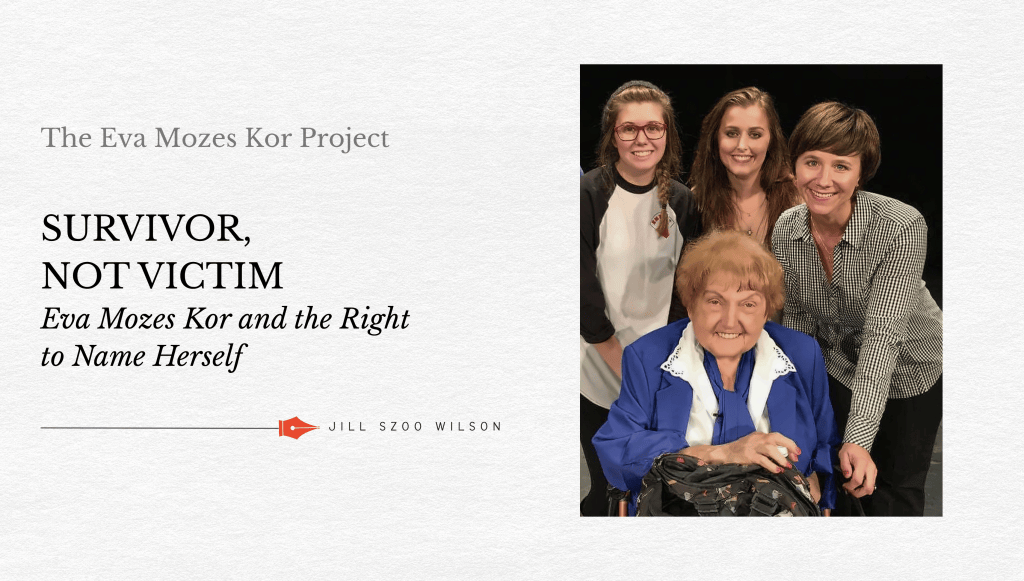
She also wanted people to understand that her life had continued after Auschwitz, and that she had the authority to decide what forgiveness meant to her. That part of Eva’s story matters enormously to me. She was not simply a child who had suffered at the hands of Mengele. She became a woman who chose how to speak about that suffering, who founded CANDLES, who taught generations of students and who challenged people to think about forgiveness in ways that sometimes made them deeply uncomfortable. Her testimony belonged to her, even when others disagreed with the conclusions she drew from it.
Why Theatre?
Kaufman and Tectonic Theater Project’s work on The Laramie Project demonstrated how interviews, documents, and competing recollections could become a theatrical investigation without requiring the playwright to invent a conventional plot around them. Here There Are Blueberries follows the historians and archivists who received the album and began the work of identifying its subjects. Its dramatic action lies partly in the process of learning what the photographs mean.
An actor can stand onstage with a photograph and study it, and the audience can watch the effort involved in understanding what is there. A name may connect one person to another, and a date may establish that an apparently ordinary gathering took place during an extraordinary historical event. The audience follows the investigation, reconsiders what it has already seen, and discovers how much depends upon information that was never included in the photographs themselves.
I have taught theatre for more than twenty years, and one of the things I return to with actors is the importance of circumstances. A character’s behavior takes on meaning through the circumstances in which it occurs. The Höcker photographs present a historical version of that problem.
A theatrical production cannot recreate the actual thoughts of the people in those photographs, nor can it give us access to an interior life the evidence does not disclose. It can show us how historians work with the evidence that survives. I have not yet seen the Broadway production, so I cannot speak to the choices its actors and director will make, but the material offers an unusually rich subject for documentary theatre.
What the Later Audience Owes
If the album’s meaning now depends on those who look at it, then looking carries obligations of its own. The first is discipline. Historical interpretation requires corroboration and an awareness of what the evidence cannot establish. It would be easy to read cruelty into every smile, or to treat the photographs as a key that unlocks the minds of their subjects. They are neither. Their value lies in what can be confirmed: names, dates, places and the work these people did when the camera was put away.
The second is something Eva understood well. She knew that the survival of testimony depends upon the people who come afterward. She told her story to audiences who had not been born when she was imprisoned, because she believed that what happened at Auschwitz mattered to the lives those listeners would lead. She could decide what to tell them, but she could not control what every listener would think, or what questions her testimony might raise after she was gone. The responsibility for understanding would eventually pass to the people who heard her.
The Höcker Album places a similar responsibility on its viewers, although it arrives by a very different route. Its owner never intended to testify. The photographs have acquired historical significance because historians, archivists and now playwrights have examined them in ways Höcker never anticipated. Whatever the album teaches, it teaches because someone chose to look at it carefully, and to keep looking after the first easy reactions had passed.
Here There Are Blueberries
When I return to the photograph of the women at Solahütte, I try to imagine the few minutes during which it was taken. Someone gathers the group along the railing. Someone else makes a joke about the empty bowls. The women laugh, and the camera records them. The afternoon continues.
What we know about Auschwitz changes those moments, but it does not make them disappear. The women really did gather there. They really did laugh. Their pleasure existed in the same summer as the deportations, selections, and killings taking place at the camp where they worked, and the caption beneath them tells us nothing about any of it.
Here there are blueberries.
The women on the railing remain exactly where the camera left them, with their empty bowls and their little joke. They are still looking toward the person holding the camera.
We are looking back at them, knowing what happened that summer.
Further Reading
- United States Holocaust Memorial Museum, Inside the Höcker Album
- United States Holocaust Memorial Museum, Auschwitz through the Lens of the SS: The Album
- Moisés Kaufman and Amanda Gronich, Here There Are Blueberries
- Jill Szoo Wilson, Eva Mozes Kor Project
- Jill Szoo Wilson, Thinking Through Theatre: Essays on Playwrights, Performance, and the Art of Paying Attention
Here There Are Blueberries begins Broadway previews at the Ethel Barrymore Theatre on November 2, 2026, and officially opens November 9. This essay considers the historical photographs and the questions raised by the play’s subject, rather than reviewing a production I have not yet seen.



Leave a Reply