
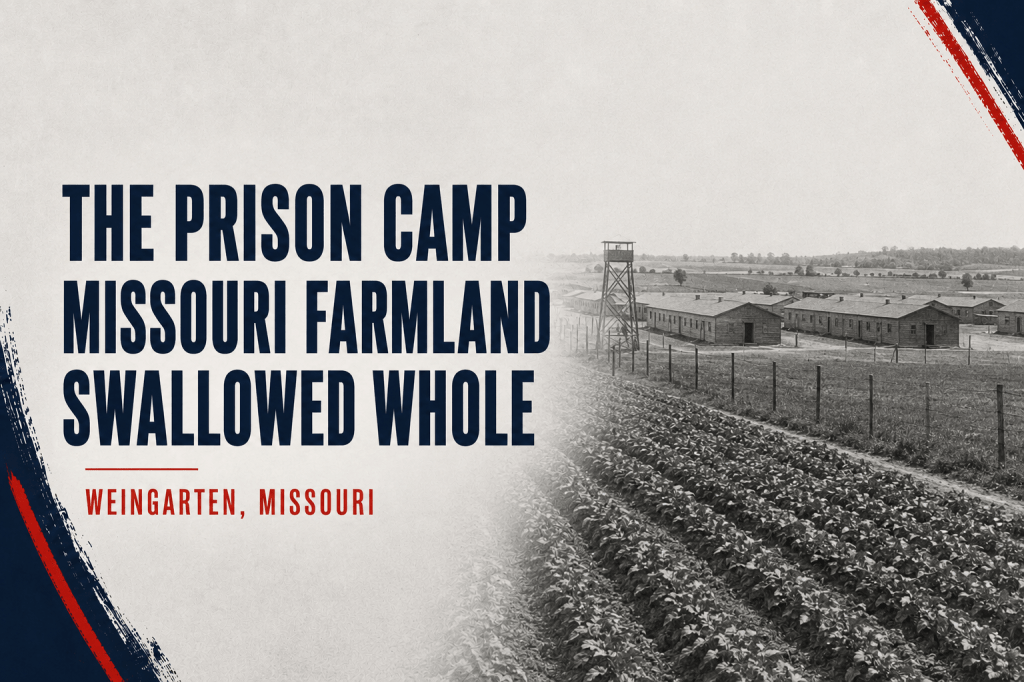
Along Highway 32 in Ste. Genevieve County, a wartime camp, once held thousands of Italian prisoners of war. Today, the site has returned almost entirely to farmland.
By Jill Szoo Wilson
Writer | Theatre Artist | Educator
History has a peculiar taste in souvenirs. A prison camp that once held nearly five thousand men left, in the end, a stone fireplace and a cigarette case fashioned from an aluminum pie pan. Both objects still exist, virtually alone among everything the camp once contained.
Camp Weingarten stood along Highway 32 in Ste. Genevieve County, roughly ninety miles south of St. Louis, from 1942 until 1945. At its height, it contained some 380 buildings and around 4,500 Italian prisoners of war, a population larger than that of many of the Missouri towns surrounding it. Today, the site is farmland, indistinguishable from the acreage on either side, and a driver could pass the spot at highway speed, registering only ordinary fields, entirely unaware that a small city of captured soldiers once occupied the same ground. The fields, in this sense, have done their job almost too well. They have absorbed a piece of the twentieth century so completely that the century has grown nearly invisible.
The cigarette case survived because someone kept it. According to an account preserved by War History Online, Pfc. Dwight Taylor asked his mother for an aluminum pie pan during a visit home and gave it to an Italian prisoner he had befriended. The prisoner fashioned it into a case with a working latch, engraving the camp’s barracks, guard tower, and perimeter fence into the metal. Taylor later gave the case to his brother-in-law, L.L. McDowell. McDowell’s daughter eventually revealed the family irony: her father had approximately zero interest in tobacco and kept the case anyway for the better part of his life.
This is the kind of detail that makes Camp Weingarten worth excavating, and also the kind that makes it difficult to write about responsibly. A pie-pan cigarette case is charming. The circumstances that produced it carry a very different weight. Between those two facts sits the entire challenge of telling this story.
A City Assembled at Wartime Speed
Construction began in August 1942, as American forces fought across North Africa and the War Department scrambled to prepare for the flood of captured Axis soldiers that a widening conflict would inevitably produce. The Camp Weingarten Research Collection, held by the Missouri Historical Society, records a completed facility of 832 acres, its buildings arranged into a self-contained military settlement complete with housing, medical care, storage, a stable, and administrative offices for the Americans who ran it. The camp was one of four principal prisoner-of-war installations in the state, alongside Camp Clark, Camp Crowder, and Fort Leonard Wood, part of a national strategy documented in the Army’s own official history of prisoner labor: camps sited near farms and forests, where captured men could replace the American workers a war economy had pulled away, and far enough from the coasts that escape carried little practical hope.
Ste. Genevieve County met every criterion. It offered open land, rail access, and a rural remoteness the Army found reassuring. What it offered, at least on paper, stopped well short of any obvious symbolic resonance. Weingarten, the small community nearest the camp, had been settled predominantly by German immigrants; its name translates roughly to “vineyard.” The prisoners who began arriving that May were, with an irony the Army seems to have missed entirely, Italian.
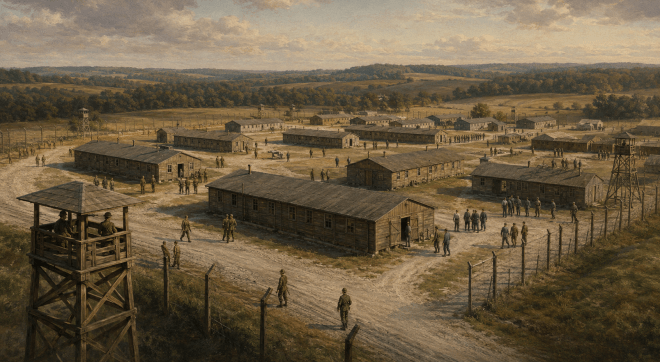
The first two trainloads reached the camp on May 7, 1943, most of the men captured during the North African campaign, where Italian forces had fought alongside Germany. The following day, the camp’s own newspaper published an issue announcing their arrival, a small bureaucratic marvel given the circumstances. Copies of the paper, called the Weingartener, survive today in the State Historical Society of Missouri’s Weingarten Internment Camp Collection, alongside military orders, photographs, and a roster of the American guard company. Even captivity, it turns out, ran on a publication schedule.
Life at Weingarten
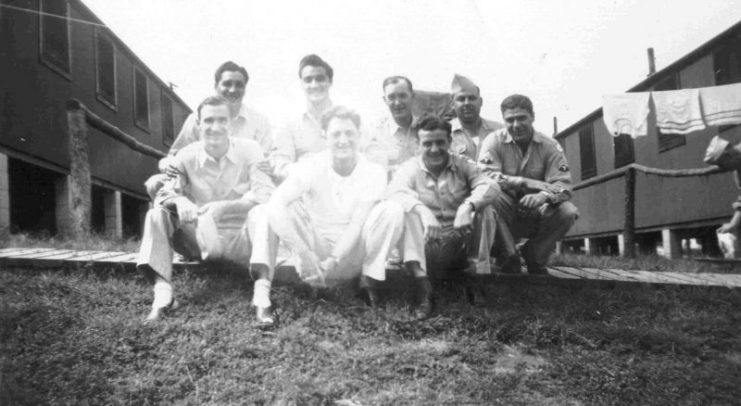
What is striking about the surviving record of Camp Weingarten is how quickly the extraordinary became routine. Prisoners slept in barracks, stood for inspection, and moved through days shaped by the 1929 Geneva Convention’s provisions on food, housing, and labor. The camp had a hospital, a theatre, and a gymnasium. Prisoners staged performances, played sports, produced artwork, and organized their own recreation with the kind of institutional thoroughness that suggests captivity, given enough time, develops its own culture.
Labor was central to the camp’s purpose from the outset. Missouri’s farms faced an acute shortage of workers by 1943, as young men entered the armed forces and others moved into defense industries offering steadier wages, while crops continued, with characteristic indifference to military planning, to ripen on schedule. Prisoners from Weingarten filled that gap, working farms under guard and earning roughly eighty cents a day, credited for use at the camp canteen, where accounts suggest beer was occasionally available, evidence that even wartime bureaucracy could locate the outer edge of its own humanity. Others repaired Army shoes, a task whose military value was real but whose glamour was nonexistent.
That labor made sustained contact unavoidable. Farmers came to know the men working their fields as individuals rather than as an abstraction called “the enemy.” Guards learned names and habits. Italian Americans from St. Louis’s Italian neighborhood, The Hill, began making the seventy-five-mile drive south to visit, drawn by a shared language and, in many cases, by little more than a shared homeland. According to KRCG’s account of Missouri’s POW camps, some of these visits developed into lasting friendships. Sustained proximity placed pressure on the abstraction of “the enemy,” even as American families continued to receive casualty notices from overseas.
The camp’s internal logic was further complicated in September 1943, when Italy signed an armistice with the Allies and declared war on Germany. Overnight, in a legal sense at least as much as an emotional one, the prisoners at Weingarten had become citizens of a co-belligerent nation. The United States offered cooperative Italian prisoners the chance to join Italian Service Units, noncombatant military work meant to support the Allied cause. Participation was voluntary, and the surviving record preserves only part of what the decision required from each man: political conviction, concern for relatives in Italy, and the disorientation of a war that had rearranged its alliances while he remained behind the same fence. The armistice altered the prisoners’ political status without ending their captivity, adding another uncertainty to life at Weingarten.
What the Fields Kept, and What They Let Go
Germany surrendered in May 1945, Japan in August, and the vast apparatus the United States had built to hold enemy prisoners began, almost immediately, to dismantle itself. By November, Camp Weingarten stood empty. Its buildings were sold, moved, or torn down with a speed that matches the urgency of their original construction. One later account reports that some buildings traveled to college campuses around the country, where they became housing for veterans attending school under the GI Bill, a small irony in its own right, since the same wooden frames that had once confined enemy soldiers went on to house the Americans who had defeated them.
Only the stone fireplace from the officers’ quarters remained standing, offering, at best, a faint outline of what once occupied the ground. The absence has a texture of its own. Camp Weingarten survives now largely through the shape of what has disappeared around the objects that happened to endure.
Camp Weingarten’s historical survival depends upon the persistence of one attentive person. Much of what can still be reconstructed survives because Stanley G. Drury decided the camp mattered. Drury was eighteen when he worked there as a laborer and carpenter’s helper; his girlfriend and future wife, Teresa Basler, worked as a clerk. After serving as a radio operator aboard a B-17 with the Eighth Air Force, he began collecting Army records, photographs, correspondence, and interviews related to Weingarten. Former prisoner Vincenzo Mancuso later contributed newsletters, poems, photographs, and a list of Italian officers, allowing the archive to preserve material from both sides of the fence.
Drury’s work remained modest in scale: a photograph received a name, a letter entered a folder, and an interview preserved what someone still remembered. Those accumulated acts allow a vanished community to become visible again through paper.
The records of an 832-acre prison camp now occupy half a cubic foot at the Missouri Historical Society: one box and an oversize folder.
The cigarette case preserves the camp from inside the fence. The fireplace still marks the room that disappeared around it. Everything else depends upon the people who understood that ordinary objects sometimes become evidence.
Sources and Further Reading
- Camp Weingarten Research Collection, Missouri Historical Society
- Weingarten Internment Camp Collection, State Historical Society of Missouri
- History of Prisoner of War Utilization by the United States Army, 1776–1945, U.S. Army
- Relic of Camp Weingarten, War History Online
- Beyond the Trivia: POWs in Missouri, KRCG
Continue Reading Hidden Missouri History:
- The Ghost Town Where I Held My Breath: The Strange Second Life of Times Beach
- Missouri’s Fault Is Quiet. Nobody Knows Why.
- Zombie Road: The Story Beneath Missouri’s Most Haunted Trail
- Castlewood: The Summer Resort Beneath One of St. Louis’s Favorite Parks
- Weldon Spring: The Radioactive Mountain You Can Climb Near St. Louis





Leave a Reply