

Readers identified five themes in my work. I answered their questions about why I keep returning to them.
By Jill Szoo Wilson
Writer | Theatre Artist | Educator
I first saw Shadowlands in a movie theater when I was fifteen, and it has been my favorite movie ever since. The film tells the story of C.S. Lewis and Joy Davidman, the woman who became his wife. At one point, a character says, “We read to know we’re not alone.” That line became something of a motto for my life. We do theatre to know we’re not alone. We travel to know we’re not alone. We write to know we’re not alone.
Writing is also how I process the world. I rarely begin with a plan or even a clear idea of what I think. I follow whatever has made me curious until I can see it more clearly on the page. When I share the work, readers often recognize patterns I cannot see from inside it.
Recently, I sent a poll to my subscribers across platforms, as well as my poetry classmates and other writing and teaching colleagues. I asked them to help me identify the themes in my writing. Here is what they noticed and what they wanted to know:
Silence and subtext (theatre criticism) — What are you actually listening for when you watch a scene, and why does what’s not said matter more to you than what is?
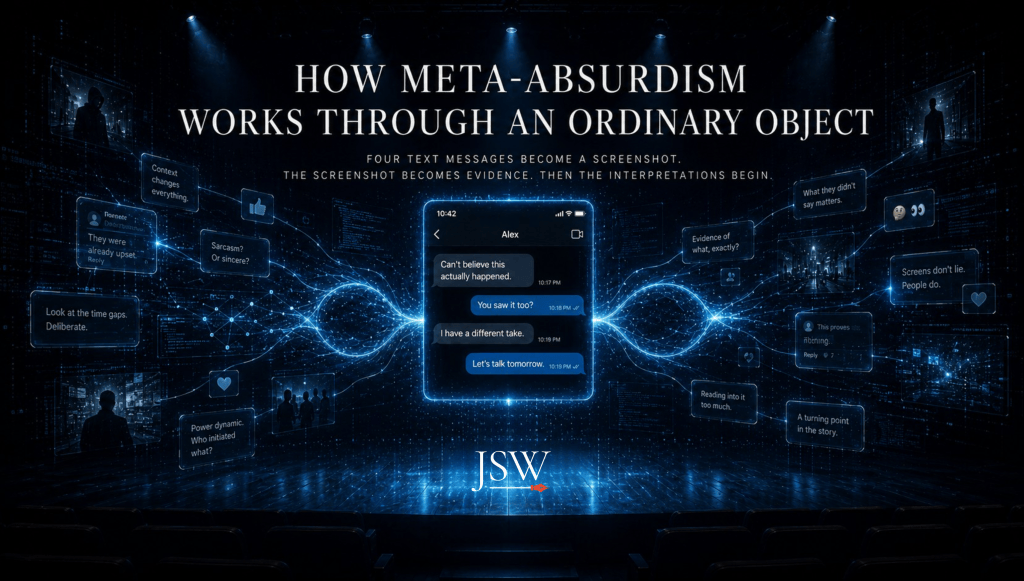
Meta-Absurdism (the framework) — What did you and your students recognize about contemporary life that existing theatrical movements couldn’t capture, and how did that become Meta-Absurdism?
Faith and poetry (Iris Lennox) — Why does this material need a different name and a different register than your essays? What does the pen name let you say that the byline doesn’t?
Eva Mozes Kor and Auschwitz — Why has this stayed mostly unwritten, and what does it mean that it keeps surfacing sideways instead of directly?
Literary friendship and rivalry (Hemingway/Fitzgerald) — Why are you drawn to two people who owed each other something neither could fully repay? What is that actually about for you?
To honor their keenness, and as an exercise in self-discovery, here are my answers to the questions that surfaced.
- Silence and subtext (theatre criticism) — What are you actually listening for when you watch a scene, and why does what’s not said matter more to you than what is?
When I watch students or professional actors on the rehearsal room floor, I am watching for instinct: those small, nearly imperceptible moments when an actor expresses an internal thought externally but then stops themselves. If you’re in the room, you’ll often hear me say, “Follow that instinct.” It might look like someone almost stepping toward another character, almost reaching out a hand or almost taking a deep breath before saying the next line. The “almosts” are indications of the honest flow from thought to the body that actors interrupt almost incessantly because they are self-monitoring instead of being fully alive and moving in the moment. They do this because they are trying to pose or “show” a performance instead of living truthfully in the imaginary circumstances and allowing themselves the freedom to simply respond. They have an idea of what they think a moment should look like from the outside, so they try to create that look instead of fully embodying and trusting their instincts.
On stage, as in life, the more interesting and truthful moments occur when a human being is interacting with her own thoughts and another person in real time. Real life is messy, and people are way more complex than the average person feels comfortable with. The more polished a performance looks, the less real it feels, and that’s when the audience and your scene partner lose interest. It’s the same in real life. When I’m in the room with someone who is performing their way through a business meeting, a faculty meeting, or any interaction in a real-life setting, I stop paying attention to what is being said and watch the behavior unfolding. The truth is always right under the surface, and it’s always more interesting than the performance.
- Meta-Absurdism (the framework) — What did you and your students recognize about contemporary life that existing theatrical movements couldn’t capture, and how did that become Meta-Absurdism?
Well, we were trying to place our current cultural moment within a movement from the past that had already been named. Every theatrical movement we turned to was missing something from our modern-day experience. For example, the tenets of realism demand that playwrights depict social and psychological interactions that an audience member might recognize as a kind of daily conversation between two people. Naturalism strips some of that away and introduces longer silences and messier interactions, described as “slice-of-life” behaviors that make the performance feel more like peering through someone’s kitchen window. There isn’t as much curated dialogue or movement, or at least that’s the way naturalistic plays are written. Then, of course, we began digging into absurdism, which tells us that there is no meaning in life, so the harder we try to find it or embody it, the more absurd we become. We thought we might be closest to absurdism as we considered the news of that particular day (Fall 2025).
That said, we went through every other established “ism” theatre had to offer and realized that, through a theatrical lens, our current moment in the world did not look realistic, expressionistic, natural, or void of meaning. We found that whatever is realistic about our day-to-day lives is largely hidden while we portray ourselves on screens. We reasoned that naturalism was definitely out as a movement to embody today because no one is peering into our kitchens anymore. Indeed, we rarely invite people into our homes as the world becomes more and more isolated. Then we started asking questions about what our culture tells us about meaning, and we realized no one is saying there is no meaning. The opposite is true. The world is screaming its answers to the question of meaning, and because we’re all screaming at once through the technology with which we have been both blessed and cursed, we needed a whole new framework to capture today’s world on stage. That’s how Meta-Absurdism was born. Absurdism told us there was no meaning, and Meta-Absurdism tells us there is too much meaning and that very fact is rendering meaning . . . meaningless.
All of that said, the most important thing about Meta-Absurdism to me is that a small group of students engaged seriously with huge questions and with the importance of artists in our world, then told other students about it until the movement grew far beyond me or my classroom. Watching students think and passionately pursue questions is the reason I teach.
- Faith and poetry (Iris Lennox) — Why does this material need a different name and a different register than your essays? What does the pen name let you say that the byline doesn’t?
There’s a huge story behind this one. For one year, I used the name Iris Lennox to write a Substack dedicated to telling a personal story I wasn’t ready to tell in my own name. I also wrote a book about my experience. I told the story. And got sued for it.
The defamation case ended in a settlement. I agreed to take down the book and the related writing. No judgment was entered against me, and I admitted no wrongdoing. I didn’t retract or revise what I had written; I removed it as part of resolving the case.
I won’t pretend to know exactly what the person who sued me wanted or believed. I can only tell you how it felt from inside. To me, it followed a familiar pattern: a woman tells her story, and if the telling causes offense, her right to tell it becomes the story. As painful as it was, I also found the whole thing fascinating. I had spent decades studying the ways human beings perform, protect themselves, and justify their choices. Now I was living inside such a dynamic, watching a personal story become a legal one. I could see the pieces as clearly as the individual colors in a kaleidoscope.
Women have understood the usefulness of another name for centuries. During the eighteenth and nineteenth centuries especially, many published anonymously or under male pseudonyms because publishers and readers took men’s writing more seriously. A borrowed name also gave a woman room to write beyond the subjects and behavior her culture permitted her. I chose a woman’s name, but I understand the impulse. Iris gave me enough distance from my public identity to write freely.
One of the things that didn’t sit right with me after the case settled was the idea that the name Iris Lennox would disappear forever. So I repurposed the name and gave her the most beautiful ending I could think of: I gave her my poetic voice.
Jill Szoo Wilson is my curious voice. Iris Lennox is the part of me that slows down. She wanders through desert landscapes, sits beside the ocean, and enjoys a glass of red wine in the evening. She looks for the sacred in the mundane: a coat left on a chair, a bird in the yard, a bridge over a creek. Her poems come from the slow, peaceful observations of life.
- Eva Mozes Kor and Auschwitz — Why has this stayed mostly unwritten, and what does it mean that it keeps surfacing sideways instead of directly?
This story has not remained unwritten, actually. I have four full drafts of a play that I wrote between 2015 and 2017. The play was workshopped at Kansas City Repertory Theatre and on two university campuses, in front of a Broadway producer and a local artistic director. All of that is to say, it was a long-term project I worked on for years. The idea was to write a one-woman show about the life of Eva Mozes Kor, who was a “Mengele Twin.” To that end, I traveled with Eva to Auschwitz on three occasions. I also traveled with her to Romania and Hungary so I could learn about her life before Auschwitz, during her enslavement in the death camp, and after her liberation.
Eva’s message was one of forgiveness. She called herself a forgiveness advocate. Therein lies the controversy.
I set out to write about her story of death and life and about forgiving her tormentors, including Dr. Josef Mengele, in her name alone. I ended up writing about how her message of forgiveness convicted me to work through forgiving a perpetrator in my own life. The play grew from a one-woman show into a four-person show in which the actors played sixteen characters among them.
I sent the script to many directors all over the world. While I received a lot of supportive and beautiful responses, one common response ultimately led me to put the project down in its current form: people don’t want to produce a story in which a Holocaust survivor forgives a Nazi.
Those years with Eva remain the most formative of my life. Through our work and travel together, I learned how to speak up even when it wasn’t popular to do so. I learned how to advocate for myself and others. I learned that there really are men who silence women, especially men with any measure of power. I learned the anatomy of forgiveness and the effects of unforgiveness on people, systems, and countries. Most of all, I learned to act courageously. I was with Eva backstage before she spoke to crowds of two thousand to five thousand people on several occasions. She was always nervous and always amazed that anyone wanted to hear her speak. I watched people protest her existence on campuses, belittle her, and try to intimidate her into silence. I also watched her sit for hours after her speaking events and talk with tearful, broken young people who wanted to forgive people in their own lives but didn’t know how. She heard story after story about abuses of all kinds, and the more broken the person, the stronger she became for them. Her resilience, fortitude, and unwavering love for others changed my life.
I’ll never stop telling Eva’s story, but I respect her too much to entrust the work itself to anyone who doesn’t wholeheartedly want to tell her most difficult story.
- Literary friendship and rivalry (Hemingway/Fitzgerald) — Why are you drawn to two people who owed each other something neither could fully repay? What is that actually about for you?
This series is relatively new, and I will probably share only a few of the pieces I’ve written on the topic because mid-writing my curiosity quickly took an off-ramp. I began with rivalries and ended up thinking about how the bigger story of good and evil is playing out on the world stage right now. We humans get all caught up in the conflicts that are close to home, but ultimately, I think that’s a distraction from the larger story of light and dark and the Day of the Lord, which seems to be moving swiftly upon us. Not that we should ignore our own stories, but we mustn’t ever take ourselves too seriously.
To answer the question, there are certainly people in my own life whom I have wronged and people who have wronged me. In the end, I can’t stay mad at anyone.
For example, right in the middle of the lawsuit, I could see the hurt, anger, and fear of the person on the other side. I never stopped feeling empathy for the human being, even while I had to fight because I was caught up in a system. A system, mind you, that couldn’t have cared less about any of the human beings involved.
Human beings are endlessly fascinating to me, and the stories we tell ourselves about who we are, who others are, and how our lives intersect can never be complete because we can never fully know another person. I love the mystery inherent in humanity. It’s that mystery that precludes me from ever believing anything is just one thing. Nothing is ever just one thing. Anyone who uses rhetoric to put you or your story in a box hasn’t yet faced their own depravity and beauty, their own evil and good. And that’s okay. They will someday, and we should wish them well in their sanctification process.
The rivalry series began when I read how Edgar Allan Poe’s enemy waited until Poe was dead to smear his reputation, and it worked. Most of us grew up thinking Poe was a madman. But he wasn’t a madman. He was just a man who incurred the ire of another man who was jealous of his talent and chose to kick him when he was . . . well, dead.
Human beings. We’re the worst. Even that sentence has a we in it.
Maybe that is the answer beneath all five answers. I write my way toward whatever I am trying to understand, then send it out so someone else can find it. We read to know we’re not alone. I write for the same reason.
 Jill Szoo Wilson
Leave a comment