
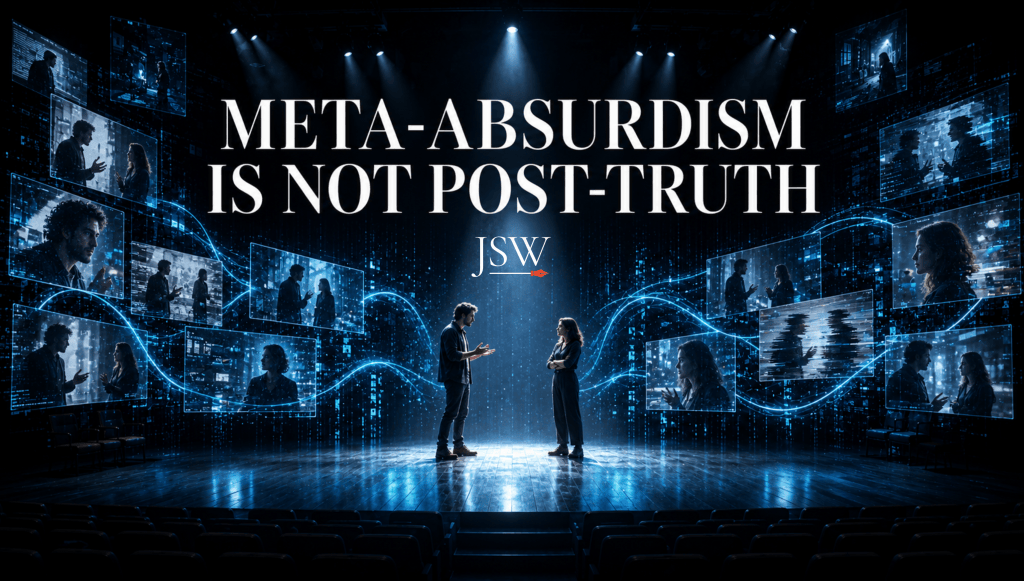
Post-truth and Meta-Absurdism both describe a world crowded with explanations. Meta-Absurdism is about the person who still wants to know what happened, and how she can find out.
By Jill Szoo Wilson
Writer | Theatre Artist | Educator
It is the second week of rehearsal. The kitchen is taped out on the floor of the rehearsal hall: a table, two chairs, a counter, and a door that exists only as a gap between two strips of blue tape. He sits at the table. She stands at the counter with her back half turned to him.
He finishes his line, and she answers it. There is a pause. He pushes his chair back, and the metal legs scrape the floor. He stands. He walks toward the gap in the tape, stops there, and without turning around says, “I’ll be back in an hour.” Then he steps through. She stays where she is, one hand flat on the counter, until I call hold.
Before I can say anything, she tells me, “He threatened me.”
I ask what he did. He stood up, she says. What else? He walked toward the door. Did he say anything? He said he would be back in an hour.
She may be right. A man leaving a room can seem threatening, especially when earlier scenes have shown us what happens after he comes back. My job in rehearsal is to help her understand why she felt the way she did. Which details gave her that feeling? What changes when she watches her partner more closely? Sometimes the feeling of threat becomes clearer, and sometimes another response opens up. Either way, the scene gives her something solid to test her first impression against.
Before we run it again, I pull two chairs into the middle of the floor and ask the actors to sit facing each other. This is where Larry Silverberg’s workbook on the Meisner approach begins, with an exercise called taking the first thing. She lowers her head. He sits across from her, relaxed and neutral, trying to communicate nothing. His job is simply “to be.” She looks up and says out loud the first thing she sees. “Eye.” Head down, head up. “Chin.” Head down, head up. “Collar.”
It can feel tedious, and the tedium is part of the training. She’s not supposed to add meaning to what she sees or go looking for anything in particular. She’s not supposed to think about how she looks to me or to anyone else in the room. She is only supposed to see. After a few minutes, her voice settles, and she sounds less like someone taking a test.
You would be amazed how little we actually see in everyday life. We look at things all day without really seeing them. I first learned this in an art class. I was drawing a grape, and my teacher told me, “You’re drawing a grape from memory. You’ve drawn curves where there are straight lines and even an angle where the grape was punctured. Look. See.” I had drawn the grape I already knew. The one in front of me had flat edges and a small wound, and I missed them because I thought I knew what a grape looked like.
Then we run the scene again, and I ask her to watch only him. This time she notices things she missed. He does not look at her when he stands. He leaves the chair pulled out, as if he plans to come back to it. He stops at the door longer than he did before, and the word hour lands differently, heavier, like a deadline. Her hand comes off the counter. She takes half a step toward him and stops. He hears that step, or feels it, and then he chooses to leave anyway. This time, he pauses outside the door. Her character can’t see the pause, and neither would an audience. I see him stop just past the tape before he walks off.
Afterward, I ask her again what happened. This time she can tell me in order. He stood without looking at her. He left the chair out. He stopped at the door, and he gave her a time. She still feels the threat, and now she can point to the moments that gave it to her. She can’t know yet that he paused outside the door. I saw it. When she moved, something changed in him, even though he still left. The scene was happening between them one moment at a time, whether or not either of them could see all of it.
The truth happens one moment at a time, in rehearsal and everywhere else. Whether we see it or not.
In rehearsal, she had time. She could run the scene again, watch her partner, and check her first impression against what he actually did. Outside the rehearsal hall, we rarely get a second run. Imagine someone had filmed that kitchen scene on a phone and posted it. Within an hour, strangers would be explaining it. He was threatening her. She was overreacting. This is what controlling men do. Most viewers would read those explanations before they watched the clip, and some would already be picturing how their own comment would look to everyone else.
Meta-Absurdism grew out of that experience. It describes what happens when explanations pile up around an event faster than we can check them against what happened. That can sound a lot like post-truth, which also describes a world where stories outrun facts. The difference matters. Post-truth describes what happens when facts stop changing people’s minds. Meta-Absurdism describes people who still want the facts and have trouble seeing them through everything piled on top. The actor in my rehearsal wanted to know what happened. Most of us do.
What Post-Truth Describes
Oxford Dictionaries chose post-truth as its Word of the Year in 2016, after use of the term rose by about 2,000 percent during the Brexit referendum and the American presidential election. The dictionary defined it as “relating to or denoting circumstances in which objective facts are less influential in shaping public opinion than appeals to emotion and personal belief” (Oxford Languages 2016).
Notice what the definition does not say. It does not say people have stopped caring about the truth. It says facts lose out to feelings and beliefs, and that can happen to people who care a great deal about the truth. A mother gets a call from her son’s teacher saying he copied another student’s homework. She asks for proof, questions how the teacher could know, and wonders whether the teacher simply dislikes him. A month later, the same teacher calls to say a classmate has been bullying her son, and she believes it immediately. She would tell you she cares about the facts, and she means it. But she asked the teacher for proof the first time, and the second time she never asked.
Philosopher Lee McIntyre explains the term further in Post-Truth. He points out that people have always lied. What is new is how many people are willing to say things, and believe things, without asking whether the evidence backs them up. McIntyre calls this “a form of ideological supremacy,” in which people try to make others believe something whether or not there is good evidence for it (McIntyre 2018, 12).
Imagine a video from a city council meeting. A ten-second clip shows a woman on her feet, shouting. The caption reads “Resident threatens council,” and within hours thousands of people are calling her unhinged and asking why security didn’t remove her. Then the full video appears. She was shouting for help because a man in the front row had collapsed. Some viewers delete their comments. Others admit the clip was misleading and keep going anyway. She’s the woman who has spoken against the new apartment complex at every meeting for a year, and they had already decided what kind of person she is. “Maybe not this time,” one writes, “but you know how she gets.”
That second response is post-truth. The facts were corrected and published. They simply had less pull than the loyalty the original story protected.
The Person Who Wants to Know
Meta-Absurdism looks at what these viewers went through before they changed their minds. They cared about what happened. They read “Resident threatens council” before they saw a single frame, though, and they were already angry when the video started.
Think of a woman who types “Why does my husband shut down during conflict?” after an argument. She badly wants to know what happened. Within a minute, she has read about stonewalling, avoidant attachment, and nervous-system overload, and each explanation hands her a role to play. If he’s stonewalling, she’s being punished. If he’s avoidant, she’s asking for too much. If his nervous system is overwhelmed, she needs to give him space. At the same time, part of her is already working out how she will describe the fight to her sister. She is trying to understand the argument while explaining it to an audience that is not in the room yet. That second layer of awareness is what the meta in Meta-Absurdism names.
In an earlier essay, I described four steps I call the Interpretive Sequence. Something happens, which is the event. Part of it reaches us, often through a phone, which is the representation. We decide what it means, which is the interpretation. Then we fit it into a bigger story about the world or ourselves, which is the narrative. In real life, the steps overlap and feed into each other. A story we already believe shapes what we notice. Picturing how we will tell it later shapes how we act while it is happening. In the kitchen clip, the event is a man standing up and walking out. The representation is the thirty seconds someone filmed on a phone. The interpretation is “He threatened her.” The narrative is “This is what controlling men do.”
Her search begins with a sincere desire to understand. By midnight she has read a dozen articles, and each one sounds right. She is close to closing the laptop with a diagnosis for a man she hasn’t spoken to since the argument. Exhaustion could eventually make a comforting explanation more appealing than the work of testing it. When every explanation sounds equally convincing, it is tempting to pick the one that feels best and stop looking. Meta-Absurdism is about the moment before she gives up, and what can keep her looking.
None of this means the frameworks are wrong. Sometimes a person lives with confusing behavior for years, then reads about a pattern and recognizes it on the page, line by line. That recognition can bring real relief. What makes it trustworthy is the order. She brings years of things she saw and heard to the book, and the book helps her name them. The woman typing her question after one argument brings only that argument, and the articles hand her a name before she has much to compare it to.
What I Saw and What I’m Guessing
The practical heart of Meta-Absurdism is a habit of sorting. When something happens, we can separate what we actually saw or heard, what we are guessing, and what we do not know yet. Actors practice the first part of this every time they take the first thing. They say what they see and leave its meaning for later.
Say a video shows a man closing a door hard during an argument. We saw him close the door quickly and with force. We might guess that he was angry, or trying to end the conversation, or making a threat. We do not yet know what was said before the video started, what he said afterward, or whether this happens often. We can be sure about the action long before we are sure about the motive, and an honest account says so.
Even what we saw can turn out to be wrong. Another camera angle might show that someone on the other side pulled the door shut. This is the discipline in a sentence I keep returning to: “I know what I saw, and I am still learning what it means.” The first half names an observation. The second half leaves its meaning open. Both halves can change when better evidence comes.
That willingness to change is the clearest line between Meta-Absurdism and post-truth. In post-truth, a story holds even after the evidence turns against it. In Meta-Absurdism, a story has to keep answering to what happened, and it changes when the evidence does.
Arendt and the Stubbornness of Facts
Hannah Arendt saw the danger of post-truth long before it had a name. In “Truth and Politics,” published in The New Yorker in 1967, she tells a story about Georges Clemenceau. Shortly before his death, he was asked what future historians would say about who was responsible for the First World War. He answered, “This I don’t know. But I know for certain that they will not say Belgium invaded Germany” (Arendt 1967).
Arendt’s point is that some facts can’t be argued away. Historians can debate the causes of the war forever, and German troops still marched into Belgium in August 1914. She writes about the “stubbornness” of truths “seen and witnessed with the eyes of the body” (Arendt 1967). Erasing a fact like that would take more than rewriting the history books. It would take control over what everyone remembers, or a public too tired to keep track.
Tiredness is one way a world flooded with information can become a world where evidence loses its influence. Legal scholars Robert Chesney and Danielle Citron call one version of it the “liar’s dividend.” Once fake photos and recordings are common, a politician caught on a real recording can say it was faked, and people who are tired of sorting may shrug and believe him (Chesney and Citron 2019).
The sorting habit helps here because it is small. You don’t have to weigh every explanation online. You only have to ask what you saw, what you’re guessing, and what you don’t know yet. Those questions keep you close to what Arendt called the eyes of the body, even on a tired day.
Baudrillard and the Map
The second neighbor is French theorist Jean Baudrillard. Simulacra and Simulation, published in 1981, opens with a fable from Borges about an empire whose mapmakers draw a map so detailed it covers the entire country. Baudrillard turns the story around. In his version, the map comes first. “It is nevertheless the map that precedes the territory,” he writes (Baudrillard 1994, 1). He means that models, images, and expectations increasingly produce the reality they seem to describe, until it becomes hard to say which came first. He called this condition the hyperreal.
Picture a college graduation planned partly for its photos. Students practice the cap toss so it will look spontaneous. Families find their spots for the picture they have already imagined. The photo has not been taken yet, and it is already shaping the day. That is Baudrillard’s point in miniature. The expected image helps create the event it will later appear to record.
Meta-Absurdism takes that seriously, and then it pays attention to the graduate. She is standing among her classmates in the heat, aware of how she looks and feeling pressure to feel what the photo promises. She might feel real joy. She might feel let down, or tired, or several things at once that the photo will leave out. Baudrillard helps explain how the image shaped her day. Her experience of the day can still differ from the image. Meta-Absurdism starts there, with her ability to notice that difference and look at it closely.
What the Stage Knows
Meta-Absurdism started in the theatre, and theatre may be the best place to see what it offers. A play is made up, and the people in it are real. The actor playing Hamlet will stand up and take a bow at the end, and while he plays the scene, his breath, his timing, and his listening are all really happening in front of us.
A glass slips and actually breaks. A scene partner says a line with a new edge, and the actor who is listening has to answer it. Sanford Meisner described acting as “living truthfully under imaginary circumstances” (Meisner and Longwell 1987, 15). The story is made up, and the listening has to be real. The quality of that listening shapes what the audience experiences.
This is why I keep coming back to the rehearsal question, “What actually happened?” When an actor tells me another character humiliated her, she has given me her reading of the scene. I ask her for the line, the laugh that followed it, and the step backward. Once she can describe what happened, we can test whether humiliation is the best reading. Sometimes she can be sure of what her partner did and still not know why he did it. Rehearsal gives her room to keep finding out.
Theatre can also blur the line between what is staged and what is real, and a Meta-Absurdist play would do that on purpose. Imagine a scene in which two people argue on a sidewalk while a third person records them. As the argument goes on, captions appear on a screen above the stage, posted by imagined viewers who are deciding what the argument means. The actors start to notice the captions and change how they behave. The audience watches the event, the recording, and the commentary all at once.
A scene like that would let the audience feel the pull of a ready-made explanation, and then catch themselves when something on stage contradicts the caption. A caption reads, “He’s about to hit her.” Then he puts his hands in his pockets and steps back. Their own changing judgment would become part of the drama. Most of the time that kind of shift happens privately, on our phones. On stage it could happen in a room full of people who notice it together.
Conclusion
Back in rehearsal, I want the actor to trust what she noticed enough to examine it. If her partner’s exit really carries a threat, looking closely will help her find exactly where it lives: in the way he stands, the pause before he speaks, the word hour. If her first reading made the scene smaller than it is, rehearsal gives her room to find more. Her feeling is not the problem. It becomes part of what she is investigating, along with the words, the actions, and the history between the characters.
Meta-Absurdism asks the same of the rest of us. We live among more explanations than we can sort. There’s the clip someone shared, the article we read at midnight, the comment we started writing before the video finished. Many of them arrive with a role already written for us. The response is to keep the event at the center, to sort what we saw from what we are guessing and from what we do not know yet, and to let our account change when the evidence does. “I know what I saw, and I am still learning what it means” admits that we are not finished. It also assumes there is something real to understand, and that it is worth the effort to keep looking.
Further reading on Meta-Absurdism:
- What is Meta-Absurdism?
- Meta-Absurdism: What Happens Between an Event and the Story We Tell
- How Meta-Absurdism Works Through an Ordinary Object
- Can ChatGPT Interpret Your Text Messages? AI Relationship Advice and Meta-Absurdism
- The Profile and the Person: Online Dating in a World of Too Much Meaning
- From Realism to Meta-Absurdism: The Evolution of the Modern Stage
- Peter Brook and the Empty Space in an Age of Meta-Absurdism
- The Ordinary Infinite: Annie Baker and the Meta-Absurdist Stage
Works Cited
Arendt, Hannah. “Truth and Politics.” The New Yorker, February 25, 1967. Reprinted in Between Past and Future. Penguin, 2006.
Baudrillard, Jean. Simulacra and Simulation. Translated by Sheila Faria Glaser. University of Michigan Press, 1994.
Chesney, Robert, and Danielle Keats Citron. “Deep Fakes: A Looming Challenge for Privacy, Democracy, and National Security.” California Law Review 107, no. 6 (2019): 1753–1820.
McIntyre, Lee. Post-Truth. MIT Press, 2018.
Meisner, Sanford, and Dennis Longwell. Sanford Meisner on Acting. Vintage, 1987.
Oxford Languages. “Word of the Year 2016.” Oxford University Press, 2016. https://languages.oup.com/word-of-the-year/2016/.
Silverberg, Larry. The Sanford Meisner Approach: An Actor’s Workbook. Smith and Kraus, 1994.
Wilson, Jill Szoo. “Meta-Absurdism: What Happens Between an Event and the Story We Tell.” Jill Szoo Wilson, September 1, 2026. https://jillszoowilson.com/2026/09/01/meta-absurdism-what-happens-between-an-event-and-the-story-we-tell/.
For more on theatre, attention, and the habit of seeing what is actually in front of us, read my book, Thinking Through Theatre: Essays on Playwrights, Performance, and the Art of Paying Attention, available in paperback and Kindle.



Leave a Reply